Europe's Youngest State, Oldest Mountains: Kosovo's Honey Landscape
On 17 February 2008, Kosovo's Assembly declared independence from Serbia — creating, at 18 years old, Europe's youngest internationally recognized state, and one of the youngest countries on earth. Recognized by more than 100 states including the United States, the United Kingdom, and most EU members, Kosovo is also one of the most contested sovereignties in the world: Serbia, Russia, China, Spain, Greece, Romania, and Cyprus do not recognize it; Kosovo is not a UN member. The practical consequences for everyday commerce — including honey — are tangible: Kosovo has no universally recognized ISO country code (XK is used informally), customs systems in non-recognizing states sometimes reject Kosovar export documentation, and no EU Geographical Indication framework yet exists to anchor a Kosovar honey designation internationally.
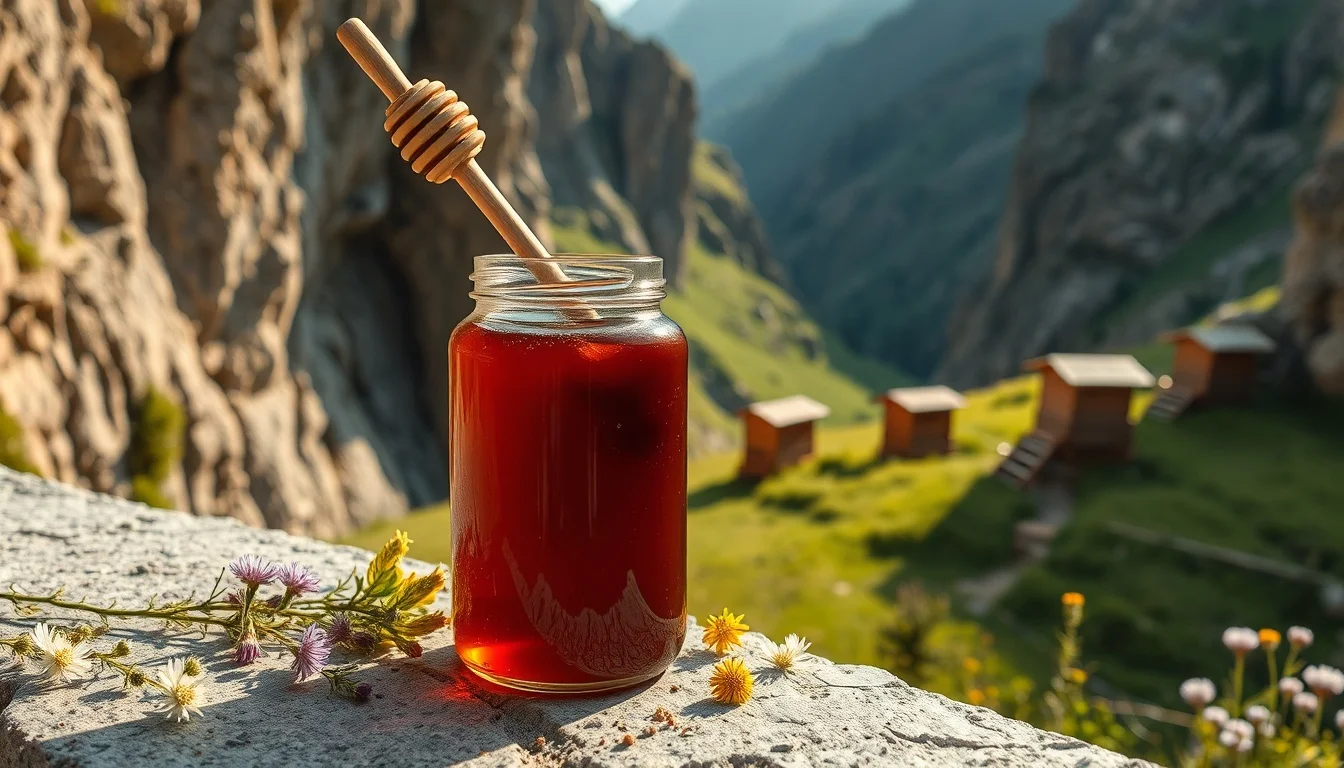
None of this is visible from the gorge. Gryka e Rugovës — Rugova Canyon — cuts northwestward from the city of Peja (Peć) toward the Albanian border through the heart of the Prokletije Alps, a 25-kilometer limestone gorge whose walls rise to 1,000 meters in places. The road through Rugova Canyon is one of the most spectacular approaches to an alpine zone anywhere in the western Balkans: hairpin bends, waterfalls, a narrow two-lane road carved into limestone cliffs, and above the gorge rim, high meadows at 1,200–2,500 meters producing the dense multi-floral wildflower bloom that has sustained beekeeping in the Peja district for centuries. The mountains here predate any modern state; the beekeeping tradition predates any living political framework. Kosovo's honey landscape is 18 years old as a nation; it is many centuries old as a landscape.
The native bee of the western Balkans — Apis mellifera macedonica (Ruttner, 1988) — was formally described from morphometric specimens collected across geographic Macedonia and the Dinaric Alps, including what is now Kosovo. The subspecies' native range covers precisely this region: the Prokletije massif, the Dinaric ridge line, and the Šar Planina range that forms Kosovo's southern border with North Macedonia. Kosovo sits at the biogeographic core of A.m. macedonica territory. Unlike neighbouring Albania — where 45 years of Communist isolation preserved an unusually pure native bee population by preventing imported queen genetics — Kosovo's A.m. macedonica populations were disrupted by the 1998–1999 war, post-war reconstruction, and more recent queen importation from Serbia and Austria. But in the high alpine zones, particularly in the Rugova highlands and the Dragash district of the Sharr range, populations of morphologically typical A.m. macedonica persist because the terrain itself limits easy access and intensive management.
Pro Tip
The name 'Rugova' carries two distinct associations in Kosovo: Rugova Canyon (Gryka e Rugovës), the gorge north of Peja, and Ibrahim Rugova (1944–2006), Kosovo's first president and the leader of the non-violent resistance movement during the 1990s. The canyon was named independently of the politician — both names derive from the Rugova highland region. Kosovo honey from the Peja district is commonly sold at Peja's city market (Pazari i Pejës) and at the Rugova Alpine Lodge area kiosks along the gorge road, typically as 'mjalti i Rugovës' (Rugova honey) or 'mjalt mali' (mountain honey).
Rugova Canyon and the Prokletije Highlands: Alpine Wildflower Honey
Rugova Canyon (Gryka e Rugovës) begins at the western edge of Peja city and runs 25 kilometers northwest to the village of Kulla, near the Çakorr Pass (2,175 m) on the Albanian border. The canyon is carved by the Lumbardhi i Pejës river — a Drina tributary — through a Triassic and Jurassic limestone formation that forms the outermost ridge of the Prokletije Alps. The lower canyon (600–1,200 m) supports mixed forest (beech, oak, hornbeam, field maple) with spring meadow clearings producing the first nectar flows from Prunus spinosa (blackthorn) in March and Crataegus (hawthorn) in April. Above 1,200 m, the limestone karst plateau opens into subalpine meadows dominated by Trifolium (mountain clover, including T. montanum, T. medium, T. alpinum), Onobrychis (sainfoin, including Balkan endemic variants), Thymus (thyme — primarily T. serpyllum complex at altitude), and mixed alpine composites (Centaurea, Achillea, Leucanthemum).
The Rugova highlands — the broad plateau above the canyon rim, extending northward toward Gjeravica (2,656 m, Kosovo's highest peak) and the Prokletije National Park boundary — have been beekeeping territory since at least the Ottoman period. The Peja district has the largest registered beekeeper population in Kosovo: the Peja (Peć) region accounts for an estimated 25–30% of Kosovo's total registered colonies. Beekeepers from the Rugova village cluster (Kulla, Raushiq, Pepić, Isniqi) practice transhumance: winter colonies in the Peja lowlands (280 m), moved in late May to the plateau meadows at 1,200–1,600 m for the summer wildflower flow, and sometimes moved again to higher pastures above 1,800 m in July for the peak alpine bloom. The resulting honey is dark amber to rich amber-brown, complex, with high diastase activity and a pronounced herbal-floral character. Pollen analyses of Rugova canyon wildflower honey typically show 30–50 plant species per sample, with Trifolium and Onobrychis as the dominant pollen types.
The Prokletije range's Kosovo portion differs from the Albanian side in one important respect: the Kosovo flank was not sealed by Communist isolation. The Peja district was part of Yugoslavia's Kosovo region — less isolated than Albania but still peripheral, and the Rugova highlands remained undeveloped for intensive agriculture throughout the Yugoslav period. This means the high meadows have not been subject to agricultural intensification: no herbicides on the alpine clover zones, no large-scale monoculture in the karst plateau, limited motorized access above 1,400 m. The ecological baseline is therefore broadly similar to the Albanian Prokletije side — not from political isolation but from topographic inaccessibility. The Deçan (Dečane) area, south of the canyon, adds another dimension: Visoki Dečani Monastery (14th century, UNESCO World Heritage Site since 2006) maintains a monastic apiary in the wooded valley below the Prokletije foothills. Dečani monastery honey — produced by Serbian Orthodox monks in an Albanian-majority municipality, in a UNESCO-protected valley within a contested state — is the most historically layered honey in the western Balkans.
Get the Honey Buyer's Cheat Sheet (free PDF)
16 varieties on one page — color, flavor, best use and what a fair price looks like — from the 304 honeys we track.
Sharr Mountains (Bjeshkët e Sharrit): Kosovo's Southern Alpine Honey
Kosovo's southern border with North Macedonia follows the crest of the Sharr Mountains (Albanian: Bjeshkët e Sharrit; Macedonian: Шар Планина, Šar Planina) — the same range that the North Macedonia guide describes from the Tetovo and Gostivar side. The range's highest point is Titov Vrv (2,748 m), located precisely on the Kosovo–North Macedonia border. On Kosovo's side, the Sharr Mountains slope southward into the Prizren district, with the Dragash municipality (population ~33,000, majority Gorani and Albanian) occupying Kosovo's southernmost highland zone: a compact municipality at 900–2,500 m elevation that produces the most botanically diverse honey in Kosovo.
The Dragash district's Sharr Mountain honey comes from a landscape that is botanically nearly identical to the Šar Planina Biosphere Reserve described in the North Macedonia guide — they are the same range, divided only by a border that the flora does not recognize. The Kosovo (Dragash) side of the Sharr is less intensively used for commercial agriculture than the North Macedonia side; the Dragash municipality has a small population, limited road infrastructure above 1,200 m, and a traditional pastoral economy in the high pastures. This translates to honey with a similar 40–70 plant-species pollen diversity, but characteristically darker in colour and more herbal-mineral in flavour than typical North Macedonian Šar Planina honey — a difference that likely reflects the Kosovo side's higher average elevation of productive colonies (Dragash villages sit at 900–1,200 m, with apiaries moving to 1,500–2,000 m in summer) and greater Thymus and Origanum density on the drier southern aspects of the Dragash slopes.
The Brezovica ski resort area (Brezovicë, 1,720–2,500 m, on the Kosovo side of the Sharr range) has established apiary infrastructure in the sub-alpine zone around the resort. Brezovica was a significant Yugoslav-era alpine resort; post-independence it has seen limited development but maintains road access to the 1,720 m base. This altitude — combined with the Sharr range's exceptional botanical richness — makes the Brezovica plateau one of the highest reliable honey-production zones in Kosovo. Beekeepers from Prizren city (Kosovo's cultural capital, 70 km south of Pristina) maintain summer apiaries in this zone, selling the resulting honey through the Prizren old bazaar (Çarshia e Vjetër — the best-preserved Ottoman commercial district in Kosovo, with several honey vendors in the historic market area). Prizren honey from Sharr mountain is rarely labelled with precise origin attribution; it is sold simply as 'mjalt mali Sharri' (Sharr mountain honey) or by beekeeper name.
Pro Tip
The Dragash municipality (Dragash/Dragaš) is the only majority-Gorani municipality in Kosovo. The Gorani people — a South Slavic community with mixed Serbian, Macedonian, and Albanian cultural heritage — have a distinct culinary tradition that includes medicinal use of mountain honey with boza (fermented grain drink) and rakija (fruit brandy). Gorani honey from the Dragash highlands is occasionally available from the Dragash municipal market or from village producers; it has no commercial distribution outside the municipality.
Dukagjini Plateau and the River Valleys: Linden and Lowland Honey
Western Kosovo — the broad plateau and valley system known as the Dukagjini Plain (Rrafshi i Dukagjinit; in Serbian, Metohija, meaning 'church estate') — stretches from the Peja basin south to Prizren between the Prokletije Alps to the west and the Sharr range to the east. The plateau sits at 320–600 m altitude and has historically been Kosovo's most productive agricultural zone. The Dukagjin region gives its name to the Kanun i Lekë Dukagjinit (Code of Lekë Dukagjini), the customary law code governing Albanian highland community life across northern Albania, Kosovo, and western North Macedonia — a cultural framework centuries older than any current political boundary.
The Dukagjini lowlands and river valleys produce a different honey profile than the alpine zones: Robinia pseudoacacia (black locust / false acacia) naturalized along the Drini i Bardhë (White Drin) river valley and its tributaries produces pale, slow-crystallizing acacia honey broadly similar to Tikveš acacia from North Macedonia or the Shkodra acacia from Albania — mild, sweet, water-white to pale gold, with very low diastase activity. Linden (Tilia cordata, small-leaved linden, and T. platyphyllos, large-leaved linden) grows throughout the Drini i Bardhë valley from Peja south to Gjakova, blooming in June–July and producing the characteristic pale-amber, menthol-mint linden honey that is Kosovo's most widely recognized premium product at domestic retail level. The Gjakova (Đakovica) district — with its Ottoman-era old bazaar (Çarshia e Gjakovës, the largest traditional bazaar in Kosovo) — has established honey vendors selling linden honey from the surrounding river valleys at prices substantially above mixed wildflower.
Fruit blossom honey is a spring specialty in the Dukagjini lowlands: apple orchards in the Klina (Klinë) district and cherry orchards around Istog (Istok) municipality produce pale spring honey from March–April bloom, largely consumed locally or sold at village farm stands. The Kosovo plain (Fusha e Kosovës) — the central basin around Pristina, Lipjan, and Fushë Kosovë, site of the 1389 Battle of Kosovo Polje — is less significant for honey production; the plain has been intensively cultivated and its flora is less diverse than the highland zones. Pristina itself has a small but active honey retail market in the city's main bazaar area, primarily selling honey sourced from the Peja and Prizren districts rather than from the central plain.
Sovereignty, Standards, and the Hardest Honey to Export in Europe
Kosovo's Stabilisation and Association Agreement (SAA) with the EU — signed in October 2015 and in force from April 2016 — is the primary framework governing Kosovo's trade with the EU and its food safety standards alignment. The SAA does not make Kosovo an EU member state, and Kosovo products do not carry EU country-of-origin guarantees; but it does commit Kosovo to progressive harmonisation of food safety, veterinary, and phytosanitary standards with EU requirements. Kosovo's food safety framework is administered by the Kosovo Agency for Food and Veterinary (AKUK — Agjencia e Kosovës për Ushqim dhe Veterinari, established under the SAA process), which enforces honey quality standards broadly aligned with EU Directive 2001/110/EC: moisture ≤20%, diastase ≥8 Schade units (or ≥3 for low-enzyme varieties), HMF ≤40 mg/kg, standard monofloral labelling requirements.
Kosovo joined the Central European Free Trade Agreement (CEFTA) in 2022 — a long-delayed process, as Serbia had blocked Kosovo's membership since CEFTA's 2006 restructuring. CEFTA membership gives Kosovo preferential trade access to Albania, North Macedonia, Serbia, Bosnia and Herzegovina, Montenegro, and Moldova, which are the natural near-market export destinations for Kosovo honey. But for export beyond the region — to the EU, US, UK, or Gulf markets — the sovereignty recognition problem creates practical friction. Kosovo products are sometimes classified under 'Serbia and Kosovo' or 'Kosovo (under UNSCR 1244)' in customs documentation of non-recognizing states; the XK informal ISO code is not universally accepted by electronic customs systems; and the absence of EU PDO/GI registration for any Kosovo honey variety means there is no protected designation to anchor an international brand.
There are no registered EU Geographical Indications for Kosovo honey. This is not unique in the western Balkans — Kosovo shares the GI gap with Albania, North Macedonia, Bosnia, and Montenegro — but Kosovo's position is the most structurally complex: even the preliminary GI application process requires a stable relationship with EU Intellectual Property authorities, which for candidate countries like North Macedonia (candidate since 2005) is already difficult, but for Kosovo (which is not yet an official EU candidate and whose sovereignty is unrecognized by four EU member states) is more complicated still. The most GI-eligible products — Rugova Canyon highland wildflower and Dragash Sharr mountain honey — have demonstrable geographic specificity and terroir differentiation, but building the certification infrastructure to support a formal application requires institutional capacity that Kosovo's young beekeeping sector is only beginning to develop. Kosovo has approximately 45,000–60,000 registered colonies managed by an estimated 3,500–5,000 beekeepers; the Kosovo Beekeeping Association (Shoqata e Bletarëve të Kosovës) has been operational since the early 2000s and coordinates training and EU standards advocacy, but commercial export scale remains very small. For buyers outside the region, Kosovo honey is essentially unavailable through conventional retail channels — it reaches international buyers almost exclusively through diaspora food networks in Germany (especially Stuttgart, Frankfurt, and the Ruhr area, which have large Kosovo Albanian communities), Switzerland (Zurich, Geneva), and Scandinavia.
Pro Tip
The Prizren old bazaar (Çarshia e Vjetër) — a dense Ottoman-era commercial district with mosques, hans (caravanserais), and craft workshops — is the most accessible place to purchase Kosovo highland honey with producer attribution. Honey vendors in the bazaar typically carry Sharr mountain honey (mjalt mali Sharri) and Rugova highland honey (mjalti i Rugovës); prices are comparable to Albanian artisan honey but labelling is minimal. The League of Prizren Museum (adjacent to the bazaar, housed in the 1878 meeting hall) and the Sinan Pasha Mosque are UNESCO-listed; the honey market is across the Bistrica river bridge.