Šumadija: The Oak Forest Heartland of Serbian Honey Culture
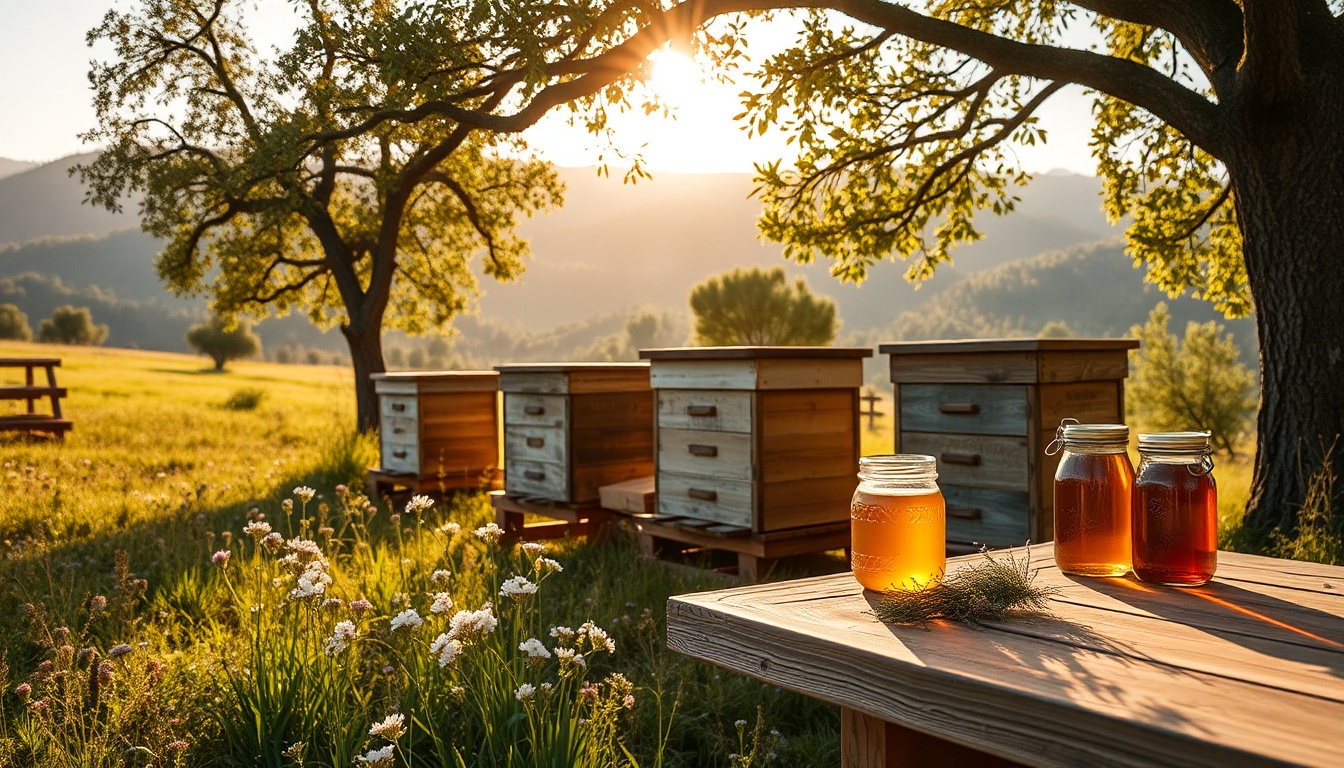
Serbia's most beloved domestic honey has a name that tells you its landscape directly: šumadijsko livadski med — wildflower honey from Šumadija. The word Šumadija comes from 'šuma,' the Serbian word for forest, and the landscape matches the etymology exactly. The Šumadija region of central Serbia, south of Belgrade between the Morava and Drina river systems, is a landscape of gently rolling oak-forested hills — Quercus petraea (sessile oak), Quercus pubescens (downy oak), Quercus cerris (Turkey oak) — interrupted by wildflower meadows, orchards, and small village apiaries. This is historically Serbia's agricultural heartland and, by extension, the origin of its most distinctive honey.
The wildflower flora of Šumadija is defined by the same mix that produces outstanding honey across the central Balkans: Trifolium pratense and T. repens (red and white clover), Onobrychis viciifolia (sainfoin), Lotus corniculatus (bird's foot trefoil), Phacelia tanacetifolia, Origanum vulgare (marjoram), Thymus serpyllum (wild thyme), Centaurea spp. (knapweeds), Filipendula ulmaria (meadowsweet), and a succession of spring and summer wildflowers that bloom from April through August. The resulting šumadijsko med is medium amber, complex, and multi-herbal — the kind of honey that tastes different from jar to jar depending on which meadow and which summer's bloom. It is not a standardized monofloral product; it is a portrait of the season.
The Šumadija town of Aranđelovac (formerly Bukovica) hosts one of Serbia's most established honey and beekeeping fairs, drawing producers from across central Serbia and the broader Balkans. It is a practical index of what the local industry values: not the globally branded monofloral exports (acacia, linden) but the complex wildflower honeys that Serbian beekeepers keep for domestic markets and consider their finest product. The contrast with what Serbia exports is striking — and defines the core paradox of Serbian honey's international position.
Pro Tip
Look for 'šumadijsko livadski med' or simply 'planinsko med' (mountain/highland honey) from central Serbian producers. Genuine Šumadija wildflower is medium amber to dark amber with overlapping herbal-clover-thyme notes and a finish that lingers. At domestic markets it often sells for $9–$15 (middle half of 16 verified clover jars, Oct 7, 2026); the same quality from a comparable European landscape would command two to three times that price.
The Morava Valley Acacia: Europe's Anonymous Export Champion
Serbia's most exported honey is also its most internationally invisible. Robinia pseudoacacia — bagrem in Serbian — grows extensively along the Morava River drainage and across the lowlands of northern and central Serbia, blooming for 10–14 days in late April to mid-May. The honey it produces (bagremov med) is chemically identical to premium Hungarian, Romanian, or Bulgarian Robinia honey: water-white to very pale amber, high fructose content (often >40%), extremely slow crystallization (sometimes years), and a mild vanilla-floral flavor that makes it the world benchmark for 'neutral premium honey.' Serbia exports thousands of tonnes of it annually.
The paradox is this: almost none of that honey is labeled 'Serbian honey.' EU food labeling rules allow multi-country blends to be labeled simply 'blend of EU honeys' without specifying countries. Serbian bagremov med — harvested and processed to the same Pravilnik o medu standards as Hungarian or Bulgarian acacia — is bought by EU bulk traders and disappears into commodity honey pools, often emerging on German, Austrian, or UK supermarket shelves as anonymous 'Akazienhonig' or 'honey blend.' The country producing it receives the commodity price; the repackaging country receives the retail margin. This is not unique to Serbia, but Serbia's exposure to it is particularly high because acacia is its dominant export variety.
Independent Serbian producers who bottle and export their own bagremov med — selling directly to diaspora buyers or niche EU specialty importers — sell single-origin jars into a different channel than the bulk honey a German blender buys. The infrastructure gap between bulk-commodity export and premium single-origin retail is the central challenge facing Serbian honey's international future — and it is directly tied to Serbia's EU candidacy status and the export-certification and GI-registration tools that come with it.
Get the Honey Buyer's Cheat Sheet (free PDF)
16 varieties on one page — color, flavor, best use and what a fair price looks like — from the 304 honeys we track.
Tara, Zlatibor, and the Mountain Wildflower Landscape
Western Serbia is dominated by the Dinaric limestone-and-sandstone mountains that continue southwest into Bosnia's Dinaric Alps. Tara National Park (620 km², up to 1,544m at Crveni Potok) and the Zlatibor plateau (up to 1,496m at Viogor) form the core of Serbia's alpine honey production landscape. Tara holds a UNESCO Man and Biosphere Reserve designation (since 1976) and shelters one of Europe's most biologically significant forests: Pančić's spruce (Picea omorika), a Tertiary-era relict conifer endemic to the Drina River valley that survives in no other natural habitat on Earth. The forest understory and clearings of Tara produce wildflower honey of extraordinary complexity — a genuine rarity in that the plant diversity of a UNESCO-protected relict forest translates directly into pollen diversity in the honey.
Tara mountain wildflower honey typically peaks from July through August, when the high meadows above 900m bloom with Trifolium alpinum, Campanula spp., Sideritis spp., Origanum vulgare, Hypericum perforatum (St. John's wort), and diverse Asteraceae. The resulting honey is dark amber, complex, often with a slightly resinous or balsamic note that reflects the conifer-adjacent flora. Small-batch producers working Tara's protected meadows use traditional Langstroth hives positioned in temporary transhumance patterns, moving between valley-floor fruit orchards in spring (cherry, apple, plum) and high meadows in midsummer.
The Zlatibor plateau south of Tara provides a somewhat different honey landscape: a broad elevated karst plateau with gentler slopes, more extensive meadow coverage, and a slightly earlier bloom window than Tara's steeper terrain. Zlatibor wildflower honey tends slightly lighter and more herb-dominated (thyme, marjoram, clover) versus Tara's darker, forest-adjacent complex. Both zones are near the Bosnian border — the same mountain range that produces Herzegovina sage honey on its Adriatic side produces Serbian wildflower honey on its inland side, separated by a political border but botanically continuous. For background on the connecting range, see our Bosnia honey guide.
Pro Tip
Tara mountain honey from Serbian producers is almost never labeled as 'Tara honey' in international export — you will find it, if at all, as 'Serbian mountain wildflower honey' or 'planinsko med Srbija.' The Zlatibor tourist zone (a popular Serbian ski and wellness destination) supports a small cottage industry of roadside honey stalls where genuine small-producer mountain honey is sold. For online purchase outside Serbia, diaspora networks in Germany, Austria, and Switzerland are more reliable than mainstream retail.
Fruška Gora and Vojvodina: Linden Country in the Flat North
Northern Serbia is geographically distinct from its southern mountain zones — the Vojvodina province is part of the Pannonian Plain, the same flat, agriculturally intensive lowland that produces Hungary's famous acacia and linden honeys across the Danube. The exception in this flat landscape is Fruška Gora: a modest east-west ridge rising to 539m above the Sava and Danube rivers between Novi Sad and Sremska Mitrovica. Fruška Gora holds a UNESCO MAB designation (since 1977), 17 medieval Serbian Orthodox monasteries (the monasteries are a UNESCO heritage cluster in themselves), and the highest linden forest density in Serbia.
Fruška Gora linden honey (lipov med) is Serbia's most prized domestic specialty honey after Šumadija wildflower. Tilia cordata (small-leaved linden) and Tilia platyphyllos (large-leaved linden) bloom in late June to mid-July, producing a very pale golden honey with the characteristic mentholated-herbal note (driven by linalool, geraniol, and trans-anethole) that defines fine linden honey across Eastern and Central Europe. Serbian lipov med is comparable in character to Hungarian or Romanian linden but draws from a smaller, less intensively harvested forest zone. It is deeply embedded in Serbian domestic food culture: linden tea with honey (čaj od lipe sa medom) is the canonical Serbian home remedy for colds, respiratory problems, and sleeplessness, with cultural roots predating modern medicine.
The Vojvodina plain itself produces substantial quantities of bagremov med (acacia) and rapeseed honey (uljane repice med) from the industrially farmed lowlands. Vojvodina's commercial apiculture is large-scale by Serbian standards — migratory beekeeping following the acacia bloom north from Šumadija to Vojvodina to Hungary is common practice. But Fruška Gora linden marks the province's quality ceiling: small-batch lipov med from the Fruška Gora slopes sells at premium prices domestically and represents the strongest candidate for a future PGI designation from the Vojvodina region.
Beekeeping Culture, EU Candidacy, and Serbia's Honey Future
Serbia's beekeeping tradition runs extraordinarily deep for a country of its size. With approximately 30,000–35,000 registered beekeepers managing an estimated 700,000–900,000 hives, Serbia operates at beekeeper-to-population ratios among the highest in Europe. Rural beekeeping is a normal part of household life across central and southern Serbia, not a specialist hobby. The Savez udruženja pčelara Srbije (SUPS — the Federation of Beekeeping Associations of Serbia) coordinates regional associations, organizes national honey fairs, and publishes Pčelar magazine — one of the Balkans' oldest continuously published beekeeping journals. There is even a district in Serbia's far south — the Pčinja district, bordering North Macedonia — whose name comes directly from 'pčela' (bee in Serbian), reflecting centuries of beekeeping tradition in a landscape where the Pčinja River valley supported dense bee populations in forested mountain terrain.
Serbia applied for EU membership in December 2009 and received EU candidate status in March 2012 — making it one of the longer-serving EU candidates alongside Montenegro. Progress has been repeatedly blocked not by agricultural or food-safety chapters but by Chapter 35: the normalization of relations with Kosovo. As long as Chapter 35 remains unresolved, Serbia's EU accession timeline remains uncertain, and with it the GI-registration infrastructure, preferential trade terms, and Single Market integration that would transform its honey industry's export economics. For honey producers, this matters practically: EU PDO and PGI designations are closed to non-members without bilateral agreements; premium shelf positioning in German, Austrian, and French specialty retail is structurally harder without EU origin traceability; and the export-certification burden remains higher than it would be for EU member competitors.
The domestically consumed honey — especially Šumadija wildflower, Tara mountain, and Fruška Gora linden — is genuine, often excellent, and extremely underpriced by international standards. The pathway from 'Serbian honey disappearing into EU blends' to 'Serbian honey as a recognized premium origin' runs through both EU accession and deliberate brand-building by producer associations. Several Serbian producers have begun marketing directly to diaspora buyers and niche EU importers, establishing country-of-origin traceability and monofloral-verified single-origin branding. The scale is small; the direction is correct. The honey is there. The audience for it is finding its way to the source.
Pro Tip
The Pčinja district in Serbia's far south (Preševo valley, Vranje area) and the Timok valley in eastern Serbia (bordering Bulgaria) both have A.m. macedonica bee populations that differ genetically from the commercial Carniolan stock dominant in Vojvodina and the north. Honey from these zones — labeled as 'southern Serbia wildflower' or 'Timok valley honey' — reflects the same native genetic lineage as Albanian, Macedonian, and Montenegrin honey. For comparative context, see our North Macedonia honey guide.