Strandzha: Europe's Ancient Oak Forest and Its Honeydew
In the far southeastern corner of Bulgaria, where the Strandzha mountain range rises between the Black Sea coast and the Turkish border, grows a forest unlike any other in Europe. The Strandzha Nature Park encompasses 1,161 km² of ancient lowland temperate woodland — the largest such complex on the continent — characterized by Pontic-Euxine flora found nowhere else in the EU: Rhododendron ponticum, Vaccinium arctostaphylos (Caucasian whortleberry), and most crucially for honey, the Valonia oak (Quercus hartwissii), an ancient species with bark that creates ideal habitat for Marchalina hellenica, the scale insect whose honeydew secretions become Bulgaria's most prized honey.
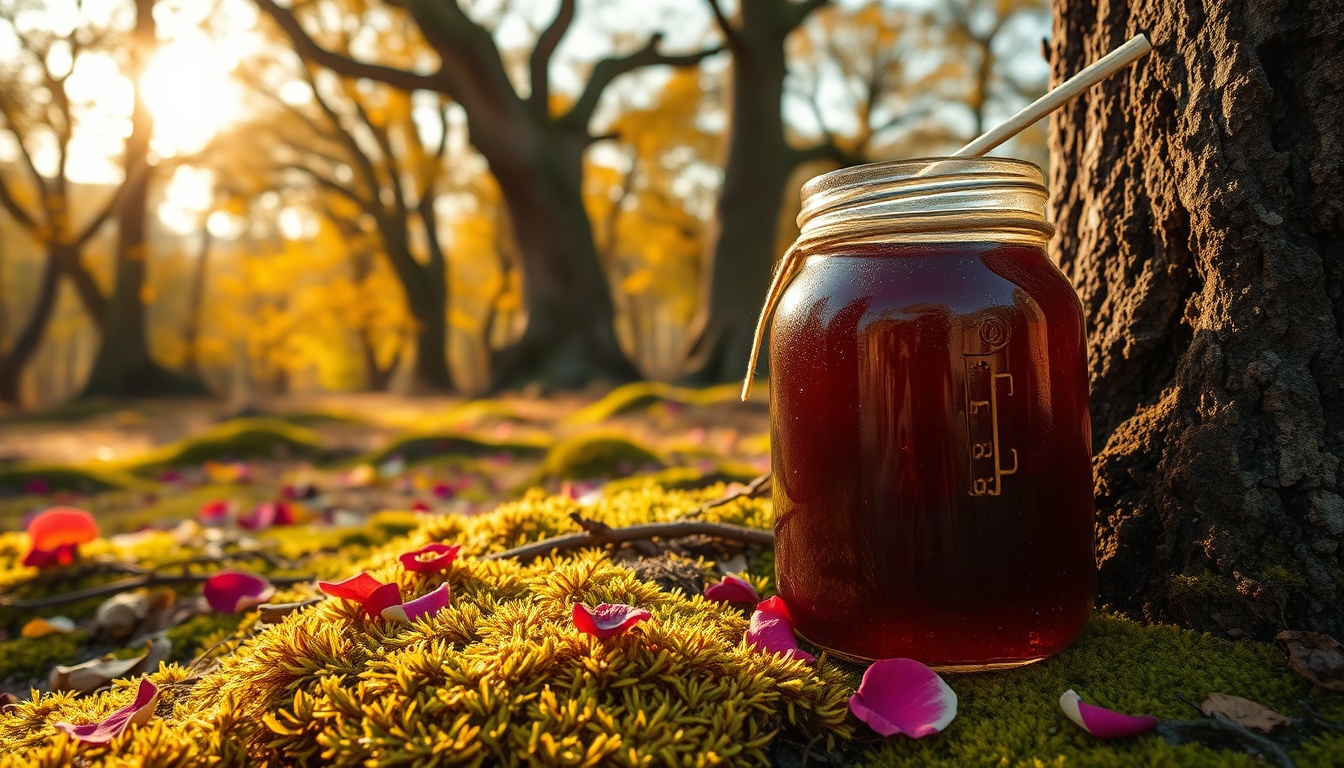
Marchalina hellenica (Greek scale insect) colonizes the bark of Valonia and other oaks in dense populations, feeding on phloem sap and excreting a sugar-rich honeydew that worker bees collect and process into a dark, complex honey with an entirely different composition from blossom honey. The resulting Strandzha honeydew honey (Мед от странджанска манова гора — 'honey from the Strandzha manova forest') is characterized by dark brown to near-black color, high mineral content (conductivity typically 0.8–1.2 mS/cm, far above the 0.8 mS/cm EU honeydew threshold), an oligosaccharide-rich sugar profile including melezitose and erlose absent from nectar honeys, and a flavor described as resinous-woody with dried-fruit undertones and a long mineral finish. While German forest honey from Central European conifer honeydew systems shares the dark color and mineral complexity, Strandzha's Valonia oak-Marchalina ecology creates a distinctly Balkan terroir expression with more pronounced dried-fruit character and ancient lowland forest positioning impossible to replicate in Germany's montane Black Forest or Bavarian highland zones.
Strandzha was designated Bulgaria's first UNESCO Biosphere Reserve in 1977 — an early recognition of its exceptional ecological value. The honey has geographical indication protection under Bulgarian regulatory frameworks, recognizing its inseparability from the specific forest biome, the ancient oak populations, and the Marchalina ecology that only exists in this corner of Europe. This is not a product that can be replicated elsewhere: the Valonia-Marchalina ecosystem requires centuries-old oak stands in a specific Pontic-Euxine climate zone that exists, in Bulgaria, only in Strandzha.
Pro Tip
Strandzha honeydew honey is often sold as 'манов мед' (manov med / manna honey) in Bulgarian markets. Look for very dark color, low sweetness intensity, and a resinous-mineral character. The oligosaccharide content means it crystallizes differently from blossom honey — forming a granular, fudge-like texture rather than a fine cream.
The Rose Valley: When Perfumery and Honey Share the Same Bloom
In the valley between the Balkan Mountains (Stara Planina) and the Sredna Gora range, centered on the city of Kazanlak, Bulgaria maintains one of the most economically improbable agricultural landscapes in Europe: over 3,000 hectares planted with Rosa damascena (Damask rose) for the production of rose otto — the essential oil at the heart of luxury perfumery. Bulgaria produces an estimated 60–70% of the world's rose oil, at prices that can reach. The rose fields of the Kazanlak basin collectively constitute the Rose Valley (Розова долина / Rozova dolina).
The Damask rose blooms for a precise three-to-four-week window, typically late May through mid-June, when entire hillsides turn deep pink and the air carries the characteristic heavy floral scent that perfumers describe as the single most complex note in aromatic chemistry. During this bloom, the region's bees — which outnumber the human population of Kazanlak's villages in active hives — forage intensively across the rose fields. The result is a pale golden-to-very-pale-pink honey with a delicate floral character unlike any other European varietal: softer and less herbaceous than Greek thyme honey, more distinctly rosy than any other blossom honey, and extraordinarily short in production season. Where Greek thyme presents intense medicinal aromatics from Thymus capitatus on Mediterranean hillsides, Bulgarian rose honey offers the opposite terroir expression — valley-grown perfumery roses creating gentle floral sweetness with rose otto complexity impossible to replicate outside the Kazanlak basin's unique microclimate.
Rose honey production volumes are very small — most Rosa damascena pollen and nectar is collected by bees working the margins of rose fields, not the central cultivation areas (where distillery-bound harvesting takes priority). Estimated Bulgarian rose honey production is under 20 tonnes per year, compared to ~20,000 tonnes of total Bulgarian honey production. The Annual Rose Festival (Фестивал на розата) in Kazanlak, held the first weekend of June, is one of Bulgaria's largest cultural events — fresh rose honey is among the most sought-after foods at the festival market. The Balkan Mountains above the valley also contribute Tilia cordata linden and mountain wildflower from Trifolium, Origanum, and Satureja to a broader Stara Planina wildflower complex.
Get the Honey Buyer's Cheat Sheet (free PDF)
16 varieties on one page — color, flavor, best use and what a fair price looks like — from the 304 honeys we track.
The Rhodope Mountains: Bulgaria's Wildflower Heartland
The Rhodope Mountains (Родопите) form the largest mountain range in Bulgaria, stretching 220 km across the southwest and continuing into northern Greece as the Xanthi and Kavala regional highlands. With peaks reaching 2,191m at Golyam Perelik and covering 14,737 km², the Rhodopes are home to over 2,000 plant species, of which approximately 200 are commercially significant nectariferous species. This density of bee forage, combined with a mosaic of altitude zones from 200m valley floors to 2,000m+ ridge pastures, makes the Rhodopes Bulgaria's most productive and diverse honey region.
The primary Rhodope honey varieties reflect the altitude gradient. At lower elevations (200–600m) in the Arda River valley and its tributaries, Robinia pseudoacacia (false acacia / black locust) dominates: water-white to very pale honey, high fructose, extremely slow to crystallize. At mid-elevations (600–1,200m), linden (Tilia cordata and Tilia platyphyllos) provides the main June–July flow: pale yellow to light amber, characteristic menthol-floral profile, prized across the region. Above 1,200m, polyfloral wildflower dominates: summer-blooming Trifolium pratense, Satureja montana (winter savory), Origanum vulgare (marjoram), Thymus serpyllum, Cirsium (thistle), and meadow forbs create a complex medium-amber honey with the multi-layered herbal character that Balkan mountain wildflower buyers recognize. While Texas wildflower honey achieves similar botanical complexity across four distinct climate zones with mesquite-huajillo-bluebonnet signatures, Bulgarian Rhodope wildflower offers uniquely Balkan terroir positioning with ancient mountain ranges, limestone karst geology, and Mediterranean-Continental climate transition creating herbal complexity impossible to replicate in American Great Plains or desert environments.
The Rhodopes' ancient beekeeping villages — including Shiroka Laka, Mogilitsa, and the Trigrad Gorge settlements — maintain traditional log hive practices alongside modern Langstroth production. The gorge villages in particular have practiced honey-hunting from wild colonies in limestone cliff caves for centuries, and some producers in the Arda valley near Kardzhali maintain hives in the same limestone-plateau landscape where the Rhodopes meet the Turkish border. The range's continuity with northern Greece (Nestos valley, Falakro mountain) creates a cross-border ecosystem that Greek and Bulgarian beekeepers access from different national territories but harvest from the same Pontic-Mediterranean botanical community.
Danubian Plain Acacia and Bulgaria's Export Engine
North of the Balkan Mountains, Bulgaria's Danubian Plain stretches flat and agricultural across the country's most productive lowland zone. Robinia pseudoacacia (false acacia / white locust) — introduced to Europe from North America in the 17th century — dominates the river margins, village edges, and shelterbelts of the plain from Vidin in the northwest to Ruse and Silistra in the northeast. Bulgarian acacia honey from this zone is indistinguishable at a molecular level from Hungarian or Romanian Robinia honey: water-white, predominantly fructose (>40%), slow crystallizing, mild floral-vanilla character. When compared to premium Italian acacia honey from Alpine foothills terroir with its exceptional water-white clarity and delicate vanilla undertones, Bulgarian Danubian acacia offers similar functional characteristics at lower pricing, though typically lacking the subtle aromatic refinement that Italian Alpine climate and limestone soil minerality provides to northern Italian production zones.
Bulgaria is a significant net honey exporter within the EU. Annual production typically ranges from 12,000–18,000 tonnes, with exports of 5,000–8,000 tonnes going primarily to Germany, Belgium, France, and the UK as bulk commodity honey for blending and repackaging. This export volume reflects both productive capacity (large acacia flows in good years) and price structure: Bulgarian acacia honey is sold mainly as bulk for blending, below the retail positioning of artisan production from Austria, Slovenia, or Hungary. While Bulgarian acacia provides similar functional characteristics to North American pure clover honey USA — clean sweetness, excellent baking performance, slow crystallization — the export commodity market positioning creates different premium structures where American clover commands higher retail prices despite comparable flavor profiles, while Bulgarian acacia competes primarily on bulk pricing for industrial blending rather than artisan terroir recognition. The consequence is a well-known authenticity pressure: bulk 'Bulgarian acacia honey' commands a lower premium, creating commercial incentive for adulteration with HFCS or lower-quality polyfloral.
The National Beekeeping Union (Национален пчеларски съюз / НПС) was founded in 1893 — one of Europe's oldest continuous apicultural associations, predating the Bulgarian state's current constitutional framework. With approximately 50,000 registered beekeepers for a population of 6.5 million (one beekeeper per ~130 citizens), Bulgaria maintains one of the highest beekeeper-to-population ratios in the EU, comparable to Slovenia and significantly above France, Germany, or the UK. Most are small-scale hobbyists and supplemental-income producers; fewer than 500 operations exceed 200 hives commercially.
Apis mellifera carnica, EU Standards, and Bulgaria's GI Landscape
Bulgarian commercial beekeeping is dominated by Apis mellifera carnica (Carniolan bee) — the same Central European subspecies that dominates Austrian, Slovenian, and German beekeeping. Carniolan queens are favored for their gentleness, strong spring build-up, frugal overwintering, and resistance to brood diseases. However, Bulgaria's biogeographic position creates a complex native bee landscape: western and southwestern Bulgaria (Struma valley, western Rhodopes, Rila and Pirin mountains) sits within the eastern fringe of the Apis mellifera macedonica range mapped by Ruttner (1988), while eastern Bulgaria (Strandzha, Black Sea zone) is transitional. High-altitude isolated populations in Rila National Park (Musala peak 2,925m — highest in the Balkans) and Pirin National Park (Vihren 2,914m) retain morphological characteristics intermediate between A.m. carnica and A.m. macedonica.
Bulgaria joined the EU in 2007, making EU Directive 2001/110/EC on honey fully applicable. Bulgarian national honey standards (BDS 886:2001 and subsequent revisions) align with EU requirements: moisture ≤20% (≤23% for heather), HMF ≤40 mg/kg (≤80 mg/kg for tropical-origin or industrial declared honeys), free acidity ≤50 mEq/kg, diastase number ≥8 (≥3 for low-enzyme varieties like acacia). The EU's Official Residue Monitoring Program covers Bulgarian exports for veterinary drug residues and environmental contaminants through BFSA (Bulgarian Food Safety Agency).
Bulgaria's geographical indication landscape for honey is anchored by the Strandzha honeydew product, recognized under national GI frameworks. The European Commission's GI register includes several Bulgarian agricultural products (Rose Oil of Bulgaria — PDO; Vinenka plums from the Rhodopes), and the Strandzha honeydew has been the subject of GI protection discussions at both national and EU levels given its demonstrably unique terroir link. Rose Valley honey (розов мед) has significant commercial and cultural recognition but has not yet completed EU PDO or PGI registration — making it an intriguing GI candidate for a Bulgarian apiculture sector increasingly focused on premium differentiation beyond commodity acacia exports.