Two Measurements That Sound Similar But Predict Different Things
If you have read the companion post on honey fructose-to-glucose ratios, you already know that the F/G ratio predicts whether a honey will crystallize and, broadly, in which direction — high F/G (acacia, tupelo, sage) stays liquid; low F/G (rapeseed, sunflower, canola) sets fast. But the F/G ratio answers a binary question. It does not tell you how fast.
The rate predictor is a different measurement: the glucose/water (G/W) ratio. First quantified as a crystallization predictor by White and Doner in their landmark 1978 USDA compositional survey and validated across European varieties by Manikis and Thrasivoulou (2001) in Apiacta, the G/W ratio measures the absolute concentration of glucose available for nucleation relative to the water available to keep it in solution. When G/W exceeds 2.1, glucose is so supersaturated at 20°C that crystallization begins within weeks — sometimes within days. When G/W falls below 1.7, the system is too dilute for stable nuclei to form under normal storage conditions. Between 1.7 and 2.1 lies the medium zone: honeys that will crystallize eventually but take months, not weeks.
This analysis ranks 16 major commercial honey varieties by their typical G/W ratio and the resulting crystallization timeline at 20°C. The data is drawn from Bogdanov, Ruoff, and Persano Oddo's Apidologie physico-chemical survey (2004), White's comprehensive Honey: A Comprehensive Survey chapter on composition (1975), Persano Oddo and Piro's unifloral honey descriptive sheets (2004 Apidologie), Manikis and Thrasivoulou's crystallization rate study of Greek unifloral honeys (2001), and Doner's 490-sample composition analysis from the Journal of Food Science (1977). Together these cover more than 3,000 analyzed samples across all major commercial varieties under standardized conditions.
Two additional findings not covered in the F/G companion post are included here: a crystal grain texture predictor derived from nucleation kinetics, and a temperature sensitivity analysis that explains why the optimal crystallization temperature is 13–16°C — not 4°C in a refrigerator.
The G/W Ratio: Why Absolute Glucose Concentration Governs Crystallization Speed
Honey crystallization is the formation of α-D-glucose monohydrate crystals from a supersaturated solution. Fructose does not crystallize under normal conditions; it remains in the liquid phase and acts partly as a crystallization inhibitor by competing with glucose for the water molecules that the growing crystal needs. Water activity is the other side of the equation: higher moisture content means more free water, which keeps more glucose in solution and slows nucleation.
The G/W ratio bundles both variables. A honey with 38% glucose and 17% water has G/W = 38/17 ≈ 2.24 — firmly in the fast-crystallization zone. A honey with 27% glucose and 18% water has G/W = 27/18 ≈ 1.50 — too dilute to crystallize at room temperature under typical storage conditions. The measurement is more precise than the F/G ratio for rate prediction because it captures the absolute glucose load rather than a relative proportion between two sugars that are both present.
The thresholds (from Doner 1977 and Manikis 2001): G/W > 2.1 predicts crystallization within weeks at 20°C; G/W 1.7–2.1 predicts crystallization within 1–12 months; G/W < 1.7 predicts that the honey will not fully crystallize under typical room-temperature storage conditions. These are empirical thresholds derived from measurement of real honeys, not theoretical predictions — they have been confirmed across European and North American variety surveys with reasonable consistency.
Pro Tip
G/W = glucose (%) ÷ water (%). Values above 2.1 predict fast crystallization (weeks); 1.7–2.1 predicts medium (months); below 1.7 predicts slow to non-crystallizing. This is the single most predictive number for crystallization rate — more useful than F/G ratio alone because it captures absolute glucose supersaturation, not just the fructose/glucose balance.
Get the Honey Buyer's Cheat Sheet (free PDF)
16 varieties on one page — color, flavor, best use and what a fair price looks like — from the 304 honeys we track.
Tier 1 — Very Fast Crystallizers: Days to Four Weeks (G/W > 2.1)
These are the honeys that set on the shelf before the consumer expects them to. Beekeepers who produce them routinely find frames solidified in the super before extraction is complete. Tier 1 honeys are some of the most produced in the world — rapeseed is Europe's largest honey crop by volume — yet they are also the most misunderstood commercially, because consumers who expect liquid honey from a jar labeled "pure honey" frequently interpret crystallization as adulteration or spoilage. Neither is true. Crystallization in these varieties is so predictable and rapid that liquid Tier 1 honey at room temperature after more than 30 days is itself a suspicious observation — it may indicate heat treatment, ultra-filtration that removed the nucleating pollen and wax particles, or blending with a slow-crystallizing variety.
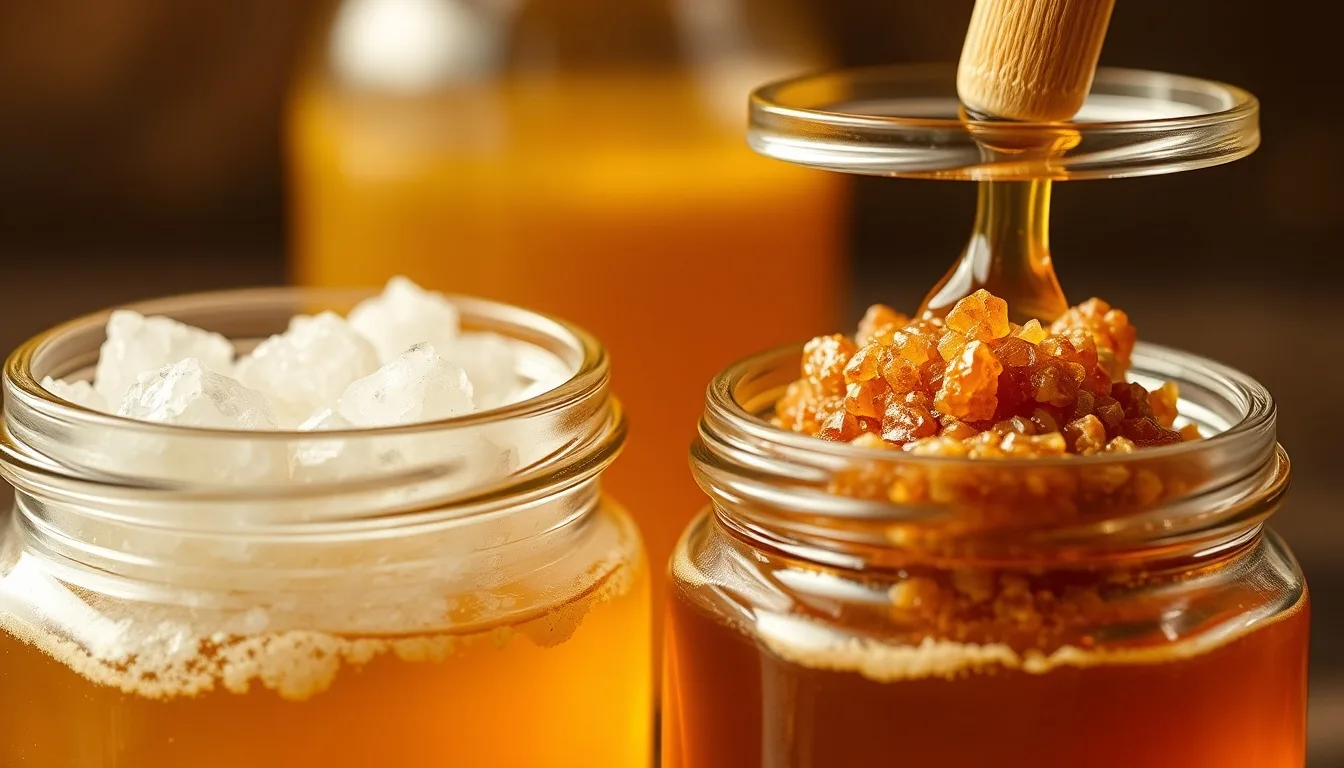
Crystal texture: Tier 1 varieties almost universally produce fine-grained crystals with a smooth, spreadable consistency. This is not a processing effect — it is a direct consequence of rapid nucleation. When G/W is high and supersaturation builds quickly, many nuclei form simultaneously. Each competing nucleus captures a portion of the available glucose and constrains the others' growth. The result is high crystal count and low crystal size — which is exactly what the creamed honey industry exploits. Rapeseed and sunflower are the standard "seed" honeys in controlled creaming operations worldwide because their G/W characteristics produce uniform, sub-100-micron crystal distributions that remain smooth on the tongue even at room temperature.
- Rapeseed / Canola (Brassica napus, B. rapa) — G/W ≈ 2.2–2.7 (median ~2.4) | Full set at 20°C: 5–14 days | Glucose ~38–44%, Water ~16–18% | Fresh color: white to pale cream | The fastest-setting widely produced commercial honey. Canola monoculture in Europe (France, Germany, UK, Poland) and Canada makes this volume production's dominant variety. Almost invariably solid at retail; liquid product is either extracted exceptionally fresh and sold within days, or heat-treated. Standard seed honey for creamed honey production across Europe and North America | Source: Bogdanov et al. (2004); White (1975)
- Dandelion (Taraxacum officinale) — G/W ≈ 2.2–2.5 (median ~2.3) | Full set at 20°C: 7–21 days | Glucose ~38–42%, Water ~17–18% | Fresh color: bright yellow transitioning to pale amber | Nearly as fast as rapeseed. Dandelion is primarily a spring honey in northern Europe and North America; its crystallization is essentially complete before the next major nectar flow begins in most climates. The bright lemon-yellow color fades to cream-white within days of crystallization onset | Source: Persano Oddo & Piro (2004); Bogdanov et al. (2004)
- Sunflower (Helianthus annuus) — G/W ≈ 2.1–2.5 (median ~2.3) | Full set at 20°C: 14–30 days | Glucose ~35–43%, Water ~17–18.5% | Fresh color: bright yellow-amber | The second most produced European honey crop after rapeseed; dominant in Ukraine, Argentina, and the Spanish meseta. Sunflower honey produced in hot climates (extractable moisture 16–17%) often has G/W approaching the upper tier threshold, setting in under 10 days | Source: Persano Oddo & Piro (2004); Manikis & Thrasivoulou (2001)
- Cotton (Gossypium hirsutum) — G/W ≈ 1.9–2.3 (median ~2.1) | Full set at 20°C: 14–45 days | Glucose ~35–41%, Water ~17–18.5% | Fresh color: white to extra light amber | Significant production in the US (Texas, Mississippi Delta), Egypt, and Uzbekistan. At the lower end of G/W for Tier 1 — some cotton honeys with moisture at the higher end of range (~18.5%) may take 5–6 weeks to fully set rather than 2–3 | Source: White (1975); Doner (1977)
Tier 2 — Fast Crystallizers: 1–3 Months (G/W ≈ 1.7–2.1)
Tier 2 covers the most commercially important temperate honeys sold globally. Clover is the world's single most produced honey variety by volume. Linden and wildflower are the dominant varieties in Central and Eastern Europe. All of them crystallize at a rate that the average consumer encounters in a jar of honey that was liquid when purchased and has turned grainy several months later.
Crystal texture in Tier 2 is intermediate — neither the fine cream of rapeseed nor the coarse grain of the slowest crystallizers. Clover honey typically produces a smooth fine-to-medium texture that has made it the industry standard for the "generic honey" consumer experience. Linden varies more depending on the water activity at extraction: a dry Central European harvest at 16–17% moisture may set with a fine cream-like consistency; a wetter extraction at 18.5% produces coarser, more irregular crystals that feel grainier on the palate. Wildflower's enormous intra-variety range (G/W anywhere from 1.7 to 2.2 depending on the specific floral mix) means its crystallization behavior is genuinely unpredictable from jar to jar even within the same supplier.
- Clover (Trifolium spp., primarily T. repens, T. pratense) — G/W ≈ 1.8–2.2 (median ~2.0) | Full set at 20°C: 30–90 days | Glucose ~31–38%, Water ~17–18.5% | Fresh color: water white to extra light amber | The world's most produced honey variety; dominant in the US, Canada, Australia, and New Zealand. Clover G/W values span the Tier 1/2 boundary — some harvests from arid regions (New Zealand Manuka-cohabitation zones with very dry White Clover extraction) set in under 4 weeks; some Canadian high-moisture harvests take 3 months | Source: Bogdanov et al. (2004); Doner (1977)
- Linden / Basswood (Tilia cordata, T. tomentosa, T. americana) — G/W ≈ 1.7–2.1 (median ~1.9) | Full set at 20°C: 30–90 days | Glucose ~29–37%, Water ~17–18.5% | Fresh color: white to extra light amber, occasionally pale green-yellow | Central and Eastern Europe's most distinctive premium variety. Tilia tomentosa (Hungary, Romania, Balkans) produces slightly higher glucose density and a faster set than T. cordata (Germany, France, Scandinavia). Crystallization produces a smooth cream that is highly valued in Czech, Polish, and Hungarian specialty retail | Source: Persano Oddo & Piro (2004); Bogdanov et al. (2004)
- Wildflower / Polyfloral (mixed flora) — G/W ≈ 1.7–2.3 (median ~1.95) | Full set at 20°C: 60–180 days (widest intra-variety range of any category) | The widest range is because "wildflower" is a genus-level approximation for whatever was blooming. A batch dominated by rapeseed and dandelion pollen may set in 3 weeks; a batch dominated by lavender, thyme, and citrus may take 6 months. For the consumer this means that wildflower honey's crystallization timeline is genuinely unpredictable — and that variability is accurate product information, not a quality problem | Source: Doner (1977); White (1975)
Tier 3 — Medium Crystallizers: 3–12 Months (G/W ≈ 1.6–1.9)
Tier 3 contains the largest number of premium single-variety honeys available in specialty retail: buckwheat, eucalyptus, orange blossom, lavender, manuka, chestnut. All of them will eventually crystallize under room-temperature storage — a jar that remains liquid at 18 months from harvest at 20°C is unusual and warrants scrutiny. But all of them set noticeably more slowly than clover or linden, which is part of their premium positioning.
This is also the tier where crystal texture diverges most dramatically from the fast-crystallizer prediction. Buckwheat, which sets slowly (G/W ~1.8, months not weeks), produces coarse, dark-pigmented crystals rather than fine cream. The coarseness is a nucleation-rate effect: slow onset → few initial nuclei → large individual crystal growth → gritty texture. The dark pigmentation — buckwheat's characteristic brown-black polyphenol content — is incorporated into the crystal matrix as it grows slowly, producing a uniquely dark crystallized product that many consumers mistake for degraded honey. It is not: dark crystallized buckwheat is simply buckwheat honey behaving as buckwheat honey does.
- Eucalyptus (Eucalyptus spp., primarily E. globulus, E. camaldulensis) — G/W ≈ 1.7–2.1 (median ~1.9) | Full set at 20°C: 90–180 days | Glucose ~30–37%, Water ~17–19% | Fresh color: medium amber | Wide G/W range reflects Eucalyptus species diversity across Australia, Portugal, Spain, and California. E. globulus honey (Tasmanian/Portuguese) typically has higher glucose density and may set in 3–4 months; E. citriodora honey (lemon-scented) is lower in glucose and may take 6 months or more | Source: Persano Oddo & Piro (2004); Bogdanov et al. (2004)
- Buckwheat (Fagopyrum esculentum) — G/W ≈ 1.6–2.0 (median ~1.8) | Full set at 20°C: 90–180 days | Glucose ~29–35%, Water ~17–20% | Fresh color: very dark amber to nearly black | Buckwheat's high polyphenol content (quercetin, luteolin, caffeic acid — driving ORAC ~796 μmol TE/100g, the highest of any major commercial variety) may also act as a mild crystallization inhibitor; multiple studies note that buckwheat sets more slowly than its G/W ratio would predict if phenolics were absent. The resulting crystals are coarse and dark — excellent quality but often unfamiliar to consumers expecting smooth beige cream | Source: White (1975); Doner (1977); Finola et al. (2007)
- Blueberry (Vaccinium spp.) — G/W ≈ 1.6–2.0 (median ~1.8) | Full set at 20°C: 90–180 days | Glucose ~29–35%, Water ~17–19% | Fresh color: medium amber | Primarily produced in New England and the Pacific Northwest (US), Nova Scotia, and the UK. Medium crystallization rate produces a fine-to-medium texture; the relatively high glucose concentration for a premium variety makes it a good starting point for controlled creamed production at smaller scale | Source: Bogdanov et al. (2004); USDA composition databases
- Orange Blossom / Citrus (Citrus spp., primarily C. sinensis, C. limon, C. paradisi) — G/W ≈ 1.5–2.0 (median ~1.8) | Full set at 20°C: 180–365 days | Glucose ~27–34%, Water ~17–18.5% | Fresh color: white to extra light amber | One of the slowest Tier 3 varieties — some batches from Andalusia, Sicily, and Florida remain liquid for 6–8 months. Crystallization when it occurs produces medium-coarse, pale yellowish crystals. Citrus honey is legally classified as a "naturally low enzyme" variety under EU standards (diastase typically 3–8 DN) | Source: Persano Oddo & Piro (2004); Sancho et al. (1992)
- Lavender (Lavandula angustifolia) — G/W ≈ 1.5–1.9 (median ~1.7) | Full set at 20°C: 180–365 days | Glucose ~27–33%, Water ~17–18.5% | Fresh color: light amber | Lavender honey sits at the Tier 3/4 boundary. Provence and Castile harvests typically set sometime within 6–12 months. The crystallized product has a medium-fine texture and a characteristic pale amber-cream color that is highly valued in French specialty retail. Its low diastase (averaging DN ~8 — see companion diastase index post) is unrelated to its crystallization rate | Source: Persano Oddo & Piro (2004)
- Manuka (Leptospermum scoparium) — G/W ≈ 1.6–1.9 (median ~1.8) | Full set at 20°C: 180–365 days | Glucose ~28–33%, Water ~17–19% | Fresh color: light to medium amber, cream-white when crystallized | Manuka's methylglyoxal (MGO) content has no known effect on crystallization kinetics — crystallization rate is governed by glucose chemistry, not antibacterial compounds. High-grade UMF Manuka (UMF 20+) crystallizes at essentially the same rate as low-grade product from the same orchard. Crystallized Manuka at 12 months from harvest is a normal product, not a degraded one | Source: Bogdanov et al. (2004); Mavric et al. (2008)
- Chestnut (Castanea sativa) — G/W ≈ 1.4–1.8 (median ~1.6) | Full set at 20°C: 180–365+ days | Glucose ~26–32%, Water ~17–20% | Fresh color: dark amber | Chestnut's high polyphenol content (primarily pinocembrin, chrysin, and tannin-derived phenolics) appears to have a mild inhibitory effect on nucleation — chestnut sets more slowly than its G/W ratio alone would predict. The resulting crystals are coarse and dark amber-brown; the high mineral content (ash ~0.6% — highest of any European blossom honey) contributes to the irregular crystal morphology | Source: Persano Oddo & Piro (2004); Bertoncelj et al. (2007)
Tier 4 — Slow to Non-Crystallizing: More Than One Year or Effectively Never (G/W < 1.7)
Tier 4 contains the varieties most prized in specialty retail precisely because they stay liquid — acacia, tupelo, and sage are premium honeys partly because their liquid shelf stability at room temperature makes them easier to use and more visually appealing in the jar. Their non-crystallizing behavior is not a processing achievement. It is a botanical fact: low G/W at the extraction point, driven by the floral source's chemistry, means the system is simply not supersaturated enough to drive nucleation under normal conditions.
The consumer consequence of this is important: if a honey labeled "acacia," "tupelo," or "sage" shows significant crystallization within 3–6 months of purchase at room temperature, something has changed in the composition. The most common explanations are: (1) blending with a fast-crystallizing variety (sunflower and rapeseed are both used to extend premium Tier 4 honeys by low-quality processors); (2) seeding by contact with a crystallized honey (using the same knife or spoon in different jars can introduce seed crystals); or (3) exceptionally cold storage (below 14°C) that brought the G/W system into a crystallization-favorable temperature range even at its dilute glucose level.
When Tier 4 honeys do eventually crystallize — acacia may occasionally produce crystals after 2–3+ years in cool storage — the crystals are typically coarse and irregular. The slow nucleation rate means few seed crystals form; each grows large before competition limits it. "Gritty" or "coarse-textured" honey is almost always a Tier 4 or slow-Tier-3 variety that has finally crystallized after months of slow nucleation.
- Sage (Salvia spp., primarily S. mellifera — California black sage, S. apiana — white sage) — G/W ≈ 1.4–1.7 (median ~1.5) | Full set at 20°C: >1 year | Glucose ~24–30%, Water ~17–18.5% | Fresh color: extra light to light amber | Sage honey is predominantly a California product from a short February–April bloom window in coastal chaparral. Its very high fructose content (F/G ~1.28; White 1975) and moderate glucose combine to produce G/W values that put it at the non-crystallizing boundary. Most sage honey remains liquid for 12–18 months at room temperature | Source: White (1975); USDA AMS honey composition data
- Tupelo (Nyssa ogeche — white tupelo, Florida) — G/W ≈ 1.3–1.6 (median ~1.4) | Full set at 20°C: 1–3+ years | Glucose ~22–28%, Water ~17–18.5% | Fresh color: extra light amber with distinctive greenish tint | Florida white tupelo is one of North America's most studied non-crystallizing honeys, produced from a narrow 2–3 week April bloom of a single tree species in the Apalachicola and Chipola river systems. Its high F/G ratio (~1.28–1.39) and low absolute glucose concentration produce a G/W value that keeps it liquid under virtually all room-temperature storage conditions. Crystallization of labeled tupelo honey is a strong adulteration signal | Source: Doner (1977); White (1975); Bogdanov et al. (2004)
- Acacia / Black Locust (Robinia pseudoacacia) — G/W ≈ 1.1–1.5 (median ~1.3) | Full set at 20°C: >2 years, or effectively never | Glucose ~22–28%, Water ~17–18.5% | Fresh color: water white to extra white | The lowest G/W ratio of any major commercial honey variety. Robinia pseudoacacia nectar has an extraordinarily high fructose concentration (~40–44%) relative to glucose (~22–27%), producing an F/G ratio of ~1.47 — the highest consistently measured in European honey literature. The resulting glucose concentration is too low for stable nucleation at 20°C under typical storage conditions. A jar of authentic Hungarian, Italian, or French acacia honey left in a kitchen cupboard at 20°C for 2 years will still pour. Crystallization within 3 months of a labeled acacia product is almost certain evidence of blending | Source: Bogdanov et al. (2004); Persano Oddo & Piro (2004); Doner (1977)
The Heather Exception: Thixotropic Gelation Is Not Crystallization
Heather honey (Calluna vulgaris) does not fit any of the four crystallization tiers because it does not crystallize in the glucose-monohydrate sense. It gels. The distinction is chemically significant and practically important.
Calluna vulgaris honey has a G/W ratio of approximately 1.8–2.2 — similar to Tier 2 clover and linden. By glucose chemistry alone, it should set in 1–3 months with medium-fine crystals. What actually happens is different: heather honey forms a semisolid colloidal gel within days to weeks of extraction, regardless of temperature, and then reverts to a more liquid state when stirred, shaken, or pumped. This behavior — solid-like at rest, liquid-like under shear — is the definition of thixotropy. It cannot be extracted by centrifugal spinning (the standard method for all other commercial honeys) without significant yield loss; it requires press extraction or a specialized tangential flow process.
The gel structure is protein-driven. Calluna honey contains 10–25× the protein concentration of most other European honeys — typically 0.3–2.0% protein versus 0.05–0.1% for clover or acacia. The primary structural proteins are arabinogalactan-proteins (AGPs), high-molecular-weight glycoproteins that form colloidal networks under the ionic conditions of honey. These networks are disrupted by mechanical shear and re-form on standing — the classic definition of a thixotropic colloid. There is also evidence of leucoanthocyanidin-derived polyphenol-protein cross-links contributing to the gel network in high-phenolic heather batches.
The practical implications: crystallized-looking heather honey in a jar is not "crystallized" in the same sense as crystallized clover or buckwheat. Stirring heather honey with a spoon and watching it reliquify is a fast authenticity test — real Calluna heather honey will do this; a blended product made to look like heather honey with added proteins generally will not. The EU Honey Directive recognizes heather's exceptional characteristics with a higher permitted moisture ceiling (up to 23% for Calluna vs. the standard 20%) because the thixotropic protein network suppresses the water activity that would normally cause fermentation in high-moisture honey.
Pro Tip
Authenticity test for heather honey: scoop a spoonful and stir it vigorously for 30 seconds in a small bowl. Genuine Calluna heather honey will become noticeably more fluid during stirring and slowly return to semisolid consistency when left undisturbed for 1–2 minutes. This thixotropic behavior cannot be easily replicated by blending crystallized honey with liquid honey.
The Crystal Texture Predictor: Why Rapeseed Feels Smooth and Buckwheat Feels Gritty
Crystallized honey can feel like smooth cream, like fine-grain sand, or like coarse gravel. The difference is almost entirely a function of crystallization rate — not processing, not variety age, not pollen content.
The mechanism comes from classical nucleation theory (LaMer & Dinegar, 1950): crystal grain size is inversely proportional to the number of nuclei that form per unit time. When a supersaturated system undergoes rapid nucleation — as it does in rapeseed honey with G/W ~2.4 — large numbers of seed crystals form simultaneously and compete for the available dissolved glucose. Each growing crystal is quickly constrained by its neighbors, producing a high population of small, fine-grained crystals. The consumer experience is a smooth, spreadable honey that feels like cold butter on the tongue.
When the same process occurs slowly — as in buckwheat (G/W ~1.8) or wildflower honey after months of gradual cooling — fewer nuclei form initially. Each has more dissolved glucose available to capture before a neighbor appears. The crystals grow larger before competition limits them. The consumer experience is a coarse, grainy texture that often surprises buyers who expected the same smoothness as commercial clover cream.
This is why the honey industry uses rapeseed and sunflower (Tier 1) as "seed" honeys in controlled creaming: adding ~5–10% fine-crystal seed honey to a batch of liquid honey that is to be creamed initiates nucleation immediately, ensuring that the resulting crystal count is high and the grain size is small. The seed honey's role is to provide pre-formed crystal nuclei so the target honey does not have to wait for spontaneous nucleation — which, in a Tier 2 or 3 honey, would produce the coarse-grained result that skilled producers try to avoid.
- Fine / Smooth (cream-like texture) — G/W > 2.1: Rapeseed, Dandelion, Sunflower. These are the basis of commercial creamed honey production worldwide. The crystals are typically <100 microns in diameter and produce no perceptible graininess on the tongue.
- Medium (fine-to-medium grain) — G/W 1.8–2.1: Clover, Linden, Cotton, Blueberry. Familiar "grocery store honey" texture when crystallized. Slightly perceptible grain at room temperature; dissolves quickly when warmed. The consumer default for "normal" crystallized honey.
- Coarse (perceptible grain) — G/W 1.5–1.8, slow crystallization: Buckwheat, Wildflower (slow batches), Chestnut, Orange Blossom. Slow nucleation produces large crystals. Completely authentic and normal for these varieties; often mistaken for coarse-sugar adulteration by consumers unfamiliar with variety-specific behavior.
- Rare / Irregular — G/W < 1.5, very slow crystallization: Acacia, Tupelo, Sage. If these honeys do eventually crystallize after years in cool storage, the few nuclei that formed over that long time period have had ample opportunity to grow large — producing visible coarse crystals. The long gap between liquid and crystallized states is the give-away that this is real slow crystallization, not sugar adulteration.
The 14°C Optimum and the Refrigerator Paradox
If you want honey to crystallize uniformly and with fine grain — for controlled creaming, or simply because you prefer the spreadable texture — the intuitive move is to put it in the refrigerator. This is wrong. The refrigerator is one of the worst places to crystallize honey.
Honey crystallization follows a temperature-dependent nucleation rate that has an optimum around 13–16°C (55–61°F) — approximately the temperature of a wine cellar or cool basement. Manikis and Thrasivoulou (2001) measured crystallization rates for Greek unifloral honeys (clover, thyme, pine, cotton, sunflower) at 10, 14, 18, 22, and 26°C and found the fastest full-set times clustered at 13–15°C across all varieties, with rates declining above and below that optimum.
Above the optimum (22–26°C): the glucose supersaturation driving force decreases — more glucose remains soluble in the warmer water, so nucleation is slower. This is why honey stored on a warm kitchen shelf stays liquid longer than the same honey in a cool cupboard. It is also why honey decrystallizes when warmed gently: you are moving it above the temperature where the solid phase is thermodynamically stable.
Below the optimum (4°C / refrigerator): viscosity increases dramatically. The diffusion rate of glucose molecules to crystal surfaces drops sharply — essentially, the honey becomes too thick for glucose to migrate efficiently to growing crystal nuclei, even though supersaturation is high. The effect is that refrigerated honey crystallizes slowly, not fast. When it does crystallize at 4°C, the slow nucleation produces fewer, coarser crystals than the same honey would produce at 14°C. The refrigerator lengthens the time to crystallization AND worsens the texture.
The practical consequence: if you want to control crystallization, use a wine cooler, cool cellar, or insulated box at 13–16°C. Dedicated honey creaming operations run their crystallization chambers at exactly this range for 24–72 hours, seeded with fine-crystal rapeseed honey, before the set becomes firm. If you want to keep liquid honey liquid for as long as possible at home, a room-temperature kitchen cupboard at 20–22°C is better than a refrigerator. If you want to decrystallize honey quickly, a 40°C water bath (never microwave) dissolves crystals in most Tier 2 and 3 honeys within 15–30 minutes without damaging enzymes.
Pro Tip
The refrigerator paradox: cold does not speed up honey crystallization — it slows it. The optimal temperature for fastest, finest-grained crystallization is 13–16°C (55–61°F), approximately wine-cellar temperature. Refrigerators at 4°C crystallize honey slowly and produce coarser texture. Room-temperature storage at 20–22°C is better for both controlled crystallization and for keeping liquid honey liquid longer than a refrigerator.
Crystallization as a Quality Signal: What It Tells You (and What It Does Not)
Crystallization does not reduce honey's quality, enzymatic activity, antimicrobial properties, or nutritional value. Diastase, HMF, organic acids, polyphenols, and MGO are all unaffected by glucose crystallization — the solid-state phase change involves only glucose-water rearrangement. The fructose, enzymes, and bioactive compounds remain in the liquid phase. Raw honey that has crystallized is still raw honey.
What crystallization does tell you: a honey that crystallizes at the expected rate for its variety is behaving authentically. Tier 1 honey (rapeseed, sunflower) should be solid within 2–4 weeks of extraction under any normal storage condition. A liquid jar of "sunflower honey" at 6 months from harvest date has been heat-treated, ultra-filtered to remove nucleating particles, or is blended with a slow-crystallizing variety — all of which compromise the "raw" or "unfiltered" claim. Conversely, Tier 4 honey (acacia, tupelo) should stay liquid for years. Crystallization within 3–6 months of a labeled acacia or tupelo product is a strong adulteration signal.
There is one authenticity caveat: spontaneous crystallization of Tier 3 and 4 honeys can sometimes be triggered by contamination with seed crystals from other honeys — a spoon used in crystallized clover honey and then dipped into acacia honey will introduce seed crystals that may initiate crystallization even in a properly non-crystallizing variety. This is a handling artifact, not evidence of the honey's intrinsic composition. If you suspect seeding, the test is to gently warm the honey to 40°C (warm water bath, not microwave) — genuine single-variety Tier 4 honey will return completely to liquid; blended honey that crystallized due to its intrinsic composition will partially recrystallize.