The Honey That Arrives With Spring
Of all the flowers that bloom in early spring, the common dandelion (Taraxacum officinale) may be the most important for bees — and the least appreciated by humans. While gardeners reach for herbicide sprayers, honeybees are doing something more urgent: fueling their colonies back to strength after a winter of dwindling stores. Dandelion is often the first abundant nectar and pollen source of the year, blooming across lawns, roadsides, and meadows from late March through May across temperate North America and Europe.
The honey that results from this early bloom is unlike most people expect: a vivid yellow-gold when fresh, earthy and caramelized in flavor, and almost impossibly fast to crystallize. Dandelion honey solidifies within days to weeks — faster than nearly any other variety — which means most people encounter it in its set, creamy form rather than as a liquid. This fast crystallization is so characteristic that beekeepers sometimes use dandelion honey as a baseline for timing their extraction schedules.
Outside North America, dandelion honey is well-known across the UK, Poland, France, Germany, and Eastern Europe, where early spring foraging yields substantial dandelion honey crops. In the United States, it's less commonly sold as a named monofloral variety — most dandelion honey gets blended into spring wildflower harvest — but small producers in the Midwest and Northeast are beginning to market it specifically, and it's worth seeking out for its unique character.
Nutritional and Antioxidant Profile
Dandelion honey inherits bioactive compounds from one of the most nutritionally dense common wildflowers. Dandelion flowers are rich in luteolin, quercetin, caffeic acid, and beta-carotene — and research shows that monofloral honeys carry detectable concentrations of the polyphenols found in their source plants.
A 2019 review in the journal Nutrients cataloged dandelion's flavonoid content and confirmed luteolin as one of its most abundant bioactive compounds. Luteolin has been studied for anti-inflammatory activity (NF-κB pathway suppression), neuroprotective effects, and antioxidant capacity. It's the same compound responsible for much of the health research around celery, parsley, and chamomile. Quercetin — also prominent in dandelion — has one of the most extensive evidence bases of any dietary flavonoid, with documented effects on blood pressure, histamine release, and inflammatory cytokines across dozens of clinical trials.
Compared to mild spring honeys like acacia or early-season clover, dandelion honey has a more substantial polyphenol content — more comparable to a light wildflower than a delicate monofloral. A 2011 study in Food Chemistry analyzing 22 European honey varieties found that dandelion honey had total phenolic content in the mid range (18-24 mg gallic acid equivalent per 100g) — meaningfully higher than acacia (8-12 mg) but lower than buckwheat (40-60 mg) or chestnut honey. For a spring honey that tastes relatively mild, its antioxidant delivery is notably good.
The pollen content of dandelion honey is distinctive. Dandelion is both nectariferous and highly polliniferous — bees collect both its nectar and its abundant pollen in large quantities. This means dandelion honey typically contains more pollen than most honeys, which contributes to its higher mineral content (potassium, iron, phosphorus) and a richer yellow color. Some researchers suggest that the high pollen load may enhance the immune-modulating effects of raw honey for people with spring allergies — though the evidence for this specific claim remains mixed and more research is needed.
Get the Honey Buyer's Cheat Sheet (free PDF)
16 varieties on one page — color, flavor, best use and what a fair price looks like — from the 304 honeys we track.
Why Dandelion Honey Crystallizes So Fast
If you've ever left dandelion honey in a jar for two weeks and come back to find a solid brick, you're not alone — and there's nothing wrong with the honey. Crystallization is driven by the glucose-to-fructose ratio, and dandelion honey sits at the extreme fast-crystallizing end of the spectrum.
Dandelion nectar produces honey with approximately 37-40% glucose and only 23-28% fructose, giving it a fructose-to-glucose (F/G) ratio well below 1.0 — sometimes as low as 0.75. When F/G drops below 1.0, honey is almost certain to crystallize quickly; when it drops below 0.85, it typically crystallizes within weeks. Dandelion honey is in the same category as rapeseed/canola honey (which can solidify in the extractor if not handled quickly) and is significantly faster than lavender, clover, or orange blossom honey.
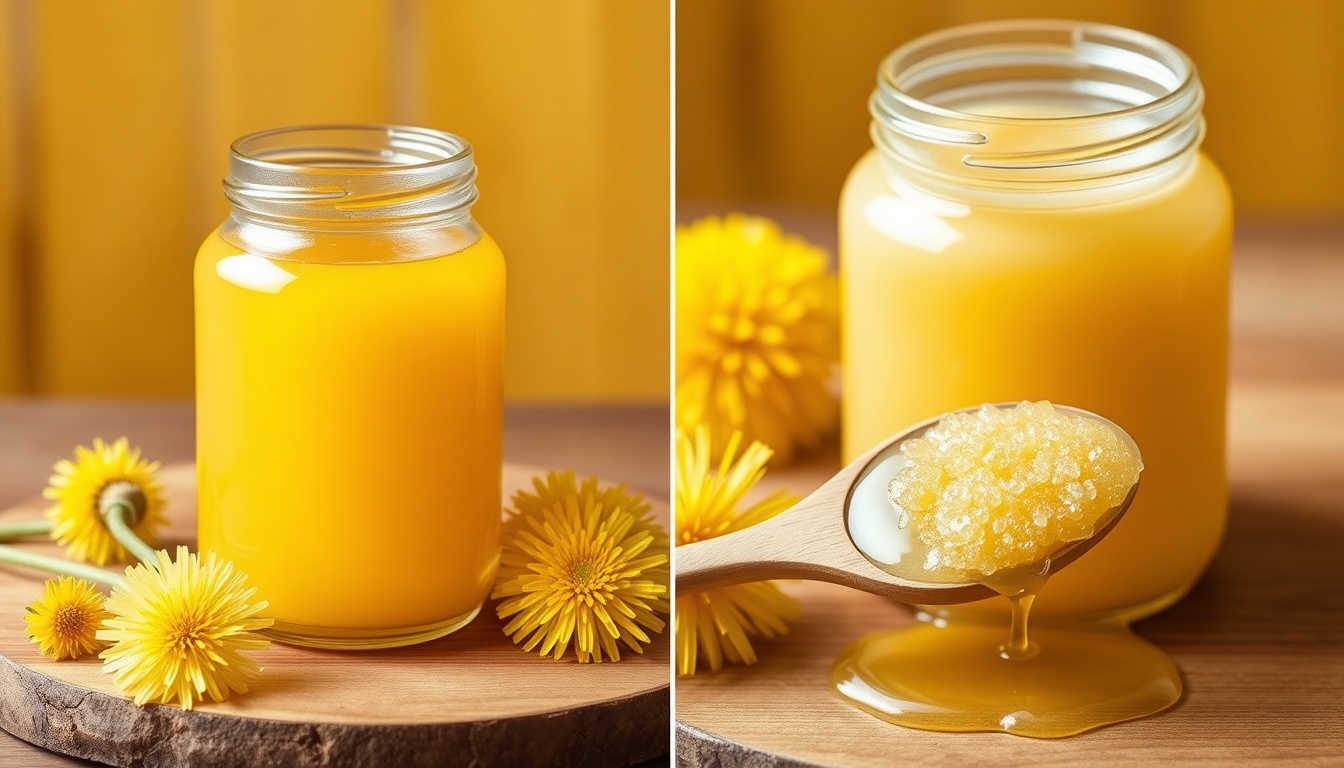
The crystallization produces a fine-grained, smooth texture — not coarse or gritty like poorly controlled clover honey — because dandelion's high pollen content provides abundant nucleation sites for small, uniform crystals. The result is a spreadable, creamy set honey similar in texture to creamed honey, with a pale yellow to cream color.
Beekeepers who want to sell liquid dandelion honey must extract quickly (before crystallization starts in the comb) and keep storage temperatures above 77°F (25°C). For home use, the crystallized form is arguably preferable — it spreads like butter and has a pleasant, dense texture. See our guide on how to decrystallize honey if you want to reliquefy it gently.
The Spring Forage Story: Why Dandelion Matters for Bees
Before appreciating dandelion honey for yourself, it's worth understanding what dandelion means to honeybees. A colony emerging from winter is depleted — adult bee population is at its lowest, stored honey and pollen have been consumed over months of winter feeding, and the queen is beginning to ramp up egg-laying. The colony needs food urgently to fuel this spring expansion.
Dandelion arrives at precisely the right moment. In most of the US and Canada, dandelions bloom weeks before most tree flowers open and months before summer nectar flows begin. A single dandelion-rich meadow can provide enormous quantities of both nectar and protein-rich pollen in a short window. Bees can gather 100-300 mg of nectar per flower visit, and a large lawn covered in dandelions provides enough forage to visibly increase a hive's weight within days.
The pollen is even more critical than the nectar. Pollen is the bees' protein source — they need it to feed larvae and develop the nurse-bee population that will sustain spring buildup. Dandelion pollen is bright orange and nutritionally rich (approximately 20% protein, with essential amino acids), making it an excellent early-season protein source when other pollen is unavailable.
This is why beekeepers and ecologists consistently advocate against herbicide use on dandelions. Treating a lawn before dandelions finish blooming in spring can deprive local bee populations of their most important early-season food source. The ecological and agricultural case for leaving dandelions is backed by substantial research — a 2020 study in the journal Insect Conservation and Diversity found that dandelion removal from managed turf significantly reduced spring bumblebee foraging activity and colony development.
Flavor Profile and Culinary Uses
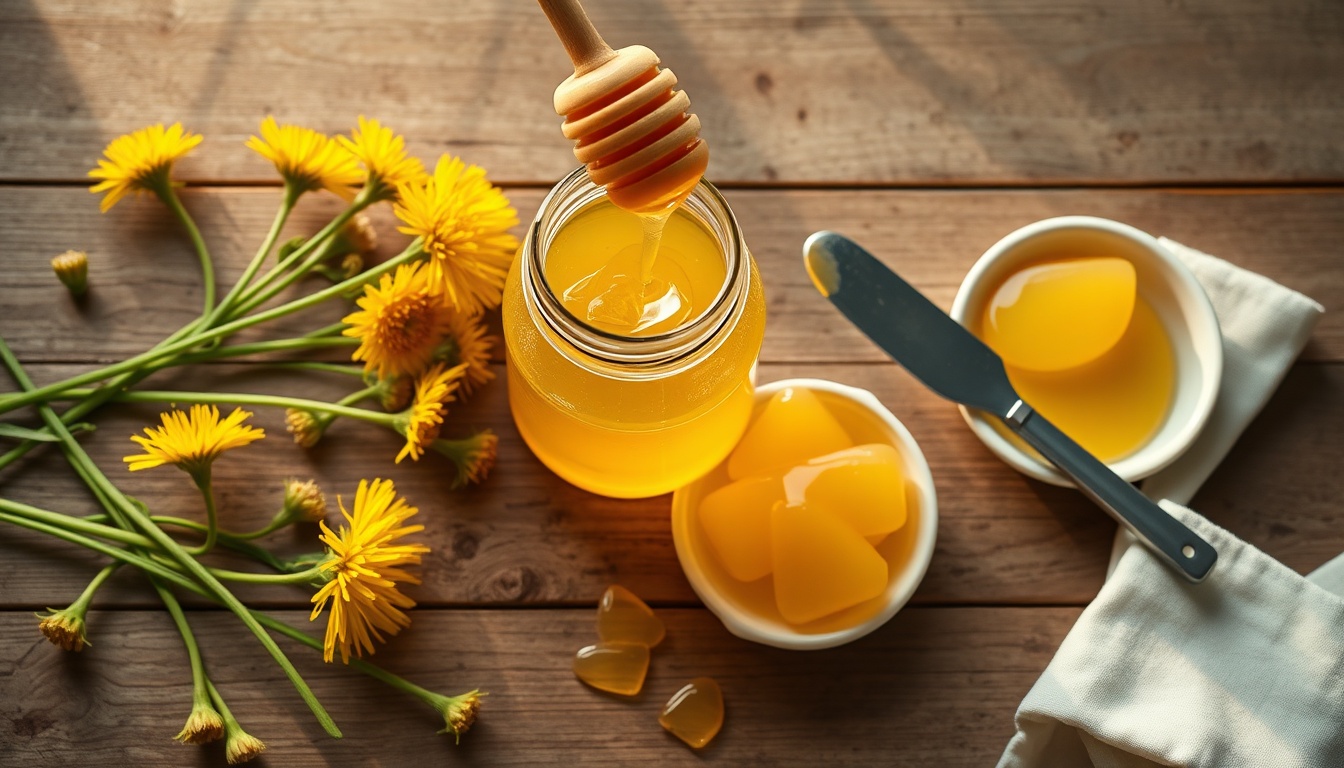
**Appearance:** Fresh dandelion honey is a distinctive vivid yellow-gold — brighter and more saturated than most spring honeys. As it crystallizes, it lightens to pale gold or cream-yellow. The fresh liquid form is one of the more visually striking honeys in a collection.
**Aroma:** Earthy, slightly medicinal, with a warm caramelized sweetness and faint herbal undertones. Not as floral as orange blossom or lavender, and not as bold as buckwheat. Some tasters detect notes of dried hay, warm caramel, and a very subtle bitterness reminiscent of the dandelion plant itself.
**Taste:** Complex, earthy sweetness with caramel and butterscotch notes and a mild herbal-bitter finish. The bitterness is subtle in quality dandelion honey — more like a pleasant counterpoint to the sweetness than an unpleasant astringency. It's more savory and grounded than most floral honeys, making it more versatile in cooking applications where sweetness alone would be one-dimensional.
**Crystallized form:** Spreads like soft butter at room temperature. Fine-grained and smooth. This is how most people will encounter it, and it's genuinely excellent in this form — perhaps the most useful spreadable honey available.
- **Toast and bread:** The classic use — dandelion honey's creamy crystallized texture spreads perfectly without sliding off warm toast. The earthiness complements whole grain and sourdough breads where acacia or clover would taste bland by comparison
- **Cheese pairings:** Outstanding with aged cheddar, gouda, gruyère, and goat cheese. The caramel and earthy notes bridge the gap between sweet and savory, and the subtle bitterness cuts through fat the way a good condiment should
- **Baking:** Works well in savory-sweet baked goods — cornbread, whole grain muffins, quick breads. Its pronounced flavor adds character where mild honey would be lost. See our honey baking guide
- **Marinades and glazes:** The earthy character adds depth to poultry, pork, and roasted root vegetable marinades. Pairs especially well with mustard, rosemary, and apple cider vinegar
- **Coffee:** A small spoonful in black coffee or espresso amplifies the coffee's roasted notes — dandelion honey's caramel and earthy notes are one of the better honey pairings for dark-roast coffee. See our honey in coffee guide
- **Yogurt and oatmeal:** Stir into plain yogurt or warm oatmeal. The crystallized form dissolves smoothly into warm dishes. See our honey and yogurt guide and honey and oatmeal guide
- **Salad dressings:** A teaspoon of dandelion honey adds complexity to vinaigrettes, particularly with apple cider vinegar, dijon mustard, and olive oil — a combination that highlights its naturally savory character
Dandelion Honey vs Other Spring Honeys
**Dandelion vs Clover:** Both are spring honeys with good antioxidant profiles, but clover is milder, more neutral, and crystallizes somewhat more slowly (weeks vs days). Dandelion has more flavor character and higher pollen content. Clover is the all-purpose choice; dandelion is for those who want a more distinctive spring honey.
**Dandelion vs Orange Blossom:** Orange blossom is more delicate, floral, and feminine — the prototypical sweet spring honey. Dandelion is earthier, bolder, and more complex. They suit entirely different culinary applications. Orange blossom for tea and desserts; dandelion for cheese, bread, and savory cooking.
**Dandelion vs Acacia:** Acacia is dandelion's opposite in almost every respect — pale, mild, high-fructose, stays liquid for years, has the lowest GI of any common honey. Dandelion is golden-yellow, flavored, high-glucose, crystallizes almost immediately, and has a moderate GI. Acacia is the choice for diabetics or anyone wanting minimal flavor influence; dandelion offers nutritional depth and culinary character.
**Dandelion vs Spring Wildflower:** Many spring wildflower honeys contain significant dandelion as a component, which is part of why early-season wildflower honey often has a rounder, slightly earthier flavor and crystallizes faster than late-summer wildflower. A named dandelion monofloral honey simply concentrates these characteristics into a purer expression.
**Dandelion vs Buckwheat:** Both are earthy, characterful honeys with significant antioxidant content, but they're seasonally and stylistically opposite. Dandelion is spring, delicate golden, and mildly earthy; buckwheat is late summer, very dark, and boldly molasses-like. Dandelion is the subtler, more food-friendly version of the "interesting honey" category.
How to Find and Buy Quality Dandelion Honey
Pure dandelion monofloral honey is not as widely available as clover or wildflower, but it's increasingly found through specialty honey retailers, farmers markets, and European import shops. Here's what to look for:
- **Regional sourcing:** The best dandelion honey comes from the UK (particularly Yorkshire, Scotland, and Wales), Poland, Hungary, Germany, and France — where dandelion covers large agricultural areas. In North America, look for producers in the Canadian prairies, the US Midwest (Iowa, Wisconsin, Minnesota), and New England. Your local honey sources may carry it in spring
- **Seasonal timing:** Dandelion honey is a spring harvest — extracted in April-May. If a supplier offers it year-round at low prices, it may be blended or from older stock. Fresh-crop dandelion honey (harvested current season) has the most vivid color and flavor
- **Crystallized is authentic:** If the honey is already set solid or creamy, that's a good authenticity signal — genuine dandelion honey almost always crystallizes before it reaches consumers. Clear liquid dandelion honey that's been sitting for months should raise questions about filtration or blending. See our honey authenticity guide
- **Color and aroma:** Fresh dandelion honey is distinctively yellow-gold. If it's pale white or very light, it may be heavily filtered or blended. The aroma should be earthy and caramelized — not generic sweet
- **Buy raw and unfiltered:** As with all honey, the heat processing and fine filtration used in commercial honey destroys pollen, enzymes, and volatile compounds. Raw dandelion honey from a local beekeeper or small producer will have significantly more nutritional value and flavor character
- **Price range:** in our catalogue, a Minnesota dandelion jar lists at $6.50-24 depending on size and an Italian dandelion jar at $21.50. Very cheap "dandelion honey" is likely blended
Health Benefits Summary
Dandelion honey shares the core health properties common to all raw honeys — prebiotic oligosaccharides supporting gut microbiome diversity, hydrogen peroxide and low pH providing antimicrobial activity, and viscous texture useful for soothing sore throats and coughs. See our guides on honey for cough and honey and gut health for the general evidence base.
Beyond the standard honey benefits, dandelion honey offers a specific polyphenol profile derived from its source plant — particularly luteolin and quercetin, two of the most-studied dietary flavonoids. These compounds contribute to the anti-inflammatory effects documented for flavonoid-rich honeys in the research literature. A 2021 meta-analysis in Food & Function reviewed 16 RCTs on honey supplementation and inflammatory markers, finding significant reductions in CRP, IL-6, and TNF-α — with polyphenol-rich varieties showing stronger effects.
The high pollen content of dandelion honey may have implications for seasonal allergies. The theoretical basis for local honey helping with pollen allergies (gradual oral desensitization) remains contested in the literature — while compelling in theory, high-quality RCTs have shown mixed results. What is clear is that dandelion pollen, unlike grass and tree pollens that cause most hay fever symptoms, is primarily bee-pollinated and not a major airborne allergen. Dandelion honey's impact on spring allergy symptoms is unlikely to be a significant benefit for most people.
Pro Tip
For maximum health benefit, consume dandelion honey raw — not heated above 105°F (40°C). A tablespoon in warm water, stirred into room-temperature yogurt, or spread on toast at room temperature preserves the enzymes, polyphenols, and pollen that give raw honey its nutritional advantage over processed honey.
Dandelion Honey as Food
Choose dandelion honey for its strong flavor; the article does not establish a medicinal advantage or fixed serving.
- **Infants under 12 months:** Never give honey to infants under 12 months due to infant botulism risk — see our baby honey safety guide
- This section does not establish a universal or medical honey dose for this purpose. Use the daily added-sugar guide to count honey with other added or free sugars.
- **Dandelion allergy:** Dandelion belongs to the Asteraceae (daisy) family. People with documented allergies to ragweed, chrysanthemum, or other Asteraceae plants should approach dandelion honey cautiously, as cross-reactivity is possible (though uncommon in practice)
- **Pregnancy:** Safe in normal food amounts. See our honey during pregnancy guide for the full picture
- **Blood thinners:** Quercetin has mild antiplatelet activity in high doses. Regular large consumption while on warfarin or aspirin therapy deserves mention to your doctor, though standard dietary amounts are not a concern