The Basic Conversion: How Much Honey Replaces Sugar?
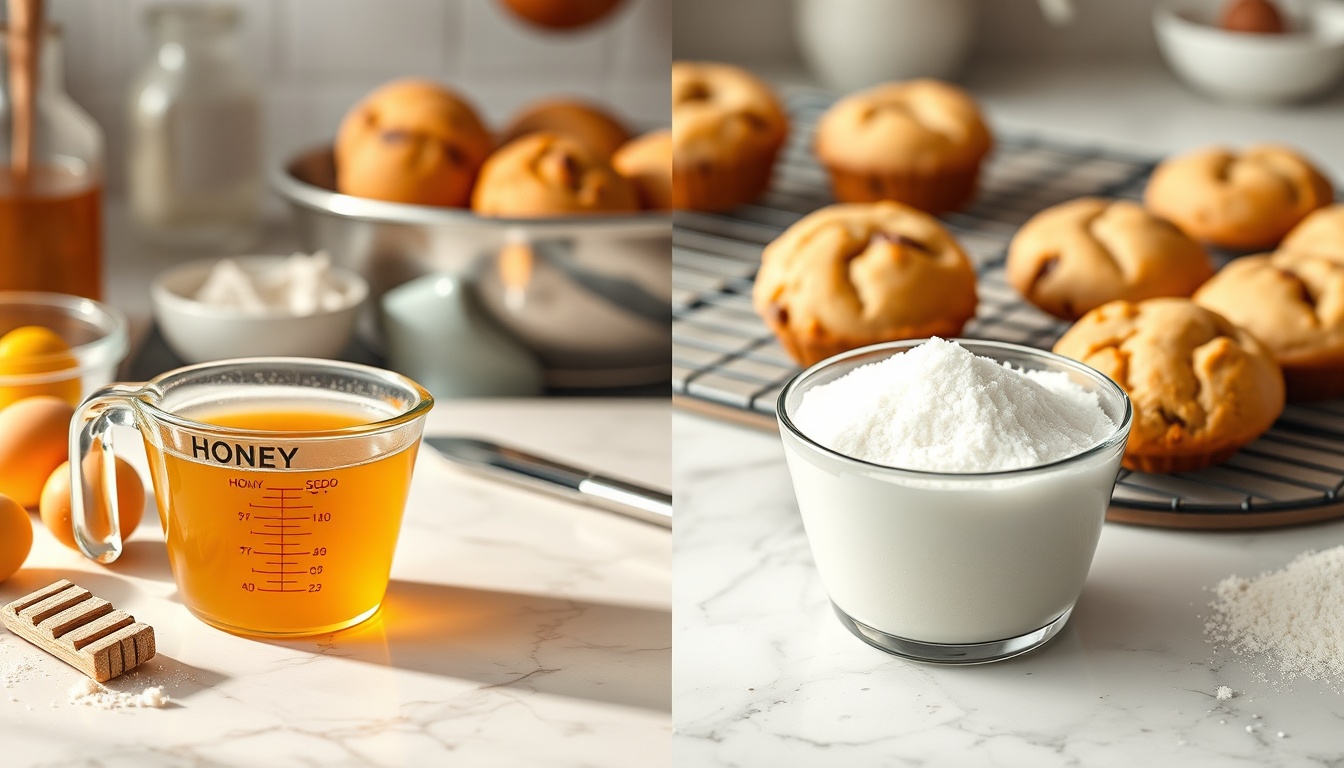
Thanksgiving 2026 pies and cookies: use ¾ cup honey for every 1 cup of granulated sugar (National Honey Board; Joy of Cooking 2019). Honey is a liquid, slightly acidic, and fructose browns at 230 °F. Skip the other three adjustments and pecan pie or sugar cookies go dense and dark.
Use the chooser on this page for recipe size. Honey is still added sugar.
The Complete Adjustment Formula
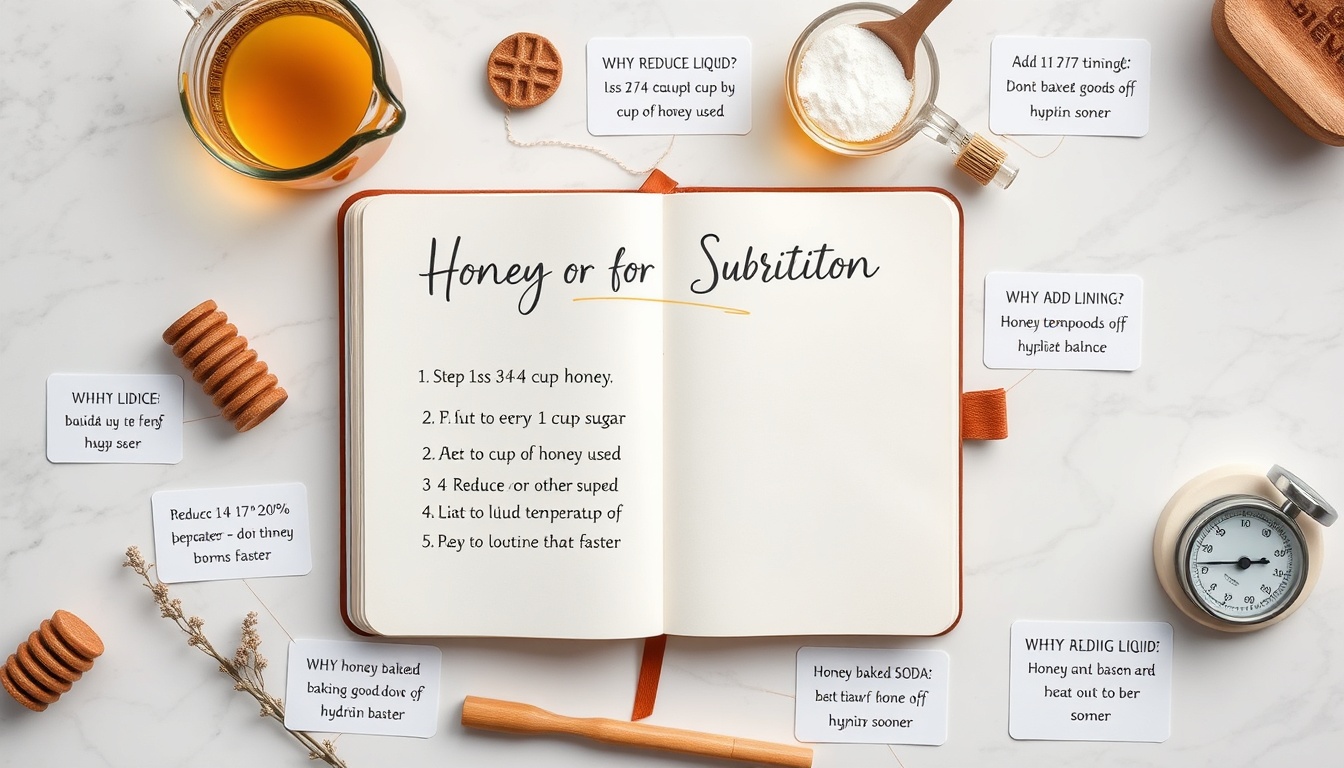
Every time you substitute honey for sugar, you need to make four adjustments — not just the sweetener swap. Here's the complete formula:
- Sweetener: Replace 1 cup sugar with ¾ cup honey
- Liquid reduction: Cut other liquids about 3 tablespoons for that ¾ cup honey (typical U.S. honey is about 17% water; White 1978)
- Baking soda: Add a scant ¼ teaspoon baking soda per ¾ cup honey
- Oven temperature: Reduce oven temperature by 25°F (15°C). Honey contains fructose, which caramelizes at a lower temperature than sucrose — without this adjustment, your baked goods will brown too quickly on the outside while staying underdone inside
Pro Tip
Write all four adjustments on a sticky note and keep it near your baking station until the formula becomes second nature: less honey, less liquid, add baking soda, lower temperature.
Get the Honey Buyer's Cheat Sheet (free PDF)
16 varieties on one page — color, flavor, best use and what a fair price looks like — from the 268 honeys we track.
Quick Conversion Table
Use this table for ¾ cup honey per cup of sugar:
- 1 cup sugar → ¾ cup honey, cut liquid ~3 tbsp, scant ¼ tsp baking soda, oven −25 °F
- ½ cup sugar → ⅜ cup honey, cut liquid ~1½ tbsp, pinch of baking soda, oven −25 °F
- ¼ cup sugar → 3 tbsp honey, cut liquid ~¾ tbsp, oven −25 °F
- 1 tablespoon sugar → 2 teaspoons honey (no other adjustments needed for this small amount)
Which Baked Goods Work Best with Honey
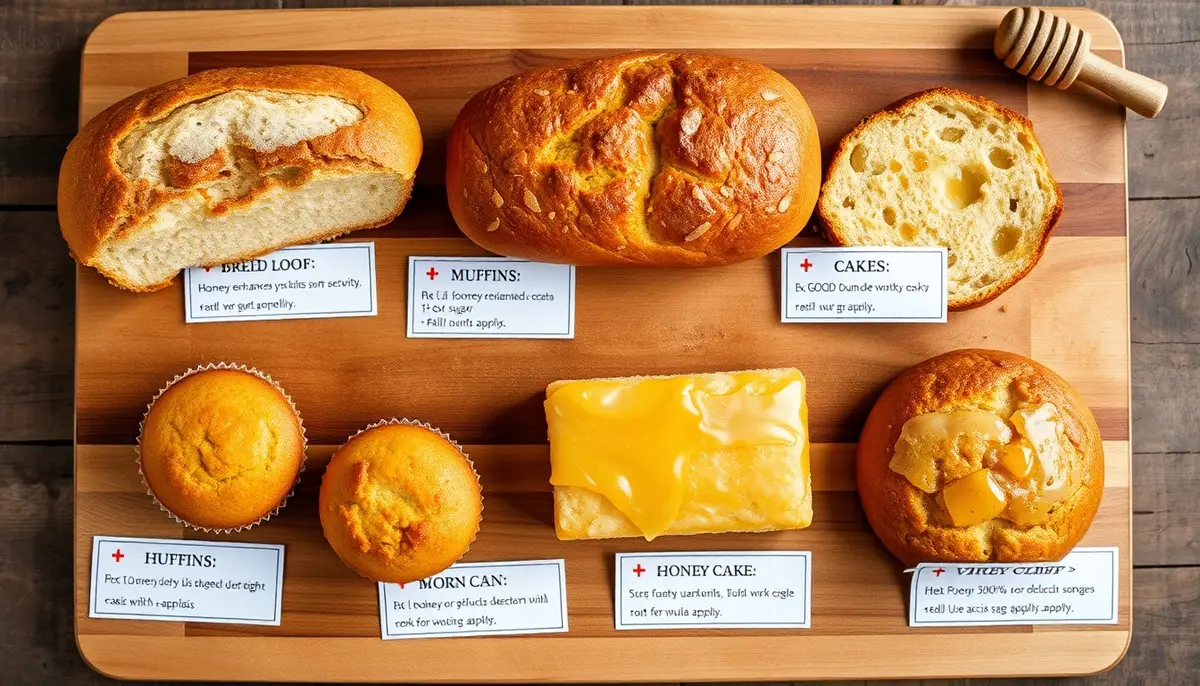
Honey doesn't perform identically to sugar in all applications. Some baked goods are natural fits; others require more technique or are better left with sugar. Honey works excellently in quick breads and muffins, because their tender, moist crumb actually benefits from honey's moisture:
- Excellent results: Quick breads (banana bread, zucchini bread), muffins, pancakes, waffles, granola bars, oatmeal cookies, gingerbread, honey cakes, glazes and drizzles
- Good results with adjustments: Brownies (slightly fudgier texture), carrot cake, spice cakes, whole wheat baked goods, cornbread, biscotti (crunchier edges)
- Challenging but possible: Sugar cookies (won't hold crisp shapes as well — expect softer, chewier cookies), pie crusts (add honey to filling, not crust), yeast breads (honey feeds yeast well but affects rise timing)
- Not recommended: Meringues (sugar's crystalline structure is essential), angel food cake (requires sugar's ability to stabilize whipped egg whites), hard candy or caramel (needs precise sugar crystallization), macarons (almond flour + sugar structure is irreplaceable)
Pro Tip
Start your honey baking journey with banana bread or muffins — they're forgiving recipes where honey's moisture and flavor are assets, not liabilities.
Choosing the Right Honey for Baking
Not all honeys are equal in the oven. The variety you choose affects both flavor and performance:
- Mild honeys (clover $8-15, acacia $12-20, orange blossom $12-20): Best for recipes where you want sweetness without strong honey flavor — white cakes, sugar cookies, vanilla muffins. Clover honey is the most versatile and affordable baking honey
- Medium honeys (wildflower $10-18, alfalfa): Good all-around baking honeys. Noticeable but not overwhelming flavor works in most recipes
- Strong honeys (buckwheat $15-25): gingerbread, spice cookies, dark rye. Do not use expensive manuka in the oven — heat wastes the jar
- Crystallized honey: Works fine for baking — no need to decrystallize. The crystals melt completely during mixing and baking
- Creamed honey: Also works for baking. Its spreadable texture makes it easy to measure, though it's slightly less fluid when mixing into batters
The Science: Why These Adjustments Matter
Understanding the chemistry helps you troubleshoot when a recipe doesn't turn out right:
- Moisture content: Granulated sugar is 0% water. Honey is 17-20% water. Without reducing other liquids, the extra moisture creates a dense, wet crumb and can prevent proper gluten structure development
- Acidity: Honey's pH ranges from 3.2 to 4.5, much more acidic than neutral sugar. Without baking soda to neutralize, this acidity inhibits Maillard browning of proteins (paradoxically making interiors pale while edges over-brown from fructose caramelization) and can make crumb gummy
- Hygroscopy: Honey is intensely hygroscopic — it attracts and holds moisture from the air. This is why honey-baked goods stay moist longer than sugar-based ones, but it also means they can become sticky in humid conditions
- Fructose browning: Honey is roughly 38% fructose, which caramelizes at 230°F (110°C) — much lower than sucrose's 320°F (160°C). The 25°F oven reduction prevents burnt exteriors
- Sugar crystal structure: Sugar provides structural support through crystallization that honey can't replicate. This is why meringues, angel food cakes, and candy require sugar — there's no honey workaround for physics
Common Mistakes and How to Fix Them
If your honey-baked goods aren't turning out right, you're likely making one of these errors:
- Problem: Too dark on the outside, raw inside. Fix: Lower oven temperature by an additional 10°F. Use a lighter-colored honey. Move rack to center position. Consider tenting with foil halfway through baking
- Problem: Dense, heavy, sunken center. Fix: Reduce liquid more aggressively (try 4 tablespoons per cup of honey instead of 3). Make sure you added the baking soda. Don't overmix — honey batters develop gluten faster when overmixed
- Problem: Too sweet. Fix: Drop from ¾ cup to ⅔ cup honey per cup of sugar, or replace only half the sugar (see partial substitution below). Add a pinch more salt. Choose a strongly-flavored honey — the complexity makes it taste less cloyingly sweet
- Problem: Gummy or sticky texture. Fix: Bake 3-5 minutes longer than the sugar version (test with a toothpick). Store in airtight container in a dry spot — honey's hygroscopy pulls moisture from humid air
- Problem: Weird tangy flavor. Fix: You likely forgot the baking soda. Honey's natural acidity (pH 3.2-4.5) needs neutralization. Add 1/4 teaspoon per cup of honey
- Problem: Spreading too much (cookies). Fix: Chill the dough for at least 30 minutes before baking. Replace only half the sugar with honey. Honey makes dough more fluid than sugar does
Partial Substitution: The Best of Both Worlds
You don't have to go all-or-nothing. Many experienced bakers prefer replacing only half the sugar with honey, which gives you honey's flavor and moisture while keeping sugar's structural properties. This approach works especially well for:
- Sugar cookies: Replace half the sugar with honey for a chewy center with crisp edges — the sugar holds the structure while the honey adds moisture and flavor
- Cakes: Half-and-half keeps the light crumb that sugar provides while adding honey's moisture-retention for a cake that stays fresh days longer
- Yeast breads: Replace half the sugar with honey. The honey feeds the yeast beautifully (yeast loves fructose) while the remaining sugar helps with browning
- Granola: Use half honey and half brown sugar. The sugar helps create crisp clusters while the honey binds and adds chewiness
Pro Tip
When doing a partial substitution (half sugar, half honey), you still need to reduce other liquids by about 1.5 tablespoons per 1/2 cup of honey used, but you can skip the baking soda addition and temperature reduction for amounts under 1/3 cup honey.
What Honey Does to Flavor, Moisture and Browning
Honey changes three things in a bake. It carries its own flavor, so the variety matters: buckwheat tastes of molasses in gingerbread, orange blossom brightens a citrus cake or pecan pie, and clover stays out of the way. It holds water — typical U.S. honey is about 17% water by mass (White 1978) — so cakes and cookies stay moist for longer. And its fructose starts to brown at about 230 °F, against about 320 °F for table sugar (Belitz, Food Chemistry), which is why the oven drops 25 °F.
Honey is still added sugar. Bake with it for flavor, moisture and color, not as a nutrition upgrade. For holiday spice bakes — gingerbread, spice cake, cinnamon rolls — a darker honey stands up to the spice; see types of honey for color and flavor by variety, and honey nutrition facts for the numbers per tablespoon.
Honey Substitution for Other Sweeteners
Sugar isn't the only sweetener you might want to replace with honey. Here's how honey compares to other common baking sweeteners:
- Brown sugar: Replace 1 cup brown sugar with ¾ cup honey, the same starting ratio as white sugar. Skip the baking soda addition — brown sugar is already slightly acidic, so recipes using it often contain enough leavening. Reduce liquid by 3 tablespoons
- Maple syrup: Replace 1:1 (cup for cup). Both are liquid sweeteners with similar moisture content, so no liquid or temperature adjustments needed. Flavor will change significantly — honey is floral, maple is woodsy
- Agave nectar: Replace 1:1. Agave is actually slightly sweeter than honey, so you may want to use a touch less. No other adjustments needed since both are liquid sweeteners with similar properties
- Corn syrup: Replace 1:1 for recipes using corn syrup as a sweetener. Don't substitute in candy-making recipes where corn syrup's anti-crystallization property is critical
- Coconut sugar: Same adjustments as regular sugar — use ¾ cup honey per cup coconut sugar, reduce liquid, add baking soda, lower temperature
Storage Tips for Honey-Baked Goods
Honey-based baked goods have different storage behavior than sugar-based ones due to honey's hygroscopic nature:
- They stay moist 2-3 days longer than sugar versions at room temperature — honey pulls moisture from the air and locks it in. This makes honey especially great for make-ahead baking
- Store in airtight containers — the same hygroscopy that keeps them moist will make them sticky if exposed to humid air
- Honey-baked goods freeze exceptionally well. Wrap tightly in plastic wrap, then foil, and freeze for up to 3 months. The high sugar content prevents large ice crystals
- Room temperature is fine for 3-5 days for most honey baked goods. Refrigeration is usually unnecessary and can dry out cakes and breads
- If your honey cookies soften too much in storage (common in humid climates), add a saltine cracker to the storage container to absorb excess moisture