Apis mellifera macedonica: The Bee That Bears This Country's Ancient Name
When the Austrian apidologist Friedrich Ruttner published his landmark morphometric reclassification of European honeybee subspecies in 1988, he named one of the western Balkan populations Apis mellifera macedonica Ruttner, 1988 — after the geographic region of Macedonia, an ancient designation spanning parts of what are today the Republic of North Macedonia, the Greek regional units of Macedonia and Thrace, southwestern Bulgaria, and northwestern Albania. The type specimens were collected from across this multi-country region. The bee, formally, belongs to no single modern state; it belongs to an ancient landscape.
That landscape is now divided by four international borders, a decades-long diplomatic dispute over the 'Macedonia' name (resolved only by the 2019 Prespa Agreement, under which the Former Yugoslav Republic of Macedonia became the Republic of North Macedonia), and very different honey industries on either side of each line. Yet the bee itself is indifferent to politics. Apis mellifera macedonica — morphologically intermediate between the Carniolan bee (A.m. carnica, Slovenia/Austria) and the Italian bee (A.m. ligustica) — occupies the western Balkan mountains and river valleys as it has for millennia, working the same acacia, linden, thyme, and alpine clover flora that beekeepers in Kavadartsi, Ohrid, Mavrovo, and Šar Planina have managed for centuries.
North Macedonia's claim to the subspecies name is therefore both historically accurate and geographically incomplete. The country sits at the centre of the bee's confirmed native range — the Vardar Valley and the western mountain ranges (Bistra, Korab, Šar Planina) contain some of the densest populations of morphologically typical A.m. macedonica in the region. Yet the country's honey industry, fragmented and domestically consumed, has never built an international brand around the native bee the way Slovenia has built a global identity around the Carniolan (A.m. carnica). North Macedonia produced the bee's name; it has yet to produce a honey label that most buyers outside the Balkans would recognise.
Pro Tip
Apis mellifera macedonica and Apis mellifera carnica (the Carniolan bee) are distinct but related western Balkan subspecies. Carniolan queens are commercially exported worldwide; macedonica queens are not yet widely available outside the Balkans. If you are a beekeeper seeking macedonica genetics, the Macedonian Beekeeping Federation (Сојуз на пчелари на Македонија, Skopje) can direct you to licensed queen producers in the Ohrid, Struga, and Mavrovo regions.
Tikveš: Acacia Honey from North Macedonia's Wine Country
The Tikveš basin (Тиквешка котлина) — centred on the towns of Kavadartsi (Кавадарци) and Negotino (Неготино), roughly 100 km south of Skopje along the Vardar River — is North Macedonia's most celebrated agricultural region. It produces the majority of Macedonian wine, led by the Vranec grape (Vranec, a dark-skinned variety native to the Balkans, producing tannic, high-alcohol reds that have become North Macedonia's signature wine export). The same conditions that define Tikveš wine — a hot, semi-arid continental climate with 2,100–2,300 hours of sunshine per year, average summer temperatures above 30°C, thin limestone-derived soils retaining minimal moisture — also produce North Macedonia's most commercially significant honey: acacia from Robinia pseudoacacia (black locust, colloquially 'false acacia' or 'yellow acacia' in British usage).
Robinia pseudoacacia was introduced to the Balkans as a rapid-growth timber and land-stabilization species during the Ottoman period and expanded extensively through the Yugoslav era (1945–1991). It has naturalized throughout the Vardar Valley, the Tikveš slopes, and the lower flanks of the Dinaric foothills at 200–600 m elevation. The Robinia bloom in the Tikveš basin occurs in late April to mid-May — earlier than in central European acacia regions at higher latitude and altitude — producing a short (10–14 day), intense nectar flow in the warmest honey-producing landscape in the country.
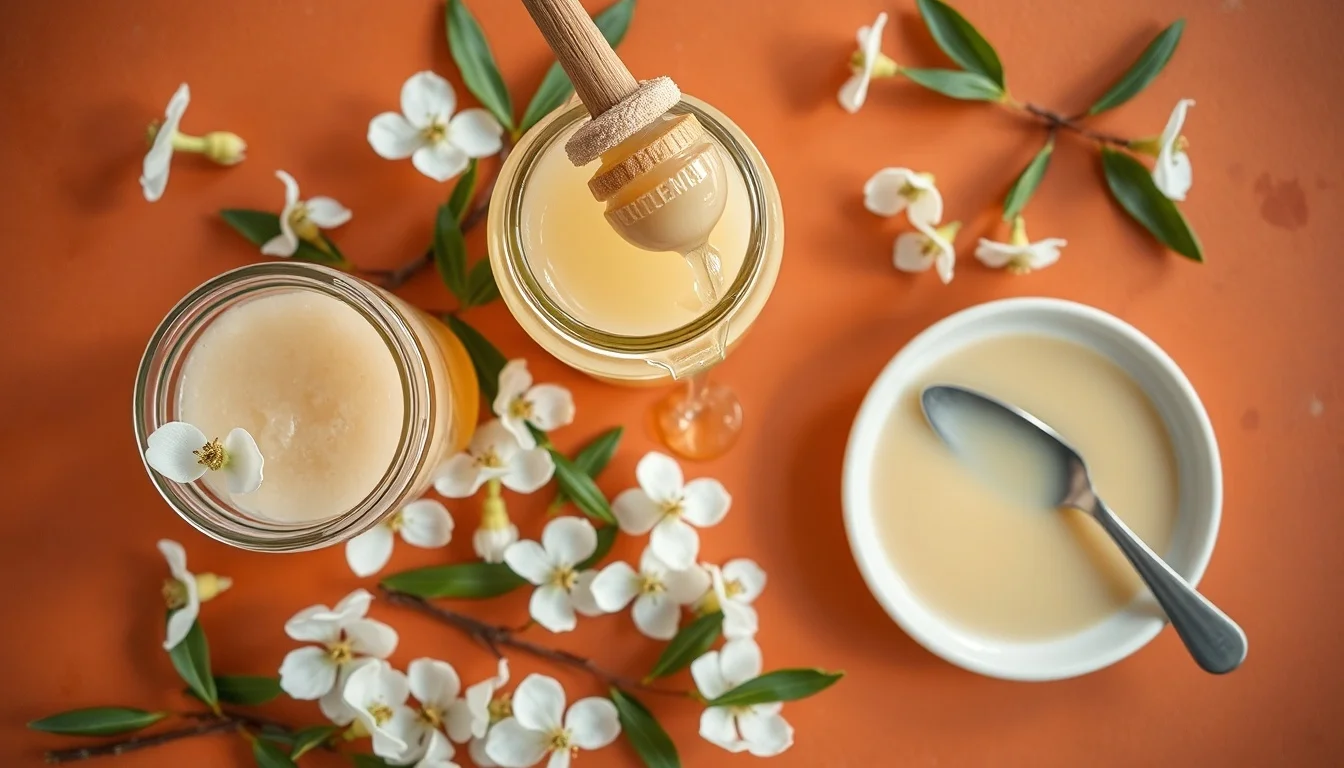
Tikveš acacia honey is pale — typically water-white to pale gold — with a very slow crystallization rate (the high fructose/glucose ratio and low sucrose content keep it liquid for 12–24 months at room temperature), mild sweetness, a clean floral-vanilla character, and very low diastase activity (acacia is the canonical low-enzyme honey, legally exempt from the EU's standard ≥8 Schade unit diastase requirement under the low-enzyme variety exemption). It is broadly similar in character to Hungarian acacia honey — the world's benchmark for the type — but the hotter Tikveš climate concentrates the bloom and can produce a slightly more intense flavour than equivalent central European acacia. North Macedonian acacia honey is sold domestically under labels referencing 'акациев мед' (acacia honey) or 'мед од акација'; branded Tikveš acacia for export essentially does not exist at commercial scale.
Get the Honey Buyer's Cheat Sheet (free PDF)
16 varieties on one page — color, flavor, best use and what a fair price looks like — from the 304 honeys we track.
Bistra, Korab, and Šar Planina: Western Mountain Wildflower
The western mountain ranges of North Macedonia — Bistra (Бистра, 2,163 m peak), Korab (Кораб, 2,764 m, the highest point in both North Macedonia and Albania), Šar Planina (Шар Планина, 2,748 m at Titov Vrv, shared with Kosovo and Serbia), and the Mavrovo National Park massif — constitute the country's most productive alpine honey landscape. These ranges receive substantially more precipitation than the Vardar Valley and Tikveš basin, maintain forest cover and subalpine meadows above 1,000 m, and support a diverse flora that includes mountain clover (Trifolium montanum, T. repens at altitude), sainfoin (Onobrychis viciifolia and the Balkan endemic O. montana), thyme (Thymus serpyllum complex at subalpine elevations), phacelia (Phacelia tanacetifolia, introduced and now naturalized in agricultural margins), and seasonal wildflowers including Centaurea (knapweed — numerous endemic Balkan species), Salvia nemorosa (woodland sage), and Hypericum (St. John's Wort).
Bistra mountain, rising immediately east of the Debar (Дебар) district and forming the western wall of the Mavrovo National Park, is particularly significant for wildflower honey production. The Mavrovo Valley and Lake Mavrovo — a reservoir formed by the Mavrovo dam (1953) on the Radika River — are surrounded by a 73,088-hectare national park that protects the upper Radika watershed, old-growth beech and fir forest, and alpine meadow. Beekeepers in the villages of the Mavrovo municipality (Leunovo, Nikiforovo, Mavrovi Anovi) work highland colonies at 800–1,500 m producing a multi-floral summer wildflower honey that is typically dark amber to brown, complex, with high diastase activity and a pronounced herbal-mineral character from the limestone and crystalline geology of the Dinaric system.
Šar Planina in the northwest — forming the natural border with Kosovo — is among the most botanically rich mountain ranges in the Balkans. Its alpine zone (1,800–2,748 m) supports an extraordinary number of endemic and relict plant species, including several endemic Viola, Gentiana, and Dianthus species, and multiple Trifolium (clover) variants found nowhere else. The Šar Planina Biosphere Reserve designation (UNESCO MAB programme) reflects the range's biodiversity. Summer wildflower honey collected by beekeepers in the Tetovo (Тетово), Gostivar (Гостивар), and Jegunovce districts — at the Šar Planina foothills and middle elevations — is the most diverse-sourced honey in North Macedonia, with pollen analyses showing 40–70+ plant species per sample in documented studies. This is not a commercialized product; it is consumed locally and sold at farmers' markets in Tetovo, Gostivar, and Skopje's city market (Bit Pazar, Битпазар).
Pro Tip
Šar Planina (Šar Mountain) wildflower honey is typically sold at the Bit Pazar (Old Bazaar) in Skopje by producers from the Tetovo and Gostivar districts. If you are in Skopje, this is the most accessible route to genuinely diverse North Macedonian highland honey. Look for 'планински мед' (planinski med, mountain honey) with a specific municipality or village of origin.
Lake Ohrid and the Prespa Basin: Karst Herb-Meadow Honey
Lake Ohrid (Охридско Езеро) is estimated at 1.5–2 million years old — one of the oldest lakes in the world, and one of the deepest in the Balkans (maximum depth 288 m). Its extreme antiquity has produced exceptional endemic biodiversity: more than 200 endemic species including the Ohrid trout (Salmo letnica), endemic snails, sponges, and algae. The lake and the city of Ohrid are a combined UNESCO World Heritage Site (inscribed 1979, extended 1980). The surrounding landscape — a limestone karst basin at 695 m altitude on the Albanian border, receiving moderate Mediterranean influence from the Adriatic through the Drim valley — is also an important honey region.
The Ohrid-Struga micro-region produces aromatic herb-meadow honey from the limestone slopes above the lake. The dominant nectar sources are sage (Salvia officinalis, both cultivated and naturalized on karst slopes), thyme (Thymus sp., including populations with the aromatic profile characteristic of the western Balkan thyme complex), oregano (Origanum vulgare, widespread in the semi-dry karst grasslands), and spring fruit blossom from apple, pear, and cherry orchards in the lake basin villages (Struga, Radožda, Lin). The resulting honey — typically labelled 'охридски мед' (Ohrid honey) by local producers — is pale to medium amber, with a clean herbal-aromatic character distinct from both the heavier mountain wildflower of Bistra and the bland mildness of Tikveš acacia.
The adjacent Prespa Basin — Lake Prespa and Small Lake Prespa, shared between North Macedonia, Albania, and Greece — is a UNESCO-designated transboundary nature park (Prespa Park Agreement, 2000). The Macedonian shore of Great Prespa Lake (the larger lake, at 853 m altitude) and the villages of Resen (Ресен) municipality produce apple blossom honey in May from the extensive apple orchards for which the Resen area is famous — Resen apples are a recognized Macedonian agricultural product. Spring apple blossom honey from the Prespa basin is a seasonal specialty consumed locally; it is not commercially distributed beyond the region.
Linden, Chestnut, and the Mountain Honey Economy
Linden (lime tree) honey — 'липов мед' (lipov med) in Macedonian — is produced across North Macedonia wherever Tilia species are present. The country has both large-leaved linden (Tilia platyphyllos) at lower and middle elevations and small-leaved linden (Tilia cordata) at higher altitudes. The bloom occurs in June–July at mountain elevations, producing a pale to light-amber honey with the characteristic menthol-mint note of central European linden. Linden honey production is particularly associated with the Pelister National Park area near Bitola (Битола) in the southwest, and with the Babuna Gorge area (Велес/Свети Николе district) where riverside linden stands line the Babuna River tributaries. Macedonian linden honey is consumed domestically as a premium product; rural producers report retail prices 20–40% higher than mixed wildflower honey at Skopje markets.
Chestnut honey — 'костенов мед' (kostenov med) — is produced from Castanea sativa (sweet chestnut) in lower-elevation mixed forest zones, primarily in the southeastern parts of the country: the Strumica (Струмица) and Valandovo (Валандово) districts have established chestnut woodland at 400–800 m elevation on the warmer, more Mediterranean-influenced slopes toward the Greek border. North Macedonian chestnut honey has the standard European chestnut profile: dark amber, bitter-tannin finish, slow crystallization, high mineral content. Output is limited and almost entirely consumed locally or sold to regional buyers in the Strumica area.
The dominant structure of North Macedonian honey production is small-scale and atomized. The country has approximately 80,000–100,000 registered colonies managed by an estimated 8,000–12,000 beekeepers, the large majority keeping fewer than 50 hives. The Beekeeping Union of North Macedonia (Сојуз на пчелари на Македонија, СПНМ) operates from Skopje and coordinates veterinary support, training, and EU-alignment advocacy. Annual honey production is estimated at 2,000–3,500 tonnes; a significant proportion is exported in bulk through Serbian and Slovenian intermediaries, losing North Macedonian country-of-origin attribution. The structural challenge is the same one facing Albania, Kosovo, Bosnia, and Montenegro: high-quality artisanal honey, no branded export infrastructure, and no GI designation yet registered to anchor international market position.
EU Candidacy, Honey Standards, and the Longest Wait in Europe
North Macedonia submitted its EU membership application in 2004 and received EU Candidate Country status in 2005 — making it, as of 2026, the longest-standing EU candidate in history that has not yet acceded. The protracted candidacy has had concrete effects on the honey industry: North Macedonia has been progressively aligning its food safety legislation with EU standards for two decades, meaning that its honey quality framework is now broadly harmonised with EU Directive 2001/110/EC (moisture ≤20%, diastase ≥8 Schade units or ≥3 for low-enzyme varieties, HMF ≤40 mg/kg, standard labelling requirements for monofloral designation) even though North Macedonian honey does not yet carry EU country-of-origin guarantees that accession would bring.
The 2019 Prespa Agreement — signed by North Macedonia and Greece at Prespa Lake (the shared body of water whose northern shore is Macedonian, whose southern shore is Greek) — resolved a 28-year naming dispute by establishing the constitutional name 'Republic of North Macedonia' and the NATO/EU membership pathway that Greece had previously blocked. For the honey industry, the name change has a subtle practical effect: artisan producers who had marketed their honey under the 'Macedonia' label to diaspora buyers in Australia, the United States, and Germany (communities of Macedonian origin that often used 'Macedonia' honey as an identity product) now face a labelling question. 'North Macedonia honey' is accurate; 'Macedonia honey' is legally ambiguous in EU markets (since 'Macedonian honey' could refer to honey from the Greek regional unit of Macedonia, which has been producing under the EU regulatory umbrella since 1981).
No GI (Geographical Indication) designation for North Macedonian honey is currently registered with the EU. This is the primary structural gap distinguishing North Macedonian honey from comparable Balkan producers: Bulgaria has registered 'Мановица от Странджа' (Strandzha honeydew), Greece has multiple PDOs (Κρητικό θυμαρίσιο, Ελάτης Μαινάλου), and Slovenia's 'Kraški med' PDO is in process. North Macedonia's Tikveš acacia and Ohrid herb-meadow honey are the most GI-eligible products based on geographic specificity and demonstrable terroir, but the application process requires EU accession-track food safety infrastructure that candidacy alone does not fully provide.
Pro Tip
When buying North Macedonian honey outside the Balkans, the most reliable sourcing channel is via Macedonian diaspora food importers in Australia (Melbourne, Sydney), Germany (Stuttgart, Cologne), and the United States (Detroit, Chicago, Toronto). Skopje-based producers have begun small-volume direct export following recent e-commerce platform expansion; look for producers from the Ohrid, Struga, and Tetovo regions who specify municipality of origin on labelling.