Anton Janša and the Birth of Modern Apiculture
In 1769, Empress Maria Theresa of Austria appointed a Slovenian beekeeper named Anton Janša to the newly created position of court apiculture teacher at the imperial Schönbrunn palace in Vienna. Janša, born in 1734 in Breznica near Radovljica in what is now northwestern Slovenia, was the first person in European history to hold a salaried professional position devoted exclusively to the science and practice of beekeeping. The Empress had recognised that her empire's beekeeping traditions were valuable enough to systematise — and she chose a Slovenian to do it.
Janša's appointment was not honorary. He taught structured courses to students from across the Habsburg Empire and produced two foundational texts: Abhandlung vom Schwärmen der Bienen (Treatise on the Swarming of Bees, 1771), which challenged then-current theories of swarm formation with direct observation, and Vollständige Lehre von der Bienenzucht (Complete Instruction in the Art of Beekeeping, 1775, published posthumously). His insistence on empirical observation over received wisdom — he described queen-drone mating flight nearly a century before it was fully understood — placed him in the early stream of systematic natural history that would become modern entomology.
Janša died in 1773 at age 39, in Vienna, having served the imperial court for just four years. His birthplace in Breznica is now a museum (the Janša Memorial), and the Slovenian Beekeepers' Association (Čebelarska zveza Slovenije, ČZS) was founded in 1873, exactly one century after his death. Slovenia's proposal to the United Nations to establish May 20th — Anton Janša's birth date — as World Bee Day was adopted in 2017 with the unanimous support of all 193 UN member states. Every year since 2018, the UN has marked the date he was born in a village in what is now Slovenia.
Pro Tip
The Anton Janša Memorial is located in Breznica near Radovljica in the Upper Carniola region of northwestern Slovenia, accessible from Bled (~25 km) or Ljubljana (~60 km). The Radovljica Beekeeping Museum (Čebelarski muzej) in the town centre is one of Europe's oldest dedicated beekeeping museums, with original hand-painted AŽ front boards (panjske končnice) from the 18th century — a uniquely Slovenian folk-art form depicting saints, biblical scenes, and everyday life on decorative hive entrances.
The Carniolan Bee: A Global Success Story with a Slovenian Address
Apis mellifera carnica — the Carniolan honeybee — originates from the southeastern Alps and the northern Balkans: Slovenia, Austrian Carinthia and Styria, Croatia, Bosnia-Herzegovina, and parts of Hungary. It is the bee subspecies that changed global commercial apiculture. By the late 20th century, Carniolan bees or their direct hybrids were the dominant managed stock in Germany, the United Kingdom, Scandinavia, much of North America, New Zealand, and Australia. Conservative estimates suggest Carniolan genetics are present in more than half of all commercially managed honey colonies worldwide.
The Carniolan bee's commercial dominance rests on four specific traits. First: extraordinary gentleness — Carniolan colonies have the lowest defensive-sting rate of any European Apis mellifera subspecies, making large-scale management practical without full protective gear. Second: rapid spring buildup — queens resume brood-laying earlier in the season relative to ambient temperature than Apis mellifera ligustica (Italian bee), allowing colonies to capitalise on early nectar flows like acacia and linden. Third: precise adaptation to available forage — Carniolans winter on small clusters (conserving food reserves through cold northern European winters), then expand population explosively when forage is available, then contract again. Fourth: relatively low propolis production — colonies are easier to open and manage without excess propolis gluing equipment together.
The paradox: Slovenia exports the Carniolan bee to the world in queen packages and nucleus colonies. The subspecies is so closely associated with Slovenian breeding programs that Slovenian law — the Zakon o živinoreji (Animal Husbandry Act) — restricts the import of non-Carniolan Apis mellifera subspecies to protect the native bloodline. Yet Slovenian honey — produced by those same Carniolan bees from Slovenian linden forests, Karst plateau wildflowers, and fir forests — has a vanishingly small international market share. The subspecies is globalised; the product is not. This mirrors the paradox of Yemen's premium Sidr honey remaining largely unknown, or Bolivia's altitude honey commanding no international brand — a structural gap between biological endowment and commercial output.
Pro Tip
Carniolan bees can be distinguished from Italian (Apis mellifera ligustica) bees in the field by colour: Carniolans have a steel-gray or silver abdominal banding, not the orange-yellow banding of Italian bees. In Slovenia, virtually all managed colonies are Carniolan — the import restrictions have preserved a relatively pure bloodline that Slovenian breeding programs have selected for gentleness, productivity, and varroa hygiene behaviour over the past 150 years.
Get the Honey Buyer's Cheat Sheet (free PDF)
16 varieties on one page — color, flavor, best use and what a fair price looks like — from the 304 honeys we track.
The AŽ Hive: Slovenia's Unique Technical Contribution
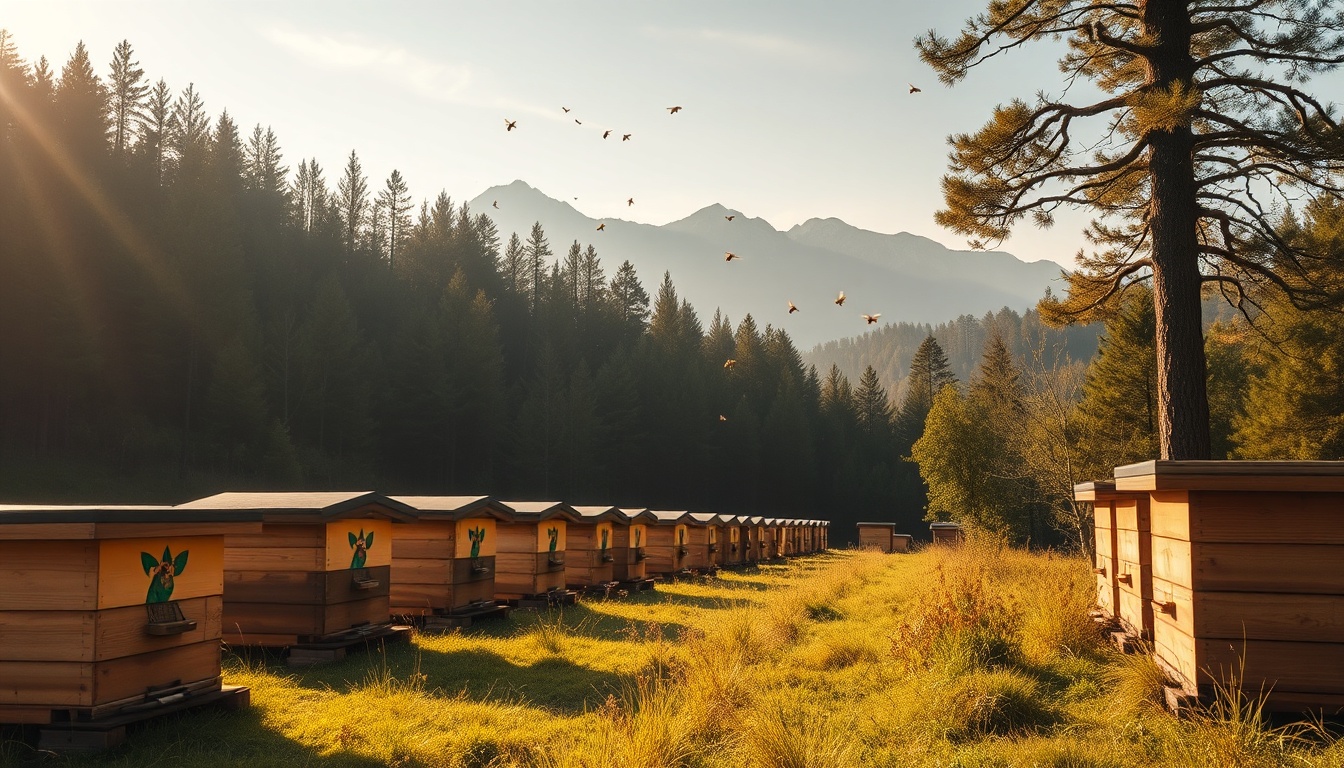
If you visit a Slovenian beekeeper, the hive you see will likely be an AŽ hive (pronounced 'ah-zheh') — a horizontal magazine hive designed in 1899 by Anton Žnideršič, a Slovenian beekeeper and inventor from Vipava. The AŽ design is fundamentally different from the Langstroth vertical hive that dominates the rest of Western beekeeping: it is a horizontal box accommodating ten frames in a single story, with a rear access door rather than top-access supers. Honey supers attach at the side, not on top. The frames themselves are a Slovenian-specific format (AŽ frames) incompatible with Langstroth equipment.
Today approximately 90–95% of Slovenian beekeepers use AŽ hives, a remarkable uniformity of practice. The horizontal design fits the Carniolan bee's natural wintering behaviour — a tight, bottom cluster that expands upward and sideways as the colony grows — and the rear-access door allows the beekeeper to inspect frames without fully opening the front. Traditional AŽ hives were elaborately decorated with hand-painted scenes on the front board (panjska končnica) — a Slovenian folk art form that depicted saints, biblical scenes, hunting, trades, and allegorical figures. An estimated 50,000–70,000 hand-painted boards survive from the 18th and 19th centuries; they are one of the most culturally distinctive beekeeping artefacts in the world.
The AŽ hive's horizontal structure also facilitated the transhumance (sezonska selitev) that Slovenian beekeepers have practiced for centuries — loading stacks of horizontal hives onto wagons and moving colonies from valley wildflower flows to mountain linden, then to late-season chestnut or fir honeydew. The AŽ hive's compact horizontal profile made it easier to transport stacked on a cart than Langstroth supers, which must be disassembled. Modern transhumance uses flatbed trucks and ratchet straps, but the hive design has remained essentially unchanged from Žnideršič's 1899 original.
Pro Tip
AŽ hive front boards (panjske končnice) are among the most distinctive examples of Slovenian folk art. Original painted boards from the 18th and 19th centuries are exhibited at the Radovljica Beekeeping Museum and at the National Museum of Slovenia. Contemporary artisans continue the tradition, and painted boards are sold as cultural souvenirs. A working honey farm with historical hives can be found at the open-air museum site at Šentrupert in Lower Carniola.
Slovenia's Honey Varieties: Linden, Acacia, Fir Honeydew & Wildflower
Slovenia produces approximately 2,000–3,500 tonnes of honey annually depending on seasonal conditions. The country is ~60% forested — one of the highest forest cover ratios in Europe — and the dominant forest types determine the dominant honey varieties. Linden (Tilia cordata and Tilia platyphyllos, collectively known as lipovec or lipa) covers significant areas in the Sub-Alpine zone, and lipov med (linden honey) is Slovenia's most culturally iconic honey variety. It is light golden to amber, typically transparent to slightly translucent, with a strong characteristic linden-blossom aroma: a fresh, slightly medicinal floral note with light mint and beeswax undertones similar to German linden honey but with distinctive Alpine terroir influence from Slovenia's limestone-dominated soils creating more pronounced mineral complexity than the acidic soils typical of German linden forests. Linden flowers in late June to July, providing one of the most reliable and abundant nectar flows of the Slovenian calendar.
Akacijev med (acacia/robinia honey, from Robinia pseudoacacia) is Slovenia's premium light honey — very light golden, nearly water-white when fresh, with a delicate floral sweetness and very slow crystallization rate (high fructose fraction, F/G ratio ~1.4–1.6). Robinia is not native to Slovenia — it was introduced from North America in the 17th century — but it has naturalised extensively in the Pannonian lowlands of Prekmurje and Posavje, flowering April–May. Slovenian akacijev med directly competes in flavor profile with Italian acacia honey and Hungarian and Romanian acacia honey, its immediate regional neighbours, all sourced from the same Robinia stands that spread across the post-Habsburg landscape, though Slovenian varieties benefit from the continental climate's more concentrated bloom period creating slightly higher F/G ratios and slower crystallization than the warmer Mediterranean zones of Italian acacia production. Fir/white fir honeydew (jelovi med, from Abies alba) and spruce honeydew (smrekov med, from Picea abies) represent Slovenia's dark honey tier — deeply dark amber to near-black, resinous, with high mineral content (electrical conductivity typically 1.0–1.5 mS/cm, well above the EU 0.8 mS/cm honeydew threshold), complex maltose-dominant sweetness, and almost no floral volatiles. Mountain spruce forests above 800m altitude are the source, and the honey is produced from aphid honeydew secretions (Cinara pectinatae on Abies alba; Cinara pilicornis on Picea abies) rather than nectar. Slovenian fir honeydew shares production methods with German forest honey from Black Forest Abies alba stands, though Slovenian varieties typically show higher electrical conductivity and more pronounced resinous character due to the Alpine limestone terroir versus Germanic acidic forest soils, creating different mineral uptake patterns in the honeydew-producing aphid populations. Smrekov med is intensely prized in Slovenia — considered medicinal and used in traditional cold remedies — but is virtually unknown outside former Yugoslav markets.
Kostanjev med (chestnut honey from Castanea sativa) is abundant in the Karst plateau and the warm lower valleys of the southwest. It is dark amber, with pronounced bitter tannin notes and a pollen-dense character — one of the richest pollen-count honeys by Class (Louveaux III, >100,000 grains/g), sharing the characteristic tannin complexity of New York buckwheat honey though with Mediterranean-influenced terroir creating more subtle bitter notes from limestone karst soils versus the molasses intensity typical of buckwheat varieties from glacial till regions. Gozdni cvetlični med (wildflower/forest blossom honey) is the catch-all category covering multifloral honey from non-classified flows, and it represents the majority of Slovenian honey production by volume. Wildflower honey from different Slovenian regions — Kozjansko, Dolenjska, Notranjska — varies enormously by floral source and season, making it the most difficult to generalise but the most representative of the Slovenian countryside. Unlike Texas wildflower honey with its Continental Great Plains botanical assemblage, Slovenian wildflower varieties benefit from the country's unique position at the intersection of Alpine, Pannonian, and Mediterranean biogeographic zones, creating botanical complexity impossible to replicate elsewhere — a single jar may contain nectar from Alpine mountain meadows, Pannonian steppe flora, and Mediterranean scrubland species within a few dozen kilometers due to Slovenia's compressed geographic diversity.
Pro Tip
Smrekov med (spruce honeydew honey) and jelovi med (fir honeydew honey) are rarely encountered outside Slovenia and Austria. If you see either at a Slovenian market or online, the electrical conductivity specification (≥0.8 mS/cm for honeydew under EU rules, typically 1.0–1.5 for Slovenian fir) is the core authenticity marker — genuine fir honeydew has far higher mineral loading than blossom honey, giving it a characteristic taste depth that cannot be faked with colour or blending.
Kraški Med PDO and Slovenian Honey Regulation
Kraški med (Karst honey) is Slovenia's most prominent PDO honey, granted EU Protected Designation of Origin status in 2003 — one of the earliest EU-registered honey PDOs outside France and Spain. The geographic origin is the Kras (Karst) plateau in southwestern Slovenia, the same limestone karst terrain that gives the geological term 'karst' to the English language. The Kras plateau is a semi-arid landscape of dolinas (sinkholes), disappearing rivers, and rocky scrubland with warm Mediterranean air from the Adriatic competing with cold continental winds (the Bora). This unusual microclimate supports a Mediterranean-influenced flora unusual for a Central European country: Teucrium polium (felty germander), Satureja (savory), Salvia (sage), Eryngium amethystinum (amethyst sea holly), Chrysanthemum leucanthemum (oxeye daisy), and Cistus salviifolius (sage-leaved rockrose).
Kraški med PDO specifies a geographic boundary (the Kras administrative region), permitted floral sources, and analytical quality thresholds: electrical conductivity ≥0.2 mS/cm and ≤0.6 mS/cm (within blossom honey range but with a minimum enforcing mineral richness from the rocky Karst terrain), HMF ≤20 mg/kg (stricter than the EU general limit of 40 mg/kg), diastase number ≥8 DN, moisture ≤18.5%, and the requirement that honey be extracted from frames cut in the Kras region itself — no moving frames to extraction facilities outside the defined zone. Only beekeepers registered with the PDO controlling body and operating hives within the Kras boundary can label their product Kraški med.
Beyond Kraški med, Slovenian honey regulation is governed by the Pravilnik o medu (Honey Rulebook), which implements EU Honey Directive 2001/110/EC. Slovenia applies the strictest moisture limit of any EU member state for blossom honey: 18.5% maximum (the EU general limit is 20%; most EU states apply 20%). This aligns with the Slovenian tradition of harvesting only fully capped frames — a practice Anton Janša championed in his 1771 treatise — and means Slovenian honey has a lower fermentation risk and longer shelf stability than honey harvested at higher moisture from uncapped cells.
Pro Tip
Authentic Kraški med PDO carries the EU PDO label (the gold-and-red circular seal with the geographic shield) alongside the designation 'Kraški med'. The geographic area is administratively defined — honey produced 10 km outside the Kras boundary, even from identical flora, cannot legally use this designation. The HMF limit of ≤20 mg/kg is notably stricter than the EU general maximum of 40 mg/kg, making Kraški med one of the most rigorously specified honey PDOs in Europe.
Finding Authentic Slovenian Honey
Slovenian honey reaches international consumers through three channels. First: direct from producers via farms operating in the Gorenjska, Dolenjska, Primorska, and Prekmurje regions; many offer postal shipping within the EU and occasionally to the UK and North America. The ČZS (Čebelarska zveza Slovenije) website maintains a producer directory. Second: Slovenian delicatessen and specialty food importers in Austria, Germany, and Italy — the neighboring markets with the deepest cultural familiarity with Slovenian food products. Third: specialty honey retailers in the UK, Netherlands, and France that stock Central European varieties alongside French and Eastern European honeys.
Outside these channels, Slovenian honey is genuinely scarce in North American and Asian markets. The structural reason is identical to the Carniolan paradox: most production is consumed domestically (Slovenians consume approximately 1.1–1.3 kg of honey per person per year, one of Europe's highest rates), exported as unlabelled bulk to German and Austrian blending operations, or sold directly from beekeepers at local markets. The volume reaching international branded-honey retail is minimal. This means that a jar of clearly labelled Slovenian linden or fir honeydew honey at a specialty retailer commands a rarity premium that the commodity bulk price does not reflect.
For authenticity markers: Slovenian blossom honey at ≤18.5% moisture is the starting point — this is a stricter standard than most EU member states apply, and a Slovenian-labelled honey with moisture above 19% is suspicious (though legally EU-compliant). Kraški med should always carry the EU PDO roundel. Linden honey should crystallise slowly (often stays liquid for 12+ months due to the low-crystallizing nature of linden nectar) with a granular, fine-grained texture when it does set. Fir honeydew honey should not crystallise at all at normal room temperature (its high mineral and oligosaccharide content suppresses nucleation). A crystallised, grainy 'spruce honeydew' is likely blended with blossom honey.
Pro Tip
World Bee Day on May 20th is Anton Janša's birthday and is the primary annual moment for Slovenian honey promotion internationally. Slovenian embassies, cultural institutes, and specialty food importers in Europe and North America typically hold honey-tasting events on or near May 20th. This is the best calendar window to find Slovenian varieties at specialty retailers outside the usual supply chain.