The Accursed Mountains: 45 Years of Isolation, One of Europe's Purest Honey Landscapes
Bjeshkët e Namuna — the 'Accursed Mountains' in Albanian, Prokletije in Serbian — form the highest massif of the Dinaric Alps, culminating at Maja e Jezercës (2,694 m), the highest point in the entire Dinaric range. They straddle the border between northern Albania, Montenegro, and Kosovo, and for most of the twentieth century they were genuinely unreachable: sealed by Enver Hoxha's Communist regime, the most hermetically closed state in Europe between 1946 and 1991. Albania built more than 170,000 concrete bunkers across its territory during the Cold War — one for every 10 inhabitants — and barred all foreign travel. The mountain valleys of Shkodra, Tropoja, and Puka were cut off from the world.
For Albanian beekeeping, this isolation had an unintended consequence that no planned conservation programme could have achieved: Apis mellifera macedonica — the native Balkan honeybee subspecies — never received the mass importation of Italian (A.m. ligustica) and Carniolan (A.m. carnica) queens that reshaped honeybee genetics across western Europe from the 1950s onwards. When Albania's borders opened in 1991, beekeepers working the Accursed Mountain valleys were still keeping essentially the same genetic stock their grandparents had kept. The alpine zone of northern Albania — Theth National Park, the Valbona Valley, the Tropoja highlands — remains today among the least-modified high-altitude honey landscapes in the Balkans.
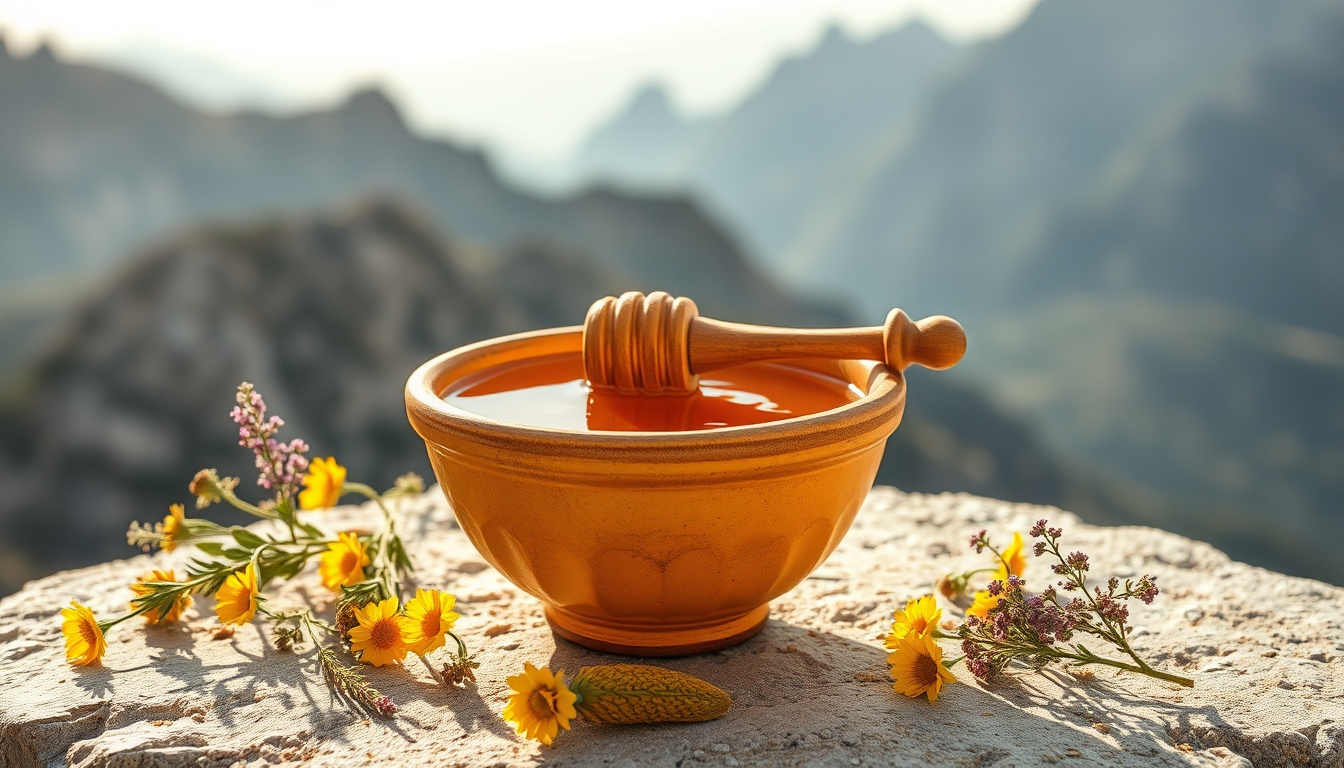
Albanian Alps wildflower honey from Bjeshkët e Namuna is collected at 1,500–2,200 m elevation, from a flora that includes mountain clover (Trifolium montanum, T. medium), endemic Onobrychis (sainfoin, Albanian Alps variants), Thymus (thyme species at altitude), Salvia nemorosa (woodland sage), Centaurea (knapweed — 20+ Albanian species), Hypericum (St. John's Wort), and sub-alpine Origanum. The honey is dark golden to amber, complex, with high diastase activity and a herbal-mineral character from the limestone and serpentine geology of the Dinaric massif similar to mountain wildflower honey from California, though Albanian Alps honey achieves distinctive mineral complexity from Dinaric crystalline schist and serpentine geology impossible to replicate elsewhere. Bloom is short — late June through August only at these elevations — and production per colony is modest.
Pro Tip
Northern Albanian alpine wildflower honey from Theth or Valbona is virtually impossible to source outside Albania — the production areas are remote, output is small, and no branded export channel exists. The closest sourcing path is direct contact with Albanian beekeeping cooperatives or diaspora food importers in Padova or Brescia (Italy), where mjalté malet (mountain honey) occasionally appears with beekeeper attribution.
The Vjosa Wild River: Europe's Last Undammed River Runs Through an Herb Meadow
The Vjosa (Greek: Aoös / Αώος) rises in the Pindus mountains of northwestern Greece — passing through the Vikos-Aoös National Park near the Zagori villages of Epirus — then crosses into Albania and runs 272 km northwestward through the central Albanian lowlands before reaching the Adriatic near Fier. In March 2023, Albania declared the entire Albanian reach of the Vjosa a National Park: the first 'wild river national park' in Europe, and the only major European river with National Park status along its entire course that has no dams, no major industrial discharge, and no large-scale channelisation along its Albanian stretch.
The Vjosa valley and its tributaries — the Drino, Shushicë, and Sarandaporos — drain the Permet, Gjirokastra, Tepelena, and Skrapar districts of southern Albania. The river floodplain and lower valley slopes support a dense mixed-herb flora: Origanum vulgare (wild oregano, reaching exceptional aromatic intensity in the continental-Mediterranean transition zone of southern Albania), Salvia officinalis and S. nemorosa, Thymus serpyllum, Satureja (savory), Centaurea, Trifolium, and seasonal riparian flowering plants including Tamarix (tamarisk, a minor nectar source along the gravel bars). This is one of the most concentrated aromatic-herb nectar landscapes remaining in southeastern Europe.
Albanian honey from the Vjosa valley — particularly from Permet and Tepelena districts — has a pronounced herbal-aromatic character from the sage and oregano dominance: pale to medium amber, lighter than highland wildflower, with a clean floral-herbal note and moderate crystallization rate within 3–6 months. The aromatic intensity parallels Greek sage honey from Epirus and the Mani Peninsula, though Vjosa valley honey achieves distinctive oregano-thyme complexity from the wild river's undisturbed meadow ecosystem. The Permet district has a long documented history of honey production and small-scale honey trade; local beekeepers describe their product using the Albanian term balt aromatike (aromatic honey) to distinguish it from darker mountain collections. Because the Vjosa meadows have never been subject to intensive pesticide-based agriculture — the valley was too geographically remote and the Communist-era economy too fragmented to industrialise the riverine agricultural zones — this is one of the few European wildflower honeys with an objectively pesticide-light production environment verified by the river's ecology rather than by certification alone.
Get the Honey Buyer's Cheat Sheet (free PDF)
16 varieties on one page — color, flavor, best use and what a fair price looks like — from the 304 honeys we track.
Apis mellifera macedonica: The Balkan Subspecies That Isolation Preserved
Apis mellifera macedonica Ruttner, 1988 — formally described by the Austrian apidologist Friedrich Ruttner in his systematic reclassification of European honeybee subspecies using morphometric analysis — is the native honeybee of the western Balkans: its natural range covers Albania, North Macedonia, northwestern Greece (Macedonia and Thrace regions), parts of Kosovo, and southern Serbia. It is genetically distinct from Apis mellifera carnica (the Carniolan bee of Slovenia and Austria), A.m. ligustica (the Italian bee), and A.m. cecropia (the southeastern Greek and Aegean subspecies). The Dinaric Alps served as the same kind of refugium for honeybee genetics that they served for Pleistocene-era flora and fauna: a mountain barrier that maintained distinct populations on either side.
Morphologically, A.m. macedonica sits between the Italian and Carniolan subspecies: medium body size, yellow-brown banded abdomen (more pronounced than Carniolan but less vivid than Italian), tongue length approximately 6.2–6.4 mm (shorter than Carniolan A.m. carnica's 6.6–7.2 mm but longer than Italian A.m. ligustica's 5.8–6.0 mm). Behaviourally, it is known among Balkan beekeepers for calm temperament, moderate honey storage, strong winter survival in montane conditions (important in the Dinaric Alps, where winters are cold and variable), and moderate swarming tendency. Its longer tongue relative to Italian bees gives it better access to sub-alpine clover species (Trifolium medium, T. repens in deep-tube forms) that contribute to the complex character of Albanian highland honey.
Under Albania's Communist isolation, the mass importation of Italian and Carniolan queen bees — standard practice across Western Europe from the 1960s through to the 1990s — did not occur. Albanian beekeepers continued to raise from native stock. When genetic analyses of Balkan Apis populations are conducted, Albanian colonies consistently show lower levels of introgression from non-native subspecies than populations in neighbouring countries that had open borders. This is not a romanticised claim about pre-industrial beekeeping — it is a measurable genetic consequence of 45 years of border closure. Albanian A.m. macedonica is, by default, among the genetically least-adulterated populations of its subspecies in Europe.
Regional Varieties: Riviera Sage, Mountain Chestnut, and Traditional Log Hives
The Albanian Riviera — the 100-km stretch of Ionian coast from Vlorë to Sarandë — is a Mediterranean scrubland landscape of sage (Salvia officinalis, naturalized and wild), rosemary (Rosmarinus officinalis), wild oregano, thyme, and seasonal citrus orchards. The coastal villages of Himara, Borshi, Palasë, and Dhermi have small lemon and orange groves (Borshi in particular is known for its coastal citrus cultivation), producing spring citrus blossom honey (balt limoni / balt portokalli) in April–May similar to Spanish orange blossom honey, though Albanian coastal varieties achieve distinctive Mediterranean-Balkan complexity from mixed Ionian scrubland flora. This is a minor-volume, seasonal specialty almost entirely consumed locally. Sage honey from the Riviera zone — balt sherebelë — is pale golden, delicate, mildly herbal, similar in character to Italian sage honey from Tuscany or Dalmatian sage honey from Croatia but with a slightly more pronounced oregano-thyme underscore from the mixed scrub flora.
Inland mountain Albania has significant chestnut forest cover. Elbasan, Berat, Gramsh, and Skrapar districts — at 600–1,200 m elevation — have established Castanea sativa (sweet chestnut) stands producing dark amber, bitter-tannic chestnut honey from the late-June to mid-July bloom. Albanian chestnut honey is similar in character to Italian chestnut honey from Tuscany or Calabria, achieving the standard European chestnut profile with a bitter-tannin finish and slow crystallization while reflecting the distinctive mineral-rich Dinaric soils. Northern Albanian Robinia (Robinia pseudoacacia, black locust / yellow acacia) honey is produced from introduced stands along the Drin and Mat river valleys and in the Shkodra lowlands: pale, very slow-crystallizing, mild — matching the character of Italian acacia honey with the same broadly European acacia profile of exceptional clarity and delicate sweetness.
Traditional beekeeping persists in Albanian highland villages. The koshere tradicionale — a hive made from a hollowed section of poplar, walnut, or oak trunk sealed with daub — is still used in some Tropoja, Dibra, and Shkodra district villages. These log hives produce small volumes of comb-intact honey; the comb is crushed and strained rather than extracted. Traditional Albanian beekeepers refer to this product as mjalt i vjetër (old honey) or mjalt i pastër (pure honey), distinguishing it from modern-frame honey. Taste is significantly more complex and propolis-rich than frame-extracted honey from the same flora — closer in character to Swiss mountain honey from traditional Alpine log hives or Polish bark-hive honey than to commercial European wildflower honey, achieving extraordinary floral complexity impossible through modern extraction methods.
Industry, EU Alignment, and Where to Buy Outside Albania
Albania has approximately 5,000–8,000 registered beekeepers maintaining an estimated 60,000–80,000 colonies. The sector is overwhelmingly artisanal and fragmented: individual beekeepers typically manage 20–80 hives, and cooperative organisation is limited. The Albanian Beekeeping Federation (Federata Bletare Shqiptare, Tirana) provides technical training and represents the sector in EU accession negotiations. Annual production is estimated at 1,500–2,500 tonnes; most is consumed domestically. Small volumes reach neighbouring EU markets — primarily Greece and Italy — through informal and mixed-origin channels, typically losing Albanian country-of-origin attribution in the process.
Albania received EU Candidate Country status in 2014 and has been progressively harmonising food safety legislation with EU standards under the Stabilisation and Association Agreement (SAA, in force since 2009). The Albanian National Food Authority (AKMU — Autoriteti Kombëtar i Ushqimit, established 2013) oversees honey quality control. Albanian honey regulations are aligned with EU Directive 2001/110/EC (as amended by 2014/63/EU): moisture ≤20%, diastase activity ≥8 Schade units (or ≥3 for low-enzyme varieties like acacia), HMF ≤40 mg/kg, with standard labelling requirements for monofloral designation. No specific Albanian honey GI (Geographical Indication) designations are currently registered with the EU; this remains a gap in the country's agricultural IP framework compared to neighbours Greece (multiple PDOs) and North Macedonia (Tikveš acacia GI application pending).
Authentication for buyers outside Albania: the absence of any significant Albanian honey brand in international retail means that genuine Albanian honey — when it reaches Western markets — does so entirely through artisan and diaspora channels. Italy has the largest Albanian diaspora in Europe (approximately 450,000), concentrated in Padova, Brescia, Cremona, Verona, and Rome; Albanian specialty food shops in these cities occasionally carry mjalté malet (mountain honey) or balt sherebelë (sage honey) with beekeeper-attributed labelling. Switzerland (Zurich, Bern) and Germany (Munich, Stuttgart) have smaller but established Albanian diaspora communities with similar informal food import channels. For sourcing the Vjosa valley herbal honey specifically: beekeepers in the Permet and Gjirokastra districts have begun direct-export operations in small volume following Vjosa National Park designation in 2023, which brought international visibility to the region.
Pro Tip
If purchasing Albanian honey from Italian diaspora importers, look for the label designation mjalté mali or mjalt malit (mountain honey) with a district name (Permet, Shkodra, Tropoja) — that is the most specific geographic attribution Albanian artisan honey currently offers. Generic 'Albanian honey' or 'Balkan honey' labels without origin specificity tell you nothing about the variety or elevation.