The Apricot Paradox: A National Symbol That Feeds the Bees
Mount Ararat rises to 5,137 metres in eastern Turkey, 50 kilometres from Yerevan — close enough to appear to be an Armenian mountain, yet unreachable by Armenian beekeepers. It appears on the Armenian coat of arms alongside Noah's ark and a cedar sprig, depicting a relationship with a landscape that was politically severed. The Araks river valley below — the Ararat plain — is what Armenia actually holds: the most fertile lowland in the South Caucasus, and the region that gave the world its apricot.
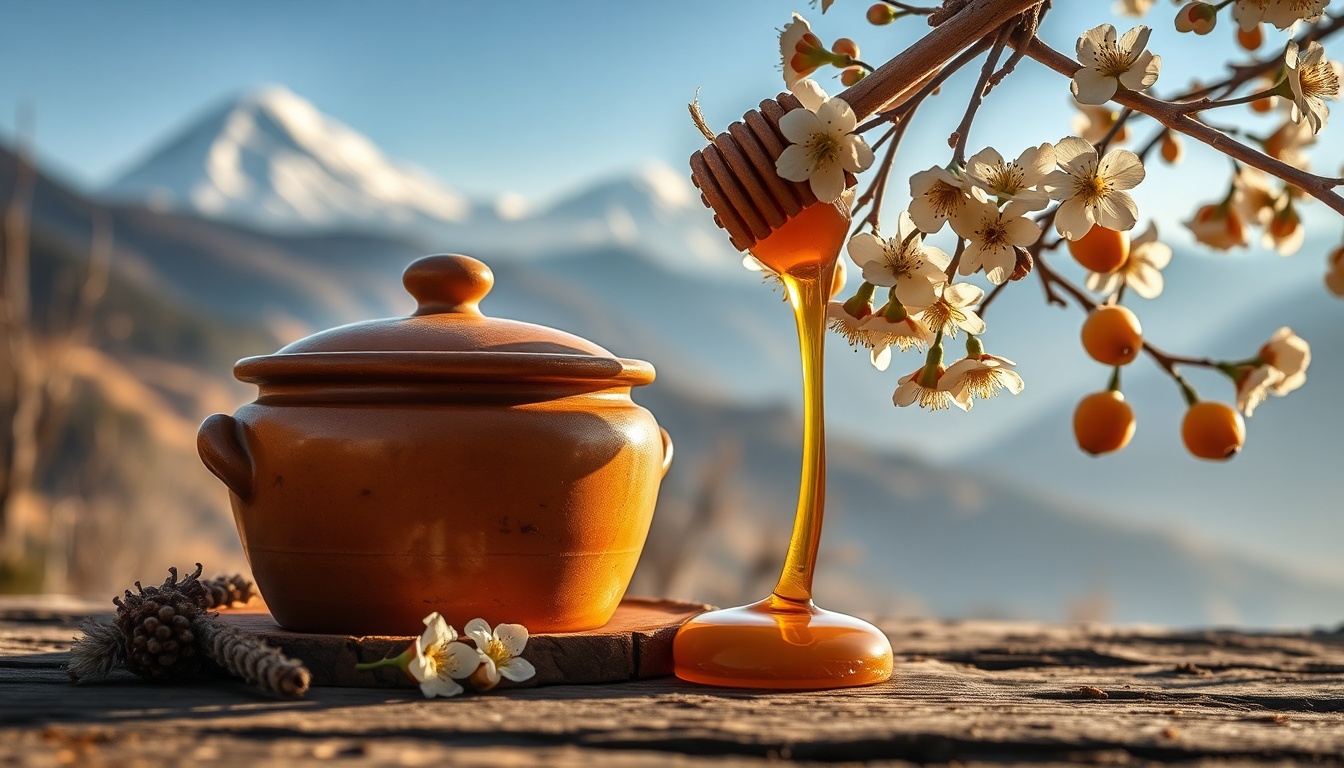
Prunus armeniaca — the Armenian plum — carries the country's name into every language that uses the Linnaean system. Apricots domesticated in the Ararat valley reached Rome via Armenian traders before the first century CE. They reached China through the Silk Road. Every jar of apricot jam, every dried apricot in a muesli, draws on a cultivar tradition that began here. For beekeepers in Ararat, Artashat, and Yerасx districts — the core orchard belt at 850–950 metres elevation — the apricot bloom opens each April, 10 to 14 days of white-to-pale-pink flowers in a mass simultaneous flush along the Araks river bottomlands.
Apricot blossom honey is pale amber, nearly transparent when fresh, with a mild stone-fruit sweetness and a clean, brief finish unusual in highland wildflower honey. Because bloom opens 2–4 weeks before mountain wildflower flows, it is the first significant nectar source of the Armenian spring — beekeepers with established colonies in the valley can capture a varietal collection in the gap before the highland season begins. The window is short enough that genuine monofloral apricot blossom honey is rare even within Armenia; most is blended into the broader wildflower harvest.
Pro Tip
Authentic Ararat valley apricot blossom honey should be labelled with the marz (province) of origin — Ararat, Araks, or Artashat district. It should show fine crystallization within 4–8 months and have a mild, clean sweetness without the heavy mineral notes typical of highland wildflower collections.
The World's Oldest Winery Landscape: Areni-1 and the Copper Age
In 2011, archaeologists excavating the Areni-1 cave complex in Vayots Dzor — a limestone karst site overlooking the Arpa river at 1,050 metres elevation — dated a complete wine-making installation to approximately 6,100 BCE: fermentation vats, storage jars, a wooden press beam, and grape seeds of Vitis vinifera sativa. It is the oldest confirmed winery in human history, predating comparable Egyptian and Mesopotamian finds by more than a thousand years. The Copper Age culture that built the first wine press also inhabited the highland valleys where Armenian beekeepers still work today.
The same archaeological period in the South Caucasus has yielded organic residue analysis from burial and storage contexts identifying beeswax and fermented honey compounds alongside plant foods. Honey, like wine, was central to Copper Age and Bronze Age ritual provision in the region — a connection between the two most significant fermented substances of early agriculture in a single landscape. Vayots Dzor, Gegharkunik, and the highland zones of southern Armenia have produced Bronze Age artefacts (clay vessels, storage pits) consistent with apiculture in continuous operation from at least the third millennium BCE.
Vayots Dzor mountain wildflower honey — collected today from the same limestone karst valleys as Areni-1 — has a distinctive mineral-herbal character from its limestone flora: Origanum vulgare (mountain oregano), Thymus kotschyanus (Kotsch's thyme, endemic to the Caucasus and Iran), high-altitude Salvia (sage), and the Artemisia that gives the region's landscape its characteristic grey-green summer colour. It is one of the few honeys in the Caucasus that can be traced to a specific geological substrate.
Get the Honey Buyer's Cheat Sheet (free PDF)
16 varieties on one page — color, flavor, best use and what a fair price looks like — from the 304 honeys we track.
Alpine Flora at Altitude: 3,500 Species in 29,800 km²
Armenia is a small country — 29,800 km², roughly the size of Maryland — but it contains more than 3,500 plant species. The South Caucasus is a recognised global biodiversity hotspot, a region where Pleistocene refugia sheltered species from glacial extinction across multiple ice ages. For honey, this botanical density translates to extraordinary variety within very short elevational gradients. Three distinct nectar zones shape the Armenian honey calendar.
The Ararat valley (400–1,100m): apricot blossom (April), wild almond (March), pomegranate blossom (May–June), white acacia (Robinia pseudoacacia, introduced but well-established in the lowland). The highland meadow zone (1,100–2,200m) is the main production belt: mountain clover (Trifolium medium, T. montanum), Centaurea (cornflower, knapweed — 40+ Armenian species), Salvia ringens and S. nemorosa, Thymus kotschyanus, Phacelia (in disturbed zones), and linden on north-facing valley slopes of Tavush and Lori. The subalpine and alpine zone (2,200–3,500m) has a short bloom window — July to August only — producing a high-enzyme, resinous mountain wildflower from Onobrychis (sainfoin, an ancient clover-relative), Astragalus (milk-vetch, with 100+ Armenian species), and Gentiana. Bees at 2,500 metres forage for 6–8 weeks maximum before the bloom collapses; the honey that results has complex resinous notes and high diastase activity.
Armenian thyme honey — from Thymus kotschyanus, Kotsch's thyme — deserves specific recognition. Named for Austrian botanist Theodor Kotschy (1813–1866), who collected plants across Armenia and the Caucasus, it grows at 1,500–2,400m and has an essential-oil profile dominated by thymol and carvacrol in proportions distinct from Turkish Thymus vulgaris or Greek Thymus capitatus. Armenian beekeepers describe it as herbal-camphor-peppery rather than the sharp medicinal character of true thyme species. A dry July at 1,800m in Vayots Dzor or Syunik produces a thyme honey genuinely different from its better-known Mediterranean counterparts.
Regional Varieties: Linden, Chestnut, and the Lake Sevan Basin
Northern Armenia — Tavush and Lori marzes — is forested at 500–2,000m with deciduous oak, hornbeam, and Tilia (Tilia cordata, T. platyphyllos, T. begoniifolia). The linden bloom (June–July) produces pale golden honey with a pronounced menthol-floral note that crystallizes to a fine, soft grain within 3–6 months. Lori linden honey is among the few Armenian varieties that occasionally reaches export-quality labelled packaging — Armenian diaspora grocery stores in Glendale, California and Lyon, France sometimes carry Lori linden with beekeeper-attributed labels.
Southern Armenia — Syunik marz, bordering Iran — produces chestnut honey from Castanea sativa stands at 600–1,200m in the Meghri and Kapan valleys. Dark amber, bitter-tannic, with a walnut-bitters finish distinct from Georgian chestnut (which tends toward a more resinous-pine character) and from Italian chestnut (which is drier and more uniformly bitter). Syunik's late-summer wildflower flow follows chestnut in August–September, producing a complex amber honey from the transition zone between sub-Mediterranean and continental alpine flora.
Central Armenia — Gegharkunik marz, surrounding Lake Sevan at 1,900m elevation — produces mountain wildflower honey from one of the world's highest-elevation large freshwater lakes. The Sevan basin has short, intense summers (July–August bloom only), sparse-but-concentrated flora, and high UV radiation that drives elevated polyphenol content in alpine plants. Armenian beekeepers describe Sevan basin honey as having an unusual mineral-saline note — attributed partly to altitude and partly to the lake basin's volcanic basalt geology, which creates alkaline-leaning soils that concentrate mineral uptake in nectar-producing plants.
Modern Industry, Authentication, and Where to Buy
Armenia has approximately 18,000–22,000 registered beekeepers holding an estimated 350,000–400,000 colonies — among the highest per-capita beekeeper densities in the post-Soviet space, and substantially higher than neighbouring Georgia or Turkey at equivalent scale. Despite this density, the industry remains almost entirely artisanal and fragmented. Most production is consumed domestically or sold informally to Armenia's diaspora communities in Russia (Moscow Armenian quarter), France (Lyon, Paris), the United States (Glendale, California; Watertown, Massachusetts), and Lebanon — before Lebanon's own post-2019 contraction.
Armenia's national honey standard (ARM ST 1065-2008) follows CODEX STAN 12-1981 parameters. Under the EU-Armenia Comprehensive and Enhanced Partnership Agreement (CEPA, in force since 2021), Armenia is progressively approximating EU food safety standards — honey exported to EU markets is subject to equivalent residue and documentation requirements, though a bilateral recognition agreement for varietally-labelled honey is not yet in place. Most Armenian honey entering EU markets does so through Georgian or Russian consolidation chains with loss of country-of-origin attribution.
Authentication challenges: the vast majority of Armenian honey sold outside Armenia carries no varietal or geographic label beyond 'wildflower' (lernain kaghtsramedz — highland wildflower) or 'mountain honey' (lernain med). Genuine Ararat valley apricot blossom honey is a seasonal specialty rarely available beyond the Ararat-Artashat local market in May–June. For buyers abroad: request a certificate of origin with beekeeper registration number and marz (province) code. Authentic highland wildflower honey should crystallize within 4–8 months at room temperature — collections from above 1,500m with high clover and Centaurea content crystallize faster than lowland acacia or apricot blossom. Honey staying liquid for 18+ months claiming highland origin is a quality-signal concern. The most reliable sourcing path for North American buyers remains Glendale, California Armenian specialty food importers (zip codes 91204–91206), where Tavush linden, Vayots Dzor highland, and Lori wildflower honey occasionally appear with beekeeper-attributed labelling.
Pro Tip
Ask specifically for 'Tavush linden' or 'Vayots Dzor wildflower' rather than generic 'Armenian honey' — the marz-level label is the most reliable authenticity marker the category currently offers. Apricot blossom honey, if you find it, should be very pale amber and mild — not heavy or resinous.