The Bailiwick Frame: Three Sub-Jurisdictions Under One Order in Council
The Bailiwick of Guernsey (Bailliage de Guernesey, Bailliage dé Guernési) is the second-largest of the three British Crown Dependencies (BCDs) by population (approximately 63,000 residents across the 2021 Bailiwick census) and the structurally most complex of the three by internal jurisdictional architecture. Unlike Jersey, which is a single self-governing jurisdiction at 118.2 km², the Bailiwick of Guernsey comprises three legally distinct sub-jurisdictions sharing a Lieutenant Governor and a common foreign-affairs interface with the UK Government: the island of Guernsey itself (~65 km², the largest by area and population at ~63,000 of the Bailiwick total — though by convention the Bailiwick is most commonly cited at the 62 km² figure used in the official Crown Dependencies summary that places Guernsey's main island at slightly above 60 km²); the Bailiwick of Guernsey's other major populated islands of Alderney (Aurigny, 7.9 km², ~2,000 residents), Sark (Sercq, 5.5 km², ~500 residents), and Herm (1.97 km², ~60 residents); plus uninhabited or sparsely-inhabited Lihou, Brecqhou, and Jethou. The Channel Islands' second Bailiwick, formed alongside Jersey in 1204 when continental Normandy fell to King Philippe II of France and the islands remained loyal to King John, has been governed continuously since as a Crown jurisdiction tied to the English Crown rather than to the Kingdom of England (later the UK).
The constitutional and food-standards consequence of the multi-island Bailiwick architecture is that a Guernsey-origin honey question must be answered against three legislative bases that share a common adoption-by-Order-in-Council ceiling but differ at the floor. The principal islands of Guernsey and Herm fall under the States of Deliberation (the Bailiwick parliament sitting at the Royal Court House in St Peter Port) and its Food Standards (Guernsey) Ordinance 2008. Alderney (Aurigny) is governed by the States of Alderney sitting at the Island Hall in Saint Anne — its food-standards regime cross-references the States of Deliberation's Ordinance through reciprocal-recognition provisions. Sark (Sercq) is governed by the Chief Pleas of Sark, the world's smallest functioning parliament (28 elected Conseillers since the 2008 Reform Law modernised what had been Europe's last feudal legislature, replacing the previous tenure-based Tenants of the Forty Quarterieux). Sark's food-standards regime adopts the States of Deliberation framework by reference under the Reciprocal Enforcement of Judgements (Sark) Law 1948 and subsequent equivalent ordinances. The same Annex II compositional limits — moisture ≤20%, HMF ≤40 mg/kg, diastase activity (Schade) ≥8 (or ≥3 for naturally low-diastase varieties), electrical conductivity ≤0.8 mS/cm for blossom honey, ≥0.8 mS/cm for honeydew — therefore apply de facto across the entire Bailiwick. Enforcement runs through the Guernsey Health & Social Care Department's Environmental Health and Trading Standards function; analytical testing for any Bailiwick sample requiring official confirmation routes to UK reference laboratories — Fera Science Limited at Sand Hutton, York, or the Government Chemist function at LGC Group, Teddington — on a fee-for-service basis the same way Jersey, English, and Scottish samples are routed.
This is the British Crown Dependencies sub-cluster's second member after Jersey, and the most jurisdictionally subdivided of the three (the Isle of Man is a single legislative jurisdiction at Tynwald, the world's oldest continuously-functioning parliament, sitting at Douglas). The three-into-one Bailiwick architecture is structurally distinct from any of the European-microstate cluster cases: Andorra, Liechtenstein, San Marino, Monaco, and Vatican City all adopt food-composition standards through a single legislature (the Consell General, the Landtag, the Consiglio Grande e Generale, the Conseil National, and the Pontifical Commission respectively). Guernsey's Bailiwick adopts via three legislatures — States of Deliberation, States of Alderney, Chief Pleas of Sark — bound to a single ceiling by Crown-Dependency Order-in-Council and reciprocal-recognition provisions. The intra-Bailiwick subdivision pattern is the cluster's first instance of internal-jurisdictional-pluralism inside a single Crown Dependency.
Guernsey Beekeepers' Association (GBKA): The Longest-Established BCD Apicultural Body
The Guernsey Beekeepers' Association (GBKA), established in 1928, is the oldest of the three British Crown Dependencies' beekeeping bodies — predating the Jersey Beekeepers' Association (JBKA, 1947) by 19 years and the Manx Beekeepers Association on the Isle of Man (founded in the 1940s) by approximately two decades. The GBKA is the Bailiwick-wide umbrella body covering Guernsey, Alderney, Sark, and Herm, with active membership consistently in the 80–150 range over the past two decades and an estimated active hive count of 250–500 colonies across the Bailiwick (the proportion on Sark and Alderney is small but non-trivial — Sark in particular has supported small-scale beekeeping since the Norman period and is one of the few European jurisdictions where commercial outdoor pesticide spraying is structurally limited by the absence of motor cars and the 1565 Letters Patent of Queen Elizabeth I that grant Sark to the Seigneur).
The GBKA's stated remit is comparable to the JBKA's: Varroa management coordination (Varroa destructor was first detected on Guernsey in 1992, six years before Jersey, with the same hybridisation-with-imports response pattern); queen-rearing programmes (the GBKA's queen-rearing initiative is centred on a small breeding apiary on the south coast); member education and training (the GBKA runs a regular Basic and Advanced Beekeeping syllabus aligned with the British Beekeepers' Association BBKA modular examination structure); and forage advocacy with the States of Deliberation's Committee for the Environment & Infrastructure on hedge-bank conservation and roadside-verge mowing schedules. The GBKA's annual show at the Saumarez Park show-ground in Castel parish is the Bailiwick's principal honey-product showcase. Notably, the GBKA does not currently operate a Bailiwick-wide subspecies-conservation programme on the SICAMM / NIHBS model, although the founding of the Native Honey Bee Society of the British Isles in 2010 brought several Guernsey-based beekeepers into voluntary alignment with mellifera-leaning queen-rearing practices.
The 1928 founding date is also load-bearing for any honest comparison across the BCD sub-cluster. Guernsey beekeeping is documented from at least the 16th century — the 1565 Letters Patent of Queen Elizabeth I granting Sark to Helier de Carteret references existing forage uses including honey production — but the formal society predates Jersey's by 19 years and the Isle of Man's by approximately two decades. The earlier founding correlates with Guernsey's larger pre-Second-World-War commercial agricultural base (the island was the principal British greenhouse-tomato producer in the 1920s–1930s, with associated demand for pollination services). The GBKA's continuity through the 1940 German Occupation of the Channel Islands is itself a notable conservation story: the Wehrmacht imposed restrictions on movement and food production but continued beekeeping was permitted as it was understood to support honey availability for occupying garrison and civilian populations alike, and most GBKA members were able to maintain colonies through the five-year Occupation (1940–1945).
Get the Honey Buyer's Cheat Sheet (free PDF)
16 varieties on one page — color, flavor, best use and what a fair price looks like — from the 304 honeys we track.
The Guernsey Forage Calendar: Douits, Hedge Banks & Brittany-Influenced Multifloral
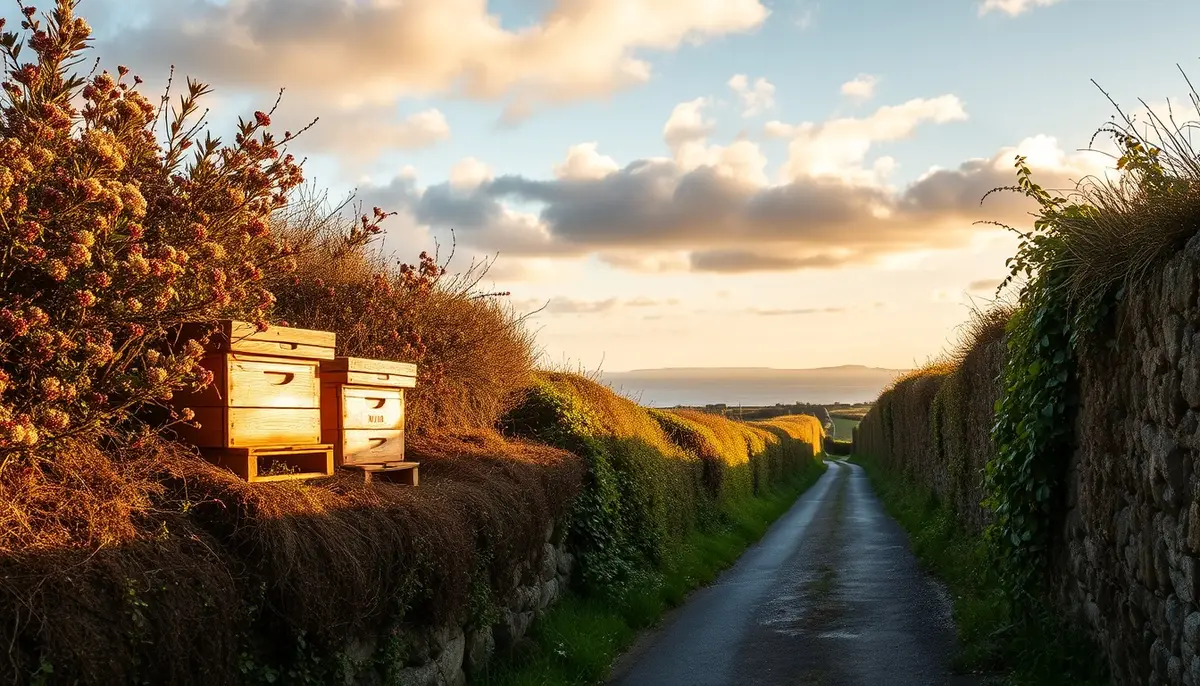
Guernsey's geology and forage profile sit on the same Channel-Islands continental shelf as Jersey but trend more strongly toward the maritime-Brittany influence: the island's northern coast (L'Ancresse, Pembroke Bay, Bordeaux Harbour) is granite low-cliff and sandy bay, the south coast is high cliff (Pleinmont to Petit Bot, ~80–100 m) on the same Late Proterozoic Icart Gneiss and Rosaire Formation that forms much of Brittany's adjacent Cap de la Hague. The Bailiwick's interior — particularly on Guernsey itself — is small-field arable and pasture cross-cut by the Bailiwick's distinctive douits (steep-sided water lanes / earthen channels that combine drainage, hedge-bank, and parish-boundary functions; from the Old Norman doï meaning conduit). The douit-and-hedge-bank network is functionally identical to Jersey's banques but is locally distinguished by a slightly higher density of honeysuckle (Lonicera periclymenum) and Atlantic ivy (Hedera helix subsp. helix) overgrowth on the older douit walls in St Pierre du Bois and Torteval parishes.
The forage calendar runs a few days earlier in spring and a few days later in autumn than Jersey because the Bailiwick's slightly more western maritime exposure gives it a marginally milder winter and longer-tail autumn ivy flow: gorse (Ulex europaeus) and willow (Salix species) from mid-February; blackthorn (Prunus spinosa) and dandelion (Taraxacum agg.) in March; oilseed rape (Brassica napus) and hawthorn (Crataegus monogyna) in April–May (the Bailiwick's commercial-arable acreage is smaller than Jersey's, so the rape contribution to honey is marginal); bramble (Rubus fruticosus aggregate) through May, June and July (the Bailiwick's dominant nectar source by some margin, just as on Jersey); white clover (Trifolium repens) on grassland in June–July; lime / linden (Tilia × europaea) in St Peter Port and surrounding parishes in late June; and the late-season ivy flow from late September into November-and-occasionally-December (Guernsey ivy reliably runs into early December in mild years, where Jersey ivy more often closes out by mid-November). The GBKA's published forage notes describe the typical Guernsey honey crop as a hedge-bank multifloral with bramble dominance in the June–July main extraction window plus the late-autumn ivy crop characteristic of all three Channel Islands.
The Bailiwick is also distinctive for its Sark-and-Herm sub-forage zones: Sark in particular, with its near-zero motor traffic and absence of large commercial-arable acreage, supports a higher density of Mediterranean-leaning herb-and-shrub species (rosemary, lavender, thyme in domestic gardens of the parish of Sercq; gorse and bramble on the cliff-edge commons) than Guernsey itself, and Sark-origin honey from the small number of Sark beekeepers carries a recognisably more aromatic profile in years when the herb component is strongest. Herm's forage is dominated by the small-field grassland-and-hedge mosaic of the island's interior and the dune system on Shell Beach. There is no PDO, PGI, or UK GI registration for any Bailiwick of Guernsey honey under the UK Geographical Indications register administered by Defra (the same scheme that protects Jersey Royal potato but not Jersey honey); no application has been filed for Guernsey- or Sark- or Alderney-origin honey, for the same structural reasons: total production volume is hobbyist-scale and the GBKA's strategic focus has historically been on Varroa management, queen rearing, and forage-conservation advocacy rather than commercial-marketing infrastructure.
Apis mellifera mellifera on Guernsey: The Intermediate-Retention Position
The Bailiwick of Guernsey occupies the intermediate position in the British Crown Dependencies' subspecies-conservation triangulation: more A. m. mellifera (the European Dark Bee) was retained through the Varroa transition than on Jersey, but less than on the Isle of Man. The honest characterisation, given the relatively thin published literature on Channel Islands subspecies genetics, is that Guernsey colonies as of 2026 are predominantly hybrid stock with a measurable but minority mellifera background — somewhere in the 15–35% mellifera-introgression range based on what limited GBKA / NIHBS / SICAMM-aligned breeding-record data exist (no peer-reviewed mitochondrial-DNA study of Guernsey colonies comparable to the published Læsø, Galway, or Manx populations has been completed as of 2026, though the GBKA's queen-rearing initiative records mellifera-leaning matings where they occur).
The structural reason for the intermediate position is the slightly earlier Varroa arrival on Guernsey (1992 vs Jersey's 1998) combined with the Bailiwick's larger pre-Varroa commercial-greenhouse-pollination base, which created earlier and stronger demand for imported Buckfast and Carniolan queens during the recovery period. Several smaller GBKA members in the inland parishes of St Pierre du Bois, St Saviour, Forest, and Torteval — and most of the Sark beekeepers — appear to have retained more mellifera-leaning genetics through the transition because their pollination commitments were lower and their queen-replacement cycles slower. The Sark situation is particularly favourable for any future mellifera-restoration effort because the island's near-isolation (boat-only access, ~5 km separation from Guernsey across the Big Russel and Little Russel channels) provides natural drone-flight-range protection from continental-Guernsey hybrid genetics: a Sark-resident queen mated on Sark drones with no cross-island traffic is one of the few scenarios in north-west Europe outside of dedicated mating-station programmes where mellifera-purity matings are practically achievable. The GBKA has not yet formalised a Sark-Bailiwick mellifera mating-station programme, but the topographical and traffic conditions for one exist and have been discussed at recent annual meetings.
The honest framing matters for any consumer or visitor buying Bailiwick honey at the GBKA shop in St Peter Port, the Saumarez Park show-ground, the Sark Saturday market, or the Alderney Saturday market in Saint Anne. The headline product is hybrid-bee bramble-and-douit-and-hedge-bank multifloral, not a heritage-mellifera-subspecies product. Marketing copy that invokes 'Guernsey native bee' or 'Channel Islands black bee' should be evaluated against this baseline — the 2026 reality is intermediate-retention hybrid, not pure-line mellifera, and the GBKA does not currently certify any Bailiwick honey as mellifera-derived. A future SICAMM-aligned Sark mellifera mating-station programme remains a possibility on the structural arguments above, but is not a current programme and should not be cited as such.
Where Guernsey Sits in the British Crown Dependencies Sub-Cluster
Guernsey is the second of three members of the British Crown Dependencies (BCDs) sub-cluster within the broader Adopted-by-Reference taxonomic frame, opened by Jersey 2026-04-30 and to be closed by the Isle of Man as the third member. All three jurisdictions adopt UK food-composition law by Order in Council under their respective constitutional frameworks; all three lost their pre-Brexit EU customs-territory access at the end of 2020 under Protocol 3 of the UK's 1972 Treaty of Accession and now trade with the EU under the UK-EU Trade and Cooperation Agreement (TCA); all three host long-established beekeeping associations (GBKA Guernsey 1928; JBKA Jersey 1947; Manx Beekeepers Association on the Isle of Man, 1940s). The shared structural adoption mechanism — Crown-Dependency-by-Order-in-Council without customs union with the parent state — distinguishes the BCD sub-cluster from the European-microstate cluster's treaty-and-customs-union mechanism (Andorra 1278 Paréages + 1993 EU Cooperation; Liechtenstein 1924 Customs Treaty + 1995 EEA; San Marino 1862 Treaty + 1991 EEC Cooperation; Monaco 1861 Treaty + 1963 Customs; Vatican 1929 Lateran + 2009 Monetary).
Guernsey extends the BCD sub-cluster on three internal differentiation axes that were opened but not exhausted by Jersey's standalone case. First, the multi-island-Bailiwick architecture — three legislatures (States of Deliberation, States of Alderney, Chief Pleas of Sark) bound to a single ceiling by reciprocal-recognition provisions — is the cluster's first instance of internal-jurisdictional-pluralism inside a Crown Dependency, and creates a natural axis the future three-member synthesis page can foreground (single-legislature Jersey + multi-legislature Bailiwick of Guernsey + single-legislature Tynwald Isle of Man = three structurally distinct Crown-Dependency parliamentary architectures under one shared Order-in-Council ceiling). Second, the GBKA's 1928 founding date is the earliest of the three BCD apicultural bodies and creates a longest-continuity axis. Third, Guernsey's intermediate Apis mellifera mellifera retention (between Jersey's near-loss and the Isle of Man's preservation) is the cluster's natural midpoint and the structural anchor for the future synthesis page's subspecies-conservation-asymmetry foregrounding.
The cluster-of-clusters now spans nine jurisdictions across two sub-clusters: five European microstates (Andorra, Liechtenstein, San Marino, Monaco, Vatican City) under the treaty-and-customs-union mechanism, plus three British Crown Dependencies (Jersey, Guernsey, and the as-yet-unshipped Isle of Man) under the Order-in-Council mechanism. With the Isle of Man's eventual ship the BCD sub-cluster will support its own three-member synthesis page mirroring the existing /learn/european-microstate-honey-cluster page — foregrounding the Order-in-Council adoption mechanism, the Bailiwick-vs-single-jurisdiction architectural difference, and the Jersey-loss / Guernsey-intermediate / Isle-of-Man-retained subspecies-conservation triangulation as the three structural axes that distinguish the BCD sub-cluster from the European-microstate cluster while sharing the Adopted-by-Reference frame.