Why Honey Is One of the Best Ingredients for Hair
Hair is not living tissue — each strand is a protein fiber made from keratin, protected by an overlapping cuticle of flattened cells. Unlike skin, hair cannot heal itself. When the cuticle is damaged by heat, chemical processing, UV exposure, or mechanical stress (brushing, rubbing with a towel), the raised, rough scales cannot lie back flat on their own. Moisture escapes, the cortex becomes vulnerable, and hair looks dull, feels rough, and breaks more easily.
This is where raw honey does something remarkable. Honey is a natural humectant — its complex mixture of fructose, glucose, amino acids, and organic acids is hygroscopic, meaning it actively attracts and binds water molecules from the environment and pulls them toward the hair shaft. A 2009 study published in the *European Journal of Medical Research* found that patients with seborrheic dermatitis who applied diluted raw honey (90% honey, 10% warm water) to the scalp showed marked improvement in hair loss within 4 weeks, attributed partly to honey's anti-inflammatory and antimicrobial mechanisms acting on the scalp — the foundation of healthy hair growth.
Beyond humectancy, honey contains trace amounts of hydrogen peroxide (produced by the enzyme glucose oxidase acting on glucose in the presence of oxygen) and a range of polyphenols — caffeic acid, kaempferol, quercetin — with antioxidant and anti-inflammatory activity. For hair, this means honey can help soothe an irritated scalp, reduce dandruff caused by the yeast *Malassezia*, and protect the follicle environment. The amino acids in honey provide additional nutrition at the scalp level.
Honey is also mildly acidic — pH 3.2–4.5. This is important because the hair cuticle tightens and lies flat at low pH and lifts at high pH. Many shampoos and conditioners are alkaline (pH 5.5–7), which leaves the cuticle partially open. Applying an acidic honey mask helps restore the hair's natural slightly acidic pH, causing the cuticle to contract and smooth — the same principle behind apple cider vinegar rinses, but gentler and combined with intense moisture delivery.
The recipes below use honey as the active base and layer in supporting ingredients — oils, egg, avocado, aloe — chosen specifically to address each hair type's primary challenge.
Pro Tip
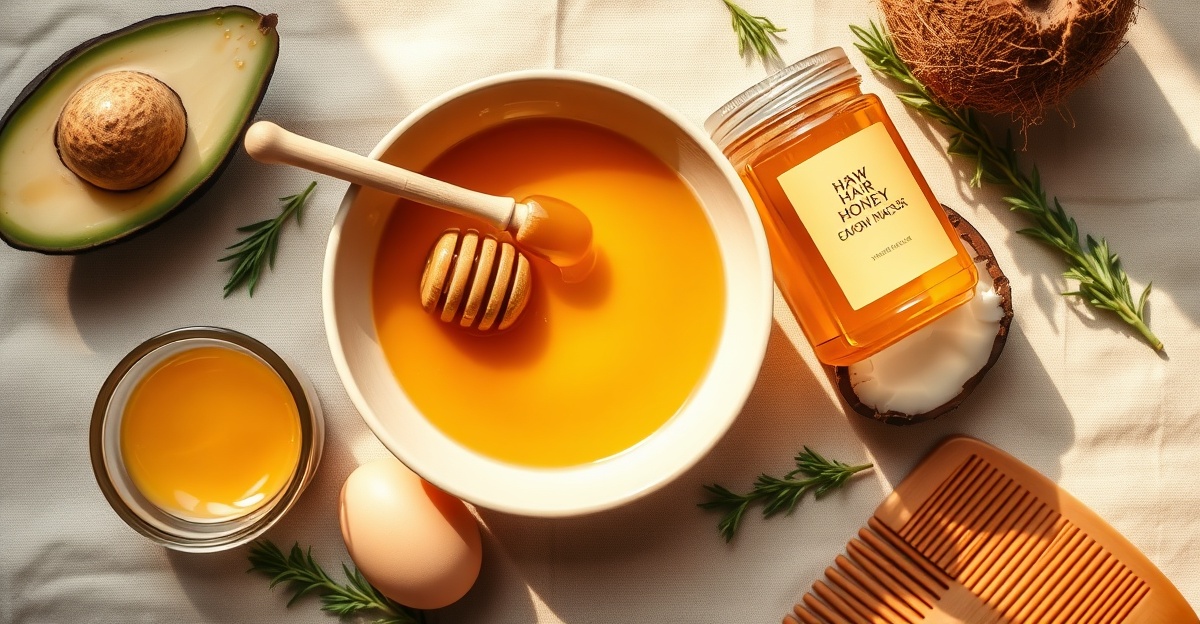
Use raw, unprocessed honey — not commercial filtered honey. Raw honey retains glucose oxidase (destroyed above 120°F/49°C), intact pollen, and its full polyphenol content. Manuka honey is the most potent option for scalp conditions due to its uniquely high methylglyoxal (MGO) content, but any good raw honey — acacia, wildflower, clover — will deliver the core humectant and pH benefits.
How Honey Benefits Different Hair Types
Before choosing a recipe, match your hair type to the primary mechanism you need:
- **Dry or coarse hair** — Needs intense humectancy and oil to seal moisture in. Honey's hygroscopic action draws water in; a heavy oil (coconut, avocado, olive) then occludes the shaft to lock it there. Best recipe: Honey & Avocado Deep Conditioning Mask.
- **Fine or oily hair** — Needs humectancy without heaviness. Heavy oils will weigh fine hair down and increase oiliness. Best recipe: Honey & Apple Cider Vinegar Clarifying Mask to rebalance scalp oil production.
- **Damaged or chemically treated hair** — Needs protein to reinforce the weakened cortex, plus moisture to restore flexibility and prevent breakage. Best recipe: Honey & Egg Protein Treatment. Bleached or frequently colored hair should use this monthly.
- **Curly or coily hair** — High porosity (common in 3C–4C hair) means the cuticle is permanently raised and moisture escapes quickly. Needs both heavy humectancy and a thick occlusive layer. Best recipe: Honey & Coconut Milk Curl Conditioning Mask.
- **Dull or flat hair** — Usually caused by product buildup, hard water mineral deposits, or a raised cuticle. Needs clarifying and cuticle-smoothing. Best recipe: Honey & Apple Cider Vinegar Clarifying Mask.
- **Scalp issues (dandruff, flaking, itching)** — Needs antimicrobial and anti-inflammatory action directly at the scalp. Use raw honey slightly diluted (70% honey, 30% warm water) applied specifically to the scalp. Manuka honey at UMF 10+ is most effective for this purpose.
Get the Honey Buyer's Cheat Sheet (free PDF)
16 varieties on one page — color, flavor, best use and what a fair price looks like — from the 304 honeys we track.
Equipment and Prep
You'll need very little equipment: a glass or ceramic mixing bowl (avoid reactive metals like aluminum), a fork or small whisk, measuring spoons, a wide-tooth comb for application, a shower cap or plastic wrap, and a towel you don't mind getting slightly sticky.
Prep your hair before applying any mask. Start with hair that is clean (shampooed) but not fully dried — towel-blotted, damp hair absorbs mask ingredients far better than dry hair because the slightly swollen shaft and open cuticle allow deeper penetration. If your hair is very dry or porous, applying to dry hair before shampooing (pre-poo treatment) is more effective: the oils and honey coat the dry shaft before water enters and causes hygral fatigue (swelling damage from excessive water absorption in high-porosity hair).
Warm ingredients slightly before mixing — not hot, but body temperature (around 98°F / 37°C). Warm honey has lower viscosity, making it far easier to apply evenly. Microwave the honey for 10–15 seconds or set the bowl in a larger bowl of warm water. Never heat above 120°F — this destroys the enzyme activity.
**Yield:** Each recipe makes one treatment for medium-length hair (shoulder to mid-back). For very long or thick hair, increase all ingredients by 50%.
Recipe 1: Classic Honey & Olive Oil (All Hair Types)
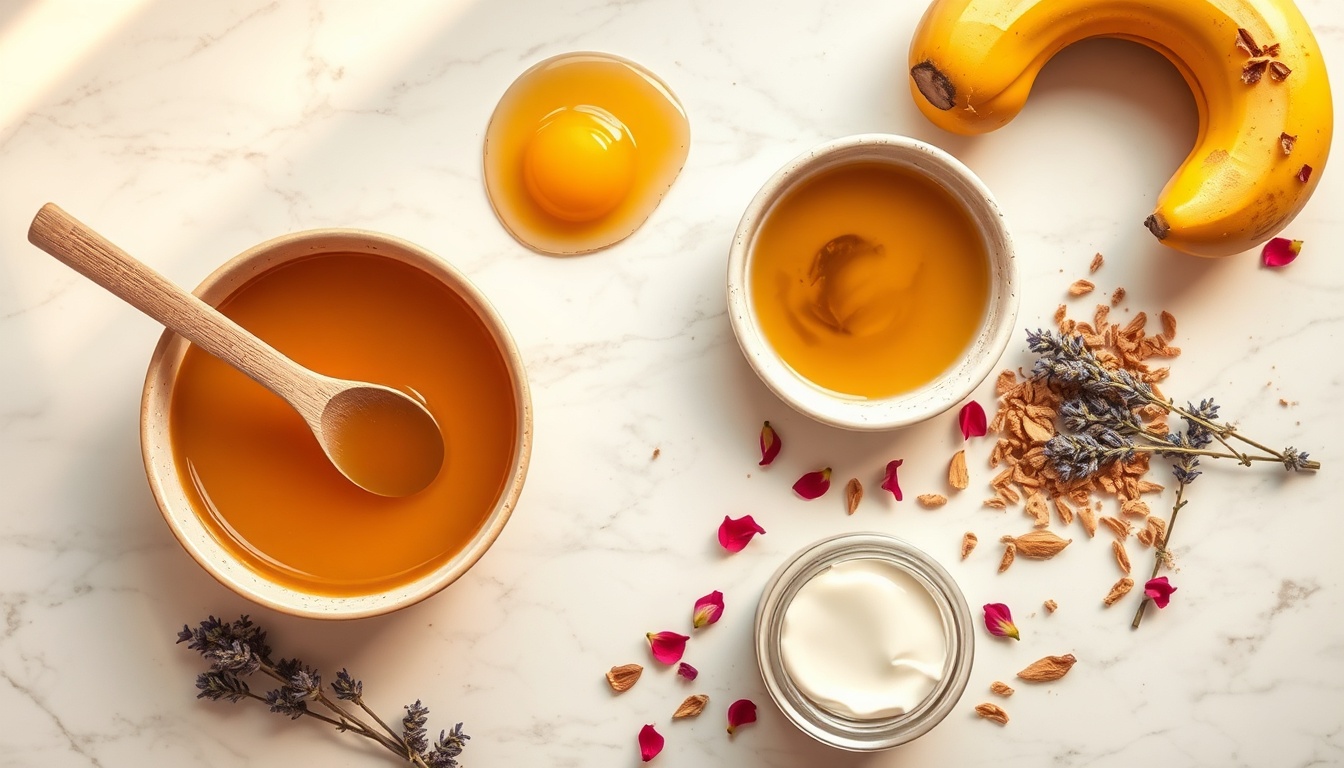
This two-ingredient baseline is the simplest effective treatment — and often the best starting point before you know which formula your hair responds to best. Olive oil is one of the most penetrating natural oils for hair, rich in oleic acid (omega-9) which has a small enough molecular structure to actually enter the hair cortex rather than just coating the surface. This genuine penetration makes it fundamentally different from heavier occlusive oils like castor oil, which coat but don't penetrate.
**Ingredients:**
• 3 tablespoons raw honey
• 2 tablespoons extra-virgin olive oil
• Optional: 5 drops rosemary essential oil (stimulates scalp circulation; a 2023 study in *Skin Appendage Disorders* found rosemary oil as effective as 2% minoxidil for mild androgenetic hair thinning)
**Instructions:**
1. Warm the honey until it flows easily (10–15 seconds in microwave or warm water bath).
2. Add olive oil and whisk together until fully combined into a uniform amber mixture.
3. Add rosemary essential oil if using and stir.
4. Apply to towel-dry hair, working from mid-shaft to ends. Use your fingers or a wide-tooth comb to ensure every strand is coated.
5. Cover with a shower cap. For deeper conditioning, wrap a warm towel around the shower cap — the heat opens the cuticle further for enhanced penetration.
6. Leave on for 20–30 minutes (up to 1 hour for very dry hair).
7. Rinse thoroughly with cool water (cool = cuticle-closing). Shampoo once if needed to remove oil residue, then condition as normal.
**Frequency:** Weekly for dry hair; every 2 weeks for normal hair.
Pro Tip
The honey-oil mixture will feel slightly grainy if your raw honey has crystallized — this is fine and actually beneficial. The fine sugar crystals provide gentle mechanical exfoliation on the scalp when you massage the mask in. Crystallization is a sign the honey is genuinely raw and unheated.
Recipe 2: Honey & Coconut Milk Curl Mask (Dry, Curly & Coily Hair)
Curly and coily hair textures have naturally higher porosity because the spiral shape creates more cuticle gaps than straight hair — moisture enters quickly but escapes just as fast. This mask layers honey's humectancy under the fatty acids and lauric acid in coconut milk to create a moisture-seal effect that lasts days, not hours. Coconut milk (from the meat, not the water) is high in lauric acid — the only fatty acid small enough to penetrate the hair shaft — plus medium-chain triglycerides that coat and smooth the cuticle from outside.
**Ingredients:**
• 3 tablespoons raw honey
• 4 tablespoons full-fat canned coconut milk (shake well before opening)
• 1 tablespoon coconut oil, melted
• ½ teaspoon argan oil (optional, for added shine and frizz control)
**Instructions:**
1. Combine all ingredients in a bowl. Whisk until smooth and creamy — the coconut milk and honey will emulsify somewhat due to their different phases.
2. Apply generously to pre-shampooed, damp hair. For high-porosity curls, apply to dry hair before shampooing.
3. Rake through with fingers, ensuring the mask reaches from root to tip. Gently scrunch hair upward to encourage curl clumping.
4. Cover with a shower cap. Leave on for 30–45 minutes.
5. Rinse with cool water, scrunch out excess, and style as usual without additional conditioner — this mask is conditioning enough.
**Frequency:** Weekly for 4C hair; every 10–14 days for 3A–3C.
Recipe 3: Honey & Egg Protein Treatment (Damaged, Bleached & Brittle Hair)
Hair is 88–95% keratin protein. Chemical processing (bleaching, perming, relaxing) breaks disulfide bonds in the cortex, causing structural weakness. The result: elasticity loss (hair snaps instead of stretching), porosity increase, and dullness. Egg protein — primarily albumen and globulin — can temporarily fill in cortex gaps, coating the shaft to reduce breakage and restore a degree of strength and smoothness.
A 2015 review in the *Journal of Cosmetic Science* found that hydrolyzed protein treatments provided measurable improvement in tensile strength for chemically damaged hair. Egg white contains these proteins in partially hydrolyzed form — small enough to adsorb onto the hair shaft surface and partially penetrate.
**Ingredients:**
• 2 tablespoons raw honey
• 1 whole egg (egg white only for oily hair/scalp; whole egg for dry/normal)
• 1 tablespoon sweet almond oil or olive oil
• 1 teaspoon apple cider vinegar (seals the cuticle, balances pH)
**Instructions:**
1. Whisk the egg thoroughly in the bowl first until smooth and uniform.
2. Add warm (not hot!) honey, oil, and apple cider vinegar. Whisk until combined. Do not use hot honey — it will cook the egg.
3. Apply to damp hair in sections, distributing evenly from roots to ends.
4. Cover with a shower cap and leave on for 20–30 minutes. Do NOT apply heat — warm temperatures will cook the egg proteins, creating a very unpleasant cleanup situation.
5. Rinse with cool or lukewarm water. Shampoo twice to fully remove egg residue. Condition lightly.
**Frequency:** Every 3–4 weeks. Protein treatments can cause protein overload if overused — hair becomes stiff and brittle. Alternate with moisture-only treatments in between.
Pro Tip
If you smell egg in your hair after washing, rinse with a diluted apple cider vinegar solution (1 tablespoon ACV in 1 cup water) or add a few drops of lavender or peppermint essential oil to the mask. Both neutralize the egg odor effectively.
Recipe 4: Honey & Avocado Deep Conditioning Mask (Very Dry, Coarse & Heat-Damaged Hair)
Avocado is nutritionally exceptional for hair. Unlike most fruits, avocado is calorie-dense — 77% of its calories come from fat, primarily oleic acid and palmitic acid. These fatty acids penetrate deeply into the hair shaft while the fruit's sterols — beta-sitosterol and campesterol — have demonstrated anti-inflammatory activity on the scalp in dermatological research. Avocado also contains biotin (B7), which supports keratin infrastructure, and vitamins E and K, both fat-soluble antioxidants that protect hair from oxidative damage.
Combined with raw honey's moisture-attracting power, this is the most intensive conditioning treatment in this guide — appropriate for hair that is severely dry, regularly heat-styled, or simply coarse and hard to manage.
**Ingredients:**
• 2 tablespoons raw honey (or buckwheat honey for its especially high antioxidant content)
• ½ ripe avocado (mashed until completely smooth — blend if necessary)
• 1 tablespoon coconut oil, melted
• 1 tablespoon plain whole-milk yogurt (adds lactic acid for gentle exfoliation and supports scalp microbiome balance)
• Optional: 5 drops lavender essential oil (anti-inflammatory, pleasant scent)
**Instructions:**
1. Mash the avocado thoroughly with a fork until no lumps remain. Even small avocado chunks will be difficult to rinse out — blend if necessary.
2. Add warm honey, coconut oil, and yogurt. Mix until smooth and creamy.
3. Apply generously to damp hair. This is a thick mask — part hair into sections and use your fingers to work it all the way to the ends.
4. Cover with shower cap and wrap with a warm towel. Leave on for 30–45 minutes.
5. Rinse thoroughly with warm water, then cool water. Shampoo once to remove avocado residue. The yogurt's lactic acid leaves hair notably smooth.
**Frequency:** Every 2–3 weeks.
Recipe 5: Honey & Apple Cider Vinegar Clarifying Mask (Oily Scalp, Dull & Product-Buildup Hair)
Hard water, dry shampoo, silicone-heavy conditioners, and styling products accumulate on the scalp and hair shaft over time. This buildup raises the cuticle, creates a barrier that prevents moisture from entering, and makes hair look flat, dull, and lifeless. Standard shampoos rarely remove silicone and mineral buildup effectively without a clarifying treatment.
Apple cider vinegar (ACV) is a proven clarifying agent. Its primary active acid is acetic acid (5–6% in standard ACV), which dissolves alkaline mineral deposits from hard water, breaks down silicone films on the hair shaft, and restores the hair's natural pH (3.5–4.5). ACV also has documented antimicrobial action against *Malassezia globosa* and other scalp yeasts that cause dandruff — an Australasian study found a 5% tea tree oil solution reduced dandruff severity by 41% vs. placebo, and ACV provides a complementary mechanism.
**Ingredients:**
• 2 tablespoons raw honey
• 2 tablespoons apple cider vinegar (raw, "with the mother" for additional probiotic content)
• 1 tablespoon aloe vera gel (from fresh leaf or food-grade gel; provides scalp soothing and lightweight humectancy)
• ½ teaspoon tea tree essential oil (optional; antifungal support for dandruff)
**Instructions:**
1. Combine honey and ACV first — they mix readily. Add aloe vera and tea tree oil if using.
2. The mixture will be thinner than the other masks — that's intentional. It's designed to be applied to the scalp first, then worked through the lengths.
3. Apply to dry hair before shampooing (pre-poo treatment works especially well here). Massage the scalp for 2–3 minutes to work the ACV into product buildup.
4. Leave on for 15–20 minutes with a shower cap.
5. Rinse with warm water. Shampoo once (you may not need conditioner — the honey leave-behind is conditioning enough for fine hair).
**Frequency:** Every 2–4 weeks, or whenever hair feels dull and heavy with buildup.
Pro Tip
If you're concerned about the ACV smell, it dissipates completely once hair is rinsed and dried. The acetic acid evaporates at room temperature. If any residual scent lingers, add 3–4 drops of lavender or rosemary essential oil to the mixture.
Application Tips for Maximum Results
The how matters as much as the what. These application techniques maximize penetration and effectiveness:
- **Start with damp, not dripping-wet hair.** Excess water dilutes the mask and prevents it from adhering. After shampooing, squeeze out excess water and blot with a microfiber towel until hair no longer drips.
- **Work in sections.** Divide hair into 4 quadrants, clip each out of the way, and apply the mask section by section. This ensures even coverage — random application leaves dry patches.
- **Focus on the areas that need it most.** The ends of hair are the oldest, most damaged part — they should receive the thickest coating. The scalp generally produces enough oil on its own; avoid heavy oil-based masks on the scalp unless your scalp is dry.
- **Use heat.** A shower cap alone works. A shower cap plus a warm towel works better. A shower cap plus 5 minutes under a hooded hair dryer on low works best. Heat opens the cuticle slightly and increases penetration of water-soluble ingredients.
- **Cool rinse to finish.** After removing the mask with warm water, do a final rinse with cool water. This causes the cuticle to contract and lie flat — exactly what produces shine and reduces frizz.
- **Don't over-wash after.** One gentle shampoo or even just a thorough cool rinse (for moisture-only masks without egg) is sufficient. Double-shampooing strips away the moisturizing residue that makes masks beneficial.
How Often Should You Use a Honey Hair Mask?
Frequency depends on hair type and mask type.
**Moisture masks (Recipes 1, 2, 4):** Dry/coily hair: weekly. Normal hair: every 2 weeks. Fine/oily hair: monthly or as needed.
**Protein treatment (Recipe 3):** Every 3–4 weeks maximum. Signs of protein overload (too frequent use): hair feels stiff, brittle, and snaps easily. If this happens, stop protein treatments and do moisture-only masks for 4–6 weeks until balance is restored.
**Clarifying mask (Recipe 5):** Every 2–4 weeks, or whenever hair feels dull and product-heavy. More than monthly is rarely necessary — over-clarifying can strip healthy oils.
Watch your hair's behavior between treatments. Healthy hair should have elasticity (stretches slightly when wet without snapping), smoothness (cuticle lies flat = shine and reduced frizz), and moisture retention (doesn't go frizzy immediately in humid air).
The Science Recap: Why These Masks Work
To summarize the mechanisms: honey contributes humectancy (moisture attraction), mild exfoliation via gluconic acid (AHA), pH normalization (cuticle-smoothing), and antimicrobial protection at the scalp. Oils (olive, coconut, avocado) contribute either penetrating moisturization (oleic acid enters the cortex) or occlusive sealing (heavier oils coat the cuticle to lock in moisture). Egg protein contributes temporary structural reinforcement of damaged cortex zones. Apple cider vinegar contributes clarification (acid dissolving alkaline mineral/silicone buildup) and pH restoration. Aloe vera contributes lightweight humectancy and scalp soothing.
Any effective hair mask is built from these mechanisms. As you learn how your specific hair responds — does it need more protein or more moisture? does it respond better to oil penetration or occlusion? — you can adjust ratios and ingredients from this foundation.
For more on how raw honey is processed and why it matters for topical applications, see our deep dive on raw vs. processed honey. For honey-based skincare, see our honey face mask guide and honey lip balm recipe. For beekeeping and sourcing the freshest local raw honey, explore our local honey finder with verified sources across all 50 states.