Two Variables That Explain Premium Honey Pricing
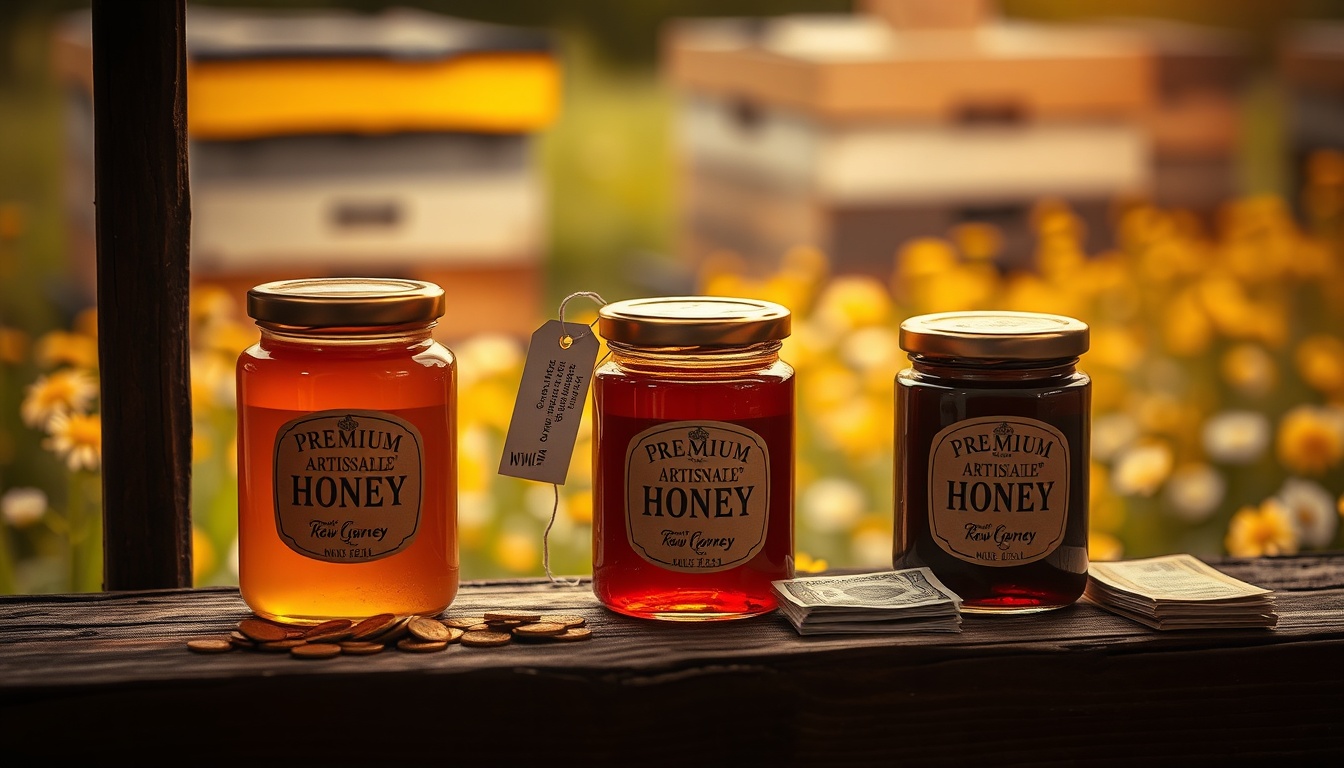
The most common explanation for why some honey costs more than supermarket clover is vague quality language — 'artisanal,' 'raw,' 'single-source.' But raw clover from a small-batch beekeeper still costs more. Raw manuka from New Zealand costs more. Raw tupelo from the Florida panhandle costs more. These price differences persist regardless of the beekeeper's scale, skill, or certification. The driver is structural, not artisanal.
The structure consists of two independent variables. The first is bloom window length: how many days per year the source plant actually produces nectar that bees can harvest. Clover blooms across a 10–14 week season. Tupelo blooms for approximately 14 days in a single spring window, then stops. No management decision changes this biology. The second is geographic concentration: how much of the world's supply comes from a small, specific area versus from a broad, distributed agricultural or wild landscape. Clover grows in virtually every temperate region. Tupelo's commercial nectar source — Nyssa ogeche, the ogeechee tupelo — grows naturally only along a 50-mile stretch of the Apalachicola and Choctawhatchee river systems in the Florida panhandle. Its commercial harvest zone is roughly 2,500 km².
When you cross these two variables — bloom window (narrow vs. wide) and geographic distribution (concentrated vs. dispersed) — you get a 2×2 matrix that positions almost every commercial honey variety with surprising accuracy. Narrow window + concentrated geography = maximum premium. Wide window + dispersed geography = commodity price. The remaining two quadrants produce intermediate price structures, each with its own logic.
Pro Tip
The 2×2 bottleneck matrix: (1) Narrow bloom + Concentrated source → True rarities: Tupelo, Sourwood, Sidr, high-UMF Manuka. (2) Narrow bloom + Distributed source → Seasonal premiums: Heather, Linden, Orange Blossom. (3) Wide bloom + Concentrated source → Moderate premiums: Lavender (Provence), US Buckwheat. (4) Wide bloom + Dispersed source → Commodity: Clover, Acacia/Robinia, Wildflower, Sunflower.
Quadrant 1 — Narrow Window, Concentrated Source: The True Rarities
Tupelo (Nyssa ogeche, ogeechee tupelo) is the American archetype of the narrow-window, concentrated-source quadrant. The bloom window is 14–21 days in April–May. The commercial harvest area is approximately 50 miles of river-system floodplain along the Apalachicola and Choctawhatchee rivers in the Florida panhandle. No other region in the world supports commercial Nyssa ogeche honey production — the tree grows more broadly in coastal Georgia and South Carolina, but only the Apalachicola basin achieves the density needed for monofloral harvest. Florida beekeepers must position hives in the river-bottom tupelo stands by barge or flat-bottomed boat, since the stands flood seasonally and road access is limited. The harvest is extracted within days of the bloom's end to prevent blending with post-bloom flows. A bad bloom year — late frost, drought, or excessive rain — reduces the entire year's US tupelo crop, with no geographic alternative. Retail price: for labeled, authenticated tupelo.
Sourwood (Oxydendrum arboreum) occupies the same quadrant in the US Appalachian system. The bloom is 18–24 days in July–August and is concentrated in the southern Appalachian Mountains — North Carolina (particularly Avery, Yancey, and Mitchell counties), Tennessee (Unicoi and Carter counties), Georgia (Union and Towns counties), and southwestern Virginia. Sourwood does not grow in Europe, South America, or Asia. Commercial harvest requires that hives be placed above 2,500 feet elevation, where Oxydendrum achieves the density needed for monofloral flow. The flavor profile — spicy anise, light vanilla, faintly floral — is unlike any European or Asian honey and has no substitute. The American Beekeeping Federation has described it as the finest North American honey. Price.
Sidr (Ziziphus spina-christi) is the Middle Eastern and South Asian equivalent: a 3-week October–November bloom concentrated in specific highland valleys of Yemen, parts of Oman, Ethiopia, Pakistan's Khyber Pakhtunkhwa, and India's Rajasthan. Yemen's Wadi Do'an region and Dhamar highlands produce the grades commanding in Gulf and Western specialty markets. Unlike tupelo or sourwood, Sidr's premium is compounded by political risk: Yemen's ongoing conflict since 2015 has disrupted production, transportation, and verification chains, creating a supply risk multiplier on top of the structural geographic bottleneck. High-UMF Manuka (Leptospermum scoparium, New Zealand) also belongs here: the UMF grading system defines sub-zones of New Zealand's South Island and parts of the North Island where soil chemistry, rainfall, and microclimate produce the methylglyoxal (MGO) concentrations required for UMF 15+ ratings. The bloom is 4–6 weeks, but UMF-grade honey can only be harvested from mapped, verified stands — a geographic concentration within the already narrow-window crop. Price: for UMF 15+ certified.
Pro Tip
Authentic sourwood and tupelo share a structural similarity: both come from a single mountain or river system in the US Southeast, bloom in the same 2-3 week window, and cannot be replicated by moving to a different region. If a jar labeled 'tupelo honey' from Florida or 'sourwood honey' from North Carolina crystallizes within a few months, it is almost certainly blended with faster-crystallizing honey — both varieties have fructose-to-glucose ratios above 1.4, making pure monofloral examples extremely slow to crystallize.
Get the Honey Buyer's Cheat Sheet (free PDF)
16 varieties on one page — color, flavor, best use and what a fair price looks like — from the 304 honeys we track.
Quadrant 2 — Narrow Window, Distributed Source: The Seasonal Premiums
Heather (Calluna vulgaris) commands a premium (in the UK, in Germany) despite being produced across a broad geography — Scotland, Wales, Ireland, England's North Yorkshire and Dartmoor, Germany's Lüneburg Heath (Lüneburger Heide), Scandinavia, and parts of Eastern Europe. The bottleneck is the bloom window, not the geography: Calluna flowers August–September, a 4–6 week window. Miss the bloom with bad weather — heavy August rain, early frost — and there is no second chance that year. The logistical demand is intense: UK and German beekeepers practice transhumance specifically for heather, moving colonies to moorland locations in late July and extracting in September. Heather honey has an additional processing constraint: its thixotropic gel structure (a non-Newtonian property shared by no other commercially produced European honey) requires pressing rather than centrifugal extraction, adding labor costs that clover honey never incurs. The result is a price premium driven entirely by time and process, not by geographic rarity.
Linden (Tilia cordata and Tilia platyphyllos) presents the clearest case of temporal bottleneck without geographic concentration. Linden grows across Poland, Germany, Hungary, Romania, Czech Republic, Slovenia, Austria, France, and the UK. At any given location, the bloom window is 10–14 days — one of the shortest reliable nectar windows of any major honey crop in Europe. European beekeepers follow the bloom upward in altitude and northward in latitude across a 4–6 week window, but each individual stand provides only 10–14 days of productive nectar flow. Miss the weather window — even three days of cold rain during bloom peak in late June to early July — and that stand produces no honey that year. German Lindenhonig, Polish lipiec, Hungarian hársmézzel, and Romanian miere de tei all command premiums in their domestic markets, with the price persisting year after year regardless of where production comes from because the temporal bottleneck cannot be escaped.
Orange Blossom occupies the lower end of this quadrant. Citrus sinensis and related species bloom for 3–4 weeks in February–April in California, Florida, Spain, Italy, Morocco, Israel, and South Africa. The geographic distribution is genuinely wide — orange blossom honey is produced on three continents. But the bloom window is narrow enough and the specific harvest conditions demanding enough (the white blossom drop within days of peak, and rain during bloom dilutes nectar rapidly) that orange blossom honey retains a modest premium $12–$24 (middle half of 14 verified orange blossom jars, Oct 19, 2026) over commodity honey. The premium erodes when the geographic distribution widens enough that any one region's failed bloom can be substituted by another's — as has happened with the growth of Moroccan and Spanish orange blossom production supplementing historically California and Florida-centric US supply.
Pro Tip
Heather honey's thixotropic property — it sets to a gel at rest but becomes liquid when stirred — is the physical signature of authentic Calluna vulgaris monofloral production. This non-Newtonian behavior is caused by specific proteins in Calluna nectar that interact with the honey matrix. No other major commercial European honey gels this way. A 'heather honey' that pours freely from a jar without stirring is either blended or misrepresented. Authentic heather honey requires a special 'loosening' screw or stirrer to extract from the frame — centrifugal extraction damages the gel structure.
Quadrant 3 & 4 — How Wide Windows and Distributed Geography Create Commodity Pricing
The counterexample to the premium quadrants is the robinia/acacia story. Robinia pseudoacacia (black locust, introduced from North America to Europe in the 17th century) blooms for only 10–14 days at any given location. That is a narrow window by the heather or orange blossom standard. But the bloom cascade — the northward and altitudinal progression of the Robinia bloom across the European continent — extends the total harvest season to 5–6 weeks for a migratory beekeeper willing to follow it. Hungary's Alföld blooms in late April. Romanian Banat and Wallachia bloom 10–14 days later. Sub-Carpathian Poland's Podkarpacie region blooms last, in late May. A beekeeper operating a multi-country transhumance circuit can harvest across this entire gradient, effectively converting a narrow-window crop into a wide-window one through management. The geographic distribution is genuine: Robinia grows across Hungary, Romania, Germany, Italy, France, Spain, and southeastern Europe. The result is that authentic single-origin acacia honey commands only $9–$16 (middle half of 16 verified acacia jars, Oct 19, 2026) at specialty retail — not a commodity price, but far below the premium quadrant.
Clover (Trifolium repens, white clover, and Trifolium pratense, red clover) represents the extreme commodity end: the bloom is 10–14 weeks in temperate regions (June through September in the Northern Hemisphere, December through March in the Southern), and clover grows in virtually every agricultural and semi-wild temperate landscape on six continents. There is no spatial or temporal bottleneck. When white clover fails in one region due to drought, Canadian or New Zealand production substitutes. When New Zealand fails, Australian or US production picks up. The commodity market equilibrates globally because the geographic distribution and bloom window length make regional substitution nearly frictionless. Retail price: for labeled single-origin clover; lower for generic blends.
Lavender (Lavandula angustifolia) is a revealing example of a bloom bottleneck eroding over time as geographic distribution expands. Provence lavender honey was historically concentrated in the Vaucluse and Alpes-de-Haute-Provence departments of southeastern France, with a 3–4 week July bloom window. The PDO protection for Miel de Provence covers lavender production within a specific zone. But lavender cultivation has expanded into Andalusia and Castile in Spain, the Atlas Mountains of Morocco, and, at the experimental level, parts of the US Pacific Northwest and New Zealand. As additional lavender-producing geographies enter the market, the premium attached to 'lavender honey' generally diminishes — even as Provence PDO honey maintains its pricing through geographic certification. The Provence story shows that quadrant 2 (narrow window, distributed geography) is not static: concentrated-source premiums can erode as agricultural expansion distributes production more widely.
Pro Tip
Buckwheat (Fagopyrum esculentum) is an instructive edge case: it occupies the 'wide window + moderately concentrated source' zone. US buckwheat production is concentrated in New York state, Pennsylvania, and the Upper Midwest, with additional production in eastern Canada, northern Japan, and Eastern Europe. The bloom is 6–8 weeks, which removes the temporal bottleneck. The geographic concentration creates moderate supply friction — a bad US buckwheat season raises prices for American buyers — but the Eastern European and Japanese production provides partial geographic substitutes. The result is a moderate premium (for US single-origin buckwheat) justified primarily by its distinctive flavor rather than harvest scarcity.
Applying the Matrix When Buying Honey
The bottleneck matrix predicts two things simultaneously: what authentic single-origin honey in each quadrant should cost, and what adulteration or mislabeling looks like. For a full breakdown of which countries produce which varieties, see the global honey origin atlas. A jar of tupelo honey priced like ordinary clover is either adulterated or mislabeled — the structural cost of authentic tupelo production (remote harvest, short window, limited annual supply) cannot be reconciled with a commodity price. A jar of clover honey priced like a scarce specialty is either from a very small producer charging artisanal markup, or the label is adding value claims ('raw,' 'unfiltered,' 'organic') rather than genuine scarcity. The matrix gives buyers a baseline expectation: premium honey below the structural cost floor is suspicious; commodity honey above the structural cost ceiling is being sold on marketing rather than harvest economics.
The matrix also explains why PDO and geographic-indication designations matter beyond origin pride. A Miel de Sapin des Vosges AOP (Alsatian silver fir honeydew PDO) protects a narrow-window + moderately concentrated-source product from substitution by cheaper non-Vosges honeydew. A Tupelo honey certification from the Siebert family or Dutchman's Honey establishes the geographic claim that anchors the premium. Without these protections, the narrow-window concentrated-source premium is simply appropriated by unscrupulous blenders who label cheaper honey with the premium name. The EU honey adulteration surveys consistently find that PDO and certified origin honeys have lower adulteration rates than equivalent non-certified premium names — not because certification adds flavor, but because it adds legal consequence.
The final insight from the matrix is that transhumance — the practice of moving hives to follow successive bloom windows across geography — is the beekeeping industry's primary mechanism for arbitraging narrow temporal bottlenecks. A California beekeeper who follows almonds (February) → orange blossom (March) → sage (May) → wildflower (June–August) → eucalyptus (September) extracts across six bloom windows in a single season. Hungarian and Romanian beekeepers follow the acacia cascade north through three countries over five weeks. New Zealand Manuka beekeepers move hives between North Island summer-blooming stands and South Island stands. Transhumance converts narrow windows into wide ones wherever the bloom can be geographically chased. Where it cannot — tupelo in the Apalachicola flood zone, heather on inaccessible Highland moorland, sourwood in the roadless Appalachian ridges — the temporal bottleneck survives management and persists as premium.
Pro Tip
When a honey costs significantly less than the matrix suggests, ask why. Three common answers: (1) it is a blend, with the premium-named variety as a minor component; (2) it is adulterated — NMR testing consistently finds exogenous sugars in some 'tupelo,' 'manuka,' and 'sidr' products at mid-range prices; (3) it is genuinely single-origin but from a less-prized production year. Authentic tupelo from verified Florida producers is a scarce crop. A tupelo jar priced like ordinary clover from a large retailer is almost certainly blended.