1. Identify your instrument and its scale
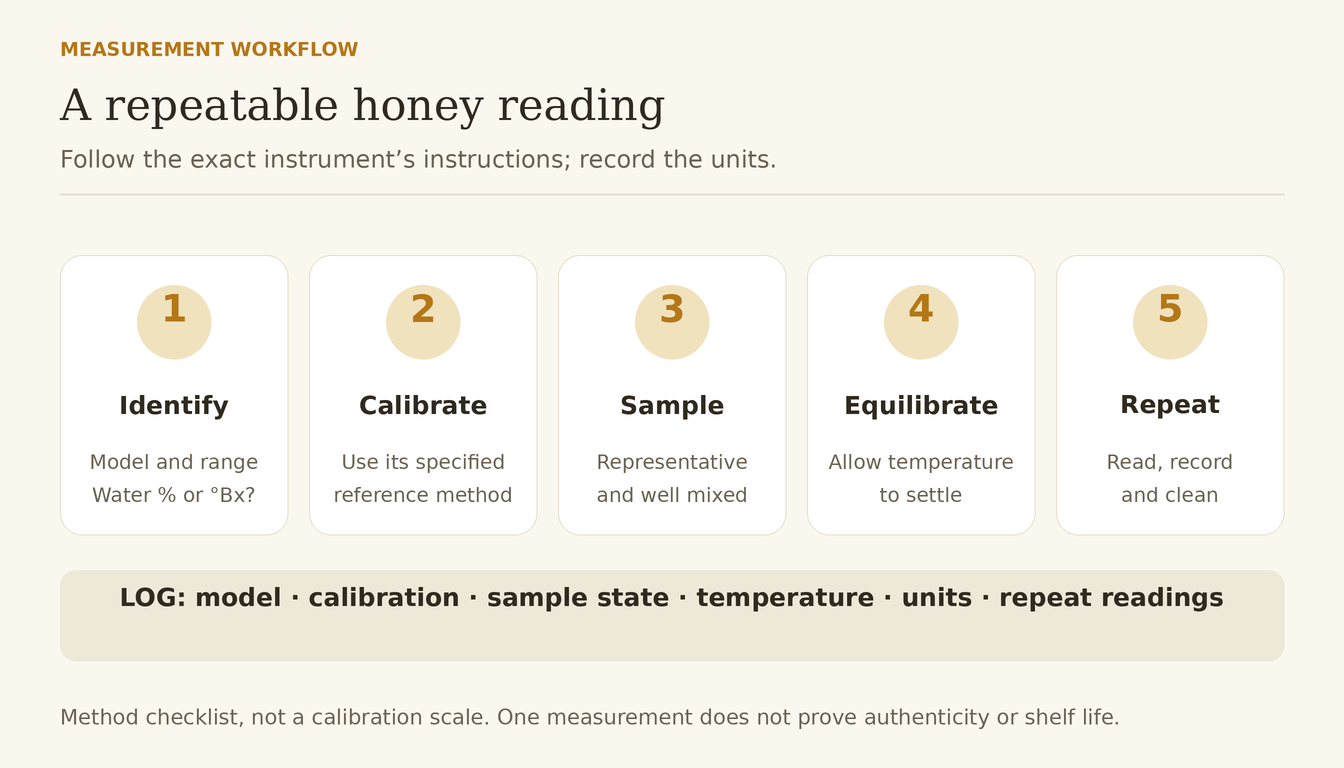
A useful honey moisture reading starts before the sample touches the prism: identify the instrument, calibrate it as its manufacturer directs, prepare a representative sample, let temperatures settle and repeat the measurement. Keep the scale and units beside every number you write down. A bare reading of “82” or “18” cannot tell another beekeeper what you measured.
Check the model number and manual, then inspect the scale. A honey-specific instrument may display “water in honey” or honey moisture %. A general refractometer may display °Bx, or Brix: a sucrose-equivalent scale. The Bellingham + Stanley Eclipse manual lists these as distinct scales. Honey is a mixture, so a Brix reading is not a direct measurement of its individual sugars or water.
Check the range as well. A meter intended for dilute drinks may not cover concentrated honey. For one specific digital example, the ATAGO PAL-22S specification lists 12.0–30.0% honey moisture. That range describes this model; it is not a specification for every device sold as a honey refractometer.
Pro Tip
Write “honey moisture %” or “°Bx” at the top of your record before taking a reading. Do not switch between the two units midway through a batch.
2. Calibrate using the exact model’s instructions
Find the calibration section for your exact model, including its required reference material, reference value and temperature. Gather that material before opening the honey. Use the manufacturer’s stated acceptance criterion to decide whether the check passes; do not invent a tolerance from the number of decimal places on the display.
The PAL-22S documentation specifies calibration with water. By contrast, the Eclipse manual distinguishes low-range models that can measure water from high-range models that cannot, and directs the latter to an appropriate certified reference material. These instructions explain why “calibrate every honey refractometer with distilled water” is unreliable. A zero-Brix mark may be outside your instrument’s range entirely.
Start with a clean, dry prism. Apply the prescribed reference, allow the instructed settling time, then check or adjust as directed. Some models have an adjustment screw; others use buttons or a fixed calibration. An unexpected result is a reason to check the reference, temperature and cleanliness before changing anything. Record the reference and outcome, and remove all calibration material before applying honey.
Avoid substituting a pantry ingredient or another jar of honey for a specified standard. An unknown sample cannot establish a known calibration point. If the manual is missing, obtain it from the manufacturer or seller rather than borrowing instructions for a similar-looking instrument.
Get the Honey Buyer's Cheat Sheet (free PDF)
16 varieties on one page — color, flavor, best use and what a fair price looks like — from the 268 honeys we track.
3. Decide what your sample needs to represent
Name the material you are assessing: one jar, one mixed extraction lot, or honey from a particular frame. Those are different sampling questions. A repeatable measurement of one drop does not establish that the drop represents an entire harvest. For a formal sale, competition or laboratory report, use the sampling plan required by that recipient.
For a jar or small prepared sample, mix the material rather than scooping only from the surface. The International Honey Commission’s sampling guidance calls for representative material and at least three minutes of stirring, minimizing introduced air. Use clean, dry sampling utensils and keep the container covered between transfers.
For frames or multiple containers, label samples separately when you need to learn whether they differ. Combining them into one sample answers a question about the mixture and hides that variation. Record where each sample came from. If you are assessing an already mixed lot, take your test portion from that prepared lot instead of treating one convenient jar as its substitute.
Pro Tip
Keep two questions separate: “Do repeat readings of this prepared sample agree?” and “Does this sample represent the material I plan to label or harvest?”
4. Prepare crystallized honey without selecting the liquid layer
Partly crystallized honey needs extra care. The free liquid above or between crystals is not a substitute for the whole sample. Describe the starting condition in your notes: liquid, partly crystallized or firmly crystallized. If you cannot prepare a uniform test portion, pause the measurement rather than assigning the liquid layer’s result to the entire jar.
The IHC sampling section allows a hard mass to be softened at no more than 40°C before mixing. Its separate Method 1 dissolution step rehomogenizes the prepared sample, uses an airtight flask in a 50°C (±0.2°C) water bath until all sugar crystals dissolve, then cools it to room temperature and stirs again. These are distinct preparation stages, not interchangeable heating instructions.
That is a controlled analytical preparation, not a direction to warm a whole harvest casually or a claim that heating leaves every honey property unchanged. Do not add water to make the sample easier to measure. Do not use an open-container shortcut that can change its water content. If you lack the equipment to maintain the stated conditions, ask the instrument supplier or testing laboratory for an appropriate preparation procedure.
5. Let the sample and instrument reach measurement temperature
Set the instrument and covered sample in the same stable location before measurement. Avoid moving directly from a cold storage room to a warm bench, or from a hot vehicle into a cool room. A heated test portion must cool before it goes on the prism. Record the sample or instrument temperature available to you, and identify which one you recorded.
Automatic temperature compensation, usually marked ATC, works within the model’s stated conditions. It does not remove the need for equilibration. The PAL-22S specifies a 10–40°C measurement range with ATC; follow that model’s operating instructions rather than applying the range to another meter. For instruments without ATC, use their specified temperature procedure or correction table.
The IHC reference table is at 20°C. Its two-minute wait belongs to the described Abbé procedure, not every handheld digital meter. Likewise, a digital display appearing quickly does not prove that a cold sample and warm instrument have equilibrated. Follow the manual’s settling instructions, and investigate readings that continue changing. Do not apply a second temperature correction to an already compensated result.
- Identify the model, scale and usable range.
- Check calibration with the reference required by that model.
- Prepare and label a representative, uniform honey sample.
- Equilibrate the sample and instrument within the specified temperature conditions.
- Apply honey, repeat with fresh portions and record readings with their units.
6. Cover the measuring surface evenly and read the correct scale
Inspect the prism for residue and moisture before loading. Apply enough prepared honey to cover the measuring surface specified in the manual, with even contact and no trapped bubbles. A tiny dot that leaves part of the active surface uncovered is not a reliable shortcut. Use a suitable non-scratching applicator; avoid dragging a metal spoon across optical glass.
On an analog instrument, close the daylight plate gently and inspect the honey film. Look toward an appropriate light source, focus the scale with the eyepiece and read where the light–dark boundary crosses the required scale. A blurry boundary calls for inspection and a fresh application. Focusing makes the scale legible; it does not calibrate the instrument.
On a digital instrument, cover the prism or sample well as directed and start the measurement. Respect its sample-volume requirement: the PAL-22S specifies at least 0.3 mL. Record the displayed unit and any error message. An out-of-range result should lead you back to the model’s range and the sample preparation, not to dilution followed by an improvised correction.
7. Repeat the measurement and keep the original readings
Take at least two independent applications from the prepared sample, cleaning and drying between them. Reloading is more informative than repeatedly looking at the same honey film. Keep every reading, then compare them with the repeatability or acceptance guidance supplied for your instrument and procedure. If they disagree, investigate before calculating a reassuring average.
Here is an illustrative record, not a test performed for this article: a honey-specific meter with 0.1% display resolution gives 17.6% and 17.8% on fresh applications of one prepared liquid sample. Their arithmetic mean is 17.7%, and their spread is 0.2 percentage points. Record all three values alongside the model, calibration result and temperature. This example shows the arithmetic; it does not establish an acceptable spread for your meter.
A pair such as 17.2% and 18.6% deserves investigation: inspect prism coverage, residual rinse water, sample uniformity, temperature and calibration. Do not silently discard the less convenient result. Display resolution, instrument accuracy and agreement between repeats describe different things; extra digits in an average cannot improve the instrument’s accuracy.
8. Use a short instrument and sample recording checklist
Keep this record with the batch rather than relying on a photograph of the display alone. It makes a later comparison useful: you can see whether the honey changed or whether the instrument, preparation or units changed. Leave unknown fields marked unknown instead of reconstructing them from memory.
- Date, operator, sample ID and material represented: jar, frame or mixed lot.
- Instrument manufacturer and model; scale, range and display resolution.
- Calibration reference, required value, check result and any adjustment.
- Starting sample state, sampling locations and mixing or crystal-dissolution procedure.
- Temperature recorded, where it was measured, equilibration time and ATC status.
- Each fresh-application reading with units; spread and any reported mean.
- Errors, preparation problems, repeat checks and the reason for any rejected reading.
9. Clean promptly and troubleshoot before the next sample
Remove honey after the reading using the cleaning procedure and materials approved for the model. Clean the sample-contact plate as well as the prism on an analog meter. Finish with a dry measuring surface before the next application; leftover rinse water would become part of the next sample. Keep cleaning liquid away from parts that the manufacturer does not permit you to wet.
The Eclipse manual identifies insufficient sample, temperature gradients and incomplete cleaning or drying as possible causes of a poor boundary. If a fresh application remains unclear, revisit those causes and the calibration check. Keep a note of recurring errors so the supplier can help distinguish a preparation problem from instrument damage.
Do not generalize one model’s washing instructions: the PAL-22S brochure permits rinsing under running water, but that does not establish that another digital meter can be rinsed or immersed. Let cleaned parts dry as instructed, then store the instrument in its case.
10. Interpret moisture separately from Brix and storage predictions
The IHC method derives honey water content, expressed as a percentage by mass, from refractive index and a honey reference table. It is not simply 100 minus Brix. If your meter displays only °Bx, use a validated honey conversion appropriate to its measurement conditions, or obtain a honey-specific instrument or laboratory result. The ATAGO Brix-to-refractive-index table illustrates that Brix is its own scale.
Our honey Brix calculator turns a Brix input into a derived moisture estimate. Treat that output as an estimate under the calculator’s stated assumptions, not an instrument-calibration procedure or a substitute for checking your sample and device. Preserve the original Brix reading and units in your record, together with the conversion method, rather than relabeling the estimate as a direct honey-moisture reading.
For the broader explanation, read honey moisture content. With a measured moisture value, the fermentation-risk tool lets you explore a storage model; its output is conditional. Refractometry alone does not identify botanical origin, prove authenticity, test for contaminants or guarantee safety or shelf life. A moisture reading is one measurement, and a legal or buyer specification requires its own applicable standard and sampling procedure.