Tynwald and the Single-Legislature Architecture: Closing the BCD Triangulation
The Isle of Man (Ellan Vannin in Manx Gaelic) is the largest of the three British Crown Dependencies (BCDs) at 572 km² and approximately 84,000 residents (2021 census), the other two being the Bailiwick of Jersey (118.2 km², ~103,267 residents) and the Bailiwick of Guernsey (62 km² across four inhabited islands, ~63,000 residents). It sits in the Irish Sea at roughly equal distance from England, Scotland, Wales, Ireland, and the Northern-Irish coast — geographically central to the Atlantic-Archipelago, constitutionally distinct from each. Like Jersey and Guernsey, the Isle of Man is a self-governing jurisdiction under the Crown that is neither part of the United Kingdom nor of the European Union: foreign affairs and defence are exercised by the UK Government and primary legislation receives Royal Assent through the Privy Council via Orders in Council. The constitutional inheritance is, however, structurally distinct from the two Channel Island Bailiwicks — and that distinction closes a load-bearing axis the BCD sub-cluster's first two members opened but did not exhaust.
The Isle of Man is governed by Tynwald (Manx: Tinvaal, from the Old Norse Þingvöllr meaning assembly-field), the world's oldest continuously functioning parliament, traditionally dated to AD 979 — over a thousand years of unbroken legislative continuity, predating England's Parliament (which traces to the 13th century via the 1215 Magna Carta and the 1265 Simon de Montfort summons), the Icelandic Althing's 13th-century interruption, and every other contemporary national legislature. Tynwald is bicameral in modern form: the directly elected House of Keys (24 Members) and the indirectly chosen Legislative Council (eight non-voting members plus the Bishop of Sodor and Man, the President of Tynwald, and the Attorney General as ex officio). The two chambers sit jointly each 5 July as Tynwald Day on Tynwald Hill at St John's, where the Lieutenant Governor and the Bishop sit on the terraced mound and laws passed during the previous session are formally promulgated in both Manx and English — the only legislative ceremony of its kind in the world that has continued unbroken since the Viking-era Norse-Gaelic kingdom of the Isles.
The single-legislature Tynwald architecture closes the BCD sub-cluster's legislative-architecture triangulation. Jersey is governed by the States Assembly (single legislature, 49 members, sitting at the States Building in St Helier — the BCD's middle-architecture case). The Bailiwick of Guernsey is governed by three legislatures bound to a single Order-in-Council ceiling by reciprocal-recognition provisions (States of Deliberation for Guernsey + Herm at the Royal Court House St Peter Port; States of Alderney at the Island Hall Saint Anne; Chief Pleas of Sark with 28 elected Conseillers since the 2008 Reform Law replaced Europe's last feudal legislature — the BCD's pluralist-architecture case). The Isle of Man's single Tynwald with the world's oldest continuous parliamentary tradition is the BCD's apex-architecture case: a single legislature with the longest unbroken continuity of any legislature within the cluster of clusters this corpus tracks. The three-architecture triangulation — Bailiwick-pluralist Guernsey + single-modern Jersey + single-millennium Isle of Man — is structurally distinct from anything in the European-microstate cluster (which is uniformly single-legislature and ranges in continuity from the Vatican's 1929 Lateran Treaty through Andorra's 1278 Paréages but does not include any millennium-continuous case).
Manx Honey Standards: Adoption by Order Under the Food Act 1996
The Isle of Man's food-standards adoption mechanism is the same Order-in-Council reference pattern shared with Jersey and Guernsey, but exercised through Tynwald-specific primary legislation. The principal enabling Act is the Food Act 1996 (an Act of Tynwald, c.10), which empowers the Department of Environment, Food and Agriculture (DEFA) to make subordinate legislation extending UK food-composition Statutory Instruments to the Isle of Man by reference. The relevant honey-composition instrument is the UK Honey (England) Regulations 2015 (Statutory Instrument 2015/1348) — which transposed EU Council Directive 2001/110/EC (as amended by Directive 2014/63/EU) into UK domestic law and remain in force post-Brexit — extended to the Isle of Man through the Food (Application of Legislation) (No. 2) Order made by DEFA under section 47 of the Food Act 1996. The composition limits in force on the Isle of Man are therefore the same as in England: moisture ≤20%, HMF ≤40 mg/kg, diastase activity (Schade) ≥8 units (or ≥3 for naturally low-diastase varieties), electrical conductivity ≤0.8 mS/cm for blossom honey and ≥0.8 mS/cm for honeydew, plus the Annex II sugar profile. Enforcement runs through DEFA Environmental Health at Thie Slieau Whallian, St John's; analytical testing for any Manx sample requiring official confirmation routes to UK reference laboratories — Fera Science Limited at Sand Hutton, York, or the Government Chemist function at LGC Group, Teddington — on a fee-for-service basis, the same routing as Jersey, Guernsey, and English commercial-scale samples.
The Isle of Man's Food Act 1996 is itself instructive as the BCD sub-cluster's most-recently-modernised primary food-law statute: Jersey's Food Safety (Jersey) Law 1966 and Food and Environment Protection (Jersey) Law 1998 form a two-Act foundation; Guernsey's Food Standards (Guernsey) Ordinance 2008 modernised an older 1953 ordinance; the Manx Food Act 1996 consolidated and replaced a series of earlier 1956 and 1979 Acts and Orders. The three jurisdictions therefore share a structurally-identical adoption-by-reference mechanism but operate it under primary legislation drafted across three distinct decades — a useful empirical demonstration that the Order-in-Council reference pattern is robust across legislative generations rather than being tied to any single drafting era. Pre-Brexit the Isle of Man was inside the EU customs territory under Protocol 3 of the UK's 1972 Treaty of Accession, the same instrument that bound Jersey and Guernsey; from 1 January 2021 the Isle of Man trades with the EU as a third country under the UK-EU Trade and Cooperation Agreement (TCA). The Isle of Man also operates a Customs and Excise Agreement with the UK that creates a de facto customs union with the United Kingdom (the Isle of Man Customs and Excise Acts 1986 + the 1979 Customs and Excise Agreement) — a notable structural distinction from Jersey and Guernsey, which are NOT in customs union with the UK. The Manx-UK customs arrangement does not affect honey-composition limits but does affect cross-Irish-Sea trade documentation: a Manx-origin jar of heather honey shipped to England requires no customs declaration, whereas a Jersey- or Guernsey-origin jar does.
The Isle of Man also maintains Manx Government Veterinary Service oversight of apiary health under the Bee Diseases and Pests Control (Isle of Man) Order 2004 (as amended), which is the Manx-specific implementing instrument for the European foulbrood (Melissococcus plutonius), American foulbrood (Paenibacillus larvae), and small hive beetle (Aethina tumida) notifiable-disease regime. The Manx Bee Inspector function is operated through DEFA on a part-time basis; the Manx Beekeepers Association (MBKA) provides volunteer disease-monitoring support across the island's apiaries. The Isle of Man has not had a confirmed small hive beetle detection as of 2026 and remains within the cluster of British-Irish jurisdictions classified as low-risk for that pest, which has practical consequences for the island's queen-import policy and for any future SICAMM-aligned mating-station programme on the Calf of Man (discussed in the subspecies section below).
Get the Honey Buyer's Cheat Sheet (free PDF)
16 varieties on one page — color, flavor, best use and what a fair price looks like — from the 304 honeys we track.
Manx Beekeepers Association and the Manx Bee Improvement Group: SICAMM-Aligned Native-Bee Conservation
The Manx Beekeepers Association (MBKA), founded in the 1940s (with member-society records placing the founding meeting in 1947 — the same year as the Jersey Beekeepers' Association), is the island's principal apicultural body. Active membership has historically run in the 60–120 range with an estimated active hive count of approximately 250–500 colonies across the island; production estimates from MBKA forage notes and from DEFA agricultural-statistics surveys place total annual production at 5–18 tonnes per year, with year-to-year variation depending on weather, Varroa pressure, and the availability of the heather flow on the Manx Hills upland (which fluctuates more than the Channel Islands lowland hedge-bank-and-bramble forage). The MBKA is the latest-founded of the three BCD apicultural bodies — predated by the Guernsey Beekeepers' Association (GBKA, 1928) by approximately 19 years and by the Jersey Beekeepers' Association (JBKA, also 1947) by zero or a few months depending on which founding-meeting record is cited as canonical. The MBKA's organisational pattern is also distinct: it operates more strongly as a federated network of local apiary-based clusters across the four traditional sheadings (Glenfaba, Michael, Garff, Ayre) rather than as a single centralised body comparable to the JBKA's Trinity-centred structure or the GBKA's St Peter Port-centred structure.
The MBKA's most distinctive structural feature, however, is its affiliated Manx Bee Improvement Group (MBIG) — established in the early 2010s with explicit alignment to the Native Honey Bee Society of the British Isles (NIHBS, founded 2010) and the SICAMM (Société Internationale pour la Conservation de l'Abeille Noire / International Association for the Protection of the European Dark Bee) framework. The MBIG operates the BCD sub-cluster's most active native-bee conservation programme: a queen-rearing initiative focused on the retained Apis mellifera mellifera (the European Dark Bee) population, member-apiary morphometric and (in collaboration with academic partners) mitochondrial-DNA assessment of subspecies status, and an active mating-station candidate-site assessment programme that has identified the Calf of Man (Manx: Yn Cholloo) — a 2.6 km² uninhabited island ~1 km off the southern tip of the main island, a Manx Wildlife Trust nature reserve and one of the Atlantic Archipelago's most important seabird-breeding sites — as a structurally favourable site for a future SICAMM-aligned mellifera-only mating station. The Calf is too small to support a permanent year-round commercial apiary but the topography (the channel separating it from Spanish Head and Cregneash on the main island is sufficient to prevent reliable queen-and-drone mating crossings outside of unusual wind conditions) and the absence of resident managed colonies make it a candidate analogue to Læsø in Denmark, where a similar small-island mating-station programme has supported European Dark Bee conservation since the 1990s.
The Manx native-bee conservation work matters non-trivially for the BCD sub-cluster's editorial framing because the Isle of Man closes the conservation triangle that Jersey and Guernsey opened. Jersey's Apis mellifera mellifera population was effectively lost during the 1998 Varroa arrival and the post-arrival Buckfast / Carniolan / ligustica import wave (the 'rebuild from imports' position). Guernsey occupies the intermediate position with an estimated 15–35% mellifera-introgression range, the legacy of the 1992 Varroa arrival driving slightly earlier and stronger import response than Jersey. The Isle of Man retained substantially more mellifera through the Varroa transition — published estimates from MBIG morphometric work and from collaborating academic mitochondrial-DNA studies (notably the 2014–2018 Liverpool John Moores University and Plymouth University collaborations with NIHBS) place the Manx population at approximately 50–80% mellifera-mitotype prevalence, the highest in the BCD sub-cluster and among the highest in the Atlantic-Archipelago outside of dedicated mating-station programmes. The Manx Varroa arrival itself was structurally later than the Channel Islands' — published MBKA records place the first confirmed Manx Varroa detection in approximately 2002–2003, ten years after Guernsey's 1992 arrival and four to five years after Jersey's 1998 arrival — which gave the MBKA a longer pre-arrival preparation window and a slower import-replacement curve, both of which are load-bearing for the higher mellifera-retention outcome.
The Manx Forage Calendar: Heather Uplands, Manx Hills & the Lowland Hedge-Bank Continuity
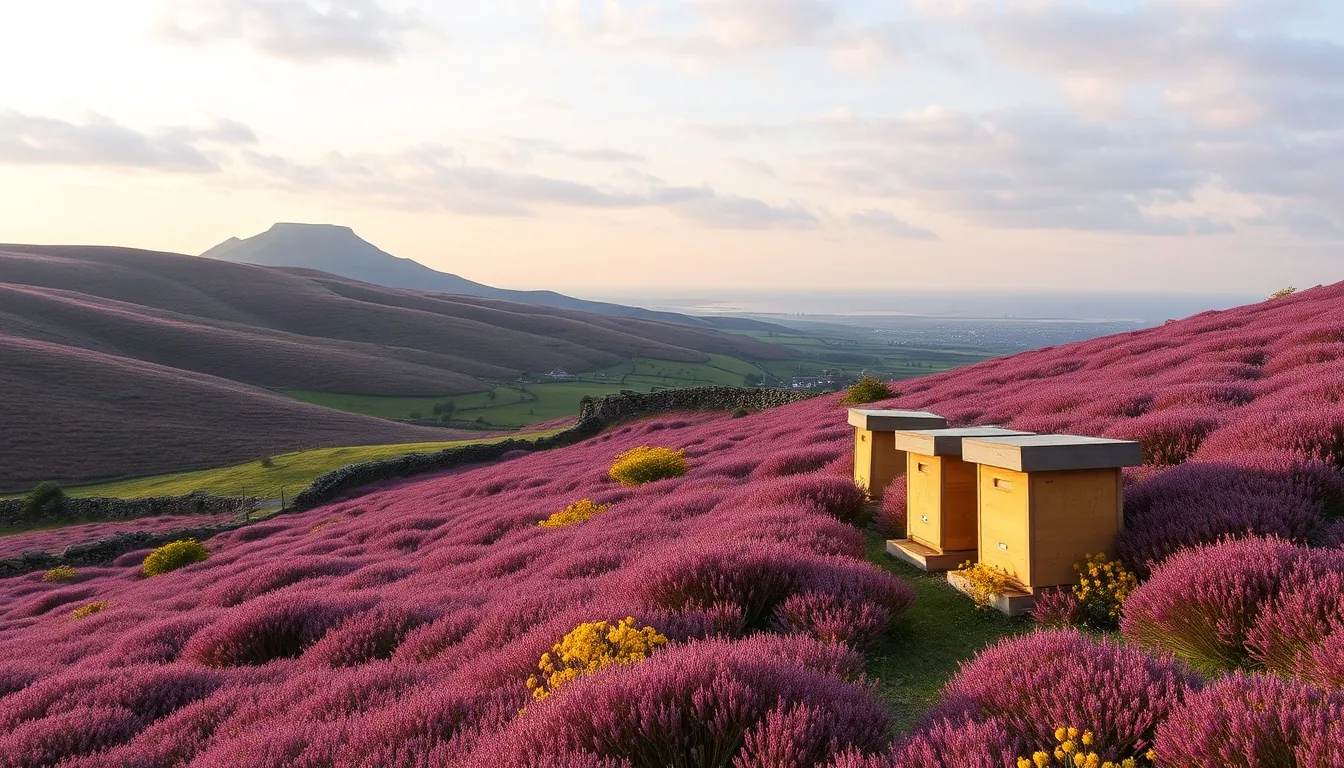
The Isle of Man's forage profile is the BCD sub-cluster's most strongly bipartite — and structurally distinct from the uniformly hedge-bank-and-bramble-and-douit lowland forage that defines Jersey and Guernsey. The island's central spine is the Manx Hills upland (Sniaefell at 621 m as the highest point, with North Barrule, Pen-y-Phot, Slieau Freoaghane, South Barrule, and Cronk ny Arrey Laa forming a continuous high ridge running north-east to south-west across the island's interior), supporting an extensive Calluna vulgaris (ling heather) and Erica cinerea (bell heather) blanket-bog and dry-heath community on the high ground above approximately 250 m. The lowland mosaic of the Manx coastal plain — the Curragh wetlands of the north, the small-field arable and pasture of the central lowlands, the south-coast valleys of Castletown, Port Erin, and Port St Mary — supports a hedge-bank-and-gorse-and-bramble forage continuum structurally similar to the Channel Islands but operated under cooler-and-wetter Irish-Sea maritime conditions (mean annual temperature ~9.5 °C compared to Jersey's ~11.5 °C, with significantly higher annual rainfall on the upland — Snaefell summit averages over 2,000 mm/year against Jersey's ~870 mm).
The bloom calendar reflects the bipartite profile. Lowland: gorse (Ulex europaeus) from late February into March; willow (Salix species) and dandelion (Taraxacum agg.) in March; blackthorn (Prunus spinosa) and hawthorn (Crataegus monogyna) in April–May; bramble (Rubus fruticosus aggregate) through May, June and into July (the dominant lowland nectar source, structurally identical to its Jersey and Guernsey position); white clover (Trifolium repens) on grassland in June–July; lime / linden (Tilia × europaea) in urban-edge plantings in Douglas, Ramsey, Peel, and Castletown in late June; and the late-season ivy (Hedera helix) flow from late September into November. Upland: the Calluna vulgaris main flow runs from approximately mid-August into mid-September (varying year-to-year with summer temperatures), preceded by the bell heather (Erica cinerea) flow in late July through mid-August, and supplemented by bilberry / Manx fraughan (Vaccinium myrtillus) and hawkweed (Hieracium agg.) on the hill-edge grasslands. The Manx heather honey crop is the BCD sub-cluster's signature high-value variety: produced on the Calluna-dominant uplands by colonies migrated from lowland apiaries to Manx Hills heather sites in late July, it carries the same characteristic dark-amber colour, the high-thixotropy gel texture (Calluna honey's pseudoplastic non-Newtonian rheology is one of its taxonomically distinctive features, requiring press-extraction or perforated comb-loosening rather than centrifugal extraction), and the bittersweet-resinous flavour profile that defines Scottish, Welsh, and Yorkshire-Moors heather honey. Manx heather honey is structurally indistinguishable from premium English / Scottish / Welsh heather honey by laboratory analysis but is consistently described in MBKA tasting notes as carrying a lighter floral top-note attributed to the bilberry and hawkweed admixture that runs alongside the main Calluna flow.
There is no PDO, PGI, or UK Geographical Indication registration for any Isle of Man honey variety under the UK GI register administered by Defra (the same scheme that protects, in the BCD sub-cluster context, Jersey Royal potato but not Jersey honey, and which protects no Guernsey honey variety). No application has been filed for Manx-origin heather honey or for the lowland hedge-bank multifloral, despite the structural distinguishability of Manx heather from the lowland mainland-British heather production zones (Yorkshire Moors, North York Moors, Scottish Highlands, Welsh Cambrian Mountains). The MBKA's strategic focus has historically been on disease management and on the MBIG's native-bee conservation work rather than on commercial-marketing GI infrastructure. A future Manx GI application — for example for a 'Manx Heather Honey' or 'Mooar Heatheragh' (Manx Gaelic, mountain heather) variety produced on the Manx Hills uplands by MBIG-aligned mellifera-introgressed colonies — is a structural possibility under the post-Brexit UK GI framework but remains hypothetical as of 2026.
Where the Isle of Man Sits in the British Crown Dependencies Sub-Cluster: The Closing Member
The Isle of Man is the third and closing member of the British Crown Dependencies (BCDs) sub-cluster within the broader Adopted-by-Reference taxonomic frame, opened by Jersey 2026-04-30 and extended by Guernsey 2026-04-29. With the Isle of Man's standalone case the BCD sub-cluster reaches three-member completion and becomes synthesis-page-eligible — the natural editorial follow-up is `/learn/british-crown-dependencies-honey-cluster`, structurally parallel to the existing `/learn/european-microstate-honey-cluster` page that synthesises Andorra + Liechtenstein + San Marino + Monaco + Vatican City under the treaty-and-customs-union mechanism. All three BCD jurisdictions adopt UK food-composition law by Order in Council under their respective constitutional frameworks; all three lost their pre-Brexit EU customs-territory access at the end of 2020 under Protocol 3 of the UK's 1972 Treaty of Accession and now trade with the EU under the UK-EU Trade and Cooperation Agreement; all three host long-established beekeeping associations (GBKA Guernsey 1928, JBKA Jersey 1947, MBKA Isle of Man 1947). The shared Crown-Dependency-by-Order-in-Council structural mechanism — without customs union with the parent state for two of the three (Jersey + Guernsey) and with customs union for the third (Isle of Man under the 1979 Customs and Excise Agreement) — distinguishes the BCD sub-cluster from the European-microstate cluster's treaty-and-customs-union mechanism while sharing the Adopted-by-Reference frame.
The Isle of Man closes the three internal differentiation axes that Jersey opened and Guernsey extended, creating a clean three-member triangulation that the future synthesis page can foreground as its structural spine. First, legislative architecture: Jersey's single States Assembly (modern, ~150-year continuity at the current institution) + Guernsey's three legislatures bound to one Order-in-Council ceiling by reciprocal-recognition (multi-island-Bailiwick pluralism with Sark's 2008-Reform-Law modernised feudal continuity) + the Isle of Man's single Tynwald (millennium-continuous unbroken since AD 979) = three structurally distinct Crown-Dependency parliamentary architectures under one shared Order-in-Council adoption ceiling, the cluster's principal architectural-pluralism axis. Second, beekeeping-association founding-date continuity: GBKA 1928 (earliest, predating both other associations by approximately two decades) + JBKA 1947 + MBKA 1947 = a longest-continuity axis with Guernsey at the apex. Third, Apis mellifera mellifera retention: Jersey's near-loss after the 1998 Varroa arrival (the conservation low) + Guernsey's intermediate 15–35% mellifera-introgression after the 1992 Varroa arrival (the cluster's natural midpoint) + the Isle of Man's substantially-retained ~50–80% mellifera-mitotype prevalence after the ~2002–2003 Varroa arrival, supported by the active MBIG / NIHBS / SICAMM-aligned breeding programme and the Calf of Man mating-station candidate site (the conservation apex). The Varroa-arrival-stagger across the three BCDs (Guernsey 1992 + Jersey 1998 + Isle of Man ~2002–2003) gives the sub-cluster a useful natural-experiment dimension on the relationship between mite-arrival timing, import-replacement intensity, and surviving mellifera-mitotype prevalence — a pattern worth foregrounding on any future synthesis page.
The cluster-of-clusters now spans nine jurisdictions across two sub-clusters: five European microstates (Andorra, Liechtenstein, San Marino, Monaco, Vatican City) under the treaty-and-customs-union Adopted-by-Reference variant + three British Crown Dependencies (Jersey, Guernsey, Isle of Man) under the Order-in-Council Adopted-by-Reference variant. The Isle of Man's ship-as-the-third-BCD-member confirms the broader Adopted-by-Reference taxonomic frame is robust across nine jurisdictions, two structurally-distinct adoption mechanisms (treaty-and-customs-union vs Order-in-Council), and forage zones from high Pyrenean (Andorra) through Rätikon Alpine (Liechtenstein) through sub-Apennine (San Marino) through Mediterranean Riviera garrigue (Monaco) through Mediterranean Sclerophyll on Castelli Romani volcanic soil (Vatican City) through North-Atlantic-maritime hedge-bank-and-bramble (Jersey + Guernsey) through Irish-Sea-maritime heather-upland-plus-lowland-hedge-bank (Isle of Man). The framework is now load-bearing on three independent editorial axes — adoption mechanism, native-bee subspecies-conservation status, and characteristic forage zone — across nine jurisdictions, sufficient evidence to count as a cross-jurisdictional pattern in the corpus and as the editorial spine for the future synthesis page.