The Arfaj: Kuwait's National Plant and the Desert Honey Paradox
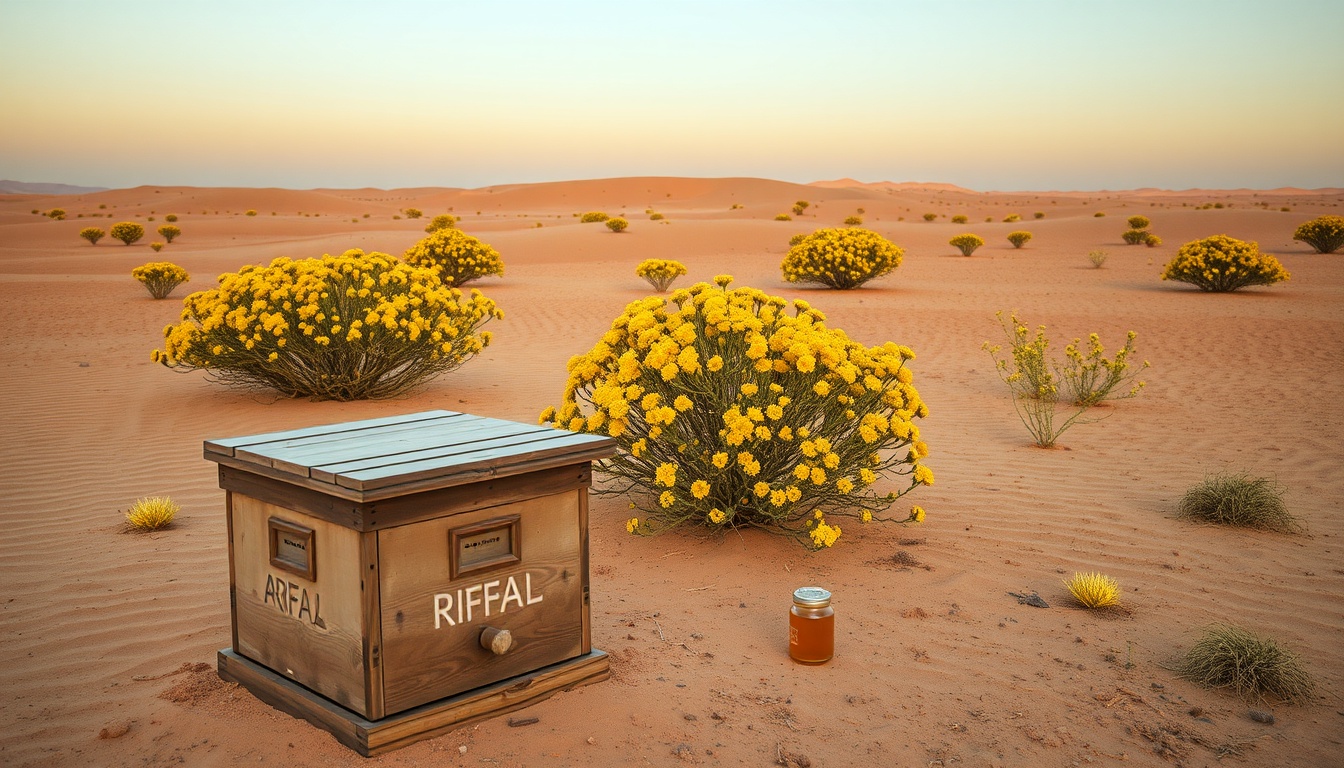
Rhanterium epapposum — the arfaj, known in Kuwaiti Arabic as arfaj (عرفج) — is a low-growing perennial desert shrub with bright yellow composite flowers that blooms spectacularly across Kuwait's interior desert in March and April following winter rainfall. The arfaj is the national plant of Kuwait, designated in recognition of its cultural and ecological centrality to the Kuwaiti Bedouin landscape: generations of desert pastoralists used it for camel fodder, fuel, and as a seasonal calendar marker — the arfaj bloom announced spring and the end of winter hardship. In years of adequate rainfall, the arfaj transforms Kuwait's otherwise brown desert into vivid yellow carpas stretching for kilometres in every direction, a phenomenon that Kuwaitis call the 'greening of the desert' and celebrate in spring desert-camping traditions. The arfaj bloom is photographed and shared widely on Kuwaiti social media each March; it is genuinely spectacular by any standard.
For a honey guide, the arfaj paradox is striking. The plant produces abundant nectar during its 3–5 week bloom, is actively worked by Apis mellifera jemenitica bees throughout its range, and creates conditions for a genuinely distinctive monofloral honey with no exact equivalent in any other country's commercial honey market. Published analyses of arfaj nectar (Rhanterium epapposum is a member of the tribe Inuleae within Asteraceae) indicate sugar concentrations in the range suitable for bee foraging. Yet there is no commercially marketed Kuwaiti arfaj honey brand, no international SKU for Kuwaiti desert wildflower honey dominated by arfaj, and no government program to develop arfaj honey as an export product. The contrast with European honey markets is instructive: Italian acacia honey from Robinia pseudoacacia achieves water-white clarity and delicate vanilla character from temperate Alpine foothills terroir, while Kuwaiti arfaj honey from extreme desert conditions develops distinctive pale amber color with mineral complexity from salt-affected soils and compressed bloom concentration impossible to replicate in mesic European climates. The arfaj paradox mirrors the pattern identified in the 126-country corpus: countries with genuinely unique floral sources and sophisticated honey-consuming cultures that have failed to convert botanical distinctiveness into export identity (Honduras Marcala coffee blossom, Panama Darién stingless bee, Kuwait arfaj — all extreme cases of the same gap).
The arfaj bloom is rainfall-dependent: in low-rainfall years the bloom is sparse or absent, making arfaj monofloral production inherently variable year to year. Kuwait's average annual rainfall is approximately 121 millimetres, concentrated in the December–March window, with high year-to-year variability (some years receive less than 50 mm, others more than 250 mm). In good rainfall years, the arfaj bloom coincides with other spring desert forbs — Convolvulus arvensis (bindweed), Medicago species (medic), Emex spinosa (devil's thorn), and annual grasses — to create a Kuwait-specific spring wildflower polyfloral that is the natural honey of Kuwaiti desert apiaries placed in the interior during March–April. This spring wildflower honey, when harvested fresh from desert apiaries rather than blended with imported product in urban honey shops, is the most authentic expression of Kuwaiti honey production.
Pro Tip
The Kuwait Institute for Scientific Research (KISR) has conducted entomological studies of Kuwait's bee fauna and documented the native Apis mellifera jemenitica population across different habitat zones. KISR's environmental baseline data from the post-Gulf War oil-fire fallout monitoring (1991–1995) includes documentation of desert vegetation recovery including arfaj recolonisation of burned zones — an indirect record of the floral landscape that Kuwaiti bees depend on.
Apis mellifera jemenitica: Desert Bee at the World's Thermal Extreme
The native honeybee of Kuwait is Apis mellifera jemenitica — the same Arabian desert bee present in Saudi Arabia, Bahrain, Oman, Yemen, the UAE, and Qatar. Described taxonomically by Friedrich Ruttner in his landmark 1988 monograph 'Biogeography and Taxonomy of Honeybees' (Springer), A. m. jemenitica is the smallest-bodied Apis mellifera subspecies by worker body mass (approximately 68–80 mg, compared to 90–100 mg for commercial European subspecies A. m. ligustica and A. m. carnica), an adaptation driven by the thermal environment of the Arabian Peninsula. Smaller body mass reduces heat storage capacity per individual worker and increases surface-area-to-volume ratio — facilitating convective and evaporative cooling in ambient temperatures that regularly exceed 50°C in Kuwaiti summer.
Kuwait holds the record for one of the highest reliably recorded air temperatures on Earth: 54.4°C recorded at Sulaibiya on 21 July 2016, verified by the Kuwait Meteorological Department and accepted in the World Meteorological Organization's archives. For A. m. jemenitica colonies in Kuwait, this represents a thermal extreme beyond the tolerance limits of European commercial subspecies: A. m. ligustica Italian bee colonies suffer physiological collapse at sustained temperatures above 48–50°C and experience brood death above 40°C internal hive temperatures. The contrast with temperate beekeeping is striking: German forest honey production from Black Forest Abies alba and Picea abies occurs in mountainous regions with summer maxima rarely exceeding 25–30°C, where bee colonies can maintain optimal brood temperatures (34–36°C) through passive thermal regulation rather than the extreme cooling behaviours required in Kuwait. Kuwaiti A. m. jemenitica populations display three characteristic thermal-response behaviours: bearding (formation of large external bee clusters, reducing internal colony thermal mass), hyper-ventilation (coordinated fanning at hive entrances to maintain evaporative cooling), and absconding (complete whole-colony hive abandonment in response to unmanageable thermal stress, food dearth, or disturbance). Absconding rates in Kuwaiti apiaries are reported by Kuwait Beekeeping Society members as significantly higher than those experienced by beekeepers using European subspecies in temperate climates.
The Iraq-Kuwait border region was historically a zone of Bedouin seasonal movement, and A. m. jemenitica genetic diversity in northern Kuwait reflects gene flow from Iraqi desert populations across Wadi Al-Batin. Published morphometric studies comparing Arabian Peninsula bee populations have not produced a Kuwait-specific subspecific designation — A. m. jemenitica populations in Kuwait are morphometrically continuous with populations across the Gulf and Arabian Peninsula. A concern documented by Kuwait Beekeeping Society members is the progressive hybridisation of Kuwait's managed bee populations with imported queens: Italian (A. m. ligustica) and Carniolan (A. m. carnica) queens are imported from European suppliers and from commercial queen breeders in Saudi Arabia and Bahrain, disrupting the local thermal-adapted jemenitica genetic pool. Feral populations in Kuwait — in rocky outcrops in the Al-Ahmadi ridge area, in irrigation infrastructure cavities, and in scattered palm-trunk hollows in Kuwait City's older residential districts — preserve the most intact jemenitica genetic signatures remaining in the country.
Get the Honey Buyer's Cheat Sheet (free PDF)
16 varieties on one page — color, flavor, best use and what a fair price looks like — from the 304 honeys we track.
The Diwaniyya: Honey as Currency in Kuwait's Hospitality Institution
The diwaniyya (ديوانية) — a uniquely Kuwaiti social institution with no direct equivalent in any other country — is a weekly or regular gathering of men (and, increasingly since the 1990s, women in separate diwaniyyat) held in a dedicated reception room (also called a diwaniyya) typically attached to or adjacent to the host's house. Diwaniyyat function simultaneously as social clubs, political forums, business networking spaces, and community support networks. They are central to Kuwaiti civil society: major political decisions, tribal negotiations, and business partnerships are formed in diwaniyyat before being formalised elsewhere. Attendance at a diwaniyya creates and reinforces social obligations; a family's diwaniyya is a statement of its social standing.
The hospitality culture of the diwaniyya operates through food and beverage service: qahwa (unsweetened cardamom coffee), dates, and — at premium levels — high-quality honey served alongside or incorporated into dishes. Premium honey is one of the most valued diwaniyya gifts: a jar of authenticated Yemeni Sidr honey from Wadi Dawan or Hadramawt, presented to the host of a prestigious diwaniyya, carries a social weight comparable to a fine wine gift in European hospitality culture. The comparison is made explicit by the absence of alcohol in Kuwaiti hospitality: alcohol is prohibited in Kuwait (one of four GCC states with full prohibition alongside Saudi Arabia, Qatar, and Brunei), and premium non-alcoholic gifts — honey, dates, oud (agarwood) perfume, saffron — have correspondingly elevated social value as status markers. Honey is the liquid gold of Kuwaiti gift culture.
The diwaniyya honey market drives extraordinary demand at the premium end of Kuwait's honey retail spectrum. Kuwait's Al-Mubarakiya covered market (the historic central souq of Kuwait City), the Salmiya retail district, and the shopping malls of Hawalli and Farwaniya all contain specialist honey shops offering Yemeni Sidr honey in multiple grades, Saudi Asir highland honey, Omani Sidr, Turkish pine honeydew and Anatolian mountain wildflower, Pakistani Sidr, Iranian Borage, and New Zealand Mānuka alongside Kuwaiti domestic wildflower and arfaj honey where available. The concentration of premium honey retail relative to population size in Kuwait City rivals any honey market in the world — driven not by large production-side supply but by the diwaniyya demand economy for prestige gifting.
Pro Tip
The word 'diwaniyya' (ديوانية) derives from 'diwan' (ديوان), the Persian-origin word for a collection of poems, a royal court, or an official register — the same root as the Ottoman diwan administrative council. The Kuwaiti diwaniyya is linguistically related to the same governmental tradition but functionally evolved into a civil society institution distinct from formal governance, reflecting the merchant families' resistance to Al-Sabah consolidation of political authority in the 19th century.
The Gulf War and the Interrupted Beekeeping Tradition (1990–1991)
Iraq's invasion and occupation of Kuwait (2 August 1990 – 28 February 1991) caused one of the most complete societal disruptions of any modern country over a seven-month period. An estimated 400,000 Kuwaiti citizens — approximately a third of the pre-war Kuwaiti population — fled to Saudi Arabia, the UAE, Egypt, and Western countries during the occupation. Of the third who remained, a significant portion lived under conditions of food insecurity, infrastructure collapse, and systematic looting of Kuwaiti assets by Iraqi forces. The commercial, agricultural, and artisanal production sectors of Kuwait were effectively halted.
Kuwait's small beekeeping sector — concentrated among a few dozen serious practitioners and several hundred hobbyist beekeepers — experienced severe disruption during and after the occupation. Multiple bee narratives have been documented by the Kuwait Beekeeping Society in post-war oral history collections: beekeepers who evacuated moved hives to Saudi Arabia across the border at Rumaila or Khafji, attempting to save genetic material and equipment from looting; those who remained reported that Iraqi forces occupied or damaged apiary sites in the Al-Ahmadi district and the suburban areas south of Kuwait City; the oil-well fires set by retreating Iraqi forces (burning from January through November 1991, with a peak of 739 simultaneous fires) created an atmospheric pollution catastrophe — a pall of black smoke covering Kuwait and parts of Saudi Arabia, Iran, and Pakistan — that reduced bee foraging activity and deposited petroleum particulates on forage plants throughout the spring 1991 bloom season.
Post-liberation recovery was complicated by the oil-field environmental damage. The Kuwait Institute for Scientific Research coordinated a multi-year environmental recovery assessment that documented the fallout from the oil-fire smoke on soil and vegetation across Kuwait. Arfaj stands in the northwestern desert — the primary spring bee-forage zone — were among the most affected, with petroleum soot deposition inhibiting spring 1991 growth. The beekeeping community that rebuilt from 1992 onwards was smaller, older, and less connected to pre-war knowledge networks than the pre-invasion sector. Young Kuwaitis who might have entered beekeeping as a family tradition experienced the occupation as children or in exile; the apprenticeship chain was broken for one generation. The Kuwait Beekeeping Society, refounded in the early 1990s, has worked systematically to document remaining traditional practices and support new-generation beekeepers, but the pre-war beekeeping community's accumulated knowledge of Kuwaiti desert seasonal patterns and A. m. jemenitica management remains incompletely recovered.
Pro Tip
The 1991 Kuwait oil-well fires produced the largest intentional release of oil into the environment in history. Approximately 4–8 million barrels of oil per day burned at peak, with smoke columns reaching 3,000–6,000 metres altitude and measurable particulate deposition recorded as far as Pakistan and the Himalayan foothills. The Kuwait Institute for Scientific Research (KISR) post-fire environmental monitoring program produced one of the most detailed datasets on petroleum-fallout effects on arid ecosystem recovery available for any region — an inadvertent study of extreme anthropogenic stress on the precise landscape that supports Kuwaiti desert beekeeping.
Kuwait as the World's Most Imbalanced Premium Honey Market
Kuwait's honey supply-demand structure is the most extreme of any country in the world: a population of approximately 4.5 million people (including 3.3 million expatriates from South Asia, Southeast Asia, the Arab world, and Western countries) consuming an estimated 3,000–5,000 tonnes of honey annually, against domestic production estimated at fewer than 10 tonnes per year — a supply gap of more than 99.8%. Every conventional honey consumption driver is maximised in Kuwait: high per-capita income (nominal GDP per capita approximately $29,000–35,000 USD), Islamic emphasis on honey as a health food (Quran Surah 16, An-Nahl, 'The Bee': 'there comes forth from their bellies a drink of varying colours, in which there is healing for the people'), alcohol prohibition (elevating honey's social value as a luxury non-alcoholic gift), and Gulf gift culture (diwaniyya hospitality, Ramadan gifting, Eid exchanges, wedding gifts). Kuwait is, by supply-gap ratio, the world's most honey-import-dependent country.
The composition of Kuwait's honey imports reflects both Gulf cultural preferences and global premium honey trade patterns. Yemen remains the prestige origin despite the ongoing civil war since 2015, which has severely disrupted Yemeni export logistics without reducing Gulf demand for Yemeni Sidr — if anything, scarcity has increased premium prices for authenticated Wadi Dawan and Hadramawt Sidr honey at Kuwaiti specialist retail. Saudi Arabian honey from the Asir and Al-Baha highlands is available through the Gulf Cooperation Council's common market framework that allows tariff-free intra-GCC trade. Turkey (pine honeydew, Anatolian wildflower), Pakistan (Sidr from Potohar Plateau and Karakoram foothills), Iran (Borage honey, bidmeshk), and New Zealand Manuka honey with UMF certification represent the most sophisticated authentication system in Kuwait's premium market — UMF ratings provide laboratory-verified Dihydroxyacetone (DHA) and Methylglyoxal (MGO) levels that Yemeni Sidr lacks, creating a premium market dynamic where New Zealand product commands higher trust despite Sidr's cultural prestige.
The authenticity crisis in Kuwait's premium honey market is as severe as in Bahrain and Saudi Arabia. Counterfeiting of Yemeni Sidr honey — blending cheaper Pakistani, Egyptian, or Indian honey with small quantities of authentic Yemeni product, re-labelling, and selling at Yemeni-tier prices — is widely documented in GCC consumer media. Kuwait's consumer protection authority (the Public Authority for Consumer Protection, PACP) has conducted periodic market sweeps testing honey authenticity, but without a domestic honey testing laboratory capable of running NMR spectroscopy, carbon isotope analysis (δ¹³C for C4 sugar adulteration), and melissopalynological pollen identification, enforcement is dependent on imported testing capacity from Saudi SASO, UAE ESMA, or European food analysis laboratories — creating slow response cycles and limited deterrent effect. PACP confiscation records from 2018–2023 include multiple seizures of mislabelled premium honey, primarily in the Al-Mubarakiya and Salmiya retail zones.
Wadi Al-Batin and the Desert Flora: Rimth, Samr, and the Spring Bloom
Wadi Al-Batin (وادي الباطن) — an ancient river valley running northeast from the Najd plateau of Saudi Arabia into northwestern Kuwait and on toward the Shatt al-Arab estuary — is Kuwait's most significant natural landscape feature and its most important zone for traditional desert beekeeping. The wadi is a dry river valley (now an intermittent drainage) that sustained permanent Bedouin settlement and seasonal grazing for millennia; the Kuwait-Iraq border follows part of its course, creating the international boundary that was disputed in the 1990 territorial claims preceding the invasion. In good rainfall years, Wadi Al-Batin's floor and margins support dense stands of desert shrubs and trees, including Ziziphus spina-christi (sidr) in valley-bottom positions where deeper soil retains winter moisture, Acacia tortilis and Acacia ehrenbergiana (samr and salam) on drier slopes, and Haloxylon salicornicum (rimth) across the flat sabkha margins.
Haloxylon salicornicum — the rimth (رمث), a salt-tolerant desert shrub related to the Central Asian white saxaul — is among the most important winter-spring nectar sources for Kuwaiti desert bees. Rimth flowers from December through April, producing small inconspicuous flowers visited heavily by A. m. jemenitica in the cool season when few other plants are blooming. Rimth honey is a winter-season Kuwait specialty: pale amber to golden, with a distinctive mild sweetness and a slightly saline mineral character from the salt-tolerant plant's physiology — similar in some respects to the mangrove honey character noted for Bahrain's Avicennia marina. The contrast with continental wildflower varieties is marked: Texas wildflower honey from mesquite-huajillo-bluebonnet assemblages across vast Great Plains enjoys extended four-season bloom succession and deep soil moisture retention, while Kuwaiti rimth honey depends entirely on sparse winter rainfall and halophytic plant adaptations to hypersaline desert soils, creating concentrated mineral complexity impossible to replicate in Continental climates. Rimth honey from winter desert apiaries in northwestern Kuwait (Jahra governorate, Abdali, and the Wadi Al-Batin margins) is the earliest-season Kuwait honey, harvested in February before the spring arfaj bloom.
Acacia tortilis — the samr (سمر), the umbrella thorn acacia, one of the most widespread trees of the Arabian desert — blooms in spring (March–May) across Kuwait's desert areas wherever deeper soils and wadi margins allow root establishment. Samr nectar production is variable with rainfall but can be abundant in wet years. Samr honey is a spring complement to arfaj honey in Kuwaiti desert apiaries: pale to medium amber, with a delicate, slightly vegetal-floral sweetness distinct from the richer characters of Sidr or acacia varieties. The combination of rimth (winter-spring), arfaj and samr (spring), and any Ziziphus spina-christi available in wadi-bottom sites (autumn, October–November) defines the annual honey cycle of Kuwait's desert beekeeping tradition — a succession entirely dependent on winter rainfall adequacy and summer survival management of A. m. jemenitica colonies through the lethal July–August heat peak.
Pro Tip
Wadi Al-Batin is historically one of the most important camel grazing routes of the Arabian interior, and the plants that feed camels and the plants that feed honey bees are largely the same: arfaj, rimth, and samr are the three primary winter-spring Bedouin camel fodder species and the three primary winter-spring Kuwaiti desert bee forage species. The Bedouin ecological knowledge system — knowing where each plant grows and when it blooms — is directly applicable to desert apiculture. Traditional desert beekeeping knowledge in Kuwait was embedded in the Bedouin seasonal movement system, which is why the occupation-era knowledge disruption (when that community was dispersed as refugees) has been difficult to recover.
Buying Authentic Honey in Kuwait: What to Look For
Kuwait's honey retail landscape divides into three tiers. The first tier is premium authenticated imports: specialist honey shops in Al-Mubarakiya, Salmiya, and high-end mall food halls that carry origin-documented Yemeni Sidr with printed pollen analysis certificates, Saudi Asir honey from named producers with SFDA certificates of conformity, and New Zealand Mānuka with UMF or MGO ratings from the Unique Mānuka Factor Honey Association. These shops exist because diwaniyya gift buyers at the premium level have enough at stake (social reputation as well as money) to demand documentation. The price premium for documentation is real: an undocumented 'Yemeni Sidr' jar at Al-Mubarakiya might cost KD 15–25 (approx. $50–82); an origin-documented jar from the same shop with pollen analysis costs KD 40–120 (approx. $130–392). The second tier is general grocery retail: Lulu Hypermarket, The Sultan Centre, and Carrefour carry a wide range of honey from Turkey, New Zealand, Argentina, and domestic GCC producers at mid-range pricing without authentication documentation.
The third tier — and the most interesting for honey enthusiasts — is direct Kuwaiti domestic production. The Kuwait Beekeeping Society (KBS, جمعية تربية النحل الكويتية) organises an annual honey festival typically held at the Scientific Center in Salmiya or at Kuwait University's agricultural extension grounds, where member beekeepers sell directly to consumers. Kuwait's seasonal agricultural exhibitions (held at the Rumaithiya showgrounds) include honey vendor sections where domestic producers display spring wildflower, arfaj-dominant, rimth, and occasional Sidr honey from Wadi Al-Batin apiaries. Direct purchase from KBS-registered beekeepers is the only reliable channel for authentically domestic Kuwaiti honey — honey from A. m. jemenitica colonies working Kuwaiti desert flora, not imported product re-labelled for the domestic premium market.
A buyer of domestic Kuwaiti honey should ask: (1) Is the beekeeper a KBS member with a registered apiary site? (2) Where are the hives located — urban, peri-urban, or Jahra/Wadi Al-Batin desert zones? (3) What was the primary bloom during extraction — arfaj, rimth, samr, or Wadi Al-Batin sidr? (4) Can the beekeeper provide a harvest date and season? Desert wildflower honey from Jahra governorate apiaries moved into the interior for the March–April arfaj bloom has a completely different floral signature from peri-urban polylfloral honey from Kuwait City apiaries working ornamental planting. The terroir difference is comparable to the gap between pure clover honey USA from Midwest agricultural zones with consistent soil moisture and predictable bloom timing versus Kuwaiti arfaj honey dependent on sporadic desert rainfall and extreme heat stress — both authentic to their regions, but representing completely different ecological and production systems. Both are authentic Kuwaiti honey; only the desert variety represents the arfaj wildflower tradition that is uniquely Kuwaiti.