The Miombo Foundation: Mozambique's Hidden Honey Landscape
Mozambique occupies 801,590 km² of southeastern Africa — a long coastal nation stretching from the Rovuma River on the Tanzanian border to Ponta do Ouro in the south, with the Zambezi valley bisecting it. Roughly 60 percent of the country's interior is covered by miombo woodland, a biome unique to southern-central Africa and largely unknown outside the continent. Miombo is dominated by two genera of nitrogen-fixing leguminous trees: Brachystegia (locally msasa, muzeze, nkwazi) and Julbernardia (munondo). These trees flower in mass-synchronised events between January and March — the dry-season flush — producing extraordinary volumes of pollen and nectar across millions of hectares simultaneously. In ecological terms, the miombo honey flow is one of sub-Saharan Africa's most significant annual events for honeybees, comparable in scale to the Australian eucalyptus flow or the Canadian canola harvest. In economic terms, almost none of it reaches international markets.
The honey produced from the miombo flow is characteristically medium amber to dark amber, with a woody-resinous character and a pleasing structural complexity — the Brachystegia species contribute tannin-adjacent notes that distinguish miombo honey from the lighter floral honeys of the coast. Julbernardia globiflora, the secondary miombo dominant, adds a slightly lighter, more herbaceous layer. In the northern highland zones of Niassa and Cabo Delgado provinces — at 800–1,400 metres, where the miombo transitions toward the miombo-mountain mosaic of the Tanzania and Malawi borders — the honey takes on a cooler, more complex character with longer finish. The domestic market consumes most of this production: informal roadside sales, urban market stalls in Maputo, Nampula, and Beira, and a small cooperative export channel to South Africa. For context on the broader southern Africa honey landscape, see the South Africa honey guide, Tanzania honey guide, and Kenya honey guide.
Mozambique's lack of international honey visibility is partly structural. The country experienced one of Africa's most destructive civil conflicts — the Mozambican Civil War (1977–1992), which followed the Portuguese colonial departure in 1975 — and then, beginning in 2017, an insurgency in the northern Cabo Delgado province that has displaced over one million people. Both disruptions hit rural beekeeping infrastructure hard. The northern provinces — Niassa, Cabo Delgado, Nampula — are simultaneously the zones with the richest miombo honey flows and the most difficult security and logistics environments. The result is that Mozambican honey exists in large natural volumes but is extracted and traded within fragmented, informal local chains rather than consolidated for export at scale.
The Cashew Blossom Paradox: Africa's Largest Cashew Zone, Zero Varietal Honey
Nampula province in northern Mozambique is the agricultural heartland of the country's cashew industry. Mozambique ranks among the top five African cashew producers by raw nut volume, with Nampula and the neighbouring Zambezia province accounting for the majority of production. Anacardium occidentale — the cashew tree — was introduced to Mozambique by the Portuguese in the sixteenth century from Brazil, and by the mid-twentieth century Mozambique had become the world's largest cashew exporter. Colonial-era processing infrastructure at Nacala and Monapo made Mozambican cashew a global commodity. Civil war devastated the industry between the 1970s and 1990s, but since 2000 a significant rehabilitation programme has restored and expanded cashew cultivation in Nampula.
The cashew bloom occurs in the Mozambican dry season, June through August, when the trees produce dense clusters of small, fragrant yellow-orange flowers with easily accessible nectar. The bloom is particularly dense and extended — six to eight weeks across staggered orchard and wild-tree populations — making it one of the longest-duration monofloral honey flows available to Nampula beekeepers. Apis mellifera scutellata colonies in the province work cashew blossoms intensively, and the honey produced from a pure cashew flow is pale amber, with a faintly fruity-sweet character distinct from the darker miombo wildflower honey of the inland zones. Despite the scale of cashew cultivation — hundreds of thousands of hectares across Nampula, Zambezia, and Cabo Delgado — no Mozambican producer has ever characterised, bottled, or marketed a varietal cashew blossom honey for international trade.
The structural reason is the same one that underlies most unnamed honey gaps in tropical agriculture: cashew farming operations are managed entirely for nut production, not for pollinator management. Bees forage on cashew flowers because the flowers are accessible and abundant, not because beekeepers have positioned colonies to capture the flow. Integrated orchard-apiculture systems of the kind that would allow simultaneous nut yield improvement (through enhanced pollination) and honey extraction exist on paper — several FAO and USAID agricultural development programmes have proposed them for Nampula — but practical implementation at scale has not occurred. The cashew blossom paradox is therefore less a market failure than an institutional one: the conditions for production exist, the flowers exist, the bees exist, and the honey opportunity exists, but the coordination between cashew farming and honey extraction has not been achieved. A verified, traceable cashew blossom honey from Nampula — labelled with its paradox — would be commercially compelling in European and US specialty food markets by direct analogy with the coffee blossom honey gap in Honduras, Colombia, and Costa Rica.
A secondary agricultural gap exists in Zambezia province: Colocasia esculenta (taro/cassava) co-cultivation zones in the valley floors, and the extensive Acacia polyacantha savannas of the Zambezi delta, both contribute to a Zambezia lowland honey that is produced in volume but unnamed and uncharacterised. The citrus plantations around Chokwé in Gaza province (irrigated by the Limpopo system) offer a third potential varietal: orange blossom honey from Citrus sinensis orchards in August–September, comparable in aromatic profile to Florida or Spanish orange blossom, but again produced in obscurity.
Get the Honey Buyer's Cheat Sheet (free PDF)
16 varieties on one page — color, flavor, best use and what a fair price looks like — from the 304 honeys we track.
Golo Beekeeping: Makua and Yao Bark-Hive Traditions
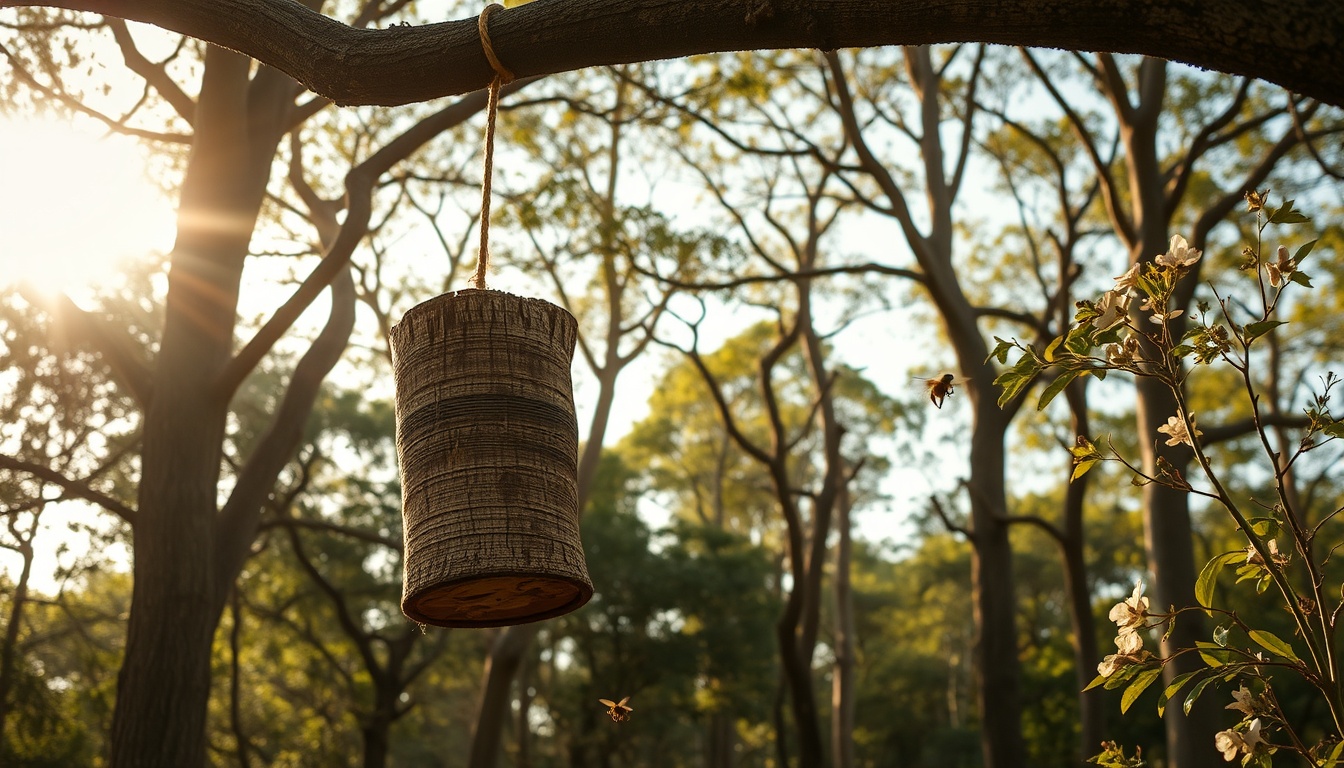
The dominant traditional beekeeping technology across northern Mozambique — in the miombo highlands of Niassa and Cabo Delgado, in the cashew zones of Nampula, and in the Rift Valley escarpment forests of the Malawi border — is the golo: a cylindrical bark-log hive cut from a straight-grained miombo tree, typically Brachystegia spiciformis or Pterocarpus angolensis (padauk/mutcherere), sealed at both ends with bark caps and hung in the upper canopy of a honey tree by rope. The golo tradition is primarily associated with the Makua people (the largest ethnic group in Mozambique, approximately 40 percent of the population, concentrated in the northern provinces) and the Yao people (concentrated in Niassa and the Malawi borderlands). In Makua, the hive is called golo; in Yao, the broader term for honey-hunting and tree-hive beekeeping uses related vocabulary embedded in a longer oral tradition of forest resource management.
The golo system is adapted to the miombo ecology in ways that conventional Langstroth or top-bar hive systems are not. Hanging hives at 5–10 metres in the forest canopy reduces predation by honey badgers (Mellivora capensis, a persistent problem in miombo zones) and reduces ground-level ant incursion. The cylindrical bark construction maintains the thermal mass and humidity profile that A.m. scutellata colonies require in the dry-season miombo climate. Colonisation is natural — bees select the most appealing golo from among several hung in a honey tree grove — meaning the beekeeper makes no investment until the colony is established. Harvest is typically twice yearly: after the miombo January-March flow and after the secondary September wildflower flow. A single productive golo can yield 5–15 kg of honey per harvest; an experienced Makua beekeeper managing 40–80 golo in a 5 km radius operates what is effectively a small commercial apiary with zero input costs for equipment.
The weakness of the golo system — like all traditional bark-hive systems in sub-Saharan Africa — is honey quality consistency. Extraction involves cutting open the bark ends, removing wax and brood comb along with honey comb, squeezing by hand or through coarse cloth, and storing in recycled containers without temperature control. The resulting honey frequently has high moisture content (above 20 percent), elevated pollen and wax particle loads, and accelerated fermentation rates in hot conditions. Development organisations — including the German development agency GIZ through its PROFISH and Agricultural Development programmes, and the FAO through the Mozambique Beekeeping Development Programme — have worked since the 1990s to introduce improved golo designs, mesh-bottom boards for moisture management, and proper extraction equipment. The results are mixed: where investment in post-harvest handling reaches Makua and Yao beekeepers, product quality improves substantially; where it does not, traditional honey is produced and consumed locally at a quality level unsuitable for international markets.
Apis mellifera in Mozambique: The Scutellata–Monticola Transition Zone
Mozambique sits at a biogeographically interesting boundary in the distribution of Apis mellifera subspecies across eastern Africa. The dominant subspecies in the lowlands — from the coastal zones north of Maputo through the Zambezia valley, the Nampula cashew belt, and the Cabo Delgado coastline — is Apis mellifera scutellata, the eastern African honeybee, also the primary component of the Africanised bee complex introduced to the Americas in 1956 via Brazil. A.m. scutellata is well-adapted to the hot, seasonally dry lowland miombo and savanna biomes: highly mobile and responsive to seasonal forage (colonies will abscond and re-establish in response to drought or forage failure), intensely defensive when disturbed, and highly productive when forage is available. The Makua and Yao golo tradition is in part a response to A.m. scutellata's defensive character — working hives at canopy height with smoke and protective gear is standard practice, not optional.
In the highland zones — the Niassa Plateau at 800–1,400 metres, the Marávia highlands near the Malawi-Zambia border, the Gorongosa mountain massif (where the Gorongosa National Park contains some of Mozambique's densest remaining wildlife populations) — the bee population transitions toward morphology characteristic of Apis mellifera monticola, the mountain bee of eastern Africa. A.m. monticola is distributed across the highland zones of Tanzania, Kenya, Rwanda, Uganda, and the Ethiopian Bale Mountains, and is consistently reported by beekeepers as calmer in temperament and more productive in cooler, wetter environments than A.m. scutellata. The highland-lowland transition in Mozambique is not a sharp boundary but a cline — beekeepers in the middle-altitude miombo zones (500–800 metres) typically encounter hybrid populations with intermediate morphology and behaviour.
The practical implication for honey quality is significant. Highland miombo honey from the Niassa Plateau — produced by A.m. monticola or monticola-dominant hybrid populations — is typically cleaner to harvest, lower in moisture (the cooler highland climate supports better in-hive dehydration), and more amenable to management with improved hive designs. If Mozambique develops an export-oriented honey programme, the highland north is the most likely starting point: better bee temperament, better honey quality conditions, proximity to the Malawi export channel (via Blantyre), and an established development-sector presence through Niassa Reserve buffer-zone livelihood programmes.
Stingless Bees and the Coastal Forest Honey
Mozambique's coastal lowlands — the mangrove-backed shoreline from Maputo Bay north through Sofala, Zambezia, and Nampula, and the offshore Quirimbas Archipelago in Cabo Delgado — support Meliponini (stingless bee) populations that are documented but incompletely characterised. The primary genera recorded in the region include Meliponula (formerly included in Dactylurina), Hypotrigona (small, cerumen-pot nesters in tree cavities), and Plebeina (known in nearby southern African woodland zones). The Quirimbas Archipelago and the adjacent coastal forest corridor — one of the few remaining intact coastal lowland forests in East Africa, protected within the Quirimbas National Park — likely hold the most diverse and undisturbed stingless bee populations in Mozambique. Coastal communities on the Quirimbas islands (particularly Quirimba, Ibo, and Matemo) have traditions of collecting honey from small stingless bee nests in mangrove and coastal forest trees, but this has not been developed into any commercial product.
The Makua peoples of the northern coast and the Muani fishing communities of the Quirimbas have specific vocabulary for the small stingless bee species, distinguishing them from the golo-colony Apis mellifera that Makua beekeeper communities manage. 'Small honey' versus 'large honey' distinctions in oral tradition are common across sub-Saharan Meliponini-range societies, and Mozambican coastal communities are no exception. The honey from coastal Hypotrigona and Meliponula nests is characteristically very small in volume per nest (100–300 grams per harvest cycle), intensely flavoured — more acidic, more aromatic, and more complex than Apis honey — and essentially unavailable outside the immediate village context. No commercial stingless bee honey product has ever been documented from Mozambique.
The broader African stingless bee honey situation is one of the most underexplored frontiers in specialty honey globally. Kenya's Trigona honey was characterised in the 2000s by researchers at the University of Nairobi; Uganda's stingless bee sector has been developed through small NGO programmes; South Africa has an emerging Meliponula bocandei sector in KwaZulu-Natal. Mozambique — with extensive coastal forest, a rich Meliponini fauna, and indigenous knowledge traditions for locating and harvesting these nests — is a plausible future entry point for African stingless bee honey if development-sector investment targets the Quirimbas corridor specifically. The combination of marine/coastal tourism (the Quirimbas is an established luxury dive destination), artisanal honey, and coastal forest conservation creates a rare alignment of incentives that could support premium-priced small-batch stingless bee honey at resort and export level.
Finding Authentic Mozambique Honey
Authentic Mozambican honey is almost entirely unavailable in international retail channels. The one consistent exception is through South African specialty food importers and fair-trade retailers — some of whom source Mozambican miombo honey from cooperative programmes near the Malawi and Zimbabwe borders — and through development-sector-linked export programmes such as those coordinated by the Mozambique Beekeeping Development Programme (MBDP) and GIZ agricultural value chain projects in Niassa province. South African specialty stores in Johannesburg and Cape Town occasionally stock branded Mozambican honey under the 'Niassa Honey' or similar cooperative labels, but supply is inconsistent and volumes are small.
Within Mozambique, the most reliable quality sources are cooperative-certified producers in Niassa province (particularly around Lichinga and Mandimba), the Nampula peri-urban markets where small-scale commercial beekeepers sell improved-technology honey with better handling standards, and the premium food stores in Maputo (where a small number of branded domestic honey products from the central and northern provinces are available). The informal roadside honey trade — ubiquitous throughout rural northern Mozambique, with golo-harvest honey sold in recycled bottles at roadsides — is authentic in origin but variable in quality, particularly regarding moisture content and fermentation risk.
For visitors to the Quirimbas Archipelago, lodge and island communities occasionally sell small quantities of coastal wildflower or stingless bee honey produced by local beekeepers; these are worth seeking out as genuinely distinctive and essentially unobtainable elsewhere. Gorongosa National Park's buffer-zone livelihood programme has included community beekeeping components, and the Gorongosa Restoration Project's community partnership network (accessible through park visitor services) is another source of documented-origin Mozambican honey. Any purchase that supports Makua or Yao golo beekeeping cooperatives contributes directly to the preservation of a centuries-old bark-hive tradition that is under pressure from both civil conflict displacement in the north and the gradual replacement of traditional systems by plastic-container and top-bar hive programmes that lack cultural continuity.