The Fynbos Paradox: The World's Most Biodiverse Honey Region with Zero International Premium
The Cape Floristic Region of South Africa's Western Cape province is one of the most extraordinary natural environments on Earth. Classified as a UNESCO World Heritage Site in 2004 and recognized as one of only six global floristic kingdoms, the Cape Floristic Region spans approximately 90,000 square kilometres — roughly the size of the island of Ireland — yet contains 8,700 plant species, of which approximately 69% (around 6,000 species) are found nowhere else on Earth. To put that number in context: the entire British Isles, eleven times larger, supports roughly 1,700 native plant species. The Amazon rainforest, a biome famous for its botanical density, has approximately 40,000 plant species across 5.5 million square kilometres — around 7 species per 1,000 km². The Cape Floristic Region supports 97 species per 1,000 km², making it the most botanically dense region on the planet.
The dominant biome of the Cape Floristic Region is fynbos — from the Afrikaans for 'fine bush,' named for the slender, fine-leaved plants that characterize it. Fynbos is defined by three plant families: Proteaceae (330+ South African species, including the pincushion proteas, sugarbushes, and pagodas), Ericaceae (660+ Erica species in the Cape alone, compared to 26 species in all of continental Europe), and Restionaceae (reed-like plants whose role in nectar production is limited, but whose presence defines the biome). Honey bees foraging in intact Cape fynbos visit dozens of plant families simultaneously in any season — the botanical diversity that fires into bloom across the Cape Peninsula, the Winelands, the Overberg, and the Garden Route from August through November creates one of the most complex nectar environments accessible to commercial beekeeping anywhere in the world.
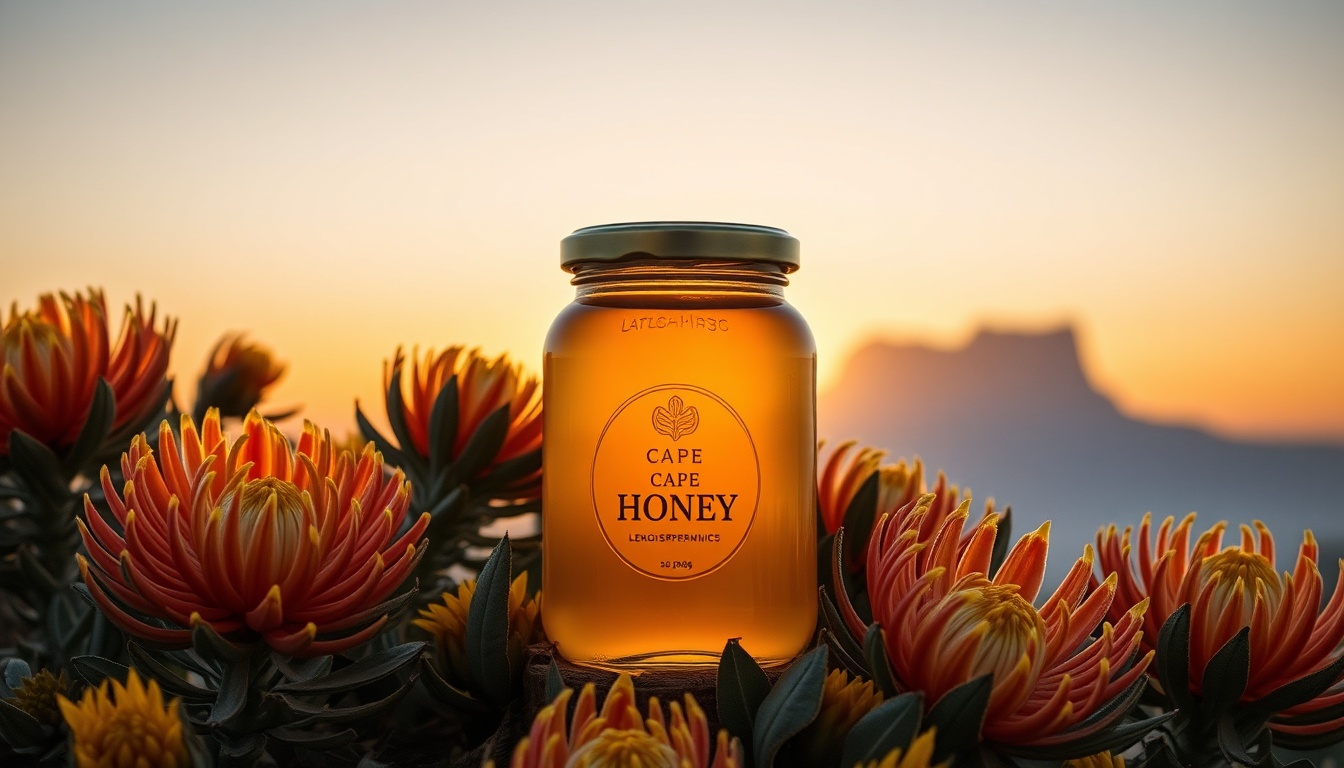
The honey produced from this environment — generically called 'fynbos honey' or 'Cape honey' by South African beekeepers — is made almost entirely from nectar sources found nowhere else on Earth. Yet outside South Africa, virtually nobody has heard of it. Cape fynbos honey does not appear on the menus of honey-forward restaurants in New York or London. It is not stocked in the specialty honey sections of upscale food retailers in Tokyo or Copenhagen. It commands no internationally recognized premium. Generic South African honey in a Western Cape supermarket is priced with commodity honey from Argentina or China. No dated retail price is cited. The anti-Manuka paradox is not about quality: it is about the complete absence of the brand-building infrastructure that transformed New Zealand's Leptospermum scoparium honey into a globally traded commodity. Fynbos honey has a better botanical story than manuka. It does not yet have a better marketing story.
Cape Fynbos Honey — What the Most Biodiverse Biome Tastes Like
Fynbos wildflower honey varies enormously across the Cape Floristic Region's geographic range and seasons, but certain characteristics are consistent across authentic fynbos honey from the Western Cape lowlands and mountains. The base color ranges from light amber (summer, from prolific protea and Erica bloom) to deep amber-brown (autumn harvests from later-season species including buchu, the yellow-flowered Rooibos relatives, and various Cape restio-adjacent species). The flavor has a distinctly herbal quality — not medicinal in the manuka sense, but genuinely complex: floral-herbal with a mild resinous undertone from protea nectars, a faint black-currant note in honey with high Erica and buchu contribution, and a mineral finish that reflects the Cape's ancient, highly leached soils (the Cape Floristic Region's soils are among the oldest and most nutrient-poor in the world, which paradoxically drives its extraordinary plant diversity by preventing competitive exclusion).
Fynbos honey crystallizes at a moderate pace — typically one to three months after harvest at room temperature — because the nectar sources include a mix of high-fructose species (particularly the Proteaceae) and high-glucose species (many Ericaceae). This is distinguishable from the extremely slow crystallization of acacia or tupelo honey. The texture when crystallized is medium-fine, occasionally with the slightly grainy crystalline structure characteristic of European heather honey, reflecting the Ericaceae component. South African beekeepers who manage hives specifically for fynbos honey production typically locate apiaries in fynbos nature reserves and private farmland on the Cape Peninsula, the Elgin Valley, the Breede River Valley, and the Kogelberg Biosphere Reserve — the last of which is sometimes called the 'finest fynbos' by conservation botanists for the density and intactness of its Proteaceae-Ericaceae mix.
Fynbos honey has a specific seasonality that distinguishes it from northern-hemisphere honey. The principal fynbos bloom occurs during the Southern Hemisphere spring — August through November — when the Cape's famously cold, wet winters give way to warming temperatures and the proteas, sugarbushes, and ericas come into flower in succession. A second, lower-intensity nectar flow continues through December and January (the southern summer) before diminishing in the hot, dry February–April period. The autumn flow from March to June is lighter but includes the fragrant buchu shrub and several late-season Erica species. This means a jar of Cape fynbos honey with a labeled harvest date of September–November represents the peak of the Cape's annual botanical flowering — the equivalent of purchasing summer wildflower honey from the Alps at the height of the Alpine season.
Pro Tip
South African fynbos honey labeling follows no standard botanical-source convention, so price and provenance are the best authenticity guides. 'Fynbos honey' or 'Cape fynbos honey' with a Western Cape regional identifier and a named beekeeper or estate is the most authentic form. Generic 'South African honey' or 'Cape honey' without a botanical descriptor may be a mixed-origin blend including Eucalyptus honey from KwaZulu-Natal plantations — botanically and geographically distinct from fynbos. Darker amber fynbos honey from the Kogelberg or Overberg Winelands regions typically represents a higher botanical diversity and more complex flavor than pale-amber Eucalyptus-dominant blends.
Get the Honey Buyer's Cheat Sheet (free PDF)
16 varieties on one page — color, flavor, best use and what a fair price looks like — from the 304 honeys we track.
Leucospermum Honey — South Africa's Non-Peroxide Antimicrobial Story
Among the Cape Floristic Region's 330+ Proteaceae species, the genus Leucospermum — the pincushion proteas — occupies a uniquely important position in both the botanical and honey-science literature. Leucospermum comprises 48 species, of which 45 are endemic to the Cape Floristic Region; the remaining three extend into adjacent South African provinces and the edge of Zimbabwe. Pincushion proteas are among the highest-volume nectar producers in the fynbos — a single Leucospermum cordifolium (heartleaf pincushion) flower head can produce 2–4 ml of nectar per day, and a large plant in full bloom may carry 50–100 active flower heads simultaneously. Commercial beekeepers who position hives adjacent to Leucospermum stands report strong nectar flows from August through December on the Cape Peninsula and Kogelberg, with peak production in October–November.
The significance of Leucospermum honey extends beyond its nectar volume. Research conducted at South African universities, primarily Stellenbosch University and the University of Pretoria, has documented that Cape fynbos honeys — and Leucospermum-dominant honeys specifically — exhibit total antimicrobial activity that exceeds what could be predicted from their hydrogen peroxide content alone. This is the same qualitative finding that underlies manuka honey's UMF (Unique Mānuka Factor) certification system: the discovery, in the 1980s and 1990s, that New Zealand Leptospermum honey inhibited bacterial growth even when H₂O₂ was catalytically removed by adding catalase — proving the existence of 'non-peroxide activity.' For Leucospermum honey, researchers identified elevated total phenolic content and flavonoid profiles (including quercetin, kaempferol, and luteolin glycosides from protea nectars) as potential contributors to the non-peroxide component, though the specific active compound equivalent to manuka's methylglyoxal (MGO) has not been identified or standardized for commercial certification.
This is the anti-Manuka paradox in full scientific detail. Manuka honey commanded zero premium before New Zealand researchers identified MGO, UMF researchers created a standardized assay, and the Unique Mānuka Factor Honey Association built a certification and marketing infrastructure over two decades that tied the scientific finding to a consumer-facing label. South Africa's Leucospermum honey has the first ingredient — documented non-peroxide antimicrobial activity in peer-reviewed literature — but none of the subsequent three. There is no standardized South African assay for Leucospermum non-peroxide activity. There is no 'Cape Fynbos Factor' or 'CFR' certification. There is no industry association coordinating the marketing of Leucospermum honey as a functional food category. A jar of authentic Leucospermum pincushion protea honey from the Cape Peninsula, produced from one of the world's most biodiverse and botanically unique nectar sources, with documented antimicrobial properties beyond the baseline H₂O₂ level, sells for (approximately $4–8 USD) at a Cape Town farmers' market. A jar of UMF 10+ manuka honey from New Zealand sells for $40–80 USD for the same volume in the same market.
Sugarbush, Buchu, and the 660 Ericas — Other Signature Fynbos Varieties
Beyond Leucospermum, the Cape Floristic Region produces several other monofloral or near-monofloral honey types with distinctive characters. Sugarbush honey — from Protea repens, the Common Sugarbush — is perhaps the most distinctly South African variety for consumers who know the country's floral landscape. Protea repens is one of the highest-volume nectar producers of any Proteaceae species worldwide: research by the South African Fynbos Forum has documented individual P. repens flowers producing up to 8 ml of nectar per flower per day, with a sugar concentration of 20–25% — an extraordinarily rich resource. The resulting honey is pale to light amber, mild, and has a clean floral-sweet character with a slight herbal note from the distinctive protea nectar. Commercial Protea repens monofloral honey is produced primarily in the Overberg (Bredasdorp, Caledon, Swellendam), the Swartland (north of Cape Town), and the Winelands (Stellenbosch, Paarl, Franschhoek) during the summer flowering of P. repens from December through March.
Buchu honey occupies a more specialized niche. Agathosma betulina — the round-leaf buchu — is a small, intensely aromatic fynbos shrub endemic to the Cederberg mountains, Swartberg range, and other high-altitude Cape fynbos zones. Buchu's essential oil (principally diosphenol, limonene, and menthone) has made it one of South Africa's most commercially valuable medicinal and aromatic plants — buchu extract is used in herbal teas, digestive bitters, and aromatherapy across southern Africa and increasingly in Europe. Honey produced from beehives in or near buchu-dominated mountain fynbos zones absorbs some of these aromatic compounds through the nectar and bee processing, resulting in a honey with a distinctive black-currant and slightly herbal-minty character that experienced tasters associate immediately with the Cape mountain biome. Buchu honey is rare — the plant flowers primarily in spring (August–October) and produces nectar in lower volumes than the Proteaceae — but it commands a distinct premium within the South African specialty food market, retailing at ($11–19 USD) at Western Cape farm stalls and organic food retailers.
The Erica component of Cape fynbos honey deserves separate mention because the scale of the Ericaceae diversity in the Cape is globally without parallel. The Cape Floristic Region contains 660+ Erica species — by comparison, Europe, including the Scottish heaths that give heather honey its character, contains 26 Erica species. Many Cape Erica species produce abundant nectar accessible to honey bees, and Erica flowers extend across every season of the year in the Cape, providing a critical nectar bridge during periods when the Proteaceae are not in bloom. Cape honey from apiaries on the slopes of Table Mountain or in the Kogelberg Biosphere Reserve often has substantial Erica contribution — producing honeys with a subtly herbal character distinct from the typical European Calluna vulgaris heather honey (which gets its characteristic thixotropic gel structure from arabinoxylan polysaccharides not present in the same form in Cape Erica nectars).
The Cape Honey Bee — A Subspecies Found Nowhere Else
South Africa's Western Cape supports one of the world's most biologically distinctive honey bee populations: Apis mellifera capensis, the Cape honey bee. Unlike every other honey bee subspecies, A. m. capensis workers can produce fertilized eggs through a process called thelytoky — a form of parthenogenesis in which unfertilized eggs develop into workers or queens rather than drones. In all other Apis mellifera subspecies worldwide, laying workers can only produce haploid (unfertilized) eggs, which develop into drones. A. m. capensis laying workers produce diploid eggs that become females — a capability unique in the honey bee world and with extraordinary evolutionary and practical consequences.
Thelytoky means that if an A. m. capensis colony loses its queen, workers can produce a replacement queen from an unfertilized egg rather than requiring the colony to raise a new queen from a fertilized egg. This gives Cape colonies a survival advantage in the Western Cape's variable climate. It also creates an ecological interaction problem known as 'the Capensis problem': A. m. capensis workers that drift into or are introduced to colonies of Apis mellifera scutellata — the African honey bee, distributed throughout sub-Saharan Africa including South Africa's northern and eastern provinces — begin laying their thelytokous eggs. These eggs develop into workers that also lay eggs rather than foraging, progressively replacing the A. m. scutellata workers with non-foraging A. m. capensis laying workers until the host colony collapses. This social parasitism is a major beekeeping management problem in South Africa when capensis and scutellata populations overlap, primarily in the Karoo transition zone between the Western Cape and the Northern Cape provinces.
For honey production purposes, A. m. capensis is highly productive in its native fynbos environment. Cape beekeepers describe the subspecies as temperamentally less defensive than A. m. scutellata (the African bee), easier to manage than the highly defensive A. m. adansonii of central Africa, and adapted to the Western Cape's cool, wet winters in ways that make winter cluster formation and spring build-up more reliable than for European-origin Apis mellifera subspecies. In practice, most commercial Cape beekeepers work with hybrid bees showing varying proportions of A. m. capensis and European A. m. ligustica or A. m. carnica ancestry — pure capensis colonies that exhibit the strongest thelytokous tendency are more challenging to manage commercially than hybrids with the subdued thelytoky of mixed populations.
South Africa's Honey Regulations — SANS 1573, SABIO, and the Missing GI
South African honey is regulated under the Agricultural Products Standards Act (Act 119 of 1990), with the specific technical standard set by SANS 1573:2007 — South African National Standard for Honey. SANS 1573 aligns with the Codex Alimentarius CXS 12-1981 standard in its principal quality parameters: moisture content ≤20%, HMF ≤40 mg/kg, diastase activity ≥8 Schade units, free acidity ≤50 mEq/kg, sucrose ≤5% (with exceptions for specific floral sources). The standard is administered by the Department of Agriculture, Land Reform and Rural Development (DALRRD) and enforced through the Agricultural Products Standards Act framework, which covers labeling requirements, grading regulations, and import/export controls.
The South African Bee Industry Organisation (SABIO) is the primary national industry body, representing commercial beekeepers, hobbyists, and honey processors. SABIO's activities include advocating for regulatory standards, coordinating pest and disease management (American Foulbrood, Varroa destructor — which was detected in South Africa in 1997 and is now endemic), and supporting market development. The National Apiculture Forum and Research Committee (NAFARC) coordinates research linkages between the beekeeping industry and South African universities, primarily Stellenbosch, Pretoria, and Rhodes. Neither SABIO nor NAFARC has, to date, created a certification mark for Cape fynbos honey comparable to New Zealand's UMF or Australian's MGO/TA systems.
South Africa currently has no geographic indication (GI) system for honey. The country operates a GI framework under the Intellectual Property Laws Amendment Act and the DALRRD's Protected Designation of Origin (PDO) and Protected Geographical Indication (PGI) regulations, primarily used for wine (Stellenbosch, Franschhoek, Swartland, Robertson are registered wine GIs) and rooibos tea (Rooibos tea received GI protection in 2021 — a significant milestone for a fynbos-region product). Whether Cape Fynbos Honey or Leucospermum Honey could follow rooibos tea toward GI protection is a question that South African apiculture researchers and food-policy academics have raised, but no formal application has been initiated. The rooibos precedent is instructive: it took decades of advocacy, a specific geographic definition (Cederberg and surrounding mountains), and an organized industry coalition before the rooibos GI was registered. Honey faces additional complications because production zones are less geographically bounded than rooibos's specific habitat.
How to Buy South African Fynbos Honey — In South Africa and Abroad
Inside South Africa, the best access to authentic botanical-variety fynbos honey is through Western Cape farm stalls, specialty food markets, and online natural-food retailers. Cape Town's Old Biscuit Mill Saturday market (Woodstock, Cape Town) regularly features Cape honey producers, including several who sell labeled fynbos wildflower and monofloral varieties. The Oranjezicht City Farm Market (Granger Bay, Cape Town Waterfront, Wednesdays and Saturdays) is another reliable source for Western Cape producers. Faithful to Nature — South Africa's leading online organic and natural food retailer — stocks several Cape honey brands year-round, including some that specify botanical source (fynbos, Leucospermum, rooibos-area wildflower) on labels.
Commercial South African honey brands for the domestic mass market (Addo, Honey, Beekeeper's Reserve at major retailers including Woolworths, Pick n Pay, and Checkers) are predominantly Eucalyptus honey from KwaZulu-Natal or undifferentiated wildflower blends. These are reliably consistent and well-regulated under SANS 1573 but do not represent the Cape fynbos story. The specialty Cape honey segment — producers labeling botanical source, harvest date, and often beekeeper name — is sold primarily at farm stalls and farmers' markets rather than supermarkets, and pricing reflects the premium: ($10–19 USD) for labeled monofloral or estate-source fynbos honey versus R65–120 ($3.50–6.50 USD) for supermarket generic.
Outside South Africa, authentic Cape fynbos honey is rare but not impossible to find. Some Dutch, German, and UK natural food importers carry South African honey, occasionally with a fynbos or Western Cape label. UK-based specialty honey retailers (including Harvey Nichols Food Hall and selected Neal's Yard affiliate shops) have stocked South African fynbos honey in the past, primarily from small export operations. In the United States, Cape fynbos honey is essentially unavailable through mainstream retail channels — the South African honey export industry has not invested in US market development the way Australian and New Zealand honey producers have. The most direct route for international buyers is purchasing from small Cape honey producers who accept international online orders, which a small number do through platforms like Yuppiechef.com or direct producer websites.
Pro Tip
When buying South African honey outside the country, 'South African honey' or 'Cape honey' on the label is the minimum identifier. Any additional label information — 'fynbos,' 'Western Cape,' 'Leucospermum,' 'protea honey,' or a producer or estate name — substantially increases confidence in botanical authenticity. Eucalyptus honey from KwaZulu-Natal is the most common South African export type and is a legitimate, quality product, but it is produced from plantation-forestry Eucalyptus rather than indigenous fynbos flora — a botanically and geographically distinct category from the Cape Floristic Region honeys described in this guide.