The ESMA Paradox: The World's Strictest Honey Enforcer Produces Almost No Honey
The Emirates Authority for Standardization and Metrology — ESMA — is responsible for the UAE honey standard that governs every jar of honey sold on UAE soil: GSO 147 (the Gulf Standardization Organization honey standard, adopted in the UAE as UAE.S GSO 147 under the 2016 UAE Scheme for the Control of Honey; current edition GSO 147:2022). ESMA's standards work moved to the Ministry of Industry and Advanced Technology in 2020. Earlier versions of this page cited GSO 817:2010; the Gulf honey standard is GSO 147. The standard mandates: maximum HMF 40 mg/kg (aligned with EU Directive 2001/110/EC), maximum moisture 20%, minimum diastase number 8 DN (with a 3 DN low-diastase exemption for acacia, orange blossom, and other naturally diastase-poor varieties), maximum sucrose 5%, and specific conductivity and free acidity parameters matching the Codex Alimentarius honey standard. ESMA conducts regular market surveillance: honey sampled from UAE retail — souqs, supermarkets, specialty shops, hotel food service — is tested at ESMA's accredited laboratories in Dubai and Abu Dhabi for HMF, moisture, adulteration markers (C4 sugar δ¹³C isotope ratio analysis), and pollen authenticity. Non-conforming lots are seized and the importing party prosecuted under UAE consumer protection law (Federal Law No. 15 of 2020). The UAE is, by active enforcement capacity, one of the world's most rigorous honey quality jurisdictions outside the EU.
The paradox is structural: the UAE enforces one of the world's most demanding honey quality standards against a market it supplies almost entirely through imports. UAE domestic honey production — from Apis mellifera jemenitica apiaries in Fujairah, Ras Al Khaimah, and interior Sharjah, combined with small-scale Apis florea honey collection from traditional beekeepers — is estimated at fewer than 200 tonnes annually against total honey consumption of approximately 15,000–20,000 tonnes per year (GCC honey market data, USDA FAS). Import dependency exceeds 98.5%. The country that most rigorously audits honey quality must therefore trust the quality assurance systems of Yemen, Saudi Arabia, Pakistan, Turkey, Australia, New Zealand, and a dozen other origin countries for the vast majority of what its population eats. Every ESMA enforcement action is ultimately a verification check on foreign producers' claims — and the gap between ESMA laboratory capacity and the scale of the import market creates systematic opportunities for adulteration that enforcement alone cannot close.
This paradox places the UAE in an unusual position in the global honey trade. It is simultaneously: (1) the world's largest premium honey import market by value per capita (driven by Gulf gift culture, Islamic health food traditions, and a 3.5 million-strong South Asian expatriate community with deep honey consumption traditions); (2) one of the world's strictest honey quality enforcement jurisdictions; and (3) a country with a largely untapped indigenous honey tradition in the Hajar Mountains and oasis agricultural zones that could — if commercialised with the same marketing sophistication applied to Dubai's date luxury brands — command premium prices equal to or exceeding Yemeni Sidr. The gap between UAE honey governance capacity and UAE honey production capacity is the defining structural fact of the UAE honey market.
Pro Tip
ESMA publishes regular product recall notices on its website (esma.gov.ae) including honey lot seizures. These notices are a useful real-time indicator of the most common adulteration patterns in the Gulf honey trade — typically C4 sugar additions (corn or cane syrup), origin mislabelling (Egyptian or Argentine honey sold as Yemeni), and moisture violations (premature extraction). Checking ESMA recall data is a practical due-diligence step before purchasing premium honey in the UAE at prices above.
Hajar Mountains: The UAE's Mountain Honey Zone (Fujairah and Ras Al Khaimah)
The Hajar Mountains — the same geological formation that forms the Al Hajar al-Gharbi (Western Hajar) of Oman — extend into the UAE through the emirate of Fujairah and the Ras Al Khaimah (RAK) highlands, reaching their highest UAE point at Jebel Jais (1,934 m, RAK), the UAE's highest peak. The Hajar Mountains are geologically distinct from the flat gravel plains and sand dune systems that characterise most of the UAE's landscape: they are an ophiolite massif — a preserved section of ancient oceanic crust thrust above sea level — producing distinctive dark-green and grey rock formations with pockets of surprisingly deep and moisture-retaining soils in the wadis. These wadi soils, fed by seasonal flash floods and — in the highest zones — by occasional winter rainfall, support the UAE's only indigenous mountain woodland.
The botanical composition of the Hajar Mountain wadis forms the basis for UAE mountain honey. Ziziphus spina-christi — the sidr tree, the same species as Yemeni, Saudi, and Bahraini Sidr — grows in wadi-bottom positions across Fujairah, Ras Al Khaimah, and the Sharjah exclave of Khor Fakkan on the east coast, reaching its UAE limit at approximately 900 m altitude. The October–November Sidr bloom (the same autumn window as in Yemen and Saudi Arabia) produces Fujairah Sidr honey with an analytically comparable pollen profile, moisture content, and caramel-floral character to the Sidr honeys commanding premium prices in UAE import retail — yet Fujairah Sidr honey is sold by local beekeepers at farmers' markets and roadside stands for a fraction of the import price, without authentication documentation, packaging, or brand identity. Acacia ehrenbergiana (salam) and Acacia tortilis (samr) provide spring nectar. The Hajar-endemic shrub Lavandula subnuda — a lavender relative with strongly aromatic purple-silver flower spikes, found on rocky slopes above 600 m in Fujairah and RAK — is a minor but distinctive contributor to mountain wildflower honey.
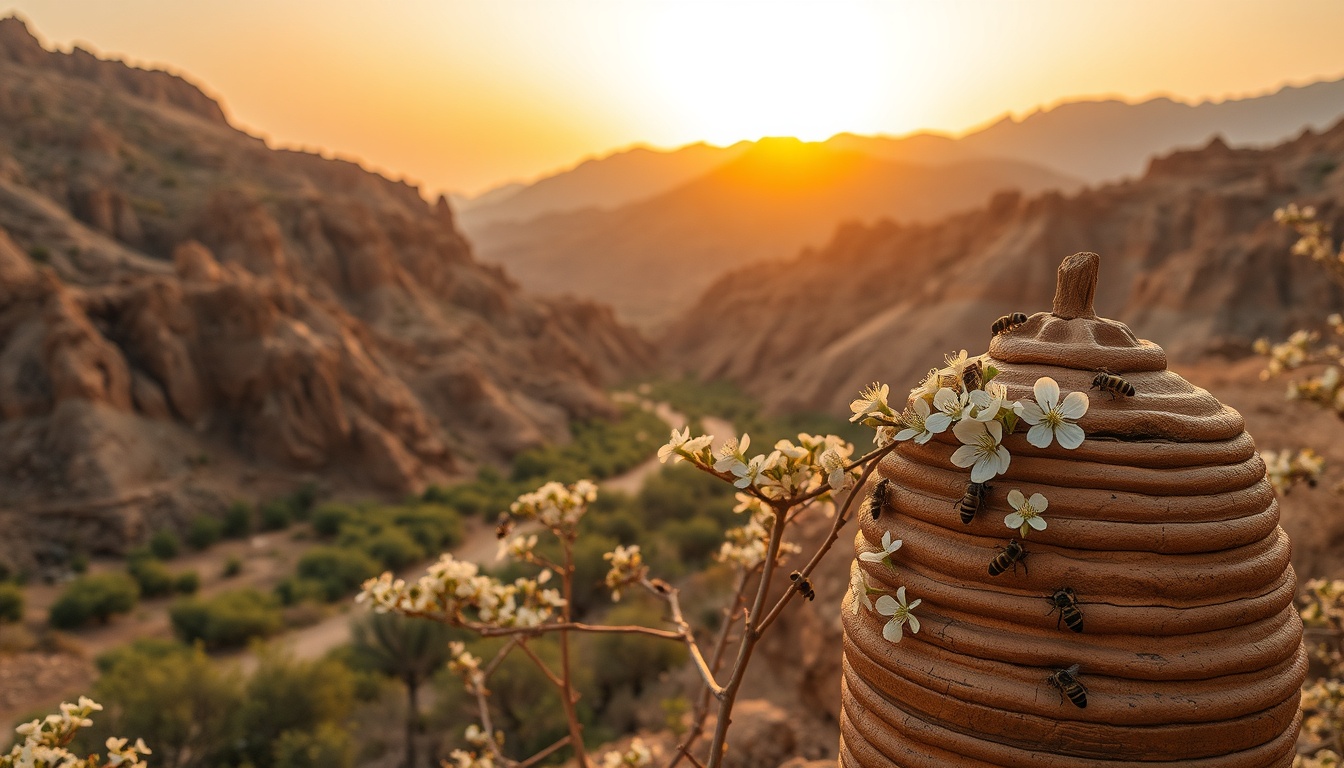
Beekeeper communities in Fujairah emirate have a longer documented beekeeping heritage than those in the coastal emirate settlements of Dubai or Abu Dhabi. Fujairah's mountainous terrain, slightly cooler temperatures (summer highs around 40–43°C rather than Dubai's 45–48°C), and spring wadi systems provided conditions marginally more hospitable to Apis mellifera jemenitica management than the coastal sabkha and desert. The Fujairah Heritage Village in Fujairah City documents traditional Emirati agricultural and beekeeping practices, including traditional hive designs (hollowed palm logs or clay tubes — a style related to the Nuristani log hive tradition of Afghanistan and the traditional hives of Pakistan's KPK). UAE heritage preservation efforts have documented Hajar Mountain beekeeping practices as part of the UAE's intangible cultural heritage program, though the scale of traditional beekeeping in the Hajar Mountains has declined sharply with urbanisation and labour market shifts.
Pro Tip
The Jebel Jais mountain road in Ras Al Khaimah — opened to tourists in 2018 as part of RAK's ecotourism strategy — passes through the highest-altitude botanical zone of the UAE, where Lavandula subnuda and high-altitude acacia associations occur above 1,200 m. Local RAK honey producers sometimes sell mountain wildflower honey at the Jebel Jais visitor centre and at the RAK heritage souq in Al Qawasim Corniche. This is the most accessible point of contact with UAE mountain honey for tourists.
Get the Honey Buyer's Cheat Sheet (free PDF)
16 varieties on one page — color, flavor, best use and what a fair price looks like — from the 304 honeys we track.
Apis florea: The World's Smallest Honeybee and the UAE's Rarest Native Honey
Apis florea — the red dwarf honeybee, known in UAE Arabic as nahal al-barr (نحل البر, 'wild bee' or 'bee of the land') or sometimes nahal al-warr — is the world's smallest honeybee species and one of the UAE's most significant native fauna. At 7–8 mm worker body length (compared to 13–15 mm for Apis mellifera), Apis florea is barely half the size of the European honeybee yet shares the same fundamental social structure: a single reproductive queen, female worker caste, male drones, and a comb-based honey storage system. The critical difference is architectural: Apis florea builds a single exposed comb — not enclosed in a hive cavity — attached to a branch, palm frond, thorny shrub, or rock overhang. The comb is camouflaged with plant resin and wax and typically measures 10–20 cm in diameter. A typical Apis florea colony stores 100–300 grams of honey in its comb — compared to 20–50 kilograms stored by a productive Apis mellifera jemenitica colony — making commercial-scale Apis florea honey production structurally impossible at any technology level.
Apis florea honey is genuinely distinctive. Its botanical profile reflects the Hajar Mountain and coastal mangrove forage zones where UAE Apis florea colonies concentrate — Avicennia marina mangrove blossom, Prosopis cineraria ghaf tree flowers, Acacia ehrenbergiana, Ziziphus spina-christi, and coastal Tamarix species. Apis florea honey typically has higher water content than Apis mellifera honey (24–32% moisture is common, above the EU/ESMA 20% limit for Apis mellifera honey), lower diastase number, and a distinctly aromatic, floral character that connoisseurs compare to the most complex of Southeast Asian stingless bee honeys. In traditional UAE honey culture, Apis florea honey was the original pre-agricultural honey of the Arabian Peninsula: Bedouin honey hunters located Apis florea colonies in date palm groves, ghaf woodland, and wadi-side shrubs, harvested the small comb by hand, and consumed it immediately or used it as a traditional remedy. The honey was never commercially scaled because the colonies move unpredictably — Apis florea absconding rates are extremely high — and the yield per colony makes labour-intensive harvesting economically marginal.
No commercially available Apis florea honey brand exists anywhere in the world as of 2026. In the UAE, a small number of beekeeping enthusiasts and heritage practitioners maintain observation colonies of Apis florea in Fujairah, Dubai (in the Al Marmoom Desert Conservation Reserve and Al Quadra Lakes area), and Abu Dhabi emirate's Rub al Khali margins. These practitioners occasionally offer Apis florea honey for sale at the Dubai Organic Market (Al Safa Park), the Abu Dhabi Farmers' Market, and heritage event honey stalls — but at entirely non-commercial scale. Obtaining authenticated UAE Apis florea honey requires direct contact with Fujairah mountain beekeeping community members or participation in UAE honey festivals. Its rarity is absolute: there is no production pathway to scale Apis florea honey while preserving the natural colony behaviour that creates its distinctive character.
Pro Tip
Apis florea is distinct from Apis dorsata (giant honey bee, the species of the Sundarbans honey hunters in Bangladesh and Nepal's cliff-face honey hunters), though both build exposed single-comb structures. Apis dorsata is 17–20 mm and builds much larger combs (50–80 cm diameter, 40+ kg honey storage in established colonies); Apis florea is small-bodied and its comb size is intrinsically limited. The UAE is home to both species: Apis dorsata nests in the Hajar Mountain cliff faces above 400 m, building the large dramatic pendulous combs visible on granite overhangs in Wadi Shawka and Wadi Helo in the RAK and Fujairah highlands. Giant bee honey from UAE cliff-face nests — harvested by Fujairah honey hunters using smoke and traditional climbing techniques — is even rarer than Apis florea honey and is essentially undocumented in the Western honey literature.
Khalas Date Blossom Honey: The Honey of Al Ain's UNESCO Oasis
Al Ain — the 'garden city' of Abu Dhabi emirate, located 160 km inland from Abu Dhabi city at the UAE-Oman border — contains the Al Ain Oasis: a UNESCO World Heritage Site inscribed in 2011 as one of the world's oldest continuously cultivated oases, with documented agricultural use spanning 3,000 years and archaeological evidence of Falaj (qanat) irrigation channels dating to the late Bronze Age. The Al Ain Oasis covers approximately 1,200 hectares within the city and contains approximately 147,000 date palms — the largest concentration of date palms in any enclosed urban oasis on Earth. The dominant variety is khalas (خلاص, 'liberation' or 'the best') — the UAE's most prized date variety, distinctive for its caramel, toffee, and honey notes at the ripe golden stage, exported to Japan, South Korea, and Europe at premium prices.
Date palm blossom honey — honey produced by Apis mellifera jemenitica bees foraging on the male date palm flowers during the February–March pollination window — has a delicate, distinctively floral character: pale amber to golden, with light caramel sweetness, mild floral aromatics from the pollen-rich male spathe, and a slow-crystallising structure. Date blossom honey is a traditional UAE and GCC specialty: beekeepers in Al Ain, Liwa, and the Al Dhafra region of Abu Dhabi emirate have historically placed colonies adjacent to date palm gardens during the February–March male flower season, when abundant pollen and nectar from the spathe (male flower cluster, containing thousands of small yellow flowers) provide a concentrated forage source. The resulting honey carries a botanical fingerprint — Phoenix dactylifera pollen is abundant and identifiable by melissopalynology — that distinguishes it from generic Gulf multifloral honey.
Commercial khalas date blossom honey from Al Ain is produced by a small number of UAE heritage producers and is occasionally available at the Al Ain Farmers' Market (held at the Al Ain Livestock Market grounds), the Abu Dhabi Farmers' Market, and through UAE artisanal food event stalls at global food events like Gulfood (held annually at Dubai World Trade Centre). The connection to Al Ain's UNESCO heritage status and the khalas date's premium brand position in Asian export markets creates an obvious basis for a premium date-blossom honey brand with documentary provenance — a project that, as of 2026, has not been commercialised. The cultural and marketing infrastructure exists (Abu Dhabi's tourism brand 'The Abu Dhabi Honey' is a marketing concept used for khalas dates; the step to date-blossom honey is short), but the production has not scaled beyond artisanal volume.
Pro Tip
Male date palms — the source of date blossom honey — are traditionally considered 'wasted' commercial space by large-scale date farming, since only female palms produce fruit. The move toward artificial pollination in industrial date cultivation (pollen collected from male spathes and manually applied to female palms, eliminating the need to maintain male palms) has reduced the density of male date palms in modern Al Ain oasis management — and correspondingly reduced the date-blossom honey forage available to managed bee colonies. This is a direct structural reason why UAE date-blossom honey has not scaled: its source is being actively reduced by agricultural modernisation.
Dubai as the World's Global Honey Bazaar
Dubai's position as a global logistics hub — home to the world's busiest international airport, a free-trade zone structure that exempts most goods from import duties (honey has a 5% GCC unified tariff but Jebel Ali Free Zone operations receive preferential treatment), and a population of 90+ nationalities with diverse honey consumption traditions — makes it the most geographically concentrated premium honey market in the world. The Deira Spice Souk and its surrounding honey trading district in Al Ras (accessible via the Bur Dubai abra crossing) represents the traditional wholesale hub: merchants from Yemen, Oman, Saudi Arabia, Pakistan, and Iran have maintained trading relationships in this district for generations, with Yemeni honey merchants in particular using Deira as the primary transshipment point for Hadramawt and Wadi Dawan Sidr honey destined for UK, US, and European markets. The Deira honey trade is the world's most concentrated physical node for premium Arab honey pricing discovery.
Contemporary high-end honey retail in Dubai reflects the 200-nationality expatriate market structure. At Waitrose (Mall of the Emirates and Jumeirah), Spinneys, and Choithrams supermarkets, the honey aisle spans New Zealand Manuka (UMF 5+ through UMF 30+, jar), UK heather honey, French lavender honey, Canadian buckwheat, and Australian leatherwood alongside the GCC premium tier (Saudi Asir highland, Omani mountain, UAE Sidr). The specialty retailers — Bateel (dates + premium honey, eight Dubai locations), The Raw Apiary (Downtown Dubai), and honey vendors at the Dubai Organic Market — target the food-literate premium consumer segment. A Yemeni Sidr honey from Wadi Dawan with documented pollen analysis retails at in this channel. The price range for honey across Dubai's retail spectrum — from for Turkish blended wildflower at a Satwa grocery to for authenticated Yemeni Sidr at a specialty retailer — is larger than in any other single retail market in the world.
The Gulf Cooperation Council common market framework is operationally significant for UAE honey trade. Saudi SFDA-certified honey, Omani MOCI-certified honey, and Bahraini BSMD-certified honey enter the UAE tariff-free under GCC intra-regional trade rules, with only ESMA conformity documentation required. This creates a two-tier import system: GCC honey (Saudi, Omani, Bahraini, Kuwaiti, Qatari) enters via a harmonised Gulf standards pathway; non-GCC honey (New Zealand, Turkish, Pakistani, European) enters under standard UAE import clearance with mandatory ESMA pre-market conformity certification. The UAE does not require import licences for honey but does require that all honey sold in UAE retail carry Arabic-language labelling, moisture certification, and halal documentation (from an accredited halal certification body recognised by ESMA's Halal Certification Schemes database). Foreign honey brands entering UAE retail for the first time typically spend 3–6 months obtaining ESMA product registration before commercial sale is permitted.
Pro Tip
The Dubai Honey Festival — organised by the Dubai Municipality and Dubai Agriculture and Food Safety Authority (DAFSA) — is held annually, typically in late October or November at Za'abeel Park, Zabeel Park Amphitheatre, or the Dubai Frame grounds. UAE honey producers from Fujairah, RAK, Al Ain, and Dubai emirate participate alongside GCC and international vendors. It is the single best opportunity for visitors to the UAE to sample authentic domestic Emirati honey alongside a curated selection of premium GCC and international varieties in direct comparison — a market experience that exists nowhere else in the world at this concentration.
The Gulf War of Standards: UAE Honey Authenticity in the World's Most Adulterated Market
The UAE's strategic position as the world's primary transshipment hub for Yemeni honey — the most counterfeited premium honey on Earth — creates specific enforcement challenges. Authenticated Yemeni Sidr honey from Wadi Dawan and Hadramawt sells at a premium in the UAE; blended honey (authentic Yemeni Sidr mixed with cheaper Pakistani, Egyptian, or Indian honey, re-labelled and re-sealed) can generate margins exceeding 300% if the adulteration passes basic moisture and HMF checks. ESMA's Carbon-13 isotope ratio analysis (δ¹³C, which detects C4 sugar additions — corn and cane syrups — at concentrations above approximately 5–7%) catches the lowest-cost adulterants. Nuclear Magnetic Resonance (NMR) spectroscopy, which can detect botanical origin fraud, concentration adulteration, and geographic mislabelling simultaneously, requires specialised equipment: as of 2026, ESMA has NMR capability in its Abu Dhabi reference laboratory and contracts with European food analysis services (Intertek, Mérieux NutriSciences) for reference testing.
Pollen analysis (melissopalynology) is the primary tool for geographic origin verification of premium Arabic honeys. Authentic Wadi Dawan Sidr honey from Yemen carries a characteristic pollen fingerprint: Ziziphus spina-christi (sidr) pollen dominant (typically >45% of pollen count), with accessory types from Acacia species, Maerua crassifolia, and other Hadramawt wadi flora. A lab claiming Yemeni Sidr status for a honey actually produced from Pakistani Ziziphus mauritiana (the same genus but a different species) will show a different pollen profile — Z. mauritiana has a subtly different pollen morphology detectable by expert palynologists, though the distinction requires a trained analyst and reference slide collection. ESMA has invested in training UAE food testing laboratory staff in palynology in partnership with Saudi SASO and the International Honey Commission (IHC) to improve origin verification capacity.
For UAE honey consumers, the practical outcome of this standards environment is a market where documentation quality predicts authenticity probability. Honey sold with a physical printed pollen analysis certificate (from a named laboratory with a reference number verifiable by email), a QR code linking to a batch-specific laboratory report, and ESMA product registration documentation is meaningfully more likely to be authentic than honey sold without documentation — even if both jars bear the same origin label. The UAE premium honey consumer who asks for laboratory documentation before purchasing above is exercising appropriate due diligence in the world's highest-stakes honey authentication context.
Buying UAE and Gulf Honey: A Practical Guide
For a visitor to the UAE, the recommended sequence for experiencing authentic Emirati honey is: (1) attend the Dubai Honey Festival (October–November) or the Abu Dhabi Farmers' Market (held year-round at various locations) to access UAE domestic producers directly; (2) visit the Deira Spice Souk honey merchants for the widest selection of authenticated GCC premium honeys, particularly Yemeni and Omani Sidr, with the caution that documentation should be requested before purchase above; (3) for UAE mountain honey from Fujairah or RAK, contact the Fujairah Chamber of Commerce heritage producers list or the RAK Tourism Authority's artisan honey producer directory, both accessible by phone from tourism information centres in those emirates.
The UAE's premium honey tier divides into three categories relevant to different buying purposes. For gifting in Gulf culture (the primary driver of premium UAE honey purchase): authenticated Yemeni Sidr from Wadi Dawan or Hadramawt with printed pollen analysis (no dated retail price is cited) is the prestige option; Saudi Asir highland honey (with SFDA certificate) is the considered alternative. For personal consumption as a quality food product: New Zealand Manuka UMF 10+ at Waitrose or Spinneys for the antibacterial activity benefit; UAE mountain Sidr from Fujairah (direct from producer) for the indigenous origin story. For culinary use where honey is an ingredient: Turkish pine honeydew (widely available, distinctive mineral-piney character excellent for cheese plates and marinades) or Saudi Talh acacia honey (pale, buttery, slow-crystallising — ideal for baking and tea service).
The UAE's most accessible domestic honey — the easiest to verify as authentic UAE-sourced — is Fujairah spring wildflower honey (multifloral blend of mountain wadi flora, Apis mellifera jemenitica, March–April harvest) available from Fujairah-registered producers at the Fujairah Heritage Village honey festival (held typically in March, coinciding with the spring bloom). Identifying a bottle of this honey and asking the producer about their apiary location, hive count, and harvest date is the one interaction in the UAE honey market that bypasses entirely the authenticity complexity of the imported premium tier — because the producer standing in front of you is the beekeeper, the product is local, and the price reflects production reality rather than brand premium.