Zambia's Honey Landscape: Miombo Woodland, Bark Hives, and Five Distinct Honey Zones
Zambia is sub-Saharan Africa's most structurally distinctive honey-producing country for a reason that is invisible on most maps: approximately 60% of the country's 752,618 km² is covered by Miombo woodland, the dominant vegetation of the Central African plateau. Miombo — named after the local term for Brachystegia trees — is a dry-deciduous tropical forest type co-dominated by Brachystegia (msasa, mchesi) and Julbernardia (munondo, miombo) trees, with an understory of grasses, forbs, and seasonally diverse flowering shrubs. The Miombo belt stretches in a broad arc across eight countries from Angola and the Democratic Republic of Congo through Zambia and Tanzania to Mozambique and Zimbabwe, but Zambia holds the single largest national share of intact Miombo woodland and has the most developed bark-hive beekeeping tradition within it.
Official figures undercount Zambian honey. FAO data put production at 853 tonnes in 2021 (Farmers Weekly), yet trade data show Zambia exporting roughly that much or more in some years, so much of the informal bark-hive harvest never reaches the statistics. Most hives are traditional bark cylinders rather than Langstroth boxes, and most honey moves through village trade, roadside sales and urban informal markets. Zambia also produced one of the continent's most cited conservation-linked beekeeping models (COMACO).
Five distinct honey zones correspond to Zambia's ecologically varied landscape: the Miombo woodland plateau (Northern, Luapula, Copperbelt, and Central provinces), where bark-hive honey from Brachystegia-dominated forest is the dominant production system; the Luangwa Valley (Eastern Province), a Great Rift Valley offshoot with a distinct semi-arid flora and the COMACO conservation-beekeeping program; the Kafue Flats and Kafue National Park (Central and Western provinces), with floodplain-adjacent Acacia and Combretum honey; Western Province (Barotseland), with the unique Zambezi floodplain honey system used by Lozi beekeepers; and the Eastern Highlands (Nyika Plateau, Viphya), where Apis mellifera monticola produces honey from montane grassland flora at 1,500–2,200 m elevation.
Pro Tip
When buying Zambian honey internationally, look for a named producer or program: COMACO's It's Wild! brand, or Miombo woodland honey from a named Northern Province cooperative or exporter. Generic 'African honey' on supermarket shelves rarely traces to Zambia specifically.
The Miombo Woodland System: Brachystegia-Julbernardia and Sub-Saharan Africa's Largest Nectar Belt
The Miombo woodland that covers most of Zambia's plateau is one of the world's most ecologically significant yet least-recognized honey-foraging landscapes. The dominant canopy trees — Brachystegia spiciformis (msasa), Brachystegia boehmii (prince of Wales feathers), Julbernardia globiflora (munondo), and Julbernardia paniculata (miombo) — are members of the Caesalpiniaceae subfamily and produce nectar in distinct seasonal pulses that define the Zambian beekeeping calendar. Brachystegia species flush brilliant red, copper, and pink new leaves at the start of the dry season (July–August) before the first rains, producing extra-floral nectaries on young leaves that bees harvest intensively alongside the flowering of the forest understory. The main nectar flow from Brachystegia flowers occurs in October–November as the rains begin, coinciding with the emergence of hundreds of herbaceous and shrubby flowering species in the woodland understory.
The ecological distinctiveness of Miombo honey is structural. Miombo woodland has very low tree-species diversity at the canopy level — three to five Brachystegia/Julbernardia species dominate 60–80% of tree cover — but extraordinary diversity in the understory flora: an estimated 8,500–9,000 vascular plant species across the full Miombo belt, many of which flower during the October–January rainy season. The result is a honey type that is technically a wildflower polyfloral — no single botanical source dominates the pollen profile — but one whose distinctive character comes from the Brachystegia floral season structure and the woodland's specific propolis environment. Miombo honey from log-hive production is typically medium amber and moderately sweet with floral-woody undertones.
Honey research specific to Zambian Miombo woodland is limited, and published pollen work on Zambian honey is sparse, which makes lab confirmation of Miombo origin harder than for well-studied European honeys. Exporters rely on documented supplier registers instead. Fresh, properly dried bark-hive honey can meet EU limits (moisture ≤20%, HMF ≤40 mg/kg), but honey stored in open containers can take on water and ferment.
Get the Honey Buyer's Cheat Sheet (free PDF)
16 varieties on one page — color, flavor, best use and what a fair price looks like — from the 304 honeys we track.
Zambia's Traditional Bark-Hive Beekeeping: Log Cylinders Hung in the Forest Canopy
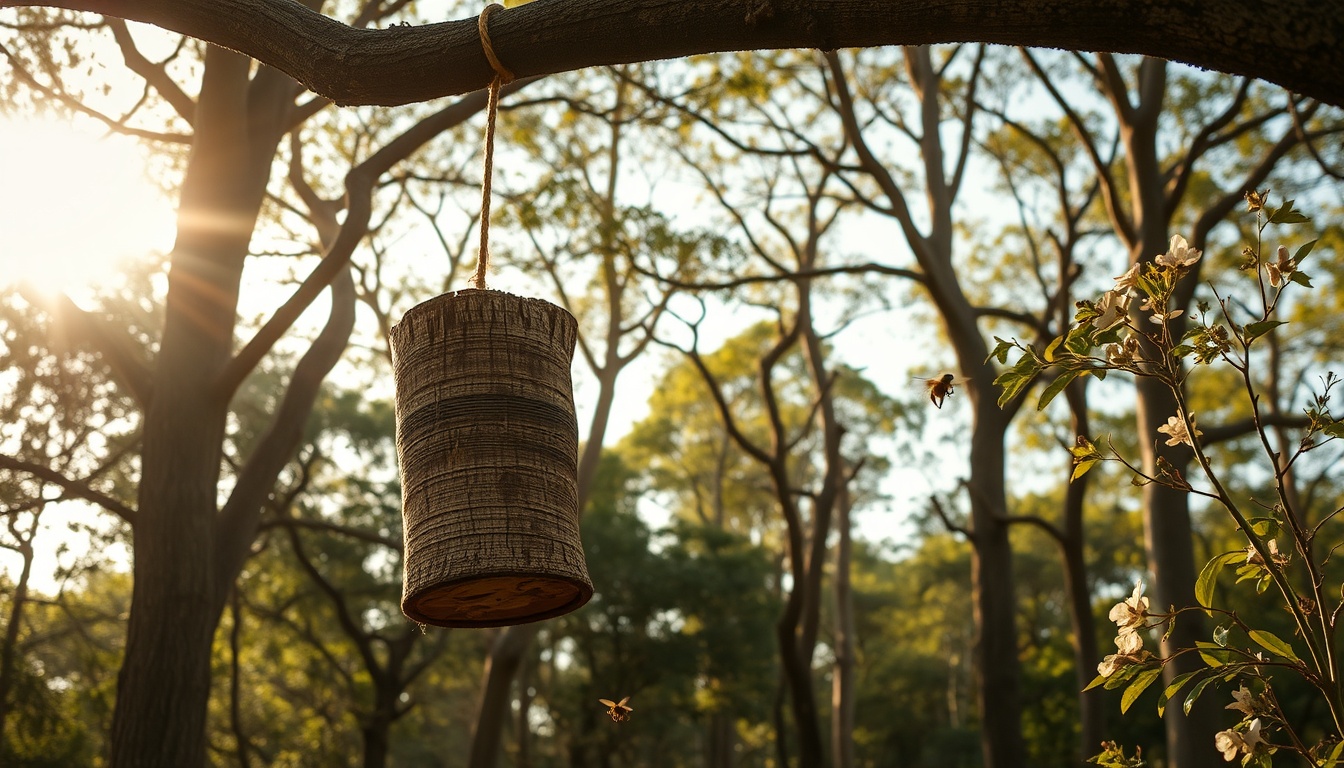
The defining feature of Zambian traditional beekeeping is the bark-hive: a cylindrical hollow section of bark, typically 60–120 cm long and 20–35 cm in diameter, cut from logs of large-diameter woodland trees (Brachystegia, Pterocarpus, Afzelia), sealed at both ends with flat bark discs and daubed with a mixture of mud and cattle dung to create weatherproof ends with a small entrance hole. These hives — called mivule (Bemba), mbaya (Tonga), or by locally specific names across Zambia's 73 languages — are hoisted into the forest canopy on rope or bark-strip slings at heights of 5–15 metres, typically on horizontal branches of large Brachystegia or Pterocarpus trees. A single beekeeper may manage 20–200 hives distributed across a forest territory of several square kilometres.
The bark-hive system is ecologically adapted to the Miombo woodland in ways that the introduced Langstroth hive is not. Miombo woodland forest fires — deliberately set annually in the dry season to clear undergrowth — are a structural feature of the ecosystem. Bark hives elevated in tree canopies survive ground fires that would destroy ground-level or low-mounted hives. The cylindrical form mimics the hollow-tree nest cavity that Apis mellifera scutellata (the Eastern African lowveld bee, Zambia's dominant subspecies) selects in the wild. Bee-space management, comb removal, and honey extraction with traditional bark hives require no imported equipment: a bark smoker using dried cattle dung, a clay pot for honey storage, and knowledge of the specific hive's comb architecture are the primary tools.
Bark-hive beekeeping in the region predates colonial rule. In Missionary Travels (1857), David Livingstone described the bark hives he met in the Balonda forests north of Barotseland on his 1853–56 journey: about five feet of bark peeled whole from a tree, pegged shut, capped with coiled grass rope and laid horizontally on high trees, 'so commonly met with all the way from this to Angola'. The bark-hive tradition is most densely maintained in Northern Province (Bemba communities), Luapula Province, and parts of Eastern Province where forest cover has not been cleared for agriculture.
Pro Tip
Zambia's bark-hive honey is harvested once or twice per year — at the end of the long rains (March–April) and sometimes again after the short dry season (August–September). Honey sold at roadside markets in Lusaka, Kitwe, and Kasama between April and June is typically fresh-harvest Miombo woodland honey from Northern or Copperbelt province.
Apis mellifera at a Biogeographic Crossroads: A.m. scutellata, A.m. monticola, and Zambia's Bee Genetics
Zambia occupies a critical position in the biogeography of African Apis mellifera subspecies. The country sits at the boundary zone between two ecologically distinct subspecies groups: Apis mellifera scutellata (the Eastern African lowveld honeybee), which dominates the woodland and savanna zones below approximately 1,500 m elevation and constitutes the majority of Zambia's managed and wild bee population; and Apis mellifera monticola (the mountain honeybee), which occupies the eastern highlands — the Nyika Plateau, Misuku Hills, and the escarpment zones of Eastern Province — at elevations above 1,500 m where lower temperatures, mist forest, and montane grassland create a distinct ecological niche.
Apis mellifera scutellata is the subspecies that, when transported to Brazil in 1956 by geneticist Warwick Estevam Kerr and subsequently hybridized with escaped Apis mellifera ligustica queens, became the progenitor of the 'Africanized honeybee' now established throughout most of the Americas. In its native range across eastern and southern Africa, A.m. scutellata is a high-energy, frequently absconding bee supremely adapted to seasonal Miombo woodland conditions: it stores large quantities of honey relative to colony size, migrates in response to food dearth and fire, and responds defensively to perceived threats near the nest. These characteristics make it an effective nectar-harvester in the variable Miombo nectar-flow environment but require beekeepers to work with appropriate protective gear and smoke management. Zambian beekeepers using traditional bark hives have developed specific manipulation techniques — typically working at dusk or dawn when bees are less active, using heavy smoke from smoldering dried cattle dung — that allow safe inspection and honey extraction.
Apis mellifera monticola, found on the Nyika Plateau (shared between Zambia and Malawi at 1,800–2,600 m), is a morphologically distinct subspecies: larger-bodied, darker in color, less defensive, and slower to abscond than lowland scutellata. Monticola honey from the Nyika Plateau and Misuku Hills — harvested from wild colonies and log hives by communities in Lundazi and Chitipa districts — has a distinct floral character derived from the montane grassland flora (Protea, Alchemilla, Helichrysum, Leonotis leonurus). No commercial brand has been established for Nyika Plateau monticola honey; production remains entirely subsistence and local trade. The Nyika Plateau's monticola population is one of the geographically isolated highland populations that serves as a genetic reference in Apis mellifera subspecies phylogeography research.
COMACO: Conservation-Linked Beekeeping in the Luangwa Valley
Community Markets for Conservation (COMACO) is one of sub-Saharan Africa's most frequently cited conservation-economy case studies and Zambia's most internationally visible honey program. Founded by Dale Lewis in 2003 under the Wildlife Conservation Society umbrella (becoming an independent Zambian company in 2009), COMACO operates in the Luangwa Valley — the catchment of the South Luangwa and North Luangwa National Parks, one of Africa's densest remaining concentrations of elephant, hippo, lion, and leopard — with a core mandate of replacing wildlife poaching and illegal charcoal burning with sustainable livelihoods including beekeeping, rice farming, and groundnut production.
COMACO's members include beekeepers across Luangwa Valley communities. Members commit to giving up poaching and destructive land use in return for training, extension support and access to COMACO's markets, which pay better than local traders. The honey is sold under the 'It's Wild!' brand in Zambian supermarkets at a premium over commodity honey.
The Luangwa Valley honey has a distinct terroir from Northern Province Miombo honey. The valley floor (500–700 m elevation) supports a semi-arid Acacia-Combretum savanna — drier, more open, and with different dominant nectar sources than the highland Miombo woodland. Luangwa honey from COMACO top-bar hives is typically lighter amber than Northern Province bark-hive honey, with a more delicate floral-Acacia character, slightly higher moisture content (18–23%), and a different crystallization rate. COMACO's model has been assessed in peer-reviewed research: Lewis and colleagues (2011, PNAS) reported data showing previously declining wildlife populations stabilizing in COMACO areas, alongside farmers adopting sustainable agricultural practices. That paper covers COMACO as a whole, not honey specifically.
Pro Tip
COMACO It's Wild! honey is the best-known conservation-linked Zambian honey. Look for the brand and a Luangwa Valley origin, and ask for organic certification if the seller claims it. Honey labeled simply 'Zambian honey' or 'African wildflower' without a specific producer or program trace is typically commodity honey with no conservation linkage.
Western Province: Lozi Bark-Hive Beekeeping and the Barotse Floodplain Honey System
Zambia's Western Province — historically the Kingdom of Barotseland, home of the Lozi people — has a distinct honey production system shaped by the Barotse Floodplain (Bulozi), the annual flood cycle of the upper Zambezi River. The floodplain — approximately 5,500 km² of seasonally inundated grassland, ox-bow lakes, and riverine woodland — floods between January and June when the Zambezi rises, then recedes to expose a rich floral succession of aquatic plants, grasses, and Combretum-Capparis woodland between July and December. Lozi beekeepers traditionally move bark hives on dugout canoes (mokoro) during the flood season to elevated termite mounds and tree canopy positions above the waterline, then relocate hives to lower forest positions during the dry season to follow the nectar flow from receding-flood floral succession.
The flood cycle shapes the whole Lozi calendar: the annual Kuomboka ceremony is the Litunga's (Lozi king's) canoe procession from the flooded plain to the high-ground capital at Limulunga, and beekeepers on the plain work around the same rising water.
Western Province honey has received less NGO and development-program attention than Northern Province and Luangwa Valley, and production remains largely subsistence and regional-trade. The Combretum-Acacia complex that dominates the dry-season woodland above the floodplain produces a honey distinct from Miombo woodland varieties: lighter in color, more floral-sweet, with Combretum imberbe (leadwood) and Acacia erioloba (camelthorn) pollen signatures. No western Zambian honey has been certified or branded for international markets as of 2026.
Modern Zambian Honey Industry: EU Export, Organic Certification, and the Branding Gap
Zambia's formal honey export sector is small but has shown it can reach premium international buyers, largely with certified-organic forest honey. EU market access requires honey quality limits (HMF ≤40 mg/kg, moisture ≤20%, no prohibited antibiotic residues) that honey collected and stored in open pots or reused containers often does not meet.
The country's honey sector faces three structural challenges that constrain premium positioning. First, exporters often send honey to accredited laboratories outside Zambia, in South Africa or the destination country, which adds cost and complexity. Second, Zambia has no Geographic Indication (GI) or Protected Designation of Origin (PDO) for any honey variety, despite having several geographically distinctive products — Miombo woodland bark-hive honey, Luangwa Valley certified organic, Nyika Plateau monticola honey — that could credibly support such designations. Third, the branding gap is structural: NGO-linked programs like COMACO operate with conservation mandates and treat honey revenue as a development tool rather than a commercial scalability objective.
The trajectory for Zambian honey's international profile is positive but gradual. Growing consumer interest in African forest honeys — driven partly by the terroir-driven honey narrative that has elevated Ethiopian forest honey, Tanzanian Tabora honey, and Kenyan acacia honey in specialty markets — creates a structural opportunity for Miombo woodland honey. The Miombo ecosystem narrative (world's largest tropical dry-deciduous forest, culturally continuous bark-hive beekeeping tradition, documented conservation-economy model) is exactly the kind of origin story that premium specialty honey retailers in the UK, Germany, and Japan respond to. As of 2026, no international brand has captured this narrative for Zambian honey at commercial scale.