The Coral Limestone Platform: Barbados's Invisible Geological Difference
Every other island in the Eastern Caribbean is volcanic. Martinique, Dominica, St. Lucia, St. Vincent, Grenada — each is a product of the Lesser Antilles volcanic arc, where the North American plate subducts beneath the Caribbean plate, producing mineral-rich volcanic soils and dramatic topography. Barbados is the exception. It sits on a separate coral limestone platform, pushed upward by geological uplift rather than eruption. The highest point, Mount Hillaby, reaches just 340 metres — not a volcanic peak but the crest of an ancient reef.
Coral limestone changes everything about agriculture and honey. There are no natural rivers. Rainfall percolates immediately through porous rock. The soil — a thin layer of limestone-derived clay over rock — does not have the volcanic mineral richness of Soufrière's slopes or Dominica's rainforest volcanic belt. What grows in Barbados grows despite the geology, not because of a mineral-rich volcanic inheritance. Flora adapted to seasonal drought, porous drainage, and Caribbean light — rather than the rain-forest abundance of St. Vincent or Dominica — shapes what bees collect.
The Scotland District in the northern parishes of St. Andrew, St. Joseph, and St. Thomas is Barbados's geological outlier. Geological uplift and erosion here exposed older rock formations, creating the island's only rough, hilly terrain — Chalky Mount, Joe's River, the rugged Atlantic-facing coast. The Scotland District's more complex topography and different drainage characteristics support a distinct flora from the island's southern limestone plateau. For honey, this matters: Scotland District producers consistently describe a more complex wildflower character than southern coastal honeys.
The Barbados Cherry Honey Gap: Highest-Vitamin-C Fruit, Zero Commercial Honey
Barbados Cherry (Malpighia emarginata, also classified as M. glabra and M. punicifolia depending on source) carries one of the most striking nutritional superlatives in the botanical world: the highest natural vitamin C content of any commercially significant fruit, at 1,000–4,700 mg per 100g of fresh fruit. For comparison, an orange contains approximately 50 mg per 100g. The Barbados Cherry delivers 20–94 times more vitamin C by weight.
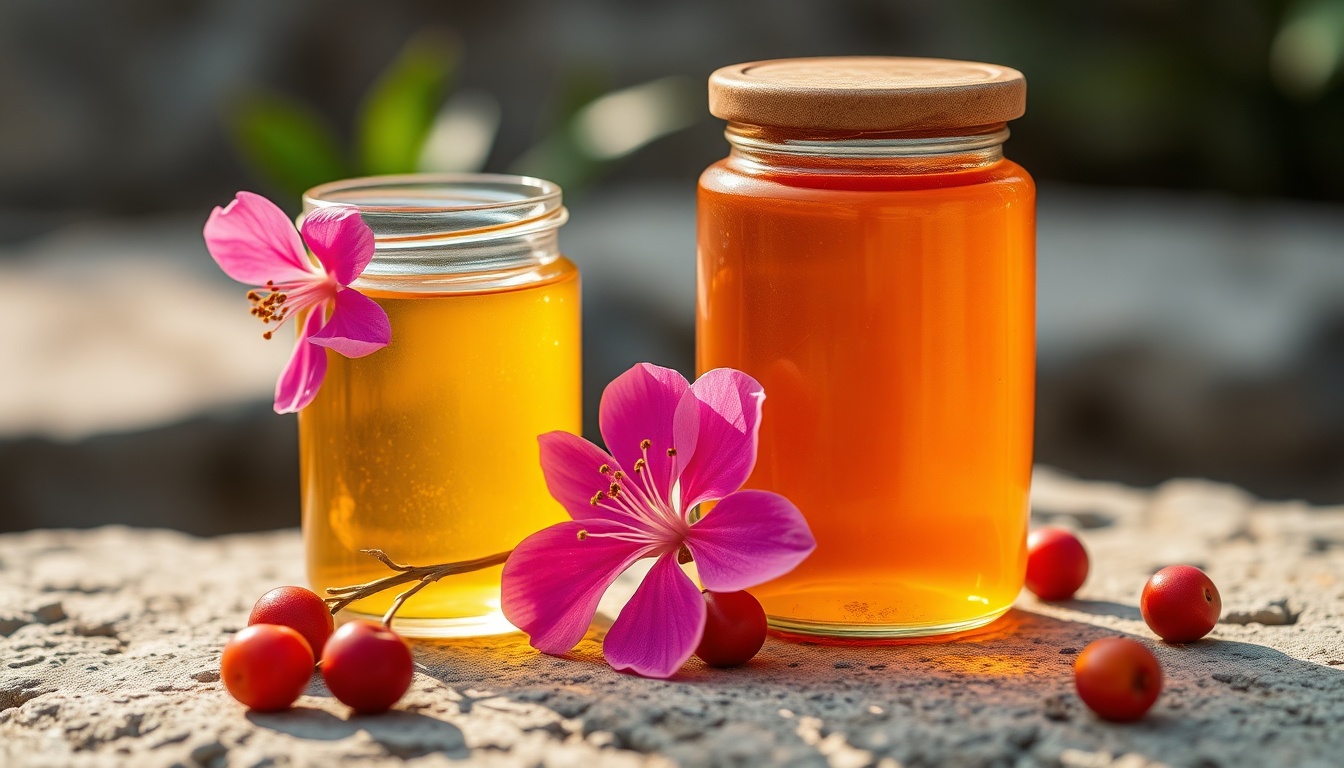
The pharmaceutical and nutraceutical industries recognized this decades ago. Today, Barbados and neighbouring Caribbean islands supply a significant proportion of global pharmaceutical-grade acerola extract — the natural vitamin C source used in supplements marketed as superior to synthetic ascorbic acid. Barbados Cherry is cultivated commercially in this context, with plantings across the island's agricultural zones. The small pink flowers bloom multiple times per year in tropical conditions, producing nectar across an extended season rather than a single peak bloom window.
The paradox: the honey from Barbados Cherry flowers has never been commercially characterized or sold with a varietal identity. No Barbados producer markets 'Barbados Cherry honey' or 'acerola blossom honey'. No scientific paper has characterized the honey's flavonoid profile, pollen density, or organoleptic properties. The flowers are biologically accessible to Apis mellifera — they produce nectar, they are worked by bees, and the plant is widespread enough to influence a hive's seasonal honey composition. What is missing is the commercial framing and the analytical chemistry. This is the defining honey gap on Barbados: the island's most globally significant agricultural product has no corresponding honey identity.
Agronomists working with Barbados Cherry in Brazil and Puerto Rico have noted that the plant's high anthocyanin content in the fruit does not necessarily transfer to honey (anthocyanins are not soluble in honey at typical concentrations), but phenolic acids may. The vitamin C in Barbados Cherry nectar is unstable and degrades during honey curing — it would not carry through to the final product. What a characterized Barbados Cherry honey might offer is a distinct floral aromatic profile shaped by the plant's unique terpenoid volatiles, not its vitamin C. That characterization has not been done.
Get the Honey Buyer's Cheat Sheet (free PDF)
16 varieties on one page — color, flavor, best use and what a fair price looks like — from the 304 honeys we track.
Post-Sugar Flora: 350 Years of Monoculture, and What Replaced It
For most of its colonial history, Barbados was sugar. By the mid-seventeenth century, the sugar revolution had transformed virtually every acre of agricultural land on the island into Saccharum officinarum cane. The ecological consequences were total: native forest gone, soil structure transformed by continuous cultivation, island hydrology altered by drainage infrastructure built for cane. At peak production, Barbados was the most intensively cultivated agricultural island in the Caribbean.
Sugar's collapse was gradual but terminal. A series of competitive pressures — the abolition of slavery (1838), the end of preferential British tariffs (1846), competition from larger producers, and eventually the 2009 closure of the last major processing facility — reduced Barbados's sugar output to a fraction of its colonial peak. Today, sugar occupies a small percentage of the agricultural land it once dominated. The transformation, while economically painful, produced an unintended ecological dividend: Barbados now has significantly more diverse agricultural flora than at any point in its post-Columbian history.
What replaced sugar varies by parish. Fruit trees — Barbados Cherry, mango, papaya, soursop, tamarind, sapodilla — fill former cane zones. Ornamental trees planted along roadsides and in gardens in the colonial and post-colonial era have matured into significant honey sources. Cassava, sweet potato, and vegetable cultivation mix with tree crops in ways impossible under the total-cane monoculture. The modern Barbados honey landscape is partly a product of the sugar industry's failure — a recovery ecology built over three and a half centuries of intensive cultivation.
Flamboyant, Mahogany, and Sea Island Flora
The flamboyant tree (Delonix regia) — known in the Eastern Caribbean as royal Poinciana, or sometimes simply 'flamboyant' — is one of the most visible honey sources in Barbados. It is not native: originally from Madagascar, it was introduced to the Caribbean as an ornamental tree and has naturalized across all the islands. In Barbados, large specimens line urban and suburban roadsides, garden boundaries, and hotel grounds. The spectacular scarlet-orange blooms — one of the most recognizable sights of the Caribbean dry season — appear primarily from May through August, providing a significant nectar flow in the months when other sources are reduced.
Flamboyant honey is not typically collected as a monofloral. The bloom coincides with diverse urban and semi-rural foraging, and the resulting honey is a summer wildflower blend rather than a single-source product. But the flamboyant's contribution to summer honey output on the island is substantial, and producers in Bridgetown's suburban belt note the distinctive golden colour and mild floral character of summer harvests relative to earlier-season production.
Caribbean mahogany (Swietenia mahagoni) — actually native to the Caribbean and southern Florida, and distinct from the more commercially famous S. macrophylla — was historically the dominant timber species of the lower-elevation Caribbean. Colonial clearing eliminated most mature stands, but specimens persist in garden, estate, and roadside plantings across Barbados. The small white flowers bloom in spring, providing an early-season nectar source with an understated, clean honey character.
Sea grape (Coccoloba uvifera) defines the Barbados coast. A salt-tolerant species that lines beach margins and coastal dunes, sea grape produces small white flower clusters from late spring through summer. Sea grape honey has a mild, slightly fruity character. Barbados Lily (Hippeastrum puniceum — Barbados's national flower), Barbados Pride (Caesalpinia pulcherrima, also called Pride of Barbados — also the national flower), and a range of garden ornamentals contribute to a year-round floral calendar more complex than the old sugar monoculture would have permitted.
Scotland District Wildflower: The Island's Honey Frontier
The northern parishes — St. Andrew, St. Joseph, and the upper reaches of St. Thomas — contain the island's most ecologically complex terrain. The Scotland District's geological character differs from the southern limestone plateau: older formations, more rugged topography, Atlantic exposure, and different drainage create a zone where native and naturalized plant communities are somewhat less disturbed than in the intensively farmed and developed south.
Producers in this area describe their honey in terms consistent with that complexity: more aromatic, darker amber in some seasons, with a bolder character that differs from the lighter floral honeys of the southern tourist belt. The Scotland District does not have a formal honey designation or marketing identity — these are informal producer observations rather than tested characterizations. But the geographical contrast with the rest of the island is consistent enough that Scotland District origin is sometimes noted on locally-sold honey.
The Barbados Beekeepers' Association (BBA) maintains active membership across parishes and supports extension work on colonial bee husbandry, swarm management in tropical conditions, and honey quality testing. The tropical climate means that Barbados bees do not experience the winter dieback of temperate-zone colonies — populations are managed year-round, with extraction timing tied to bloom cycles rather than a single annual harvest season. This allows for multiple harvests per year, with seasonal character variation between the dry-season (January–May) and wet-season (June–November) honey profiles.
No Stingless Bee Tradition: The Meliponini Absence
Unlike Jamaica, Trinidad & Tobago, Dominican Republic, and Haiti — all of which have documented stingless bee traditions — Barbados has no recorded Meliponini culture. No native Melipona or Trigona species are documented as established on the island. This absence is partly geological: the small coral limestone island, never connected to South America's continental shelf (as Trinidad was), never served as a bridge for mainland Meliponini fauna. The island's limited land area and total agricultural transformation under sugar also reduced the hollow-tree nesting habitat that stingless bees require.
The absence of stingless bees is not a loss unique to Barbados among Eastern Caribbean islands — most of the smaller Windward and Leeward Islands lack established Meliponini populations. But it does mean that Barbados's honey story is entirely an Apis mellifera story, without the parallel stingless bee tradition that distinguishes Jamaica's scotch bonnet honey context or Trinidad's Melipona favosa geological heritage. What Barbados offers instead is the coral limestone island ecology — a genuinely different physical context from every volcanic neighbor — and the acerola paradox.
Certification, Export, and Finding Authentic Barbados Honey
Barbados honey quality is regulated by the Barbados National Standards Institution (BNSI), which adopts Codex Alimentarius honey standards as the domestic framework. The Barbados Ministry of Agriculture, Food, Fisheries and Water Resource Management (MAFFWRM) provides extension services and oversight. There is no Barbados GI or PDO equivalent for honey — no designated origin or variety certification comparable to the EU DOP/PDO system or New Zealand's UMF certification.
International export of Barbados honey is extremely limited. Most production is consumed domestically — through farm shops, the Saturday morning market at Cheapside in Bridgetown, supermarket shelf space, and direct sales from beekeepers. The island's small size (432 km²) means production volumes are modest relative to the larger Caribbean islands, and virtually no Barbados honey reaches international specialty food retailers. What reaches tourists typically comes from small producers selling at craft markets, hotels, or directly from apiaries.
The most reliable way to access authentic Barbados honey is through the Barbados Beekeepers' Association, which can direct buyers to member producers, or through the island's agricultural markets. As with other small-island honeys in this cluster — Jamaica allspice, Trinidad immortelle, Dominican Republic Barahona coffee blossom — the absence of international brand presence is structural rather than a quality reflection: the volume doesn't exist to support a formal export operation.