About This Recipe
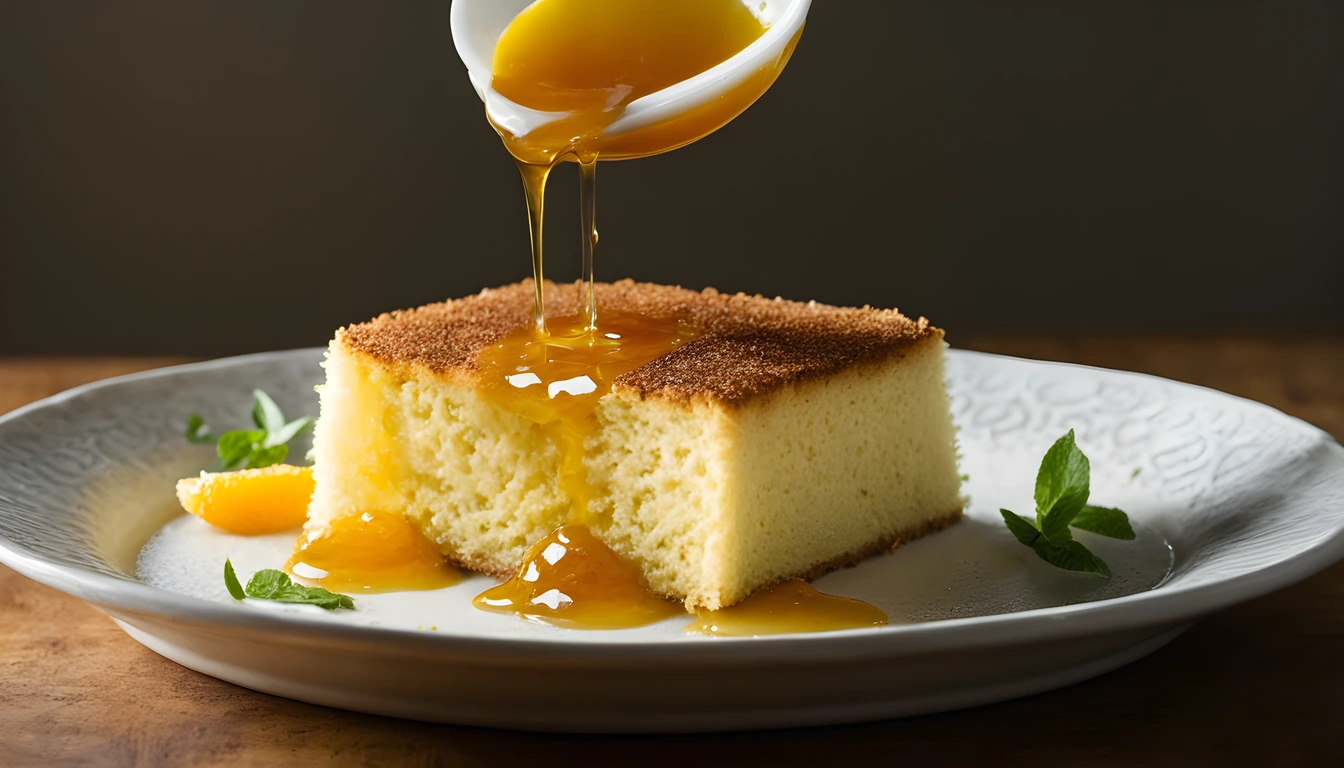
Honey revani is a coarse-grained sponge cake soaked with warm honey-citrus syrup until the crumb turns heavy and glossy. Whole-grain cornmeal stands in for the usual semolina here, giving a sandy texture that holds the syrup without collapsing.
The eggs and honey are beaten to a thick foam before the oil, yogurt and dry ingredients go in. That foam does most of the lifting; baking powder helps, but the cake stays tender because it is mixed only until the flour disappears.
Pour the syrup over the cake while both are still warm, then leave it alone for an hour. The cake should feel wet at the center but still hold a clean cut. Serve it at room temperature, in 12 pieces.
Recipe
Honey Revani Recipe
A honey-soaked revani: a coarse-crumbed sponge made with whole-grain cornmeal, eggs and yogurt, then drenched in a warm orange-lemon honey syrup. Makes 12 pieces.
14Ingredients
Yield: 12 servings
- 150 g honey, for the batter (about 7 tbsp)
- 4 large eggs (about 200 g)
- 120 g plain whole-milk Greek yogurt
- 80 g canola oil (about 1/3 cup plus 2 tsp)
- 100 g all-purpose flour (about 3/4 cup plus 1 tbsp)
- 140 g whole-grain yellow cornmeal (about 1 cup plus 2 tbsp)
- 9 g baking powder (about 2 tsp)
- 1.5 g salt (about 1/4 tsp)
- 6 g orange zest (about 1 tbsp)
- 4.2 g vanilla extract (about 1 tsp)
- 150 g honey, for the syrup (about 7 tbsp)
- 120 g orange juice (about 4 fl oz)
- 30 g lemon juice (about 1 fl oz)
- 50 g water (about 3 tbsp plus 1 tsp)
Ingredient amounts scale; instructions show the original batch. Cooking times and pan sizes may need adjustment. Season to taste. Honey grams use US measures at 20°C and 17.5% moisture, a density estimate; weigh your honey for precision.
Instructions
- 1Heat the oven and line the panHeat the oven to 350°F (175°C). Line a 20 cm (8-inch) square baking pan with parchment, leaving a slight overhang on two sides. Do not grease the parchment; the batter has enough oil.
- 2Warm the honey and whip the eggsWarm the batter honey in a small bowl set over hot water or in short microwave bursts until it runs from a spoon, about 20 seconds. In a large bowl, beat the eggs and warm honey with an electric mixer on high for 5 minutes, until pale, thick and falling in a ribbon.
- 3Stream in the oil and add the yogurtWith the mixer on medium-low, pour in the canola oil in a thin stream. Add the yogurt, orange zest and vanilla and beat just until even. The mixture may look slightly broken at the edge; it will come together with the dry ingredients.
- 4Fold in the dry ingredientsWhisk the flour, cornmeal, baking powder and salt in a separate bowl. Add half to the egg mixture and fold with a spatula until nearly combined. Fold in the rest, stopping as soon as no dry streaks remain. The batter should be thick enough to mound on the spatula.
- 5Bake the cakeScrape the batter into the lined pan and smooth the top. Bake 30 to 35 minutes, until the cake is deep gold, the edges pull away from the parchment and a skewer in the center comes out clean. Set the pan on a rack and cool 10 minutes.
- 6Make the honey-citrus syrupWhile the cake bakes, combine the syrup honey, orange juice, lemon juice and water in a small saucepan. Warm over medium heat, stirring, until the honey dissolves and the liquid steams, about 3 minutes. Do not boil it down; you want about 350 g of thin syrup. Keep the syrup warm.
- 7Soak and restPoke the warm cake all over with a skewer at 2 cm intervals. Ladle the warm syrup over the cake in three additions, waiting a minute between each so it sinks in. Leave the cake in the pan at room temperature for 1 hour. It should take all the syrup; if a little pools at a corner, tip the pan and spoon it back over the top.
- 8Cut and serveLift the cake out by the parchment and cut into 12 pieces, 3 by 4. Serve at room temperature. The cake is ready when a piece holds its shape on a plate but leaves a little syrup on the fork.
Estimated nutrition per serving
247.97 calories · 9.28 g fat · 38.04 g carbohydrate · 4.97 g protein · 160.75 mg sodium
Serving: 1 piece (about 90 g), 1 of 12 servings
Calculated from ingredient weights and USDA FoodData Central: 169640, 171287, 171304, 172336, 168894, 169697, 172803, 173468, 169103, 173471, 169098, 167747, 173647. Estimates use ingredient input weights; actual portions, brands and cooking losses vary. Omitted nutrient values are unavailable, not zero.
What the finished cake should be like
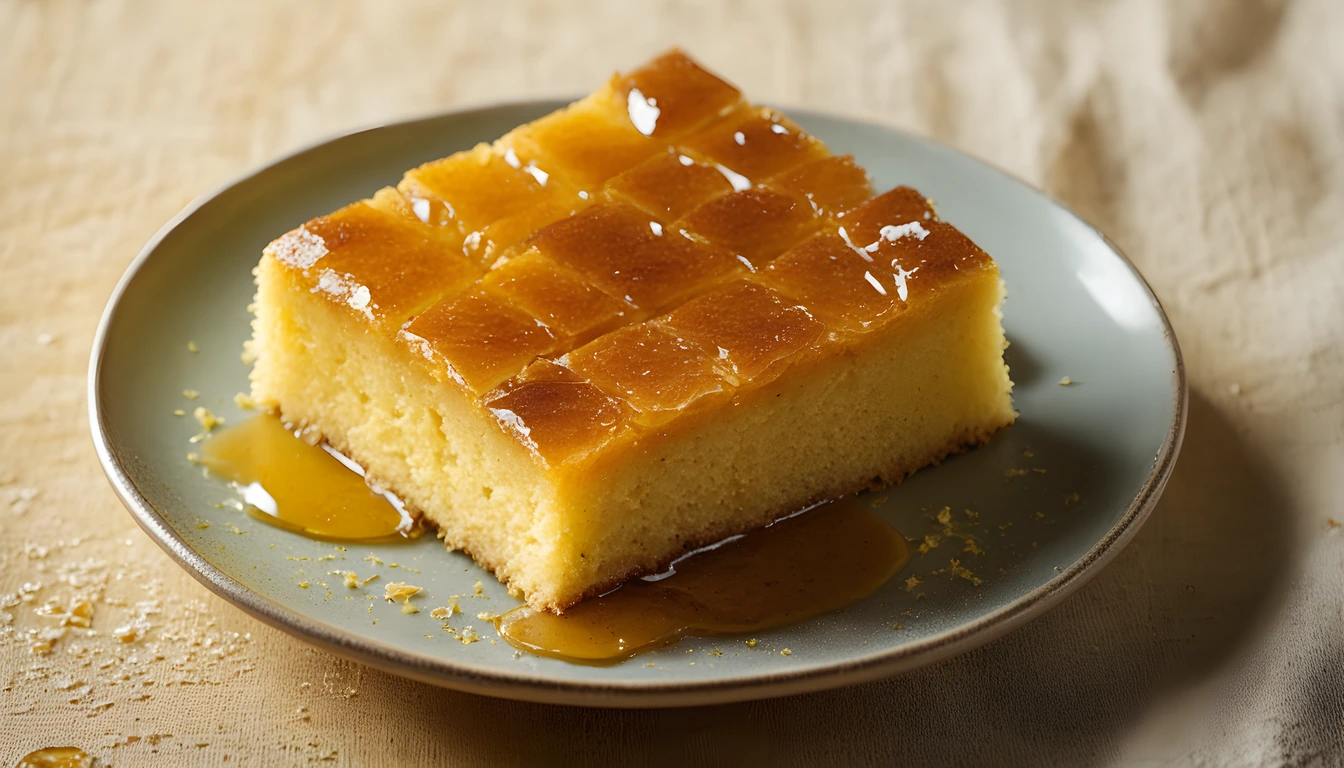
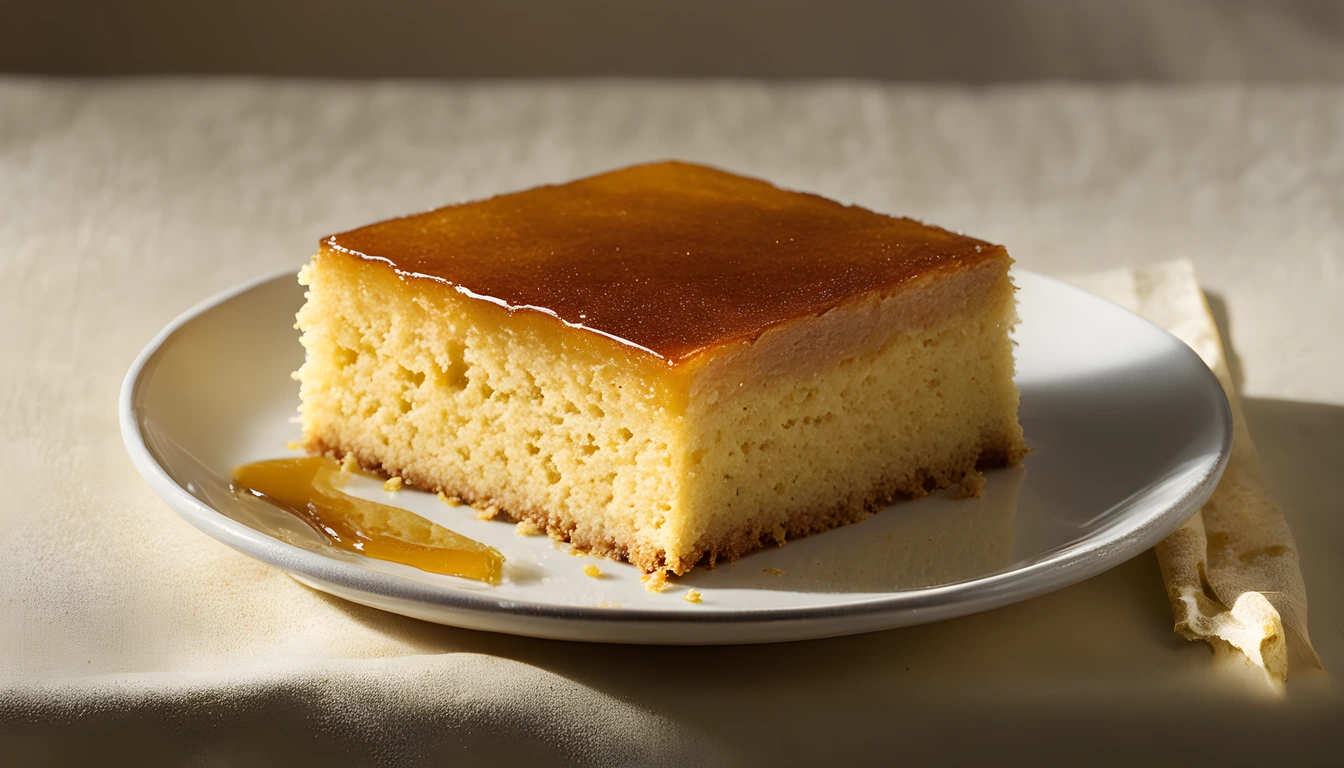
The top is a deep amber-brown, darker at the edges, and the cut side shows a close, grainy crumb with no dry patches. Syrup should be visible at the base of each piece, not standing in the pan.
A good piece is heavy for its size, soft at the center and firm enough to lift with a spatula. If a piece tastes dry in the middle, the cake was probably baked past the point where a skewer comes out clean, or the syrup was poured too quickly and ran down the sides instead of soaking in.
Flavor intensity is computed from the listed flavor notes of 89 honeys in our catalog: 1 means most are described as mild or light, 5 means most are described as bold or dark. It is a tasting guide, not a laboratory measurement.
Sources: Honey (UC Agriculture and Natural Resources, Cottage Foods); USDA FoodData Central: Honey; USDA FoodData Central: Egg, whole, raw, fresh; USDA FoodData Central: Yogurt, Greek, plain, whole milk; USDA FoodData Central: Oil, canola; USDA FoodData Central: Wheat flour, white, all-purpose, enriched, bleached; USDA FoodData Central: Cornmeal, whole-grain, yellow; USDA FoodData Central: Leavening agents, baking powder, double-acting, sodium aluminum sulfate; USDA FoodData Central: Salt, table; USDA FoodData Central: Orange peel, raw; USDA FoodData Central: Vanilla extract; USDA FoodData Central: Orange juice, raw (Includes foods for USDA's Food Distribution Program); USDA FoodData Central: Lemon juice, raw; USDA FoodData Central: Beverages, water, tap, drinking.
- Deep gold top, not pale
- Skewer comes out clean before syrup
- Syrup absorbed, not pooled
- Cut pieces hold their shape
Pro Tip
If the cake is browning faster than the center sets, lay a sheet of foil loosely over the top for the last 10 minutes.
1 = mild, 5 = bold. Editorial pairing guidance, not laboratory measurements; jars vary.
- Orange Blossom
- The honey-citrus syrup, where it echoes the orange juice
- Wildflower
- The batter, for a round floral note
- Clover
- A mild batch when you want the citrus forward
- Acacia
- A pale, delicate cake with a lighter syrup
- Buckwheat
- A spoonful in the syrup for a dark, malty edge
Matching a honey to another dish: the honey flavor map
Get the Honey Buyer's Cheat Sheet (free PDF)
16 varieties on one page — color, flavor, best use and what a fair price looks like — from the 304 honeys we track.
Serving and storage
Serve revani at room temperature, cut into 12 pieces. It is rich enough to eat plain.
Because the cake contains eggs and yogurt, refrigerate leftovers in a sealed container. Let a piece sit at room temperature for 20 minutes before eating so the crumb softens again. It keeps 4 days in the refrigerator; freeze slices for up to 2 months, wrapped individually, and thaw in the refrigerator.
- Room temperature: the day it is made
- Refrigerator: up to 4 days, sealed
- Freezer: up to 2 months, sliced
- Thaw overnight in the refrigerator
Pro Tip
Cut only what you plan to serve; the uncut cake stays moister in the refrigerator.
Why cornmeal instead of semolina
Classic revani uses fine semolina, which gives a sandy crumb and a slight chew. Whole-grain cornmeal behaves in a similar way: it stays granular, drinks up syrup and keeps the cake from tasting like a plain sponge.
The cornmeal here is whole-grain and fairly fine. If yours is coarse, pulse it in a food processor for 10 seconds before measuring; large grains make the cake crumbly.
- Fine semolina can replace the cornmeal by weight
- Let a semolina batter rest 10 minutes before baking
- Coarse cornmeal should be ground finer
- Do not pack the cornmeal into the cup
Pro Tip
If you use semolina, keep the same 140 g and add 1 tbsp orange juice if the batter looks stiff after resting.
Choosing the Honey
Use Orange Blossom Honey or Wildflower Honey or Clover Honey for the flavor described in this recipe. See our honey selection guide for other culinary choices.