Why Honey Makes Better Baklava
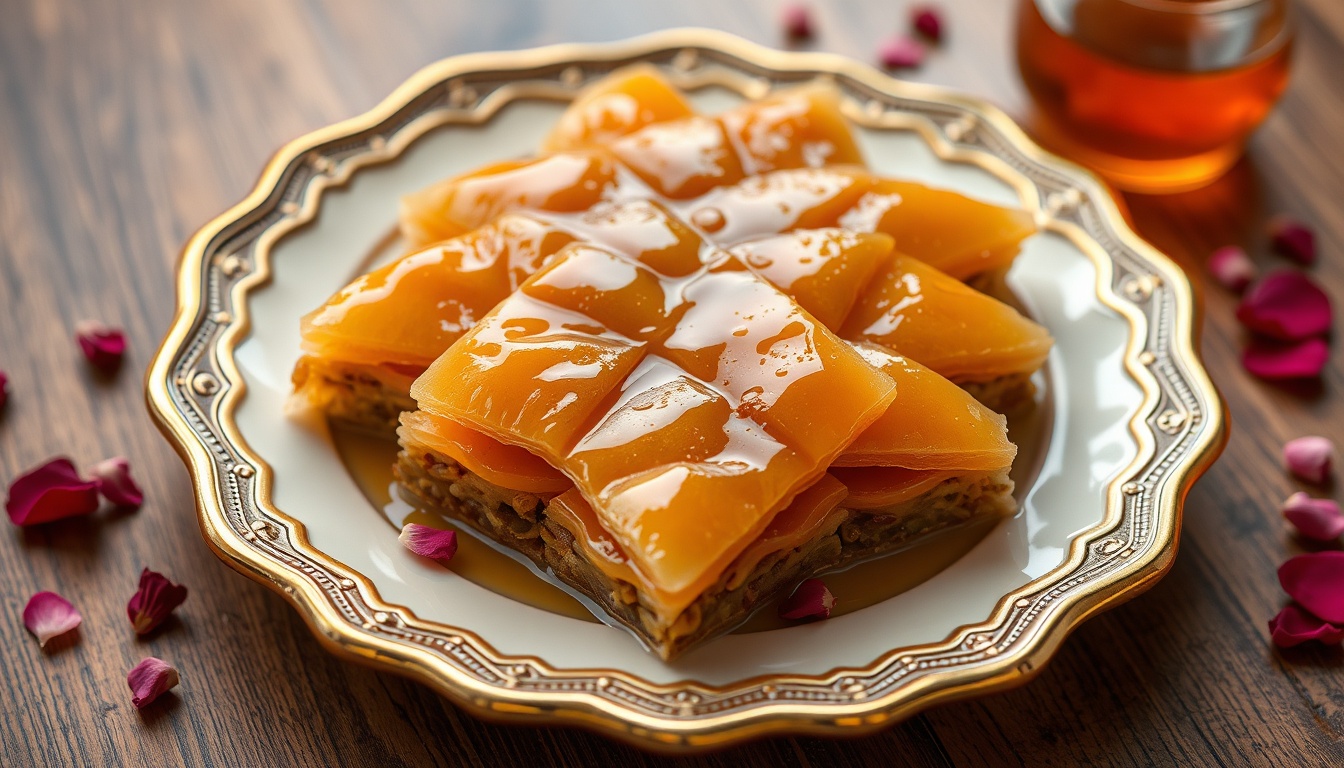
Traditional baklava from Greece, Turkey, and the Middle East is soaked in a sweet syrup — and the best versions use raw honey as the primary sweetener rather than plain sugar syrup. Honey brings three things sugar cannot: viscosity that clings to phyllo layers without making them soggy, floral complexity that complements the toasted nuts, and a golden sheen that looks as good as it tastes.
The key difference between bakery-quality baklava and the disappointing kind is the syrup. Too-sweet, too-thin sugar syrup soaks through and turns the phyllo into a wet, collapsing mess. A honey-based syrup has natural body from its fructose and glucose content, coating each layer evenly while letting the phyllo stay crisp and flaky.
This recipe uses a 50/50 honey-sugar syrup — pure honey alone can be overwhelming and crystallizes faster, while mixing it with a small amount of sugar produces the ideal consistency. A squeeze of lemon juice prevents crystallization and brightens the sweetness.
Ingredients
This recipe makes about 24 pieces in a standard 9×13 inch baking pan. Gather everything before you start — once you begin layering phyllo, you need to work quickly to prevent it from drying out.
- **For the nut filling:** 2 cups walnuts (finely chopped, not ground); 1 cup pistachios (finely chopped); 1 teaspoon cinnamon; 1/2 teaspoon cardamom; 1/4 teaspoon ground cloves; pinch of salt.
- **For the phyllo layers:** 1 pound (16 oz) frozen phyllo dough, thawed overnight in the refrigerator; 1 cup (2 sticks) unsalted butter, melted and slightly cooled.
- **For the honey syrup:** 3/4 cup water; 3/4 cup granulated sugar; 3/4 cup raw honey (wildflower or clover); 1 tablespoon fresh lemon juice; 1 strip of lemon zest; 1 cinnamon stick; optional: 1 teaspoon rosewater or orange blossom water.
Get the Honey Buyer's Cheat Sheet (free PDF)
16 varieties on one page — color, flavor, best use and what a fair price looks like — from the 304 honeys we track.
Honey Baklava Recipe (Step-by-Step)
The process has three stages: make the syrup, layer the phyllo and nuts, then bake and soak. Allow about 90 minutes total plus cooling time.
- **Step 1: Make the syrup first** — Combine water, sugar, honey, lemon juice, lemon zest, and cinnamon stick in a saucepan. Bring to a boil over medium heat, stirring until sugar dissolves. Reduce heat and simmer for 10 minutes until slightly thickened. Remove from heat, stir in rosewater if using, and let cool completely. The syrup MUST be cool when you pour it over hot baklava — hot syrup on hot pastry creates steam that makes soggy baklava.
- **Step 2: Prepare the nut filling** — Combine chopped walnuts, pistachios, cinnamon, cardamom, cloves, and salt in a bowl. Toss to distribute the spices evenly. The nuts should be chopped to roughly the size of rice grains — too fine becomes paste, too coarse tears the phyllo.
- **Step 3: Prepare the pan** — Preheat oven to 350°F (175°C). Brush a 9×13 inch baking pan generously with melted butter. Unroll the phyllo dough and cover with a damp (not wet) kitchen towel to prevent drying.
- **Step 4: Layer the bottom** — Place one sheet of phyllo in the pan, trimming to fit if needed. Brush lightly with melted butter. Repeat for 8 sheets total, buttering each one. This thick bottom layer creates a sturdy, crispy base.
- **Step 5: Add first nut layer** — Spread 1/3 of the nut mixture evenly over the phyllo. Layer 4 more sheets of phyllo on top, buttering each one.
- **Step 6: Continue layering** — Spread another 1/3 of the nuts, then 4 more buttered phyllo sheets. Spread the remaining nuts, then finish with 8 sheets of buttered phyllo on top. Brush the very top sheet generously with butter.
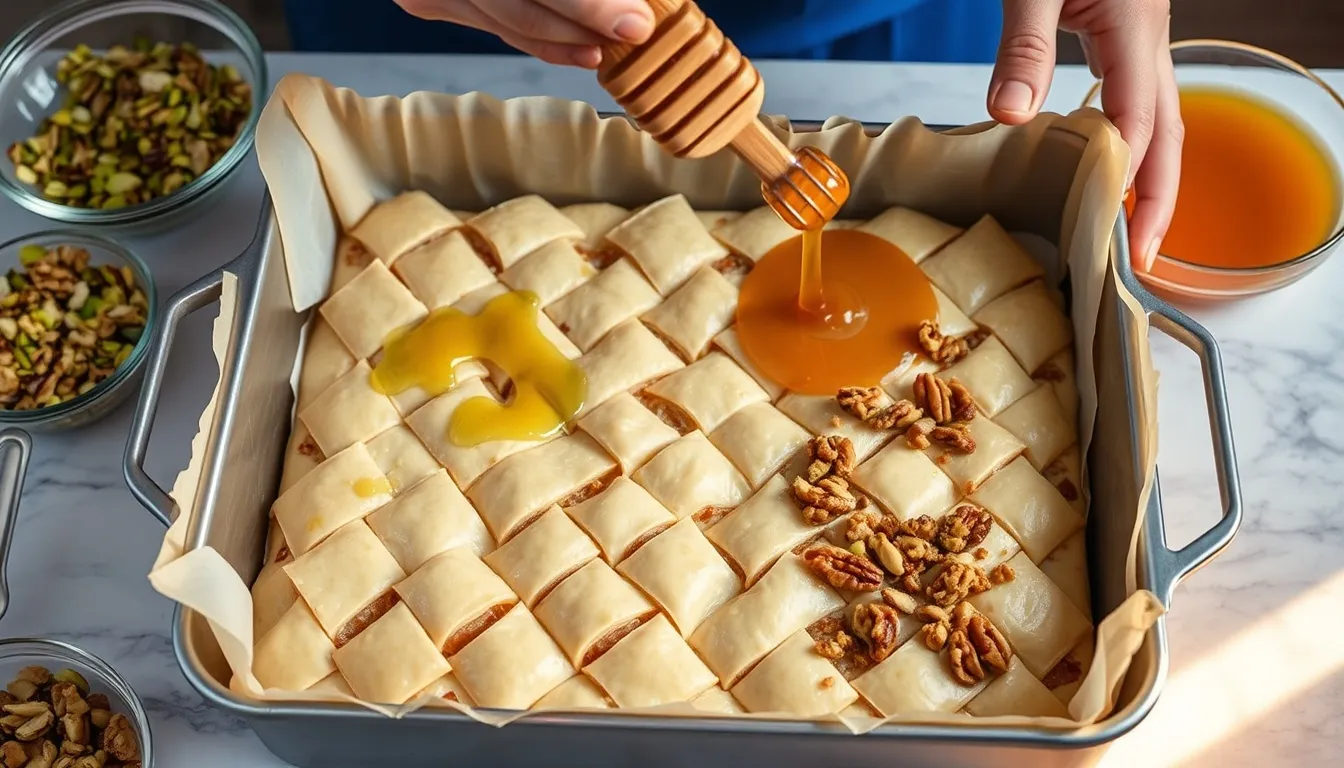
- **Step 7: Cut before baking** — Using a sharp knife, cut the baklava into diamonds or squares. Cut all the way through to the bottom of the pan. This is essential — cutting after baking shatters the crispy phyllo. Make 4 lengthwise cuts and 6-7 diagonal cuts for traditional diamond shapes.
- **Step 8: Bake** — Bake at 350°F for 45-50 minutes until the top is deep golden brown and the layers are visibly puffed and crispy. The baklava should look darker than you might expect — pale baklava means underbaked, soggy layers.
- **Step 9: Soak immediately** — Remove from oven and immediately pour the cooled honey syrup evenly over the hot baklava. You will hear it sizzle. The hot pastry absorbs the cool syrup perfectly. Let it sit uncovered at room temperature for at least 4 hours (overnight is better) before serving.
Pro Tip
The single most important rule: cool syrup on hot baklava (or hot syrup on cool baklava — never both the same temperature). The temperature difference is what creates the perfect absorption without sogginess.
Choosing the Best Honey for Baklava
Since honey is a primary flavoring — not just a sweetener — the variety you choose matters enormously.
- **Wildflower honey** — Complex and aromatic. The mixed floral profile pairs beautifully with the warm spices. The most traditional Greek choice.
- **Clover honey** — Mild and clean. Lets the nuts and spices dominate. A good neutral option if you are new to making baklava.
- **Orange blossom honey** — Citrus-floral notes that add brightness. Traditional in Lebanese and some Turkish preparations. Pairs especially well with pistachios.
- **Thyme honey** — Intensely aromatic with herbal, slightly savory notes. The classic Greek taverna choice. Bold flavor that stands up to walnuts and cinnamon.
- **Buckwheat honey** — Dark and malty, almost like molasses. Produces a richer, more robust baklava. Not traditional but interesting for adventurous bakers.
Nut Variations
The classic nut combination varies by region. Here are the most common options.
- **Walnut (Greek style)** — Walnuts are the traditional Greek choice. Their mild bitterness balances the sweet honey syrup. Use the full 3 cups as walnuts only.
- **Pistachio (Turkish style)** — All-pistachio baklava is the luxury version. The green color is stunning against the golden phyllo. Use unsalted, shelled pistachios — the bright green inner color indicates freshness.
- **Walnut-pistachio mix** — The combination in this recipe. The walnuts add substance and the pistachios add color and a buttery sweetness.
- **Almond** — Less common but delicious. Sliced almonds create more delicate layers. Toast them first for deeper flavor.
- **Hazelnut** — Popular in some Turkish regions. Pairs especially well with the cinnamon and cardamom spicing.
Storage and Make-Ahead Tips
Baklava is one of the best make-ahead desserts because it actually improves over the first day or two as the syrup fully penetrates the layers.
- **Room temperature** — Store uncovered or loosely tented with foil at room temperature for up to 1 week. The honey acts as a natural preservative due to its low water activity and antimicrobial properties.
- **Do not refrigerate** — Refrigeration makes the phyllo lose its crispness and become chewy. The honey syrup prevents spoilage at room temperature.
- **Freezing** — Baked baklava freezes well for up to 3 months. Wrap individual pieces in plastic wrap, then place in a freezer bag. Thaw at room temperature for 2-3 hours.
- **Make-ahead timeline** — Make the syrup up to 1 week ahead (refrigerate). Assemble and bake the baklava 1-2 days before serving for the best flavor. The flavors meld and the texture reaches its peak after resting overnight.
Common Mistakes to Avoid
Baklava is straightforward but unforgiving of a few specific errors.
- **Both syrup and baklava at the same temperature** — This is the number one cause of soggy baklava. The temperature contrast drives proper absorption. Cool syrup on hot baklava is the safest method.
- **Not enough butter** — Every single phyllo sheet needs a brush of butter. Dry sheets crack, stick together, and never get crispy. Use the full cup of melted butter.
- **Cutting after baking** — Baked phyllo shatters when cut. Always cut the baklava into diamonds or squares before it goes in the oven.
- **Chopping nuts too fine** — A food processor can turn nuts into paste in seconds. Pulse briefly or chop by hand to rice-grain size. Nut paste creates dense, gummy layers instead of crunchy ones.
- **Underbaking** — Pale baklava is underbaked baklava. The top should be deeply golden brown, almost the color of a well-toasted piece of bread. This takes the full 45-50 minutes.
- **Covering while cooling** — Let the baklava cool completely uncovered. Covering traps steam and softens the top layer of phyllo.
Nutrition Information
One piece of baklava (1/24 of the pan) contains approximately 230 calories, 14g fat, 25g carbohydrates, and 4g protein. The nuts contribute unsaturated fats, and the honey adds floral depth that refined sugar lacks.
Baklava is calorie-dense because of the butter and nuts, but a single piece is typically satisfying due to its rich flavor and sweetness. It is a better occasional dessert choice than many alternatives because the primary ingredients — nuts, honey, and butter — are whole foods rather than processed ingredients.