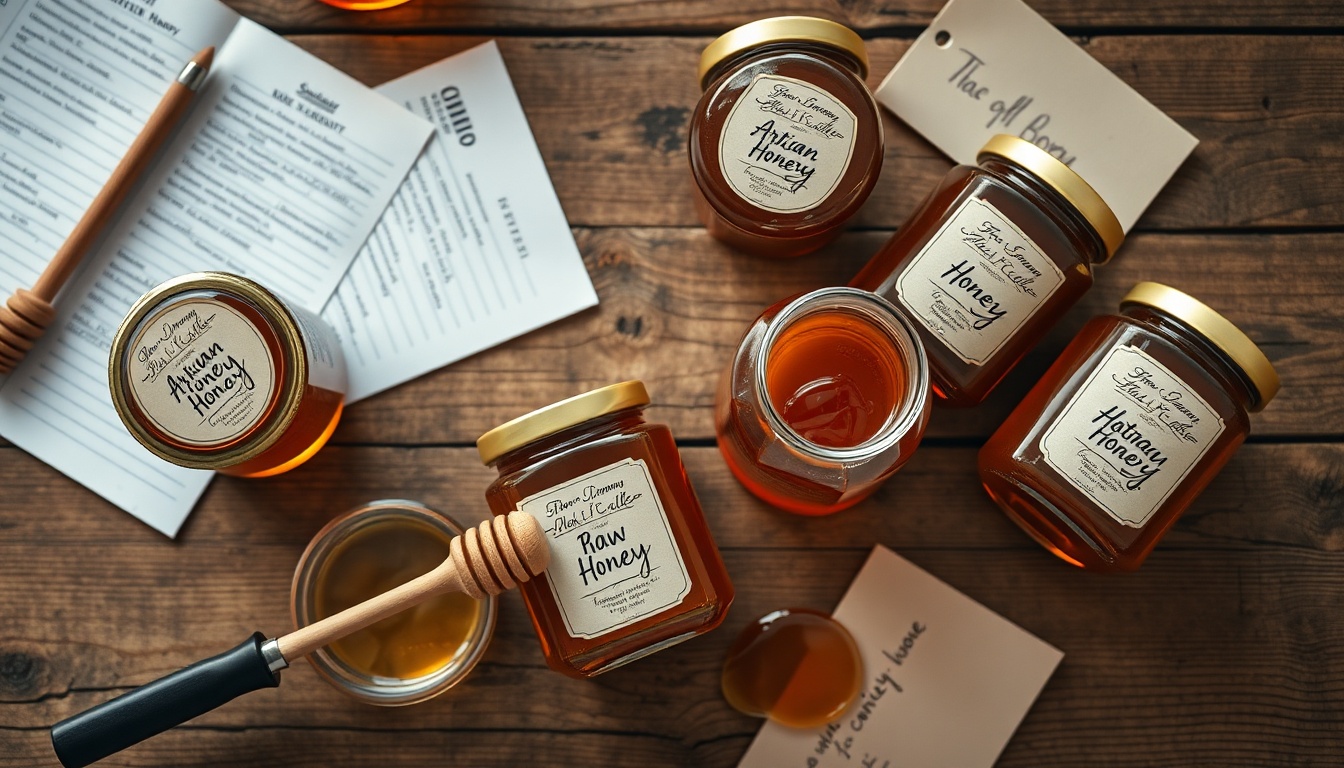
Portugal's Seven Honey Worlds: A DOP Atlas
Portugal produces honey in seven legally distinct geographic zones, each with its own DOP (Denominação de Origem Protegida — the Portuguese equivalent of the EU Protected Designation of Origin). Seven DOP designations place Portugal among the most formally documented honey-producing nations in Europe, yet a single supermarket shelf in London or New York carries Portuguese olive oil and wine while Portuguese honey remains virtually unknown internationally.
The seven designations are: Mel de Barroso (Trás-os-Montes heather and rosemary highlands); Mel dos Açores (Azorean archipelago with endemic Erica azorica heather); Mel da Serra da Lousã (Central Portugal cistus and heather uplands); Mel da Terra Quente (Eastern Trás-os-Montes rosemary and lavender); Mel do Alentejo (the great southern plain, dominated by eucalyptus and lavender); Mel do Parque Biológico de Gerês (Peneda-Gerês National Park heather moorland); and Mel do Ribatejo Norte (ribatejo eucalyptus-heather blend). Each designation specifies geographic boundaries, eligible floral sources, and analytical quality thresholds enforced by DGAV (Direção-Geral de Alimentação e Veterinária).
The national backdrop: Portugal is Western Europe's 4th or 5th largest honey producer, generating approximately 10,000–14,000 tonnes annually depending on drought conditions in the Alentejo. The Alentejo alone accounts for roughly 40% of national production. Portugal is also a net exporter, but most exported volume travels as unlabelled bulk into EU blending pools — a structural mismatch that explains why the regional DOP labels exist: they are the mechanism for value capture above commodity price.
Pro Tip
The seven Portuguese DOP honey designations are legally enforced by DGAV. Packaging must carry the EU DOP roundel (a blue-and-yellow geographic shield) and the controlling body's certification number. If a label says 'Mel do Alentejo' without the DOP roundel, it is not protected-designation honey — it is generic regional marketing.
Serra da Estrela and Northern Heather Honey
Serra da Estrela, Portugal's highest mountain range at 1,993m (the peak Torre), produces heather honey from a suite of Erica species: Erica australis (Spanish heath, flowering April–June), Erica cinerea (bell heather, June–September), and Erica umbellata (cross-leaved heath, July–September), with Calluna vulgaris (ling heather, August–October) at altitude. The overlapping bloom windows extend the heather nectar season from April through October — an unusually long window compared to most European heather honey regions, which have a narrow August–September peak.
Serra da Estrela heather honey is typically dark amber, slightly gel-like, with a persistent floral bitterness and a phenolic complexity that experienced tasters compare to Scotch malt whisky: dried heather blossom, a faint iodine note, and a dry tannin-like finish. The gel-like texture is a thixotropic effect caused by high-molecular-weight proteins specific to Calluna and Erica nectars — authentic heather honey sets semi-solid in the jar and reverts to liquid when stirred. Water content in Serra da Estrela heather honey typically runs 18.5–19.5%, contributing to the dense texture.
Further north, the Mel de Barroso DOP zone in the Barroso highlands of Trás-os-Montes (Montalegre and Boticas municipalities) mixes heather with rosemary (Rosmarinus officinalis), chestnut (Castanea sativa), and bramble (Rubus ulmifolius). The Barroso is a high plateau at 900–1,400m altitude, culturally isolated from the coast. Traditional cork-bark hives (cortiços de cortiça) still operate alongside modern Langstroth equipment. Mel de Barroso DOP specifies a minimum electrical conductivity of 0.3 mS/cm for blossom honey, enforcing a mineral baseline that rules out heavily diluted product.
Pro Tip
Serra da Estrela heather honey appearing gel-like or thixotropic in the jar is a quality signal, not a defect. The semi-solid texture caused by Erica and Calluna nectary proteins reverts to liquid when stirred with a spoon. If a heather honey is freely pourable without stirring, it was likely heated above 40°C during processing — destroying the protein structure and signalling over-processing.
Get the Honey Buyer's Cheat Sheet (free PDF)
16 varieties on one page — color, flavor, best use and what a fair price looks like — from the 304 honeys we track.
Alentejo Eucalyptus and the Rosemary-Lavender Belt
The Alentejo is Portugal's great southern plain — 31,000 km² of gently rolling cork oak savanna (montado), wheat fields, and increasingly, eucalyptus plantation. Eucalyptus globulus (blue gum) was introduced from Australia in the 19th century for pulpwood and today covers roughly 800,000 hectares in Portugal, making Portugal one of Europe's top three eucalyptus timber producers. For beekeepers, this is both resource and limitation: eucalyptus flowers (October–December in southern Portugal) produce an abundant, reliable nectar flow, but the resulting Mel do Alentejo DOP honey is pungent, dark amber to brown, and strongly medicinal — camphor and eucalyptol dominate the aroma.
Portuguese eucalyptus honey differs from Australian eucalyptus honey in one measurable respect: Eucalyptus globulus monofloral honey from Portugal typically shows lower diastase activity (diastase number 8–12) compared to Australian eucalyptus varieties (15–25 DN). This is a species and climate difference, not an adulteration signal — but it means Portuguese eucalyptus honey sits near the lower end of the EU diastase minimum (≥8 DN), a point that auditors flag during export certification.
Beyond eucalyptus, the Alentejo and the Algarve's interior produce rosemary (Rosmarinus officinalis, February–May), lavender (Lavandula stoechas, March–June), and Cistus ladanifer (rockrose / esteva, April–June). Cistus honey deserves special mention: Cistus ladanifer is endemic to the western Iberian Peninsula, and its honey — amber to light amber, with a distinctive balsamic-resinous note from labdanum terpenoids — is difficult to find outside Portugal and Spain. The balsamic undertone comes not from the nectar itself but from trace labdanum gum volatiles present on Cistus flowers, which bees collect alongside nectar. The resulting honey has a flavor profile with no close analog in northern European markets.
Pro Tip
Mel do Alentejo DOP eucalyptus honey has a strongly medicinal, camphor-eucalyptol aroma that divides tasters. For the table, look for bottles labelled 'lavanda' (lavender), 'alecrim' (rosemary), or 'poliflorais Alentejo' for a gentler profile. The eucalyptus monofloral is better deployed as a cold-and-cough remedy or in strong-flavored meat glazes where its intensity becomes an asset.
Algarve Carob Blossom and Medronho Honey
Carob blossom honey (mel de alfarroba) is perhaps Portugal's most structurally distinctive variety. The carob tree (Ceratonia siliqua) is native to the Mediterranean basin, and the Algarve — Portugal's southernmost region — holds one of the highest carob tree densities in Europe. Carob blooms September–October, producing a pollen-rich flower with a distinctive amine-heavy scent on the tree. The resulting honey, harvested October–November, is dark amber to nearly black, dense, with molasses depth, dried fig notes, and a mild tannin finish. The aroma in the jar is far more refined than the bloom: the amine volatiles do not carry through the nectar-to-honey conversion.
Carob blossom honey crystallizes slowly (moderate fructose fraction) and commands at Algarve specialty producers — a premium driven by the short harvest window and the near-total absence of carob monofloral from any other major honey-producing country at scale. On international specialty markets it is essentially unknown despite its unique flavor profile.
Medronho honey (mel de medronho) comes from Arbutus unedo (strawberry tree), which blooms October–December — one of the latest-blooming trees in the European calendar — while the previous year's fruit simultaneously ripens red on the same branch. Medronho honey is intensely bitter: Arbutus nectar contains arbutin and related hydroquinone glycosides that contribute a pronounced, clean bitterness distinct from the tannin bitterness of chestnut. The bitterness is authentic and varies by tree density and harvest timing. Medronho honey is also the raw botanical material for aguardente de medronho (strawberry tree brandy), the Algarve's regional spirit — bees and distillers share the same botanical source in October–November.
Pro Tip
Medronho honey's bitterness is a quality indicator, not a sign of poor processing. The bitter compounds (arbutin, methylarbutin) are heat-stable and present in authentic Arbutus unedo monofloral honey. Pair it with strong aged cheeses — Queijo da Serra, Queijo de Azeitão — where the bitterness becomes a flavor complement rather than a challenge.
Azores: Erica azorica and Endemic-Flora Honey
The Azorean archipelago — nine volcanic islands 1,400 km west of mainland Portugal in the North Atlantic — produces honey that is legally and ecologically distinct from mainland Portugal under the Mel dos Açores DOP. São Miguel, the largest island, and Flores and Corvo, the westernmost, are the primary sources.
The defining botanical feature of Azorean honey is Erica azorica — the Azorean tree heather, a species endemic to the islands, which grows to 4–6 metres tall (unlike mainland European Erica species, which are shrubs) and flowers January–May. This creates a winter-to-spring nectar flow that does not exist on the European continent, extending the Azorean honey season into months when all other European honey production is dormant. Erica azorica honey is light amber, with a delicate, slightly sweet-herbal profile closer to a light wildflower than to the intense northern heather honeys.
Pittosporum undulatum (Australian cheesewood), though an invasive species in the Azores, has become an important secondary nectar source: it blooms March–May alongside late Erica azorica and produces a light floral honey with jasmine-like top notes. Other Azorean contributions include Laurus azorica (Azorean laurel, endemic), Myrica faya (fire tree, endemic), and coastal Rubus bramble. The Azorean honey matrix is not fully characterized by melissopalynological analysis — a research gap, since the archipelago's high endemic-flora proportion means no comprehensive pollen reference library covers all potential nectar sources.
Pro Tip
Mel dos Açores DOP honey labelled specifically 'São Miguel' or 'Flores' and harvested January–March (Erica azorica peak) has the most distinctive flavor profile. Avoid blends simply labelled 'Mel dos Açores' without island or seasonal specification — these are typically summer wildflower blends from Pittosporum-heavy sources, which are pleasant but not the most distinctive expression of Azorean honey.
Apis mellifera iberiensis and Portuguese Beekeeping
The native bee of Portugal and Spain is Apis mellifera iberiensis (the Iberian honeybee subspecies). Like other Mediterranean subspecies, A. m. iberiensis is known for defensive behaviour — more prone to sting than northern European subspecies such as A. m. ligustica (Italian) or A. m. carnica (Carniolan) — but also highly productive, well-adapted to the hot dry Mediterranean summer, and capable of exploiting the fragmented floral resources of the Portuguese montado landscape. Most Portuguese commercial apiaries use A. m. iberiensis stock or local crosses, though crossbreeding with Italian bees is common in apiaries that prioritize temperament.
Transhumant beekeeping (apicultura migratória) is widespread: hives move from Trás-os-Montes in summer (heather peak, August–October) to the Alentejo for the eucalyptus flow (October–December) and on to the Algarve for almond blossom (January–March). A single hive may complete a 1,000 km annual circuit. This mobility produces blended honey that falls outside any single DOP designation — a structural limitation of the geographic designation system applied to a transhumant industry.
Portugal has approximately 10,000–12,000 registered beekeepers, most small-scale. The national association FNAP (Federação Nacional dos Apicultores de Portugal) coordinates DOP application and quality audit. Export certification is handled by DGAV, applying EU Honey Directive 2001/110/EC standards plus the additional DOP specifications. A. m. iberiensis honey accumulates HMF (hydroxymethylfurfural) more quickly during storage than northern European subspecies honey, partly because of its adaptation to the Mediterranean climate where ambient temperatures during the curing period are higher — a practical argument for keeping Portuguese honey at 14–18°C and shaded.
Pro Tip
Store Portuguese honey — especially eucalyptus and rosemary varieties — at 14–18°C and away from direct light. The A. m. iberiensis subspecies produces honey slightly more susceptible to HMF accumulation at warm temperatures than northern European varieties. Proper cold storage preserves both quality and shelf life well within the EU 40 mg/kg HMF threshold.
How to Buy Authentic Portuguese Honey
Seven DOP designations are the strongest authenticity mechanism available. Genuine Mel de Barroso DOP, Mel dos Açores DOP, and the other five designations carry the EU PDO roundel (blue-and-yellow geographic shield) on the label alongside the certification number of the controlling body. DGAV publishes lists of certified DOP operators — cross-referenceable if a designation claim seems suspect.
Outside DOP channels, Portuguese honey is sold as mel silvestre (wildflower), mel de urze (heather), mel de eucalipto (eucalyptus), mel de rosmaninho (rosemary), or mel de alfarroba (carob blossom). These unlabelled regional descriptions are not protected — a jar labelled 'mel de urze' does not guarantee Serra da Estrela origin or Erica-dominant floral source. The DOP roundel is the only retail verification mechanism.
For specialty varieties — medronho (Arbutus unedo) and carob blossom (alfarroba) — the only reliable sourcing channels are direct from Algarve producers or Portuguese specialty importers. The carob blossom season is October–November; medronho is November–December. Most production sells out locally within weeks of harvest. Portuguese food retailers occasionally stock limited quantities with international shipping. The structural anomaly — 7 DOP designations but negligible international brand — is a distribution problem, not a quality problem. The honey exists; the international channel largely does not.