Qatar's Honey Market: Heavy Imports, Almost No Production
Qatar buys far more honey than it makes. Domestic production is estimated at fewer than 30–50 tonnes per year, among the lowest of any GCC state, in a country of 3.1 million people with one of the world's highest per-capita GDPs (~$55,000). It can afford to import premium honey, and in a Gulf market where authenticated Sidr sells at a premium, the question buyers care about is authenticity. No dated retail price is cited.
**Updated October 21, 2026:** earlier versions of this guide described Qatar University and Hamad Medical studies of Sidr and Manuka honey (a 2018 Sidr-versus-MRSA study, a 2021 Sidr-versus-Manuka comparison, polyphenol profiling of Doha retail honey) and a Hamad wound-care protocol naming UMF 10+ Manuka. We could not find any of them in PubMed or Europe PMC, so we removed them, along with the claim that Qatar is the Gulf's most research-active honey market.
The Qatar Standards and Metrology Organisation (QSMO) adopted GSO 147 — the Gulf Standardization Organization honey standard — as Qatar's national honey standard, applying the same framework as UAE's ESMA, Bahrain's BSMD, and Kuwait's BSI: HMF ≤ 40 mg/kg, moisture ≤ 20%, diastase ≥ 8 DN (with the standard low-diastase exemption for naturally diastase-poor varieties), maximum sucrose 5%, and Codex Alimentarius-aligned acidity and conductivity parameters. Qatar Customs and the Ministry of Commerce and Industry enforce QSMO conformity certification for imported honey. Unlike ESMA in the UAE, QSMO does not currently conduct systematic market surveillance with NMR-grade spectroscopy — conformity is primarily based on certificate documentation rather than in-Qatar laboratory testing of retail samples. This creates the same documentation-as-proxy-for-authenticity dynamic that characterises the broader GCC premium honey market.
Pro Tip
If a jar or seller cites a study, look it up on PubMed (pubmed.ncbi.nlm.nih.gov). A study you cannot find is marketing, not evidence.
Alhagi Maurorum: The Camel Thorn and the Thermal Limit of Gulf Beekeeping
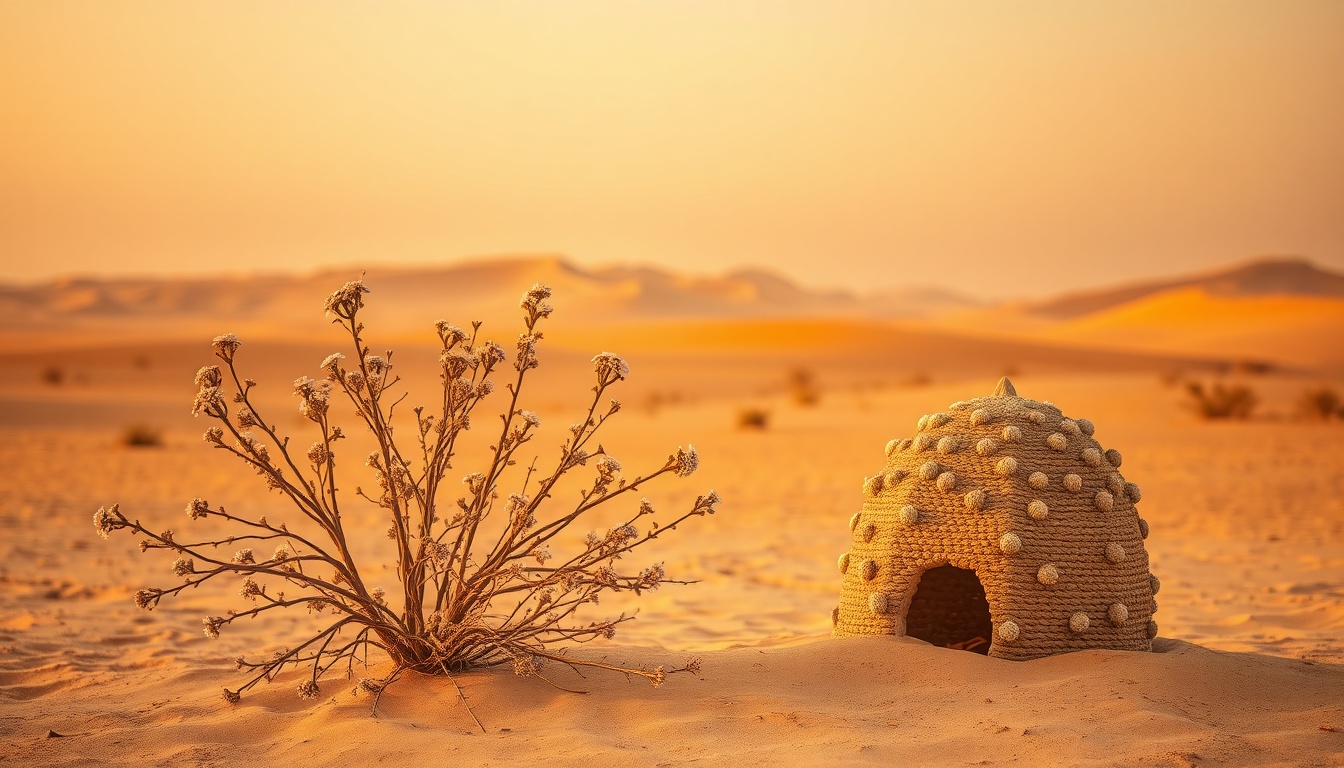
Qatar is 90% hyperarid desert — classified Bwh (hot desert climate) across virtually its entire territory, with annual rainfall averaging 75 mm concentrated in December–March and average summer temperatures in the interior reaching 45–50°C from June through September. This extreme aridity places Qatar at the edge of sustained beekeeping viability. The country's most significant native nectar plant is Alhagi maurorum — the camel thorn (known in Qatari Arabic as shok al-jamal, 'camel's thorns', or alhagi) — a drought-resistant perennial legume that occurs throughout the Arabian Peninsula's semi-arid and arid zones, producing small pale-pink to magenta pea-flowers on dense spiny branches from June through September: precisely the months when Qatar's daytime temperatures peak at 45–50°C in the interior and when most cultivated flora have ceased flowering entirely.
Alhagi maurorum is a paradox plant: it thrives under conditions that eliminate almost every other nectar source, persisting through Qatar's summer heat by drawing water from deep root systems (taproots reaching 5–8 metres in some populations). Its flowers produce nectar even at ambient temperatures approaching 50°C — a thermal environment that approaches the physiological limit for Apis mellifera worker bee foraging. Standard entomological models suggest that Apis mellifera foragers reduce activity significantly above 38–40°C ambient temperature, retreating to hive ventilation behaviour; at 45°C+ sustained ambient temperatures, colonies that cannot thermoregulate adequately collapse. Apis mellifera jemenitica — the GCC's native desert-adapted bee subspecies — has a higher thermal tolerance than European commercial subspecies (ligustica, carnica), sustaining foraging behaviour at ambient temperatures up to 43–45°C in documented observations from Saudi Arabia, Oman, and UAE highland-adjacent zones. Whether Qatar's interior jemenitica populations forage Alhagi at peak July–August temperatures of 48–50°C remains unclear in the published literature — this specific question has not been studied in Qatar, though it is the most practically important question for anyone considering whether a genuine Qatari desert honey tradition exists.
In practical terms, the few hundred active Qatari beekeepers concentrate their apiaries in Qatar's cooler coastal zones (particularly the north coast and the Al Khor / Al Thakhira mangrove areas), the agricultural areas around Al Shahaniya and Al Rayyan, and in the shaded interior wadi systems of the Dukhan anticline. Spring flowering (February–April) provides the most productive foraging window: Prosopis cineraria (ghaf, desert mesquite), Acacia tortilis (samr, umbrella thorn acacia), and Ziziphus spina-christi (sidr, occurring in Qatar's coastal zones and along seasonal wadi channels) bloom before the summer heat peaks. The resulting honey — a multifloral desert blend weighted toward acacia, ghaf, and sidr pollen, pale amber to amber in colour, with a mild-sweet character and relatively slow crystallisation rate — is what Qatari beekeepers call asal qatari (Qatari honey) and sell at Souq Waqif and private orders. The price premium is cultural provenance, not botanical documentation: pollen analysis of commercial Qatari-labelled honey is essentially unavailable in the public record.
Pro Tip
Alhagi maurorum honey — a known monofloral in countries with higher bee densities relative to camel thorn occurrence (northern Iran, parts of Iraq) — has a pale amber colour, mild caramel-sweet flavour, and fast crystallisation rate due to relatively high glucose content. In Qatar, the plant is commonly visible along highway medians and desert roadsides, particularly on the road to Dukhan and around Al Rayyan agricultural areas.
Get the Honey Buyer's Cheat Sheet (free PDF)
16 varieties on one page — color, flavor, best use and what a fair price looks like — from the 304 honeys we track.
Souq Waqif: Doha's Historic Honey Trading District
Souq Waqif — Qatar's restored traditional market in central Doha, a short walk from the Corniche — is the oldest continuously operating commercial district in Qatar and the primary cultural focal point for premium honey retail in the country. The souq's honey district, concentrated in the spice and natural products section near the Al Jazeera Gate entrance, carries a selection of GCC premium honeys comparable to Bahrain's Manama souq honey vendors or Dubai's Deira Spice Souk: authenticated Yemeni Sidr from Wadi Dawan and Hadramawt, Saudi Asir highland Sidr from Al-Baha, Omani mountain wildflower and Dhofar honey, and imported multifloral honeys (Turkish, Pakistani) at lower price points. Qatari-labelled local honey occupies a separate shelf position, with producers' names (sometimes beekeepers' personal names) on hand-filled jars.
The history of Souq Waqif's honey trade predates Qatar's emergence as a major LNG exporter: pearl divers and traders in the pre-oil Qatar economy maintained the same cross-Gulf honey trading relationships that connected Bahrain, Oman, and the Hadramawt coast. The 2006–08 restoration of Souq Waqif (which had degraded through the 1990s as modern shopping centres supplanted traditional commerce) was part of the Qatar Emiri Diwan's cultural heritage program and specifically maintained the honey vendor section as a living heritage trade. Today, the Souq Waqif honey vendors include second- and third-generation traders whose families originally imported from Omani mountain producers along the traditional Gulf dhow trading routes — and who now combine that traditional provenance with modern documentation requirements (QSMO certificates, pollen analysis from Turkish or Gulf food testing labs).
The 2017–21 Qatar diplomatic crisis — when Saudi Arabia, UAE, Bahrain, and Egypt imposed a land, sea, and air blockade on Qatar — had a direct and largely undocumented effect on Qatar's premium honey supply chains. Saudi Arabia is the GCC's largest premium honey producer (Asir highland Sidr, Talh acacia, Osher Calotropis) and was a primary supplier to Qatar's Souq Waqif honey district. The blockade eliminated direct Saudi honey imports; Qatar responded by expanding imports from Oman (which maintained diplomatic relations), Turkey, Pakistan, and directly from Yemen through the Omani overland route. Qatari honey merchants developed new relationships with Turkish highland wildflower producers in Kastamonu and Artvin and with Pakistani KPK Sidr producers in Peshawar — suppliers who had previously been marginal in the Qatar market. When the blockade ended in January 2021, Saudi honey returned to Qatari retail but it returned into a market that had diversified. The long-term result: Qatar's honey import profile is now more geographically varied than pre-2017, and Turkish and Pakistani Sidr honey have permanent shelf presence in Souq Waqif that they did not have before the crisis.
Pro Tip
When visiting Souq Waqif's honey district, ask vendors specifically about Yemeni honey origin documentation. Authentic Wadi Dawan or Hadramawt Sidr should come with a pollen analysis certificate (palynology report) from a named laboratory. The certificate may be in Arabic; the key data point is the percentage of Ziziphus spina-christi pollen (should be ≥45% for monofloral Sidr). Without pollen documentation at prices above, assume the product is blended or of uncertain origin.
Qatar National Food Security: Beekeeping Under the QNV 2030
Qatar National Vision 2030 (QNV 2030) — the strategic development framework published in 2008 and coordinated by the Ministry of Planning and Statistics — includes food security and agricultural development as core pillars. The Qatar Agricultural Food Security Authority (QAFSA) has operated small-scale beekeeping development programs since approximately 2015, training Qatari nationals and long-term residents in modern hive management, honey extraction hygiene, and product labelling. The program's scale is modest by regional standards: training cohorts of 20–50 beekeepers per year, provision of subsidised starter hive equipment (Langstroth hives and nucleus colonies of locally adapted Apis mellifera jemenitica), and access to QAFSA-maintained teaching apiaries at the demonstration farms in Al Shahaniya.
The agricultural constraints Qatar faces are genuinely severe. Annual rainfall of 75 mm — distributed over 10–15 rain events per year, mostly December through March — means that most plant biomass requires irrigation or dryland-farming techniques. Qatar's desalination capacity (among the world's largest, per capita) provides the water for its date palm gardens and agricultural plots, but beekeeping is constrained by foraging range (typically 3 km radius) and the limited floral diversity within that radius in urban-suburban Doha. The result is that Qatari beekeeping tends toward semi-urban apiaries in garden and small-farm environments where irrigated ornamental plants (Bougainvillea, Tecoma, Callistemon, Conocarpus) supplement desert foraging — a different floral profile from the traditional desert Alhagi/Acacia/Sidr honey of Qatar's pre-oil beekeeping heritage. The irrigated multifloral Doha suburban honey that results is pleasant and mild but lacks the botanical identity that would justify premium pricing in the Souq Waqif context.
The most viable pathway to a commercially distinctive Qatari honey — the approach that would allow 'asal qatari' to occupy a documented premium position rather than a provenance-only price point — would require systematic pollen analysis of hive samples from apiaries in Qatar's northern and western zones (where native vegetation density is highest), during the spring Acacia/sidr and autumn/post-summer windows when native nectar sources dominate over irrigated exotics. As of 2026, we found no published botanical-origin study of Qatar's wild-forage honey.
The GCC Hexagon Complete: What the Six-Country Pattern Reveals
With Qatar's inclusion, the Gulf Cooperation Council honey landscape forms a complete pattern across six sovereign states: Saudi Arabia, Oman, UAE, Bahrain, Kuwait, and Qatar. The pattern that emerges when all six are examined together is more coherent than any individual country study suggests. All six operate under the same GSO 147 honey standard. All six have per-capita honey consumption among the highest in the world (driven by Islamic Prophetic medicine traditions, honey gifting culture in a context where alcohol gifting is prohibited, and high discretionary income). All six import more than 95% of their honey consumption. All six have native Apis mellifera jemenitica populations whose honey commands domestic provenance premiums. And all six are connected to the Yemeni Sidr honey trade — the world's most expensive and most counterfeited premium honey — through trading relationships that predate the formation of the GCC itself.
The variation across the six countries is in what makes each distinctive within this shared framework. Saudi Arabia has the only GCC domestic honey production at meaningful scale (500–700 tonnes/year from Asir, Al-Baha, and Hail highlands) and the strongest Quranic honey narrative (Surah 16 An-Nahl). Oman has the most botanically diverse domestic honey landscape (Dhofar monsoon zone, Jebel Akhdar mountain, Hajar range) and the most consistent artisanal production across remote wadi zones. The UAE has the strictest import enforcement apparatus (ESMA + NMR + δ¹³C) and the world's smallest commercially-relevant honeybee species (Apis florea) as an indigenous novelty. Bahrain has the oldest paradise-garden narrative (Dilmun, 2000 BCE Sumerian) connecting its geography to honey symbolism. Kuwait has the most extreme supply-gap paradox (>99.8% import dependence, world's highest ambient temperature record, national plant whose honey no brand has claimed). Qatar completes the hexagon with almost no domestic production and a supply chain that was permanently restructured by four years of diplomatic blockade.
Seen together, the GCC hexagon is a useful lens for understanding how Islamic food culture, petro-wealth, and ancient trade networks interact with modern food safety enforcement. The GCC premium honey trade is simultaneously one of the world's most sophisticated (ESMA NMR enforcement, documented pollen analysis requirements) and one of its most fragile (near-total production dependence on Yemen, a country in active civil war; authentic Sidr monofloral adulteration rates estimated at 60–80% of international retail samples tested by independent labs). The paradox is structural and will persist as long as the demand-production gap exists — which, given GCC climate and land constraints, will be indefinitely.
Pro Tip
Travellers to Qatar can purchase high-quality domestic Qatari honey at the Souq Waqif honey vendors (ask specifically for asal qatari — Qatari honey), at the Al Khor Farmers' Market (held Fridays in the Al Khor corniche car park area, seasonal), and at occasional honey exhibitions at Katara Cultural Village in Al Waab. Qatari honey from northern coastal apiaries near Al Khor tends to have the most distinctive botanical character — the Al Thakhira mangrove area's Avicennia marina contributes to a saline-mineral edge in some spring honey samples that is genuinely unlike any mainland GCC equivalent.
The Doha Premium Honey Market: Buying Authentic Honey in Qatar
Qatar's premium honey retail spans four distinct channels with different risk/quality profiles. First, Souq Waqif honey district (described above) — best for GCC premium honey with traditional provenance claims; documentation quality is variable; prices are negotiable and often high for undocumented product. Second, high-end supermarket chains: Carrefour (Villagio Mall, Festival City), LuLu Hypermarket (multiple Doha locations), and Monoprix (The Pearl-Qatar, Lagoona Mall) carry a curated range of documented premium honeys including Certified New Zealand Manuka (UMF 10–30+), European honeys (Greek thyme, Turkish pine honeydew, Spanish rosemary), and a smaller Gulf monofloral selection. Documentation at these retailers is higher-trust than souq vendors for the international product category.
Third, specialty food retailers at high-end Doha malls: Galeries Lafayette Food Hall (The Pearl-Qatar, Porto Arabia) carries a European-curated honey selection including French Corsican maquis honey, Italian chestnut, and New Zealand Manuka — the most reliable retail destination for European premium honey brands with full provenance documentation. Katara Cultural Village's specialty food vendors carry GCC honey including occasional Qatari artisanal product during cultural events. Fourth, direct from producers: the QAFSA-trained beekeeper community sells direct via Instagram and WhatsApp at for domestic multifloral — the most cost-effective way to obtain authentic Qatari honey with direct producer accountability.
For visitors, the Souq Waqif honey purchase has cultural value regardless of the documentation status of the product — the experience of the market, the visual display of honeycomb, and the tasting of multiple origin honeys offered by vendors is part of Gulf food tourism that the souq does better than any other retail format. The practical guidance for high-value purchases (above) is: request and photograph the laboratory certificate before paying; verify the lab name is real (acceptable labs include Al Razi laboratories Amman, Dubai Central Laboratory, UKAS-accredited UK labs, and ADAS labs in the UK for Manuka authentication); and be sceptical of certificates with no reference number or QR code. At for locally-branded honey labelled 'Qatari multifloral', provenance authenticity is usually genuine even without formal certification — the premium is cultural and the volume is too small to motivate sophisticated fraud.
Varieties, Seasons, and What to Look For: Qatar's Honey Calendar
Qatar's honey production calendar is simpler than any of its GCC neighbours by virtue of its geography. Two distinct production windows define Qatari domestic honey. The spring window (February–April) is the primary and most botanically rich production period: Prosopis cineraria (ghaf tree), Acacia tortilis (samr), and Ziziphus spina-christi (sidr, occurring in Qatar's northern coastal zones and wadi systems) bloom in sequence as temperatures rise from winter lows of 15–18°C toward April highs of 32–38°C. Spring honey from north Qatar coastal and wadi apiaries is pale to medium amber, mild-sweet, with slow crystallisation (the ghaf and samr contribution suppresses crystallisation similarly to acacia). Spring is the only window when authentic sidr monofloral honey is theoretically possible in Qatar — though documented production is negligible.
The secondary window (June–September) encompasses the Alhagi maurorum (camel thorn) bloom period, occurring at peak summer temperatures (40–50°C) when almost all other Qatari nectar sources have ceased. Production from this window is minimal — jemenitica colony performance at these temperatures is severely constrained — but honey from apiaries positioned in Qatar's cooler coastal Al Khor zone, where sea breezes moderate afternoon temperatures by 3–5°C relative to the interior, may have a meaningful Alhagi contribution in good years. The resulting honey is typically darker amber, with a slightly richer, more complex flavour than the spring pale-amber multifloral, and a mineral-aromatic edge from the camel thorn and Avicennia marina mangrove blossom (if the apiary is in the mangrove coastal zone).
Imported honey for the Qatar market follows the broader GCC import calendar: Yemeni Sidr (October–November harvest, arriving in Doha markets January–February), Saudi Asir highland Sidr (October–December harvest, March–April market arrival), Omani Dhofar honey (September–October harvest from the Khareef monsoon flowering zone, December–February market arrival), Turkish highland wildflower (July–August harvest, October–December market arrival), and New Zealand Manuka (Southern Hemisphere autumn harvest January–May, year-round retail availability in Qatar given Manuka's long shelf life and documentation-heavy retail channel).