About This Recipe
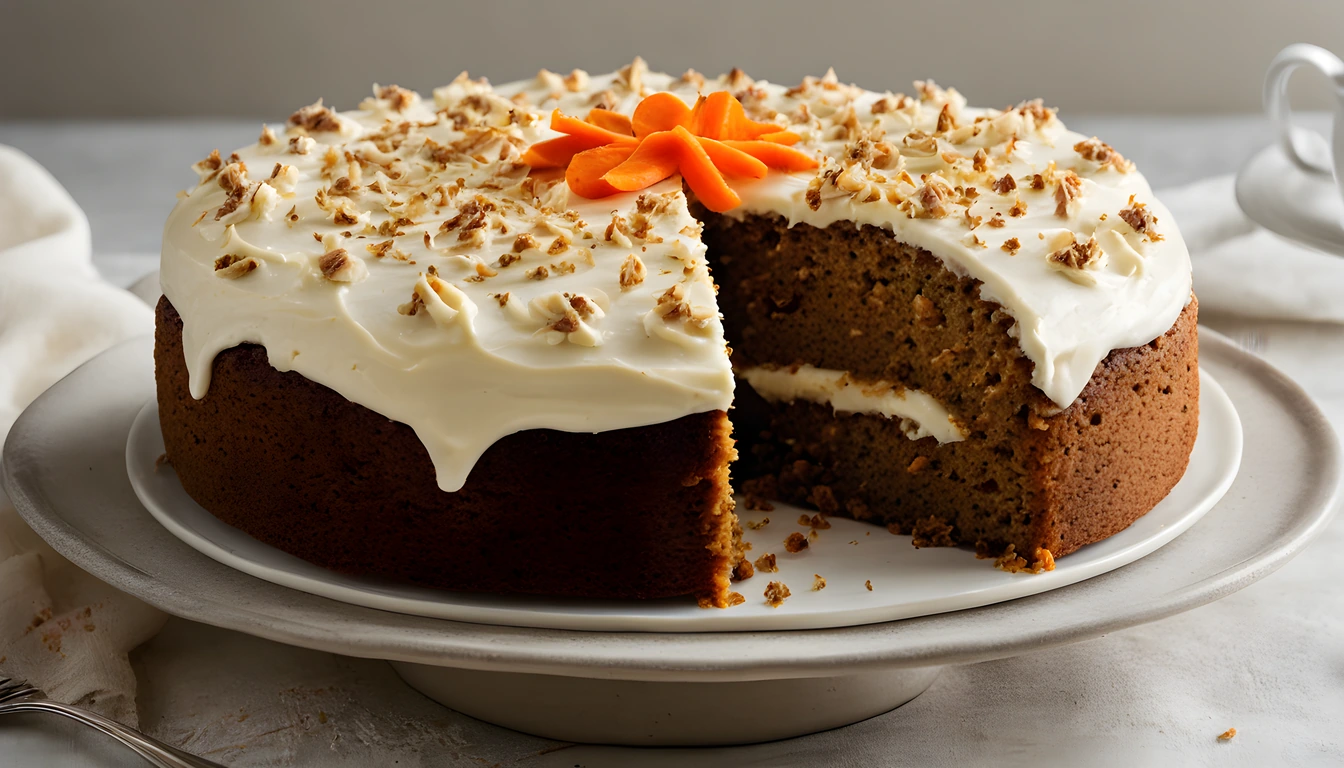
Honey carrot cake is a two-layer 8-inch cake built on coarsely grated carrot, walnuts and warm spice, sweetened partly with honey and finished with a thin coat of honey cream cheese frosting. The batter is oil-based, so the crumb stays soft even after a night in the refrigerator.
Honey holds water in the crumb and browns faster than sugar, so the cake bakes at 325°F and the layers stay level instead of doming hard. Baking soda is in the formula to lift a batter this heavy and to balance the honey's acidity.
Everything is measured by weight, which matters most for honey: a cup weighs 339 g, and a sticky cup measure can be off by 20 g or more. A scale also means a crystallized jar can be warmed just until it flows and still hit the number exactly.
Recipe
Honey Carrot Cake Recipe
A two-layer honey carrot cake with walnuts and cinnamon, baked at 325°F and finished with a thin coat of honey cream cheese frosting. Makes one 8-inch cake, 16 slices.
16Ingredients
Yield: 16 servings
- 170 g honey (about 1/2 cup)
- 110 g packed light brown sugar (about 1/2 cup)
- 200 g eggs (4 large)
- 218 g canola oil (about 1 cup)
- 275 g carrots, peeled and coarsely grated (about 2 1/2 cups)
- 250 g all-purpose flour (about 2 cups)
- 9.2 g baking soda (2 tsp)
- 5.2 g ground cinnamon (2 tsp)
- 3 g fine salt (1/2 tsp)
- 8.4 g vanilla extract (2 tsp)
- 117 g walnuts, coarsely chopped (about 1 cup)
- 10 g unsalted butter, softened, for greasing the pans (about 2 tsp)
- 225 g cream cheese, softened
- 113 g unsalted butter, softened, for the frosting (1 stick)
- 112 g honey (a scant 1/3 cup)
- 50 g powdered sugar (1/2 cup, sifted)
Ingredient amounts scale; instructions show the original batch. Cooking times and pan sizes may need adjustment. Season to taste. Honey grams use US measures at 20°C and 17.5% moisture, a density estimate; weigh your honey for precision.
Instructions
- 1Heat the oven and line the pansSet a rack in the middle of the oven and heat to 325°F (165°C). Use the 10 g of softened butter to coat two 8-inch round pans, line the bottoms with parchment, and butter the parchment too. If you only have 9-inch pans, the layers will be thinner and will bake a few minutes faster.
- 2Grate the carrotsPeel and coarsely grate 275 g of carrots, about 2 1/2 cups. Work on the large holes of a box grater and do not press the shreds dry in a towel; that moisture belongs in the cake and is part of why the crumb stays soft.
- 3Whisk the honey, sugar, eggs and oilIf the 170 g of honey has crystallized, stand the jar in a bowl of hot water for a few minutes and stir until it flows; crystals will not whisk out cold. In a large bowl, whisk the honey with 110 g brown sugar until no lumps remain. Whisk in 200 g eggs one at a time, then 218 g canola oil and 8.4 g vanilla. Keep whisking for a full minute after the oil goes in, until the batter looks glossy and slightly thickened rather than slick.
- 4Combine the dry ingredientsIn a second bowl, whisk 250 g flour with 9.2 g baking soda, 5.2 g cinnamon and 3 g salt for about 30 seconds, so the soda and spice are spread evenly rather than sitting in pockets.
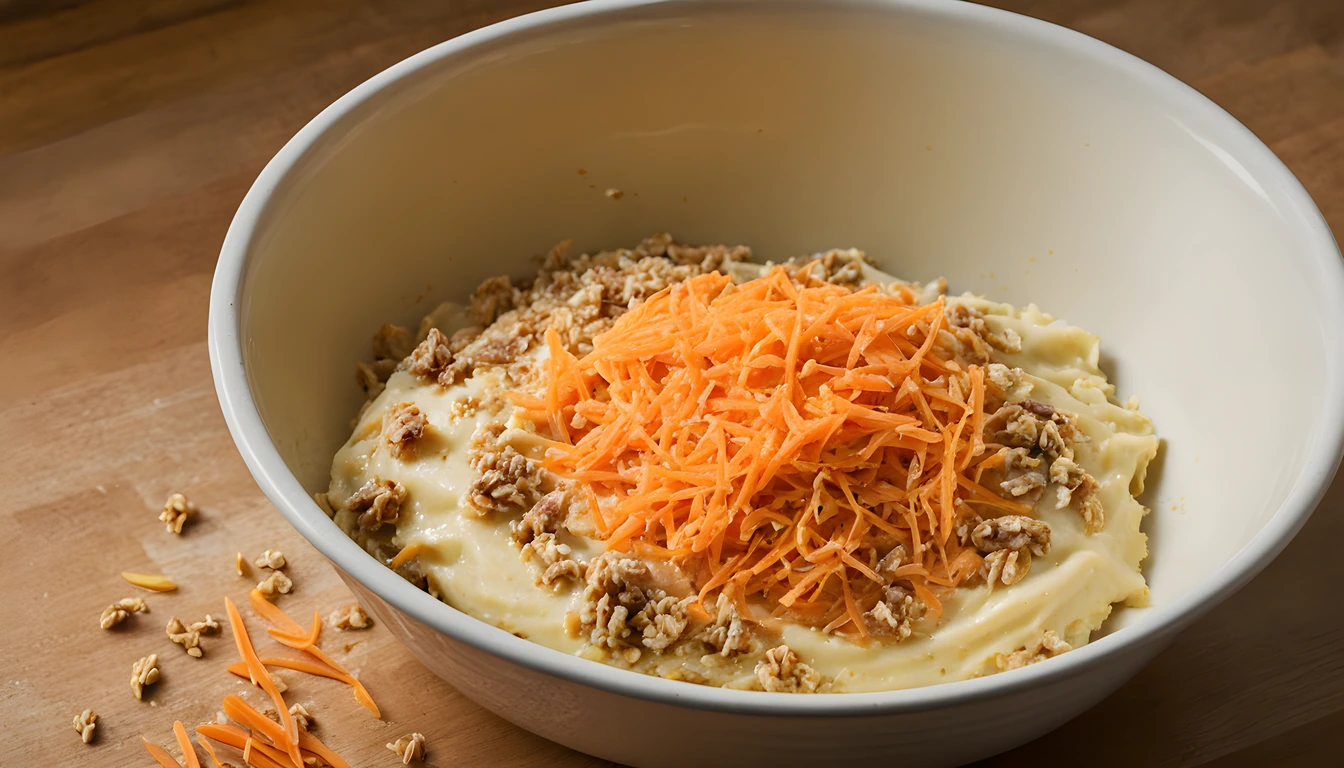
- 5Fold the batter togetherAdd the dry mixture to the wet in two additions, folding with a spatula until the last streaks of flour just disappear. Fold in the grated carrots and 117 g chopped walnuts. Stop as soon as the pieces are evenly distributed; extra stirring makes the crumb tough.
- 6Bake the layersDivide the batter between the pans, about 680 g each, and smooth the tops. Bake 30 to 35 minutes, rotating the pans at 20 minutes, until the tops spring back under a light press and a skewer in the center comes out with a few moist crumbs. Start checking at 28 minutes.
- 7Cool the layersLeave the layers in their pans 10 minutes, then run a thin knife around the edges, turn them out onto a rack, peel off the parchment and cool right side up for about 80 minutes, until the bottoms feel neither warm nor damp.
- 8Make the frostingBeat 225 g softened cream cheese and 113 g softened butter on medium until smooth, about 1 minute. Add 112 g honey and 50 g sifted powdered sugar and beat just until combined, about 30 seconds. Overbeating whips in air and leaves the frosting loose.
- 9Fill and frostTrim the domed top of one layer with a serrated knife if it rose unevenly. Set that layer cut side down on a plate, spread about 150 g of frosting over it, and set the second layer on top. Spread the remaining 350 g over the top and around the sides in a thin, even coat.
- 10Chill, rest and sliceRefrigerate the cake uncovered for 30 minutes so the frosting sets, then let it stand at room temperature for 20 minutes before slicing. Cut with a thin knife run under hot water and wiped dry between cuts.
Estimated nutrition per serving
448.58 calories · 30.85 g fat · 40.16 g carbohydrate · 5.46 g protein · 308.14 mg sodium
Serving: 1 slice (1/16 of the cake, about 108 g), 1 of 16 servings
Calculated from ingredient weights and USDA FoodData Central: 169640, 168833, 171287, 172336, 170393, 168894, 175040, 171320, 173468, 173471, 170187, 173430, 173418, 169656. Estimates use ingredient input weights; actual portions, brands and cooking losses vary. Omitted nutrient values are unavailable, not zero.
What the baked layers should look and feel like
The layers are ready when the tops spring back under a light press, the edges have pulled a few millimeters from the pan, and a skewer in the center comes out with moist crumbs rather than wet batter. A batter this wet can look set while the middle is still raw, so trust the skewer over the clock.
Cooled layers should be moist but not greasy, and a slice should hold together when you pick it up. If the crumb is damp and heavy, the carrots were probably packed wet or the flour was stirred hard after it went in.
Flavor intensity is computed from the listed flavor notes of 89 honeys in our catalog: 1 means most are described as mild or light, 5 means most are described as bold or dark. It is a tasting guide, not a laboratory measurement.
Sources: Honey (UC Agriculture and Natural Resources, Cottage Foods); USDA FoodData Central: Honey; USDA FoodData Central: Sugars, brown; USDA FoodData Central: Egg, whole, raw, fresh; USDA FoodData Central: Oil, canola; USDA FoodData Central: Carrots, raw; USDA FoodData Central: Wheat flour, white, all-purpose, enriched, bleached; USDA FoodData Central: Leavening agents, baking soda; USDA FoodData Central: Spices, cinnamon, ground; USDA FoodData Central: Salt, table; USDA FoodData Central: Vanilla extract; USDA FoodData Central: Nuts, walnuts, english; USDA FoodData Central: Butter, without salt; USDA FoodData Central: Cheese, cream; USDA FoodData Central: Sugars, powdered.
- Top springs back when pressed lightly
- Edges pull away from the pan
- Skewer comes out with moist crumbs, no wet batter
- Layers sit level enough to stack without sliding
Pro Tip
Grate the carrots on the coarse holes. Finely grated carrots vanish into the crumb and leave the cake with less texture.
1 = mild, 5 = bold. Editorial pairing guidance, not laboratory measurements; jars vary.
- Clover
- The cake batter; mild enough to let cinnamon and carrot show
- Wildflower
- Everyday baking; sturdy enough for walnuts and spice
- Orange Blossom
- Cream cheese frosting, where the floral note reads clearly
- Buckwheat
- A darker, molasses-like cake batter for heavy spice
- Acacia
- Frosting when you want sweetness without darkening the color
Matching a honey to another dish: the honey flavor map
Get the Honey Buyer's Cheat Sheet (free PDF)
16 varieties on one page — color, flavor, best use and what a fair price looks like — from the 304 honeys we track.
Why the oven runs at 325°F and what the honey does
Honey browns faster than sugar, so this cake bakes at 325°F rather than 350°F. The gentler heat gives the thick batter time to set before the crust darkens, and the layers stay flatter instead of doming.
Honey also holds moisture in the crumb, which is why the cake is still soft on the third day. Oil rather than butter keeps it tender straight from the refrigerator, which matters because the cream cheese frosting needs chilling.
The frosting is deliberately small: 500 g covers the filling, the top and the sides in a thin coat. Doubling it makes a sweeter cake that buries the cinnamon and the carrot.
- 325°F, middle rack, pans rotated at 20 minutes
- Oil rather than butter, for a soft crumb when cold
- Coarse shreds so the carrot still reads in the slice
- A thin frosting coat so the spice is not lost
Pro Tip
Warm a crystallized jar in a bowl of hot water and stir until it flows. The weight stays the same, but liquid honey whisks into the eggs without leaving hard crystals in the batter.
Storage and making ahead
Unfrosted layers keep well wrapped at room temperature for 2 days, or frozen for 2 months. Frost them at cool room temperature, never straight from the freezer, or the frosting will slide.
Once frosted, keep the cake refrigerated in a sealed container and eat it within 4 days. The two layers bake to about 1250 g, leveling the domes takes off roughly 22 g, and the 500 g of frosting brings the finished cake to 1728 g. The 10 g of butter used on the pans stays behind on the pans and is not part of that weight.
- Unfrosted layers: 2 days wrapped at room temperature
- Unfrosted layers: 2 months frozen, wrapped tightly
- Frosted cake: 4 days refrigerated
- Freeze slices on a tray first, then wrap them
Pro Tip
To carry the cake somewhere, chill it for 30 minutes before the trip; a cold frosting holds the layers in place.
Choosing the Honey
Use Clover Honey or Orange Blossom Honey or Buckwheat Honey for the flavor described in this recipe. See our honey selection guide for other culinary choices.