About This Recipe
Honey pound cake is a dense butter loaf sweetened mostly with honey, with just enough granulated sugar to keep the crumb tender and even. It bakes at 325°F rather than the usual 350°F, because honey drives the crust toward dark brown well before the center is set.
Honey carries water with it, close to a sixth of its weight, so the milk here is cut back and the flour runs a little higher than in a standard pound cake. Weigh the honey if you have a scale. A cup of honey varies with variety and temperature, and 20 g either way changes how the loaf sets.
The finished cake is firm enough to cut into thin slices and stays moist for days. It slices best fully cooled, so the total time below includes the long rest on the rack.
Recipe
Honey Pound Cake Recipe
A dense butter pound cake sweetened mostly with honey and baked at 325°F so the crust sets before it darkens. One 9-by-5-inch loaf, cut into 12 slices.
10Ingredients
Yield: 12 servings
- 227 g unsalted butter, softened (about 1 cup, 2 sticks)
- 170 g honey (about 1/2 cup)
- 100 g granulated sugar (about 1/2 cup)
- 3 large eggs, at room temperature (about 150 g)
- 2 fl oz whole milk (about 61 g)
- 250 g all-purpose flour (about 2 cups)
- 1/2 tsp baking powder (about 2.3 g)
- 1/4 tsp baking soda (about 1.2 g)
- 1/2 tsp table salt (about 3 g)
- 1 tsp vanilla extract (about 4.2 g)
Ingredient amounts scale; instructions show the original batch. Cooking times and pan sizes may need adjustment. Season to taste. Honey grams use US measures at 20°C and 17.5% moisture, a density estimate; weigh your honey for precision.
Instructions
- 1Heat the oven and line the panSet a rack in the middle of the oven and heat to 325°F (165°C). Grease a 9-by-5-inch loaf pan, then line the bottom and the two long sides with one strip of parchment so the cake can be lifted out. The lower temperature is deliberate: at 350°F the honey darkens the crust before the middle sets.
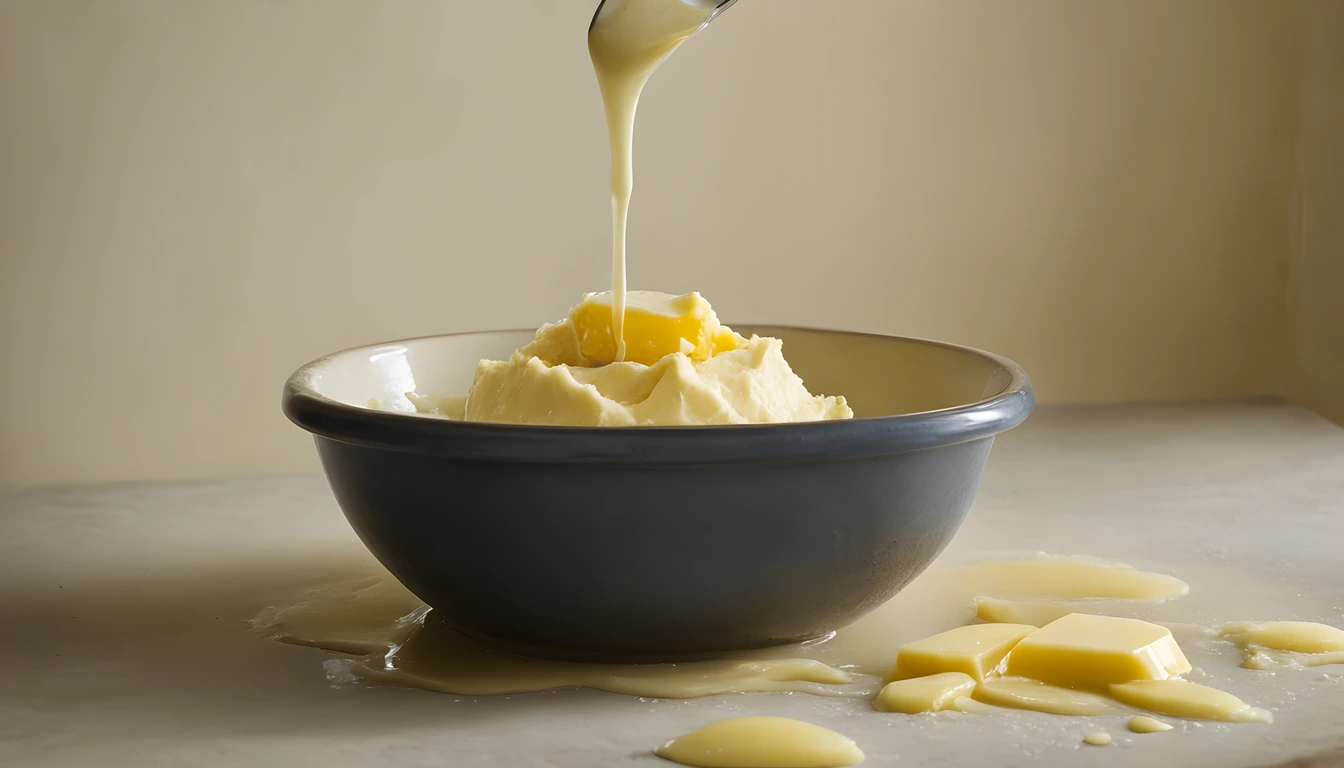
- 2Cream the butter with the sugarBeat the butter and granulated sugar on medium speed until pale and fluffy, about 4 minutes, scraping the bowl twice. With the mixer running, pour in the honey in a slow steady stream, then beat 1 minute more. Room-temperature honey blends in cleanly; cold honey seizes the butter into lumps.
- 3Beat in the eggs and vanillaAdd the eggs one at a time, mixing just until each one disappears before adding the next, then beat in the vanilla. After the third egg the mixture may look slightly broken or grainy. That is expected with this much liquid and it smooths out once the flour goes in.
- 4Alternate the dry ingredients and milkWhisk the flour, baking powder, baking soda and salt in a bowl. On low speed, add a third of the flour mix, then half the milk, then another third of the flour, the rest of the milk, and finally the last of the flour. Stop the mixer as soon as each addition disappears, then finish by hand with a spatula, scraping the bottom of the bowl once.
- 5BakeScrape the batter into the pan and smooth the top, nudging it slightly higher around the sides so the center rises level. Bake 55 to 65 minutes, until the crust is deep golden brown and a skewer in the center comes out with a few moist crumbs, or an instant-read thermometer reads 200 to 205°F. Rotate the pan after 35 minutes if the top is coloring unevenly.
- 6Cool completely before slicingSet the pan on a rack and leave the cake in it 15 minutes. Lift it out by the parchment and cool on the rack 45 minutes more, until the loaf feels room temperature all the way through. A warm honey cake compresses under the knife and tears instead of slicing; the total time above includes this full cool.
Estimated nutrition per serving
308.87 calories · 16.9 g fat · 36.35 g carbohydrate · 4.08 g protein · 167.83 mg sodium
Serving: 1 slice (about 75 g), 1 of 12 servings
Calculated from ingredient weights and USDA FoodData Central: 173430, 169640, 169655, 171287, 171265, 168894, 172803, 175040, 173468, 173471. Estimates use ingredient input weights; actual portions, brands and cooking losses vary. Omitted nutrient values are unavailable, not zero.
What the finished loaf should look and feel like
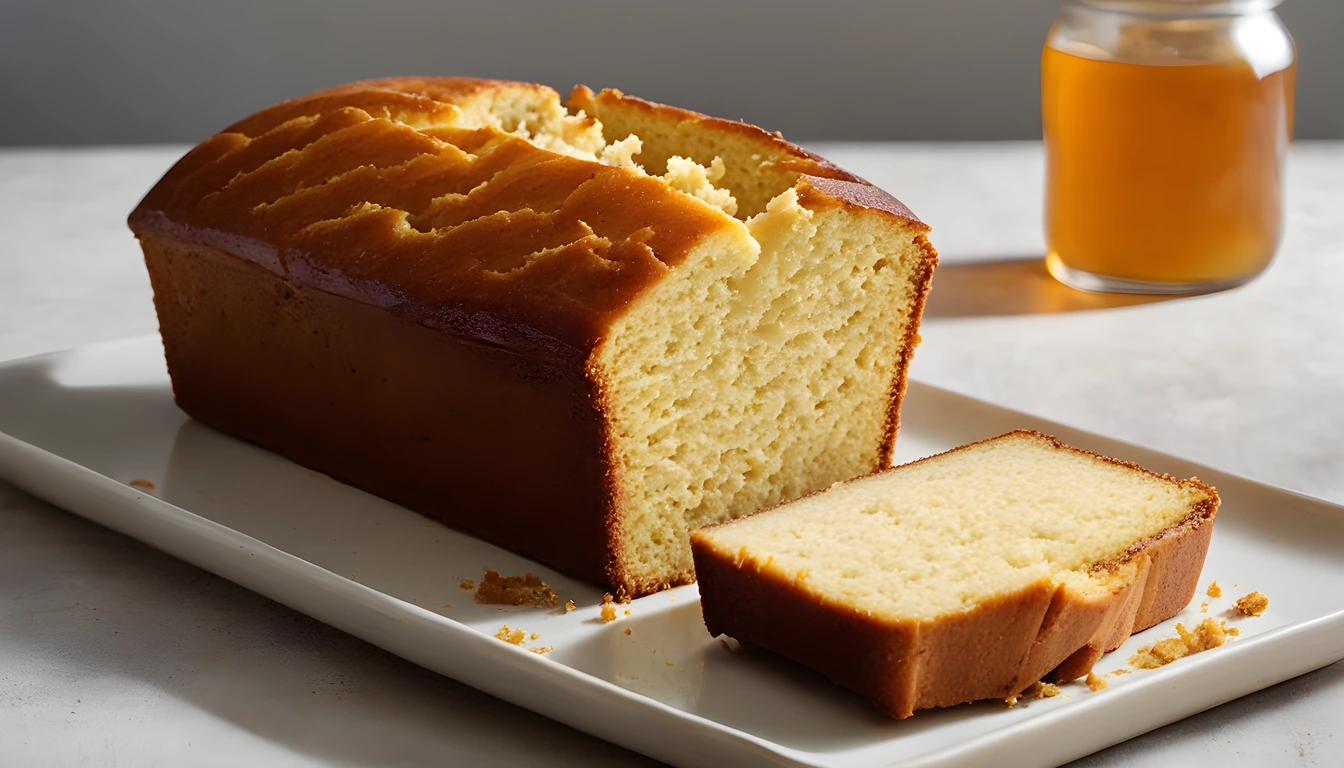
The crust is deep golden brown, glossy in patches where the honey caramelized, with a crack running down the center. Underneath, the crumb is tight and even, closer to a butter cake than a sponge, and the loaf pulls away from the parchment without sticking.
A skewer pushed into the middle should come out with a few moist crumbs, not clean and not coated in wet batter. A thermometer is more reliable than the skewer: 200 to 205°F at the center means the structure has set and the cake will slice cleanly once cool.
Flavor intensity is computed from the listed flavor notes of 85 honeys in our catalog: 1 means most are described as mild or light, 5 means most are described as bold or dark. It is a tasting guide, not a laboratory measurement.
Sources: Baking with Honey (UC Agriculture and Natural Resources, Cottage Foods); USDA FoodData Central: Butter, without salt; USDA FoodData Central: Honey; USDA FoodData Central: Sugars, granulated; USDA FoodData Central: Egg, whole, raw, fresh; USDA FoodData Central: Milk, whole, 3.25% milkfat, with added vitamin D; USDA FoodData Central: Wheat flour, white, all-purpose, enriched, bleached; USDA FoodData Central: Leavening agents, baking powder, double-acting, sodium aluminum sulfate; USDA FoodData Central: Leavening agents, baking soda; USDA FoodData Central: Salt, table; USDA FoodData Central: Vanilla extract.
- Deep golden crust with a center crack, not a blackened top
- Skewer shows a few moist crumbs and no wet batter
- Center reads 200 to 205°F
- Sides have pulled slightly away from the pan
Pro Tip
If the top reaches the color you want while the center is still wet, lay a sheet of foil loosely over the pan and keep baking; the crust stops darkening and the middle catches up.
1 = mild, 5 = bold. Editorial pairing guidance, not laboratory measurements; jars vary.
- Clover
- The plain loaf; butter and vanilla lead
- Orange Blossom
- Cake served with tea, light floral crumb
- Wildflower
- An everyday bake with a rounded floral note
- Sourwood
- Loaf with a spiced, buttery finish
- Buckwheat
- Replace half the honey only; the molasses edge is strong
Matching a honey to another dish: the honey flavor map
Get the Honey Buyer's Cheat Sheet (free PDF)
16 varieties on one page — color, flavor, best use and what a fair price looks like — from the 304 honeys we track.
Why the honey is weighed and the sugar stays
Honey is roughly 17 percent water, so 170 g of it brings about 30 g of liquid that sugar would not. That is why the milk is only 2 fl oz and the flour runs to 250 g. The batter should ribbon off the beater and hold a soft shape for a moment before it sinks back.
The 100 g of granulated sugar is there for structure, not sweetness. Creaming it with the butter builds the air and the fine, even crumb a pound cake is supposed to have; with honey alone the batter is wetter and rises less. Honey also browns faster than sugar, which is the reason for the 325°F oven.
- Weigh the honey in the bowl on a scale, or oil the cup first so it releases
- Warm crystallized honey until it flows, then weigh it
- Butter and eggs at room temperature emulsify more easily
- Mix the flour only until the streaks disappear
Pro Tip
If the batter looks curdled after the eggs, add a spoonful of the measured flour and beat again for a few seconds; it comes back together.
Storage, slicing and serving
Wrap the cooled loaf tightly and keep it at room temperature for up to 3 days. Honey holds moisture, so the crumb stays soft, but a cut face dries first; press plastic wrap against it. Refrigerate only in hot, humid weather, and let slices sit out a few minutes before eating.
Slices freeze well. Wrap them individually, freeze up to 3 months, and thaw at room temperature for about an hour, or warm them straight from frozen in a buttered skillet.
- Room temperature, well wrapped: up to 3 days
- Freezer, sliced and wrapped: up to 3 months
- Cut with a serrated knife, sawing rather than pressing down
- A buttered skillet gives cold slices a crisp edge
Pro Tip
Slice only what you plan to eat. A whole loaf keeps far better than a plate of cut slices, which dry out within hours.
Choosing the Honey
Use Honey Acres Clover Honey or Mitchem Bee Company Raw, Unfiltered Florida Orange Blossom Honey or Ames Farm Raw Single Source Buckwheat Honey for the flavor described in this recipe. See our honey selection guide for other culinary choices.