About This Recipe
Honey chiffon cake is an oil-based foam cake. Egg yolks, oil, water and honey make a loose batter, and a meringue of whipped egg whites is folded through it. The oil keeps the crumb soft for days, and the whites supply all the lift, so there is no butter and no creaming step.
Using honey as the only sweetener changes two things. Honey is roughly 17 percent water by weight, so the added liquid here stays modest, and it takes color faster than sugar, which is why the oven runs at 325°F instead of 350°F.
The whites are whipped with no sugar at all, stabilized only with cream of tartar, so they are folded in gently, and the cake cools upside down in its bare pan. That inverted cooling is what holds a tall, fine crumb together while it sets.
Recipe
Honey Chiffon Cake Recipe
A honey chiffon cake: an oil-based foam cake sweetened only with honey, with an egg-white meringue folded through it. Makes one 20 cm cake, 12 slices, and stays soft for days.
10Ingredients
Yield: 12 servings
- 110 g all-purpose flour (about 3/4 cup plus 2 tbsp)
- 150 g honey (about 7 tbsp)
- 4 large eggs, separated (about 200 g)
- 56 g canola oil (4 tbsp)
- 60 g water (about 2 fl oz)
- 5 g baking powder (about 1 tsp)
- 1 g baking soda (about 1/4 tsp)
- 2 g fine salt (about 1/3 tsp)
- 1.5 g cream of tartar (about 1/2 tsp)
- 4 g vanilla extract (about 1 tsp)
Ingredient amounts scale; instructions show the original batch. Cooking times and pan sizes may need adjustment. Season to taste. Honey grams use US measures at 20°C and 17.5% moisture, a density estimate; weigh your honey for precision.
Instructions
- 1Heat the oven and set up the panSet a rack in the lower third of the oven and heat to 325°F (163°C). Use a 20 cm (8-inch) tube pan about 10 cm deep. Do not grease it, butter it or line the base; the batter has to grip bare metal to climb. Sift the flour with the baking powder, baking soda and salt onto a sheet of paper.
- 2Build the honey baseWhisk the honey, water and oil in a large bowl until the honey has thinned into the liquid, about 1 minute. If the honey is stiff, stand the bowl in warm water for a few minutes first. Whisk in the yolks and vanilla; the mixture should turn glossy and slightly thicker, with no sticky streaks at the bottom.
- 3Work in the dry ingredientsAdd the sifted flour mixture in two goes, whisking gently until just smooth. The batter will be loose enough to ribbon off the whisk. If it stands up in a stiff mound instead, whisk in water a teaspoon at a time. Stop mixing as soon as the last dry patch disappears.
- 4Whip the egg whitesPut the whites in a clean, dry bowl with the cream of tartar. Beat on medium speed until foamy, then raise the speed and beat 4 to 5 minutes, until the peaks are firm but the tips still curl over and the surface looks glossy. Stop before the whites turn dry, clumped or grainy.
- 5Fold the two togetherStir about a third of the whites into the honey base to loosen it. Add the rest in two additions, folding with a wide spatula: cut down the middle, sweep along the bottom, turn the bowl a quarter turn, repeat. Stop while a few faint white streaks remain, since they work out as you pour.
- 6BakePour the batter into the pan from one spot and smooth the top with the spatula. Bake 40 to 50 minutes, until the top is light amber and springs back when pressed and a skewer pushed in near the tube comes out clean. If the top browns deeply before the center sets, lay foil over it for the last 10 minutes.
- 7Cool upside downTake the pan straight from the oven and invert it, either on its own legs or over the neck of a heavy bottle. Leave it 2 hours, until the pan is completely cold to the touch. Do not loosen the edges while it is warm; a cake released early tears and slumps.
- 8Release and sliceRun a thin flexible knife around the outer edge and around the tube, pressing against the pan rather than sawing. Push the base up out of the ring, slide the knife under the cake, and invert onto a plate. Cut with a serrated knife in a light sawing motion. The total time covers baking and the full cooling, so the cake is ready to slice at room temperature.
Estimated nutrition per serving
137.96 calories · 6.34 g fat · 17.65 g carbohydrate · 3.08 g protein · 156.31 mg sodium
Serving: 1 slice (about 49 g), 1 of 12 servings
Calculated from ingredient weights and USDA FoodData Central: 168894, 169640, 171287, 172336, 173647, 172803, 175040, 173468, 175041, 173471. Estimates use ingredient input weights; actual portions, brands and cooking losses vary. Omitted nutrient values are unavailable, not zero.
What the baked cake should look and taste like
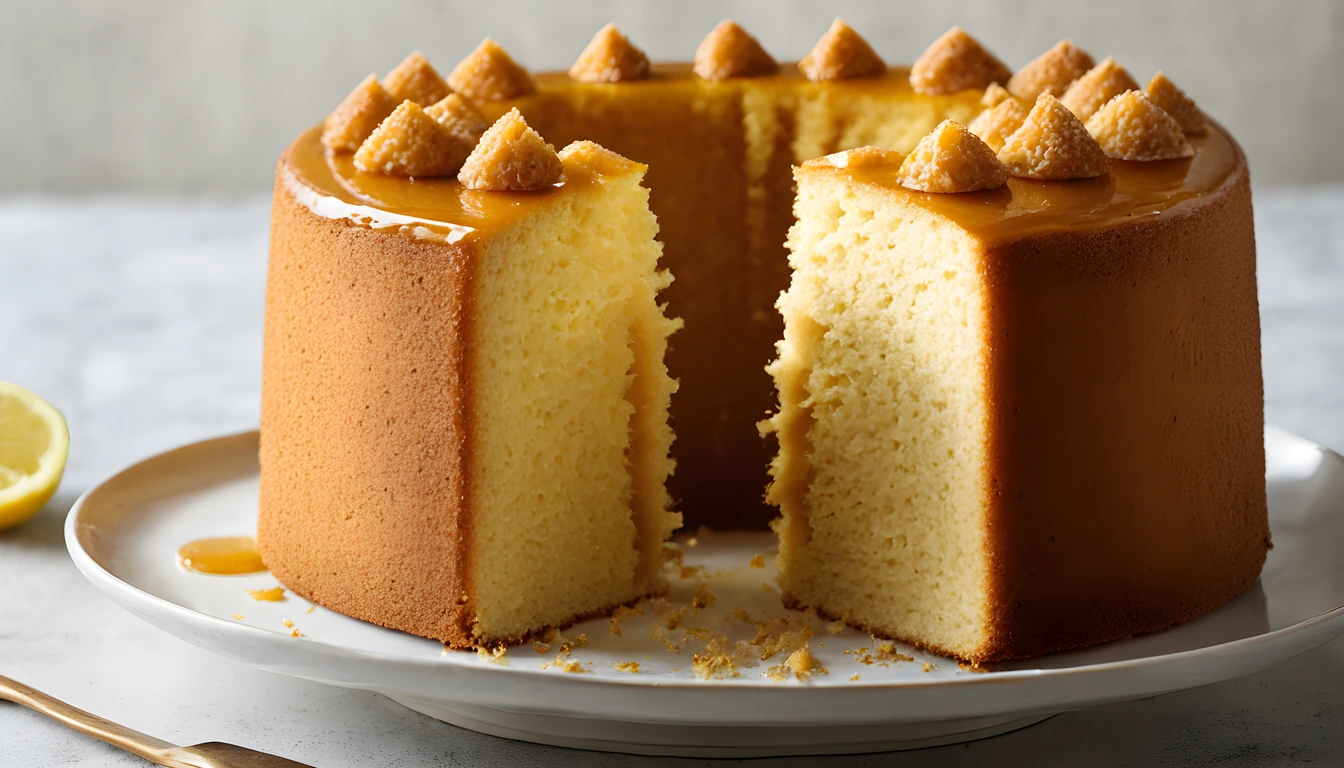
A finished chiffon rises several centimeters above the rim during baking and settles back roughly level. The top is the color of light amber and springs back at once when you press the middle, leaving no dent. A skewer pushed in beside the tube comes out clean, or with a crumb or two clinging to it.
The crumb is fine and even, and a little damp in a way angel food cake is not. Honey reads as a broad, soft sweetness rather than a sharp one, strongest in the crust and on the day after baking.
If the crust is dark brown while the center is still wet, the oven ran hot; honey-sweetened batters take color early. Cover the top with foil rather than dropping the temperature partway through.
Flavor intensity is computed from the listed flavor notes of 80 honeys in our catalog: 1 means most are described as mild or light, 5 means most are described as bold or dark. It is a tasting guide, not a laboratory measurement.
Sources: Honey (UC Agriculture and Natural Resources, Cottage Foods); USDA FoodData Central: Wheat flour, white, all-purpose, enriched, bleached; USDA FoodData Central: Honey; USDA FoodData Central: Egg, whole, raw, fresh; USDA FoodData Central: Oil, canola; USDA FoodData Central: Beverages, water, tap, drinking; USDA FoodData Central: Leavening agents, baking powder, double-acting, sodium aluminum sulfate; USDA FoodData Central: Leavening agents, baking soda; USDA FoodData Central: Salt, table; USDA FoodData Central: Leavening agents, cream of tartar; USDA FoodData Central: Vanilla extract.
- Top springs back and does not stay dented
- Skewer near the tube comes out clean
- Sides have pulled slightly away from the pan
- Crumb is fine and even, with no gummy band at the bottom
Pro Tip
Judge by the skewer, not the clock: a wet skewer means another 5 minutes even when the top already looks done.
1 = mild, 5 = bold. Editorial pairing guidance, not laboratory measurements; jars vary.
- Clover
- Plain chiffon, keeping the honey note light
- Wildflower
- An everyday bake with a mild floral crumb
- Orange Blossom
- A citrus-scented version of this cake
- Buckwheat
- Replace a third of the honey for a dark, malty cake
- Sage
- Mild and clean with a plain slice
Matching a honey to another dish: the honey flavor map
Get the Honey Buyer's Cheat Sheet (free PDF)
16 varieties on one page — color, flavor, best use and what a fair price looks like — from the 304 honeys we track.
The bare pan and the upside-down cool
A chiffon batter has to climb the walls of the pan to set tall. A greased or non-stick pan lets it slide back down, and the cake falls as it cools. Leave the pan bare, do not line the base, and do not run a knife around the edge when it comes out of the oven.
Cool it inverted, on the pan's own legs or over the neck of a heavy bottle. The cake hangs while the starch and the egg proteins set. Cooled right side up, its own weight presses the crumb into a dense band at the bottom.
Give it the full 2 hours. A cake turned out while still warm tears at the tube and slumps at the center within minutes.
- 20 cm (8-inch) tube pan, about 10 cm deep
- Bare metal, no grease and no parchment
- Invert immediately, still in the pan
- Two hours, until completely cold to the touch
Pro Tip
If your pan has no feet, stand the tube over a wine bottle neck so air can move underneath the cake while it cools.
When it goes wrong
A sunken middle usually means the cake was underbaked or the whites were knocked back. The meringue should be firm but still glossy. Whites beaten to dry, clumped peaks will not fold in evenly and leave pockets that collapse in the oven.
A gummy layer just above the base is the same fault in another form: the outside set before the center did. Use the lower rack next time, check with a skewer at 40 minutes, and cover the top early if it browns.
Streaks of darker, denser cake near the bottom mean the honey base was not folded evenly through the whites. Scrape the bottom of the bowl with every fold.
- Sunken middle: underbaked, or the batter was overfolded
- Gummy band: oven too hot or rack set too high
- Coarse tunnels: whites too stiff, or folded roughly
- Sticky top: foil went on too late
Pro Tip
Fold with a wide flexible spatula and turn the bowl a quarter turn each stroke, working from the bottom of the bowl up over the top.
Serving and storage
Serve at room temperature, cut with a serrated knife in a light sawing motion so the crumb does not compress. The cake is sweet enough to eat plain; a spoonful of whipped cream alongside is optional and counted separately.
Keep it covered at room temperature for 2 days, or refrigerate it sealed for up to 4 days. Cold firms the crumb, so let a slice sit out 20 minutes before eating. Slices freeze well on a tray, then bagged, for up to 1 month.
A thin drizzle of warm honey over a slice adds sweetness and shine. Add it at the table rather than over the whole cake, which would soften the crust.
- Room temperature: 2 days, covered
- Refrigerator: up to 4 days, sealed
- Freezer: up to 1 month, slices interleaved
- Never refrigerate before the cake is fully cool
Pro Tip
Eight to ten seconds in the microwave brings back the soft crumb of a refrigerated slice; longer than that and the edges turn rubbery.
Choosing the Honey
Use Honey Acres Clover Honey or Mitchem Bee Company Raw, Unfiltered Florida Orange Blossom Honey or The Bee Charmer California Sage Honey for the flavor described in this recipe. See our honey selection guide for other culinary choices.