About This Recipe
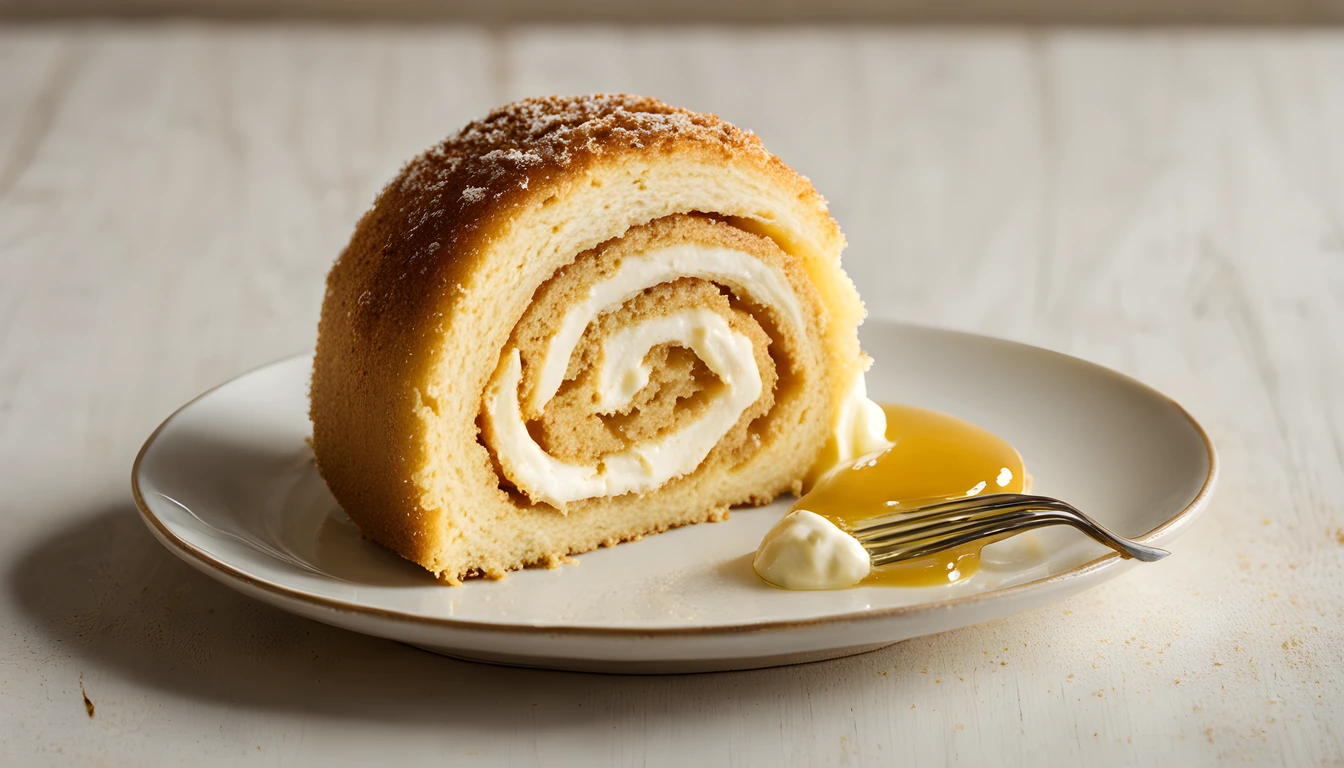
A honey sponge roll is a thin sheet of honey-sweetened sponge, baked in about twelve minutes, rolled up while still hot, then unrolled and spread with honey whipped cream. Rolling the warm cake trains it to hold a coil, so the sheet bends instead of cracking when you fill it once the sponge has cooled.
Honey does most of the sweetening in the cream and part of it in the batter. Because honey browns faster than sugar, the sponge bakes at 350°F rather than 375°F and finishes pale gold with only a few darker patches.
Budget about two and a half hours from start to first slice, most of it waiting: 45 minutes for the rolled sponge to cool and roughly an hour of chilling once it is filled. Cut with a serrated knife and wipe the blade between slices.
Recipe
Honey Sponge Roll Recipe
A thin honey-sweetened sponge baked, rolled warm in a towel, then unrolled and filled with honey whipped cream. Makes 8 slices, about 750 g.
9Ingredients
Yield: 8 servings
- 4 large eggs (about 200 g)
- 105 g honey (about 5 tbsp)
- 100 g granulated sugar (about 1/2 cup)
- 125 g all-purpose flour (about 1 cup)
- 4.6 g baking powder (1 tsp)
- 3 g salt (1/2 tsp)
- 238 g heavy whipping cream (about 1 cup)
- 42 g honey (2 tbsp), for the filling
- 4.2 g vanilla extract (1 tsp)
Ingredient amounts scale; instructions show the original batch. Cooking times and pan sizes may need adjustment. Season to taste. Honey grams use US measures at 20°C and 17.5% moisture, a density estimate; weigh your honey for precision.
Instructions
- 1Heat the oven and set up the panHeat the oven to 350°F (175°C). Line the bottom of a 10x15-inch rimmed sheet pan with parchment, leaving a 1-inch overhang on the two short sides, and grease the paper lightly. The batter needs that exact pan size; a bigger pan gives a sheet thin enough to tear when rolled.
- 2Mix the dry ingredientsWhisk the flour, baking powder and salt together in a small bowl and set it beside the mixer. Have a clean thin kitchen towel ready on the counter, with no sugar or flour dusted on it.
- 3Whip the eggs with honey and sugarWarm the 105 g honey briefly if it is stiff, then beat it with the eggs and granulated sugar on high speed until the foam is pale, thick and falls from the beater in a slow ribbon that holds for a second on the surface, about 5 minutes. Stop short of stiff peaks; the foam should still look soft and glossy.
- 4Fold in the flourSift the dry mixture over the eggs in three additions, folding each one in with a wide spatula until no dry streaks remain. Fold gently and stop as soon as the last of the flour disappears, then pour the batter into the prepared pan and spread it level into the corners with an offset spatula.
- 5Bake the spongeBake on the middle rack for 12 to 14 minutes, checking at 10. The sponge is done when the top springs back under a fingertip, the edges have pulled slightly from the parchment, and the center shows no damp shine. Honey browns quickly, so pull it at the first sign of setting rather than letting the surface darken.
- 6Roll it warmRun a knife around the edges. Lay the clean towel over the pan, invert the pan onto a board, and lift the pan off. The parchment is now on top; peel it away. Roll the sponge up from a short side with the towel inside, set it seam-side down, and leave it undisturbed for 45 minutes until completely cool.
- 7Whip the honey creamChill the bowl and beaters, then whip the cream with the 42 g honey and the vanilla on medium-high until it holds a firm peak that barely bends at the tip. Keep it glossy; grainy cream will look curdled against the cake.
- 8Fill and re-rollUnroll the cooled sponge and spread the cream evenly over it, stopping 1 inch short of the far short edge. Roll it back up from the near short side, using the towel to guide the first turn, then set it seam-side down on a plate, wrap it in parchment and chill for 45 to 60 minutes before slicing.
- 9Slice and serveCut the roll into 8 slices with a serrated knife, wiping the blade clean between cuts. The cut face shows the spiral; serve slightly cool rather than ice-cold. The whole process, start to first slice, runs about 2 1/2 hours.
Estimated nutrition per serving
299.83 calories · 13.27 g fat · 40.81 g carbohydrate · 5.66 g protein · 251.2 mg sodium
Serving: 1 slice, 1/8 of the roll (about 94 g), 1 of 8 servings
Calculated from ingredient weights and USDA FoodData Central: 171287, 169640, 169655, 168894, 172803, 173468, 170859, 173471. Estimates use ingredient input weights; actual portions, brands and cooking losses vary. Omitted nutrient values are unavailable, not zero.
Why the warm roll does not crack
A hot sponge sheet is flexible because the set egg foam and the starch have not yet stiffened, so it takes a curve without splitting. Left flat until cold, the same sheet resists the bend and cracks along the outside of the coil. Rolling it within a couple of minutes of turning it out is the step that decides whether the finished roll looks clean.
The sponge also holds more water than a plain génoise because of the honey, which keeps the crumb soft enough to bend. The roll cools seam-side down so its own weight sets the spiral, and the towel inside keeps the layers from pressing into each other.
Flavor intensity is computed from the listed flavor notes of 85 honeys in our catalog: 1 means most are described as mild or light, 5 means most are described as bold or dark. It is a tasting guide, not a laboratory measurement.
Sources: Baking with Honey (UC Agriculture and Natural Resources, Cottage Foods); USDA FoodData Central: Egg, whole, raw, fresh; USDA FoodData Central: Honey; USDA FoodData Central: Sugars, granulated; USDA FoodData Central: Wheat flour, white, all-purpose, enriched, bleached; USDA FoodData Central: Leavening agents, baking powder, double-acting, sodium aluminum sulfate; USDA FoodData Central: Salt, table; USDA FoodData Central: Cream, fluid, heavy whipping; USDA FoodData Central: Vanilla extract.
- Roll the sheet within 2 minutes of turning it out
- Start from a short side so the finished coil is wide, not long
- Cool it seam-side down so the spiral holds its shape
- Do not press hard while rolling; let the cake take its own curve
Pro Tip
If the sheet has cooled and split on the first roll, warm it for 60 seconds in a 300°F oven and roll again. Small cracks disappear under the cream.
1 = mild, 5 = bold. Editorial pairing guidance, not laboratory measurements; jars vary.
- Clover
- Whipped cream filling, letting vanilla lead
- Orange Blossom
- Sponge batter with a light floral edge
- Wildflower
- All-purpose batter honey for an everyday roll
- Linden
- Cream filling when you want a pronounced honey note
- Buckwheat
- Half the batter honey for a dark, malty sponge
Matching a honey to another dish: the honey flavor map
Get the Honey Buyer's Cheat Sheet (free PDF)
16 varieties on one page — color, flavor, best use and what a fair price looks like — from the 304 honeys we track.
Texture, doneness and what the batch weighs
The finished sponge should be pale gold, springy and a little moist in the crumb, never leathery. A wet, shiny patch in the center means it needed another minute; a surface that is uniformly deep brown means it went too long and will crack.
The batter weighs about 540 g going into the pan and the baked sheet comes out around 465 g after giving up water in the oven. The cream filling adds about 284 g, so the finished roll weighs roughly 750 g and cuts into 8 slices of about 94 g each.
- Top springs back with no wet indent
- Edges just beginning to pull from the parchment
- No damp, reflective patches in the middle
- Cream holds a peak that barely tips over
Pro Tip
If the cream tightens past firm peaks, stir in a tablespoon of cold cream to loosen it back to a spreadable consistency.
Choosing the honey and changing the filling
The cream is where honey shows most plainly, so a mild one such as clover or orange blossom keeps the filling clean and lets the vanilla through. A dark honey in that quantity can taste heavy against cold cream.
In the batter, a stronger honey works because the flour and egg dilute it. Swapping buckwheat for half the honey gives a darker crumb with a malty edge, though the sponge will brown faster still, so watch it from 9 minutes.
- Clover or orange blossom honey for the whipped cream
- Half buckwheat honey in the batter for a deeper flavor
- A pinch of salt in the cream sharpens the honey note
- A teaspoon of ground cinnamon in the flour for a spiced version
Pro Tip
Spread the cream no closer than 1 inch from the far short edge; rolling pushes it forward and a full layer there ends up on the plate.
Storage and making it ahead
A filled roll keeps for 2 days in the refrigerator, wrapped first in parchment and then in a bag so the sponge does not pick up other smells. Beyond that the cream starts to weep and the crumb turns soggy.
The unfilled sponge freezes well. Roll it in parchment while warm, cool it completely, bag it and freeze for up to 1 month; thaw at room temperature for an hour before unrolling and filling.
- Refrigerator: filled roll, 2 days, well wrapped
- Freezer: unfilled sponge only, up to 1 month
- Do not freeze the filled roll; the cream breaks and turns grainy
- Slice with a serrated knife, wiping the blade between cuts
Pro Tip
Take the roll out 10 minutes before serving. The cream spreads more cleanly and the crumb tastes of honey rather than cold.
Choosing the Honey
Use Clover Honey or Orange Blossom Honey or Wildflower Honey for the flavor described in this recipe. See our honey selection guide for other culinary choices.