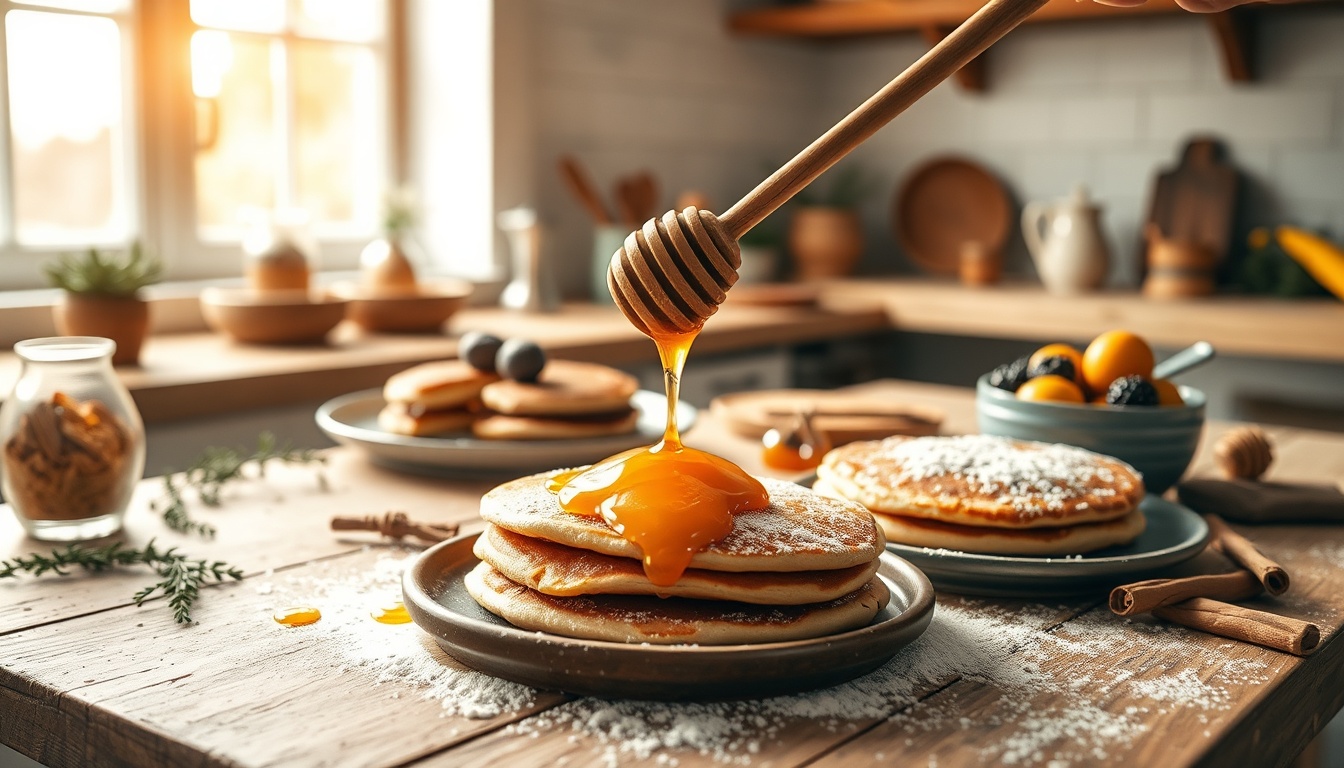
Why Honey Makes Better Baked Goods
Honey has been a baking ingredient for at least 8,000 years — long before refined sugar existed. Ancient Egyptian bakers used honey in cakes and breads. Medieval European gingerbread was built on honey. The oldest known cake recipe, from ancient Rome, is a honey cake called libum. There is a reason honey has persisted across millennia of baking: it does things sugar simply cannot.
The core advantage is chemistry. Honey is approximately 38% fructose and 31% glucose, compared to table sugar (sucrose) which is 50% fructose and 50% glucose bound together. Fructose is more hygroscopic than sucrose — it pulls moisture from the air and holds it. This is why honey-based baked goods stay moist longer, have a more tender crumb, and resist staling in ways that sugar-sweetened equivalents do not.
Honey also contains over 180 aroma compounds including aldehydes, alcohols, and organic acids. Depending on the nectar source, these contribute floral, fruity, caramel, earthy, or spicy notes that layer with the other flavors in your recipe. A banana bread sweetened with buckwheat honey ($9-23) tastes completely different from one sweetened with acacia honey ($9-16) — both are delicious, but in distinct ways. This flavor dimension is simply unavailable with refined sugar.
For Thanksgiving and Christmas 2026 baking, this site uses one ratio everywhere: ¾ cup honey replaces 1 cup sugar, with about 3 tablespoons less liquid and a 25 °F cooler oven. The baking substitution calculator scales it to any recipe, and buckwheat is the gingerbread honey.
Finally, honey browns faster than sugar due to its free fructose reacting with amino acids in a Maillard reaction at lower temperatures. This means deeper color, crisper crusts, and richer caramelized notes — the kind of golden-brown you see on artisan honey breads and baklava. The flip side is that you need to manage oven temperature carefully, which this guide addresses for each category of baked good.
Choosing the Right Honey Variety for Baking
Not all honey bakes the same. The variety you choose directly shapes the flavor of everything you make. Understanding the flavor spectrum helps you match honey to baked goods the way a chef matches wine to food.
For most everyday baking — muffins, quick breads, cookies, glazes — a good raw wildflower honey is the default choice. Its multi-floral complexity adds depth without being assertive. It works with chocolate, fruit, nut, spice, and vanilla flavors alike.
When you want the honey to be the star — honey cakes, honey breads, honey glazes — variety matters far more. Here is how the major varieties perform in the oven:
- **Clover honey ($9-15)** — Mild, clean, vanilla-adjacent sweetness creating perfect neutral sweetening for delicate baked goods. The most versatile and budget-friendly baking honey, allowing butter, spices, and vanilla flavors to dominate while providing superior moisture retention compared to sugar. Best for: layer cakes, sugar cookies with honey, recipes where you want subtle honey notes without any assertiveness, beginners starting with honey substitution
- **Wildflower honey ($13-24)** — Complex multi-floral depth varying by region and season, adding sophisticated flavor dimension impossible to achieve with single-varietal honeys. Creates richer color development and enhanced caramelization notes during Maillard reaction. Best for: banana bread, muffins, oat bars, all-purpose use when you want more character than clover, artisan breads requiring complexity
- **Orange blossom honey ($12-24)** — Delicate citrus-floral aroma that intensifies beautifully when baked, creating sophisticated Mediterranean pastry character. Light golden color prevents over-browning in delicate batters while contributing bright citrus undertones complementing lemon and vanilla perfectly. Best for: pound cakes, Mediterranean pastries like baklava, lemon and citrus recipes, morning buns, tea cakes
- **Buckwheat honey ($9-23)** — Dark, molasses-like intensity with bold malty depth perfect for assertive spice combinations. Its dark color and strong flavor give deeper browning and richer caramel notes, essential for traditional European honey cakes and gingerbread authenticity. Best for: gingerbread, spice cakes, dark rye breads, bran muffins, anything that normally calls for molasses, robust flavor profiles
- **Manuka honey ($29-71)** — Distinctive earthy herbaceous character that can be polarizing when baked at high temperatures. Premium pricing makes it better suited for finishing applications rather than primary sweetening. Best for: use sparingly in savory baked goods, finishing drizzle rather than primary sweetener
- **Tupelo honey ($19-29)** — Exceptionally mild buttery-floral profile with remarkable resistance to crystallization keeping baked goods moist longer. Creates tender crumb structure perfect for delicate pastries requiring subtle sweetness without competing flavors. Best for: buttery baked goods, croissants, shortbread, butter cakes, pastries requiring extended shelf life
- **Lavender honey ($11-17)** — Distinctive herbal-floral notes creating sophisticated aromatic complexity perfect for European-style baking traditions. Delicate purple hue and floral intensity pair beautifully with vanilla, butter, and citrus flavor profiles. Best for: shortbread, pound cake, scones, anything in the lavender-vanilla flavor family, French pastry applications
- **Chestnut honey ($15-24)** — Complex bitter-sweet tannic character with deeply savory-sweet profile perfect for autumn baking and nut-forward recipes. Dark amber color and robust flavor create sophisticated depth in hearty baked goods requiring bold honey presence. Best for: nut breads, chestnut stuffings, hearty autumn bakes, savory-sweet combinations, artisan sourdough enhancement
Pro Tip
When a recipe calls for "honey" without specifying a variety, use raw wildflower or raw clover — both are widely available and produce excellent results. Save specialty varieties (buckwheat, orange blossom, tupelo) for recipes where you want their distinct character to come through.
Get the Honey Buyer's Cheat Sheet (free PDF)
16 varieties on one page — color, flavor, best use and what a fair price looks like — from the 304 honeys we track.
How Honey Affects Texture, Moisture, and Browning
Understanding three key effects helps you use honey confidently in any recipe rather than following substitution formulas mechanically.
**Moisture retention (hygroscopicity):** Fructose in honey attracts and holds water molecules from the surrounding environment. This extends the shelf life of baked goods noticeably — a honey banana bread stays moist for 5-6 days vs. 3-4 days for a sugar version. It also means baked goods can feel slightly sticky on the surface if stored in humid conditions. Solution: let honey baked goods cool completely before storing, and store in an airtight container.
**Browning and crust formation:** Honey's free fructose participates in the Maillard reaction more readily than sucrose. Your baked goods will brown faster and more deeply than sugar-based equivalents. This produces beautiful golden crusts and caramelized surfaces — but can lead to over-browning on the outside before the inside is fully baked if you don't adjust oven temperature. The standard adjustment is 25°F lower than the recipe specifies. Monitor visually and tent with foil if the surface is browning too quickly.
**Tenderness and crumb structure:** Honey's acidity (pH 3.2–4.5) interferes slightly with gluten development, contributing to a more tender, less chewy crumb. This is an asset in quick breads, muffins, and cakes; a more complex trade-off in yeasted breads where you want some chew. Honey also contributes to a denser, moister crumb than sugar, which most bakers find preferable in loaf breads and snack cakes.
Honey in Yeast Breads
Honey is one of the oldest yeast-feeding agents in breadmaking, and it remains one of the best. The free sugars (fructose and glucose) in honey are immediately available to yeast — more so than sucrose, which yeast must first enzymatically split. This means honey can produce a more vigorous and reliable rise than sugar in identical amounts.
The practical implication: if you're adding 1-2 tablespoons of honey to a sandwich bread or dinner roll recipe, you may see slightly faster proofing. Don't shorten the proofing time arbitrarily — let the dough tell you when it's ready (doubled in size, passes the poke test). Rushing fermentation loses flavor complexity.
Higher honey quantities (more than 3-4 tablespoons in a standard loaf) slow fermentation by osmotic stress on the yeast — similar to the effect of high sugar levels in enriched doughs like brioche. For honey-forward breads like honey whole wheat or honey oat, plan for slightly longer proofing and use fresh, active yeast.
Flavor matching in honey breads: whole wheat flour and oat-based doughs pair beautifully with deeper, more complex honeys — buckwheat honey providing bold malty depth or raw wildflower honey contributing multi-floral complexity that enhances whole grain character. White sandwich breads and dinner rolls benefit from milder honeys — clover honey or acacia honey — that complement rather than overpower the delicate yeast-fermented flavor development.
- Dinner rolls: 2-3 tbsp honey per batch. Clover honey for mild sweetness or wildflower honey for subtle complexity. Slightly lower oven temp to prevent over-browning on the tops
- Whole wheat sandwich bread: 3-4 tbsp honey per loaf. Buckwheat honey or wildflower honey adds rich complexity that pairs perfectly with whole grain nutty flavor, creating superior moisture retention
- Honey oat bread: 3-4 tbsp honey, rolled oats in dough. Wildflower honey is traditional and excellent, complementing oat texture with multi-floral depth
- Artisan sourdough: 1-2 tbsp honey optional. Acacia honey or light clover honey won't interfere with the complex sourdough flavor development while enhancing crust browning
- Cinnamon raisin bread: 2-3 tbsp honey. Orange blossom honey creates an exceptional aromatic combination with cinnamon spice, enhancing both flavors beautifully
Pro Tip
Never add honey directly to hot proofing liquid — temperatures above 110°F can kill yeast. Mix honey into the flour before adding yeast, or dissolve honey in liquid that has cooled to 100-110°F.
Honey in Quick Breads and Muffins
Quick breads and muffins are where honey shines most naturally. These leavened-by-baking-powder baked goods don't need gluten development, so honey's slight gluten-inhibiting acidity is purely an asset. The result is an exceptionally tender, moist crumb that stays fresh longer than sugar-sweetened equivalents.
For full substitution in quick bread and muffin recipes, use the standard adjustments: replace 1 cup sugar with ¾ cup honey, reduce other liquids by 3 tablespoons, add 1/4 teaspoon baking soda to neutralize honey's acidity, and reduce oven temperature by 25°F. (See our complete sugar substitution guide for detailed tables.)
The most important variable in honey quick breads is mixing technique. Honey is significantly heavier and stickier than sugar. Mix dry ingredients and wet ingredients separately, then combine with minimal stirring — no more than 10-15 folds. Overmixing develops gluten even in low-gluten recipes and produces a tough, tunneled crumb. The batter should look slightly lumpy when it goes into the pan.
Variety pairings that work exceptionally well in quick breads and muffins:
- Banana bread: wildflower honey or buckwheat honey. The darker honey varieties amplify banana's natural caramel notes and add sophisticated complexity impossible with sugar alone
- Blueberry muffins: orange blossom honey or light wildflower honey. Delicate floral notes lift berry flavor without competing, creating elegant bakery-quality results
- Cornbread: clover honey or wildflower honey. Southern-style honey cornbread benefits from mild honey that enhances corn flavor without overpowering the delicate grain character
- Zucchini bread: wildflower honey or cinnamon-spiced honey. Multi-floral complexity works beautifully with traditional cinnamon-nutmeg spice profile and moist vegetable texture
- Morning glory muffins (carrot, apple, raisin): buckwheat honey or darker wildflower honey. The bold fruit and vegetable flavors can handle assertive honey varieties that create depth
- Pumpkin bread: buckwheat honey or spiced honey. Deep malty honey amplifies warm spice profile perfectly, creating traditional autumn baking authenticity
- Lemon poppy seed: orange blossom honey or lavender honey. Floral-citrus combination is outstanding, elevating simple quick bread to sophisticated pastry level
Honey in Cakes
Honey cakes have been made across nearly every food culture — the Jewish New Year honey cake (lekach), Russian medovik, German Lebkuchen, French pain d'épices, and Middle Eastern basbousa all use honey as a primary sweetener. This tradition exists for good reason: honey's moisture-retaining properties are ideal for layer cakes and loaf cakes that need to stay fresh for multiple days.
The primary challenge with honey in cakes is structural: sugar's crystalline structure traps air bubbles when creamed with butter, creating lift. Honey doesn't do this. Honey cakes need leavening support from baking soda (to neutralize acidity and add rise), baking powder (mechanical leavening), or beaten eggs (for structure and air incorporation).
For chiffon-style and oil-based cakes, honey substitutes for sugar very naturally because there is no creaming step to worry about. Oil-based spice cakes, carrot cakes, and yogurt cakes are ideal candidates for partial or full honey substitution.
For butter cakes where creaming is essential (classic yellow cake, pound cake, Victoria sponge), replace only up to half the sugar with honey. This preserves enough crystalline structure for proper aeration while adding honey's flavor and moisture benefits. Using more than half honey in a creamed butter cake often produces a denser crumb than desired.
- Classic honey cake: Use honey as the primary sweetener with a combination of baking soda + baking powder for lift. Buckwheat honey or wildflower honey creates authentic depth enhanced by dark tea or coffee
- Carrot cake: Replace all sugar with wildflower honey (following the standard adjustments) — oil-based carrot cake is an ideal candidate gaining significantly from honey's superior moisture retention and complex flavor development
- Spice cake: Replace 50-75% of sugar with buckwheat honey or wildflower honey for deeply complex results that elevate traditional spice cake to artisan bakery quality
- Pound cake: Replace 25-50% sugar maximum to preserve delicate structure. Tupelo honey or orange blossom honey works beautifully, creating sophisticated buttery-floral character
- Cheesecake: Replace all sugar in the filling with clover honey or acacia honey. No other adjustments needed — no baking soda, no liquid reduction. The filling's egg-set structure compensates perfectly for honey's structural differences
Pro Tip
Honey cakes benefit from resting after baking. Many traditional honey cake recipes (lekach, pain d'épices) explicitly instruct you to wrap the cake and wait 24-48 hours before cutting. The honey draws moisture inward during this rest, producing a softer, more cohesive crumb.
Honey in Cookies and Bars
Honey's effect on cookies is distinct from its effect on breads and cakes. Honey creates chewy, soft cookies rather than crisp ones — because its hygroscopicity prevents the cookie from drying out and crisping. If you prefer soft, chewy cookies (most people do), this is an advantage. If you want crisp, snappy cookies, stick with granulated sugar or add molasses instead.
In bar cookies and brownies, honey contributes to a fudgy, moist texture that improves over the first 24-48 hours. Honey blondies and honey brownies often taste better on day two than on day one, as the moisture distributes evenly through the bar.
For cookies that already call for molasses or brown sugar (gingerbread, oatmeal cookies, hermit cookies), buckwheat honey is a natural partial substitute providing superior complexity. Replace up to half the molasses with buckwheat honey; it contributes similar rich color and malty depth while adding sophisticated mineral undertones impossible with molasses alone.
The practical limitation: honey adds liquid. Most cookie recipes aren't formulated to handle extra moisture. The safest approach is partial substitution (replacing up to half the sugar) or using honey-specific cookie recipes rather than converting sugar-based ones.
- Oatmeal cookies: Replace 50% of sugar with wildflower honey or buckwheat honey for exceptional chewy texture and complex flavor depth. Reduce liquid slightly to maintain proper dough consistency
- Gingerbread cookies: Replace all molasses with buckwheat honey or replace half the brown sugar with wildflower honey. Roll thicker (3/8") since honey creates more tender dough requiring gentle handling
- Peanut butter cookies: Replace half the sugar with clover honey. The mild clean sweetness complements rich peanut butter perfectly without competing, creating sophisticated bakery-quality results
- Shortbread: Add 1-2 tablespoons of tupelo honey or lavender honey alongside butter. Don't replace all the sugar — preserve sugar's crystalline structure for proper shortbread crumble texture
- Honey bars (like flapjacks or oat bars): Use wildflower honey as primary sweetener alongside butter for no-added-sugar results with complex natural sweetness and superior binding properties
- Granola bars: Replace all sugar and corn syrup with clover honey or wildflower honey. Bake at lower temperature (300°F) to prevent honey's enhanced browning from burning
Honey Glazes, Syrups, and Finishes
Honey glazes are one of the simplest and most impactful applications in baking. A thin honey wash applied to bread before baking creates a glossy, golden crust. Applied after baking while still warm, honey creates a sticky, shiny finish that intensifies the surface color and adds a subtle floral sweetness.
The ratio for a simple honey glaze: 2 tablespoons honey + 2 tablespoons warm water, whisked together. Brush over breads, rolls, pastries, or muffins immediately out of the oven. For richer applications, replace water with warm butter for a honey butter glaze.
For syrup-soaked pastries in the tradition of baklava or revani (a Greek semolina cake), a honey syrup poured over hot-from-the-oven pastry creates the perfect absorption — capillary action pulls the syrup into every layer and cell of the pastry as it cools. The ratio: 1 cup honey + 1 cup water + flavorings (lemon peel, cinnamon stick, rose water, or orange blossom water). Simmer 5 minutes, then use immediately — hot syrup on hot pastry creates even absorption.
Honey also functions as a superior egg wash alternative for vegan or egg-free baking. Brush full-strength or diluted honey over pastry surfaces before baking for a glossy, golden finish comparable to egg wash.
Pro Tip
For the most beautiful honey glaze on dinner rolls or brioche: mix 1 tablespoon honey with 1 tablespoon melted butter. Apply as soon as rolls come out of the oven. The glaze sets as it cools, creating a shine that holds even after the rolls cool completely.
Honey in Pastry, Phyllo, and Tart Doughs
Phyllo-based pastries are arguably honey's greatest baking application. Baklava depends on honey not just for sweetness but for structural integrity — the syrup binds layers of phyllo that would otherwise fall apart. Honey's hygroscopicity prevents the syrup from crystallizing and keeps the pastry tender for days after baking.
For tart and shortcrust pastry, the conventional guidance is to keep honey out of the dough itself (honey adds too much moisture and softness for a pastry that needs to hold its shape and crisp up) but use it liberally in the filling and as a glaze. A honey-almond frangipane, a honey-lemon curd, or a honey-walnut filling can replace sugar equivalents in most tart recipes — the dough shell keeps its integrity while the filling gains honey's flavor and moisture benefits.
Puff pastry and croissant doughs are laminated doughs that depend on precise hydration. Do not substitute honey for sugar in the dough itself. However, honey butter for croissant filling, honey glazes applied after baking, and honey-based fillings for Danish pastries all work beautifully.
Choux pastry (for éclairs, cream puffs, profiteroles): replace 1 teaspoon sugar in the dough with 1 teaspoon honey for a subtle depth of flavor without meaningfully changing the pastry's behavior.
Common Baking Mistakes with Honey (and How to Avoid Them)
Even experienced bakers make these mistakes when working with honey. Understanding them in advance saves ruined batches.
- **Over-browning:** The most common issue. Honey's fructose browns faster than sugar. Solution: reduce oven temperature by 25°F and check 5-10 minutes early. Tent with foil if the surface is browning while the inside needs more time
- **Too moist or sticky crumb:** Usually caused by not reducing liquid when substituting honey for sugar. Every cup of honey brings approximately 3-4 tablespoons of extra water into the recipe. Reduce other liquids accordingly
- **Dense, flat baked goods:** Forgetting to add baking soda when substituting honey for sugar. Honey's acidity interferes with baking powder's leavening action unless neutralized. Add 1/4 tsp baking soda per cup of honey
- **Bitter aftertaste in heat-sensitive recipes:** Some dark honeys (especially buckwheat and chestnut) can develop a slightly bitter edge when exposed to high heat for extended times. Use lighter honeys in long-bake applications (slow-cooked cakes, long-proof breads), and reserve dark honeys for shorter baking times or where the bitter-sweet complexity is an asset
- **Honey seizing in cold butter or eggs:** When adding honey to a creamed butter mixture or to cold eggs, it can seize into a lumpy, uneven mass. Solution: bring honey to room temperature before mixing, and add it in a slow stream while the mixer is running
- **Measuring mess:** Honey clings to measuring cups and spoons, making accurate measurement difficult. Solution: spray the measuring cup lightly with cooking spray before measuring, or weigh honey on a kitchen scale (1 cup honey = 340g)
Honey Baking at a Glance: Quick Reference
A reference summary for the most common honey baking scenarios:
- Substituting for sugar: ¾ cup honey per 1 cup sugar · reduce other liquids by 3 tbsp · add 1/4 tsp baking soda · reduce oven temp by 25°F
- Honey bread loaf: 2-3 tbsp honey per standard loaf recipe · mild wildflower or clover · proof fully (may take slightly longer than sugar)
- Honey quick bread/muffins: full substitution works well · 325°F instead of 350°F · wildflower, buckwheat, or orange blossom depending on desired flavor
- Honey cake: partial substitution (50%) works best in butter cakes · full substitution works in oil-based cakes · rest 24 hrs before cutting
- Honey cookies: partial substitution (50%) for chewy result · buckwheat for gingerbread-style · reduce liquid slightly
- Honey glaze: 2 tbsp honey + 2 tbsp warm water · apply immediately out of oven for best sheen
- Best honey varieties for baking: wildflower (all-purpose), clover (neutral), buckwheat (bold/spice), orange blossom (citrus-floral), tupelo (buttery)
Pro Tip
The single most reliable tip for honey baking: taste your honey before using it. A honey you enjoy eating straight will make baked goods you enjoy eating. If the honey seems overly floral, bitter, or fermented, use a different jar — you'll taste it in the finished bake.
Honey Baking and Food Science: What the Research Shows
The functional advantages of honey in baking are well-documented in food science literature. A 2012 study in the Journal of Food Science found that honey extended the mold-free shelf life of bread by up to 4 days compared to sugar, attributed to honey's low water activity and antimicrobial compounds including hydrogen peroxide and phenolic acids.
A 2019 review in Foods (MDPI) documented that honey's hydroxymethylfurfural (HMF) content increases during baking — particularly at temperatures above 120°C — and that high-quality raw honey begins with much lower HMF levels, giving it more headroom before HMF reaches levels considered quality concerns. This supports using genuinely raw honey (which has minimal processing) for baking applications.
Darker honeys (buckwheat, tulip poplar, sunflower) carry higher polyphenol concentrations than lighter varieties, and polyphenols are more heat-stable than most of honey's delicate aromatics. That is part of the flavor complexity bakers value in darker varieties.
These findings reinforce what traditional bakers have known empirically for centuries: honey is not just a sweetener but a functional ingredient that improves texture, extends shelf life, and adds flavor complexity unavailable from any other source. For more on honey's nutritional compounds, see our honey nutrition guide.
Getting Started: Three Recipes to Try First
If you're new to baking with honey, start with these three recipes to develop intuition before converting your existing favorites:
**1. Honey banana bread** — The most forgiving starting point. Banana bread is almost impossible to ruin, and honey amplifies the caramel-fruit notes beautifully. Use wildflower or buckwheat honey. See our honey banana muffins recipe for a tested formula.
**2. Honey whole wheat dinner rolls** — A simple yeasted recipe where honey feeds the yeast and glazes the finished rolls. The honey-milk-butter flavor combination is universally loved and teaches you how honey behaves in yeast doughs. Use clover or wildflower honey.
**3. Honey oat bars** — No creaming, no proofing, minimal technique. Honey binds rolled oats, nuts, and dried fruit into chewy bars that last a week without refrigeration. A no-fail recipe that demonstrates honey's structural bonding properties.
Once you've made these three, you'll have a working intuition for how honey behaves across different baking applications. From there, converting your favorite recipes is a matter of applying the principles in this guide.
For more honey recipe inspiration, explore our honey recipes collection, or browse honey varieties by flavor profile to find the right honey for your next baking project.