Why Honey Makes Better Banana Bread
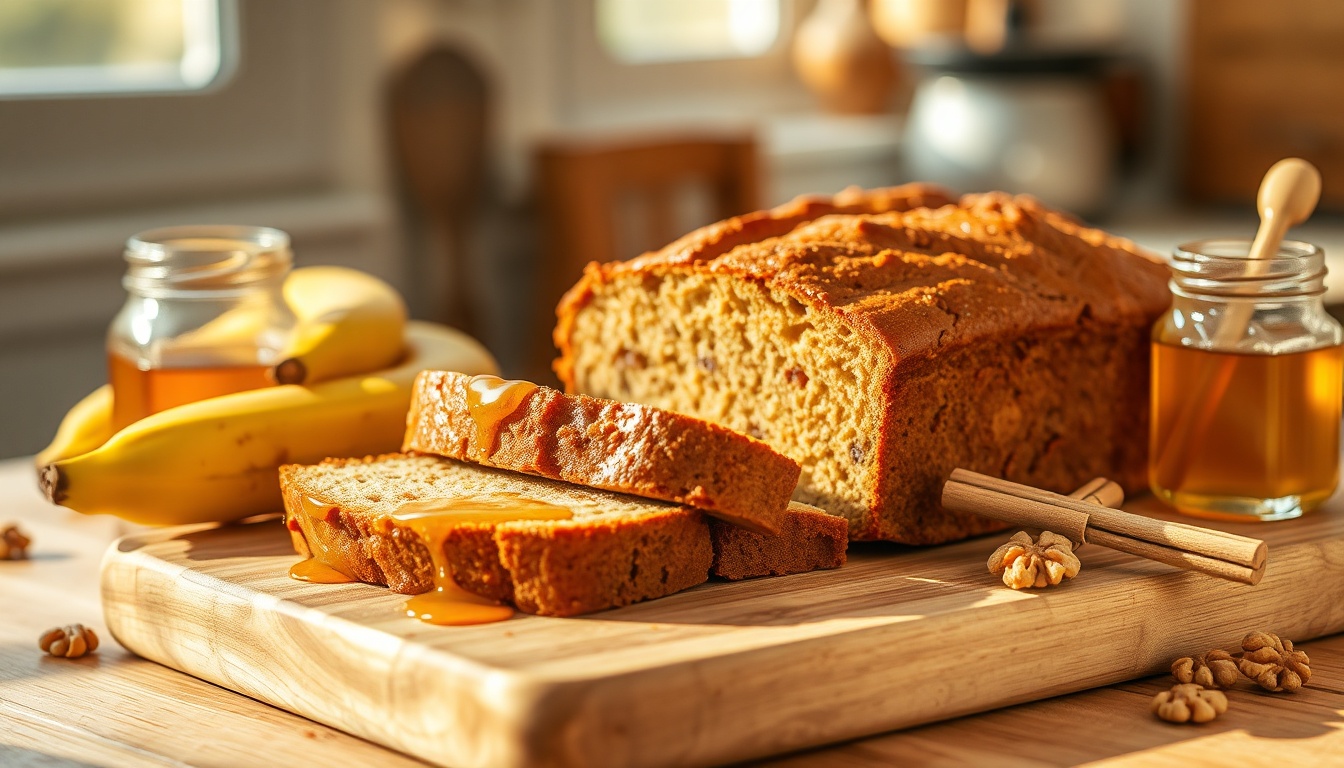
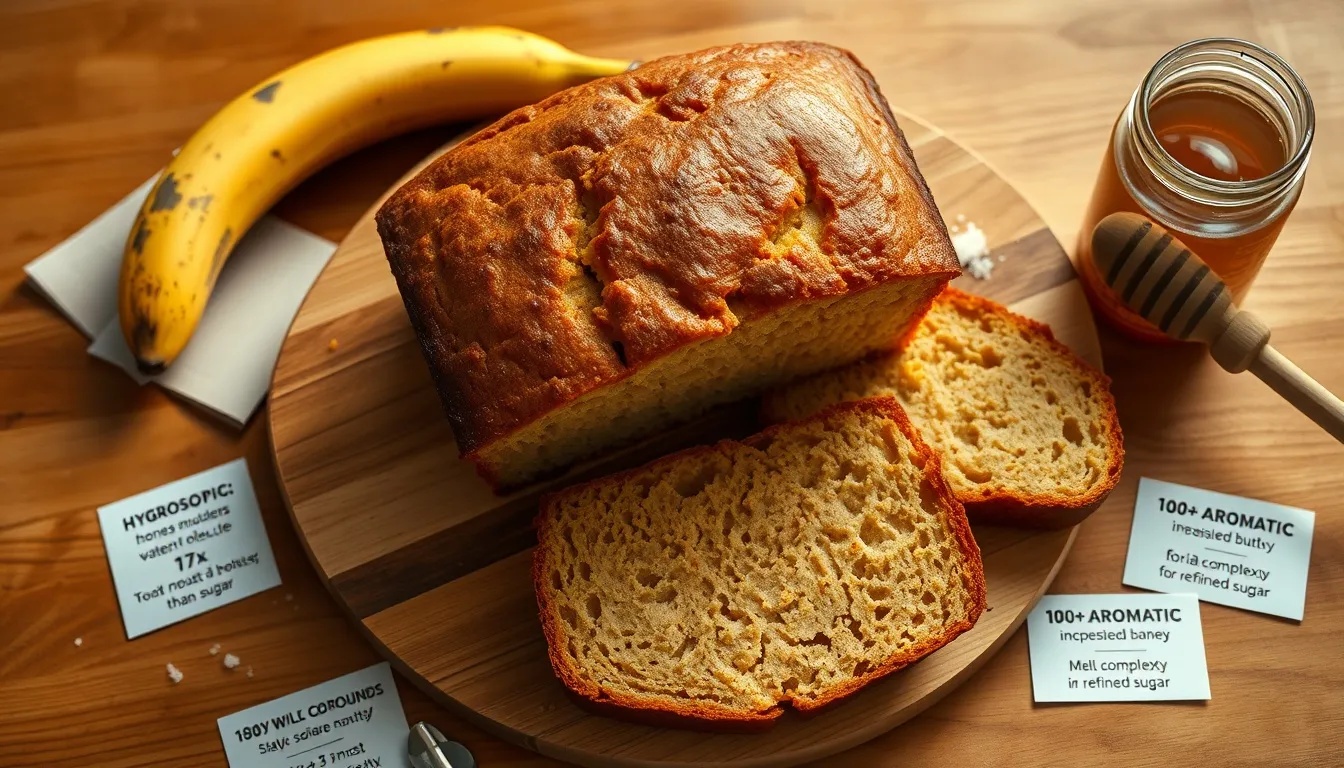
Standard banana bread recipes rely on 3/4 to 1 cup of granulated sugar — a one-dimensional sweetener that adds nothing but sweetness. Honey transforms banana bread in three distinct ways: it is hygroscopic (attracts and holds water), so the crumb stays moist for days longer than sugar-sweetened versions. It contains over 180 aromatic compounds that deepen the banana flavor rather than masking it. And fructose caramelizes at a lower temperature than sucrose, producing a rich golden crust without overbaking the interior.
Replacing sugar with honey means you need about 25% less sweetener by volume (honey is sweeter per tablespoon than white sugar). You also gain a floral note that refined sugar lacks entirely. The banana bread is still a dessert — just a more interesting one.
The secret to great honey banana bread is using extremely ripe bananas. When the peels are mostly brown with black spots, the starch has converted to sugar and the bananas will mash into a smooth, almost liquid puree. Combined with honey, this gives you enough sweetness and moisture to skip refined sugar and oil entirely.
Choosing the Right Honey for Banana Bread
Not all honeys perform equally in banana bread. The best choices complement the banana flavor without competing with it.
- **Clover honey** ($9–15) — Mild, clean sweetness that lets banana flavor dominate. The most versatile choice and what most bakeries use.
- **Wildflower honey** ($13–24) — Slightly more complex than clover with subtle floral notes. Adds depth without overwhelming.
- **Orange blossom honey** ($12–24) — Light citrus undertones that brighten the banana flavor. Excellent for lemon or citrus variations.
- **Buckwheat honey** ($9–23) — Bold, molasses-like flavor with for a darker, more robust banana bread. Best for chocolate chip or walnut variations.
- Perfect when you want pure banana flavor with minimal honey character.
Pro Tip
For the most nuanced flavor, use a lighter honey (clover, acacia) in the batter and drizzle a more flavorful variety (wildflower, orange blossom) over the finished loaf.
Get the Honey Buyer's Cheat Sheet (free PDF)
16 varieties on one page — color, flavor, best use and what a fair price looks like — from the 304 honeys we track.
Honey Banana Bread: The Complete Recipe
This one-bowl recipe uses no refined sugar, no oil, and no mixer — just a fork, a bowl, and about 10 minutes of hands-on time. The combination of ripe bananas, honey, and melted butter produces a tender crumb that stays moist for up to 5 days.
- **Wet ingredients:** 3 large very ripe bananas (about 1 1/4 cups mashed); 1/3 cup raw honey (clover $9–15 or wildflower $13–24); 1/3 cup unsalted butter, melted and cooled; 2 large eggs; 1 teaspoon vanilla extract.
- **Dry ingredients:** 1 3/4 cups all-purpose flour (or 1:1 gluten-free blend); 1 teaspoon baking soda; 1/2 teaspoon salt; 1/2 teaspoon ground cinnamon (optional).
- **Step 1: Prep** — Preheat oven to 350°F (175°C). Line a 9x5-inch loaf pan with parchment paper or grease with butter. Let parchment hang over the long sides for easy removal.
- **Step 2: Mash and mix wet** — In a large bowl, mash bananas with a fork until mostly smooth (a few small chunks are fine). Add melted butter and honey, stirring until combined. Add eggs and vanilla, mix until uniform.
- **Step 3: Add dry** — Sprinkle flour, baking soda, salt, and cinnamon over the wet mixture. Fold with a spatula until just combined — stop as soon as no dry streaks remain. Overmixing develops gluten and makes the bread tough.
- **Step 4: Bake** — Pour batter into prepared pan and smooth the top. Bake for 55-65 minutes until a toothpick inserted in the center comes out with just a few moist crumbs (not wet batter). The top should be deep golden brown.
- **Step 5: Cool** — Let the bread cool in the pan for 15 minutes, then lift out using the parchment overhang and transfer to a wire rack. Cool completely before slicing (at least 30 minutes) for the cleanest slices.
Pro Tip
If the top is browning too quickly but the center is still raw, tent loosely with aluminum foil for the last 15-20 minutes of baking. This is common with honey recipes because fructose browns faster than sucrose.
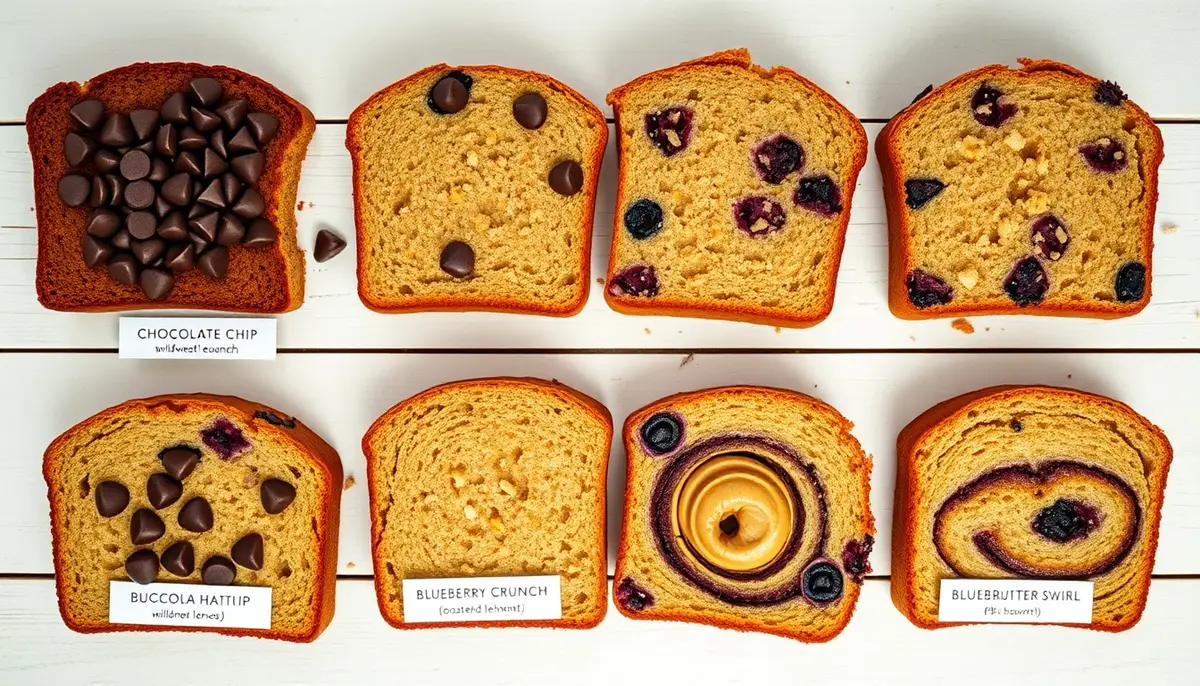
6 Honey Banana Bread Variations
The base recipe is a perfect canvas for mix-ins and flavor twists. Fold any of these additions in at the end of Step 3, just before pouring into the pan.
- **1. Chocolate Chip** — Fold in 3/4 cup dark chocolate chips (60-70% cacao). The bittersweet chocolate plays beautifully against the honey sweetness. Use buckwheat honey ($9–23) for a double-dark bread.
- **2. Walnut Crunch** — Fold in 3/4 cup roughly chopped toasted walnuts. Toast the walnuts first (350°F for 8 minutes) to intensify their flavor and ensure they stay crunchy after baking.
- **3. Blueberry Lemon** — Fold in 1 cup fresh blueberries (tossed in 1 tablespoon flour to prevent sinking) and the zest of 1 lemon. Use orange blossom honey for citrus harmony.
- **4. Peanut Butter Swirl** — Warm 1/3 cup natural peanut butter with 1 tablespoon honey until drizzleable. Pour batter into pan, then dollop and swirl peanut butter through the top with a knife.
- **5. Cinnamon Streusel** — Make a crumble topping: 1/4 cup flour, 2 tablespoons cold butter (cut in), 2 tablespoons honey, 1 teaspoon cinnamon. Sprinkle over batter before baking for a cafe-style top.
- **6. Coconut Tropical** — Fold in 1/2 cup unsweetened shredded coconut and 1/2 cup diced dried pineapple or mango. Use a light floral honey like acacia honey ($9–16) for a tropical flavor profile.
The Baking Science Behind Honey Banana Bread
Understanding why this recipe works helps you troubleshoot and adapt it with confidence.
- **Moisture retention** — Honey is hygroscopic, meaning it pulls moisture from the air and holds it. This is why honey banana bread stays soft and moist for days while sugar-based versions dry out within 24-48 hours. The fructose in honey binds water molecules more effectively than sucrose.
- **Lower browning temperature** — Fructose and glucose (the simple sugars in honey) undergo Maillard browning at roughly 230°F, compared to 320°F for sucrose. This means a deeper golden crust forms earlier in baking. If your bread looks done on top but is raw inside, the solution is lower heat (325°F) and longer baking time, or a foil tent.
- **Acidity and leavening** — Honey is slightly acidic (pH 3.4-6.1). When it meets baking soda (alkaline), the reaction produces extra CO2, giving the bread a slightly better rise than a sugar version. This is why most honey quick breads use baking soda rather than baking powder.
- **Gluten development** — The extra moisture from both honey and bananas means more water available to hydrate flour proteins (glutenin and gliadin). This is why minimal mixing is critical — overmixed honey banana bread becomes gummy and dense. Fold gently, stop early.
- **Banana enzyme activity** — Very ripe bananas contain amylase enzymes that continue breaking down starch during baking, contributing to a moister crumb. This is why overripe bananas (brown-black peels) produce fundamentally better banana bread than yellow bananas.
Storage, Freezing, and Meal Prep Tips
Honey banana bread stores exceptionally well thanks to honey's moisture-retaining properties.
- **Room temperature** — Wrap tightly in plastic wrap or store in an airtight container for up to 5 days. The bread actually improves on day 2 as flavors meld and the crumb settles.
- **Refrigerator** — Wrap tightly and refrigerate for up to 10 days. Bring slices to room temperature before eating (15 minutes) or warm briefly in the toaster.
- **Freezer** — Wrap the whole loaf in plastic wrap, then aluminum foil. Freeze for up to 3 months. Or slice first and freeze individual slices with parchment between them for grab-and-go convenience.
- **Meal prep tip** — Make a double batch on Sunday. Keep one loaf for the week and freeze the other. Frozen slices toast directly from frozen in about 3 minutes.
- **Gifting** — Honey banana bread makes an excellent gift because it stays moist during transport. Wrap in parchment, tie with twine, and include the honey variety used on the tag.
Pro Tip
For the best results when substituting honey for sugar in other baking recipes, reduce the liquid by 3 tablespoons per cup of honey, lower the oven temperature by 25°F, and add 1/4 teaspoon baking soda per cup of honey to neutralize acidity.