About This Recipe
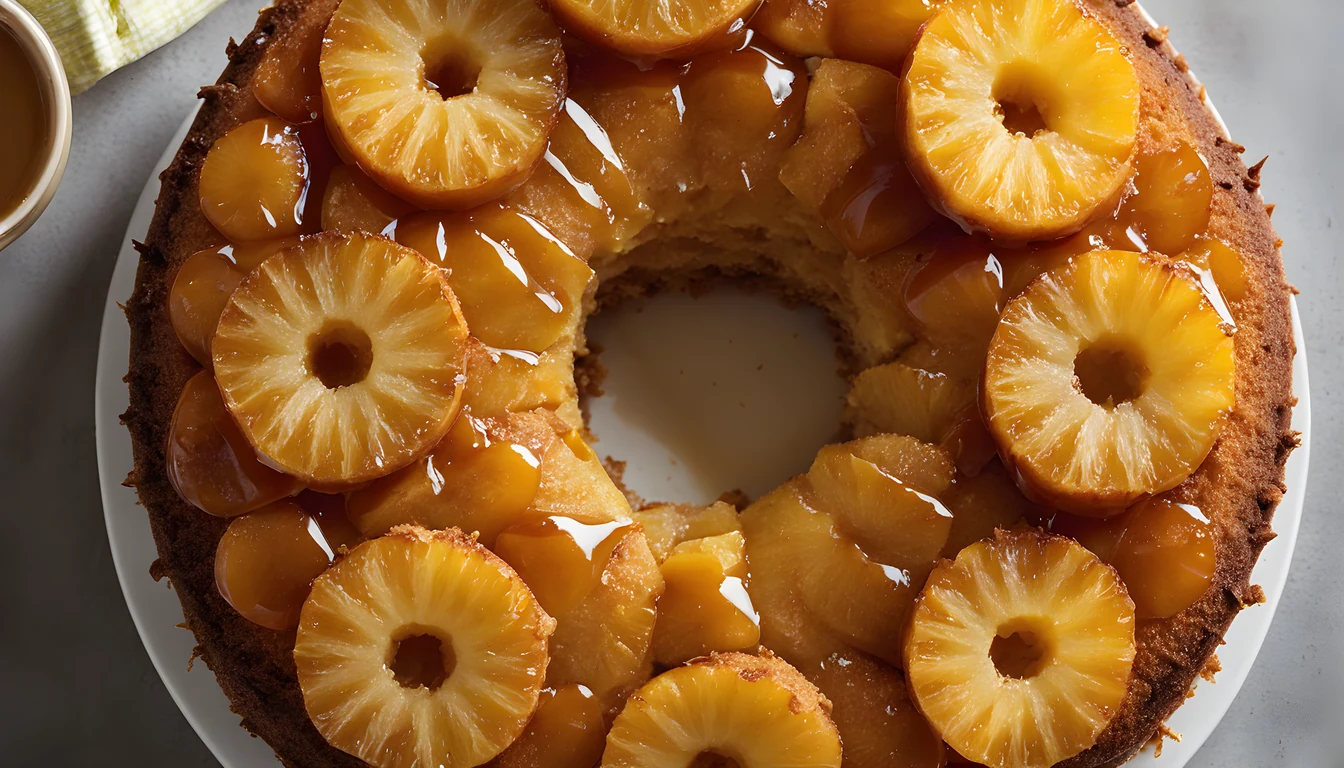
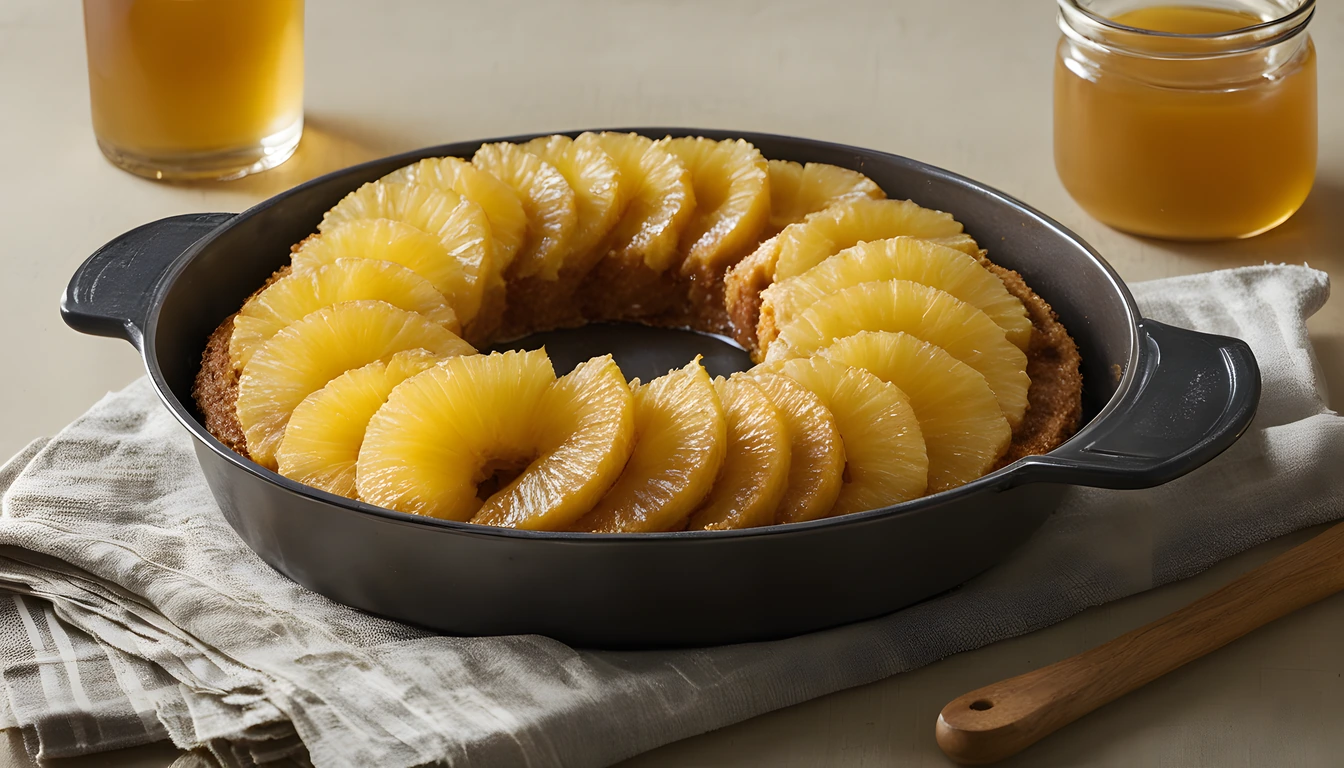
Honey upside-down pineapple cake is a single-layer butter cake baked over pineapple rings set in a honey-butter caramel, then flipped so the fruit ends up on top. Honey goes into both the topping and the batter, which keeps the crumb soft for a couple of days and gives the glaze more depth than plain sugar alone.
The method rests on two details: a caramel cooked just until it bubbles without darkening, and a batter stiff enough to sit on the fruit instead of sliding underneath it. Spoon the batter over the rings in dollops and spread it level rather than pouring it into one spot.
Bake at 350°F and start checking at 35 minutes. Honey browns sooner than sugar, so a loose foil tent in the last stretch often decides between a deep gold top and a scorched one.
Recipe
Honey Upside Down Pineapple Cake Recipe
A one-layer honey upside-down pineapple cake: pineapple rings set in a honey-butter caramel, covered with buttermilk honey batter, baked, then inverted. Makes one 9-inch cake, 8 slices.
13Ingredients
Yield: 8 servings
- 57 g unsalted butter, for the topping (4 tbsp)
- 105 g honey, for the topping (5 tbsp)
- 55 g packed light brown sugar (1/4 cup)
- 400 g drained canned pineapple rings in juice, patted dry
- 188 g all-purpose flour (1 1/2 cups)
- 4.6 g baking powder (1 tsp)
- 1.5 g fine salt (1/4 tsp)
- 113 g unsalted butter, softened, for the batter (1 stick)
- 63 g honey, for the batter (3 tbsp)
- 50 g granulated sugar (1/4 cup)
- 100 g eggs (2 large)
- 4.2 g vanilla extract (1 tsp)
- 184 g buttermilk (3/4 cup)
Ingredient amounts scale; instructions show the original batch. Cooking times and pan sizes may need adjustment. Season to taste. Honey grams use US measures at 20°C and 17.5% moisture, a density estimate; weigh your honey for precision.
Instructions
- 1Make the toppingMelt the 57 g topping butter in a small saucepan over low heat. Add the 105 g honey and the brown sugar and stir for about 2 minutes, until the sugar dissolves and the mixture bubbles lightly at the edges. Pour it into a 9-inch round cake pan at least 2 inches deep. Arrange the drained pineapple rings in the caramel in a single layer, fitting them snugly.
- 2Heat the oven and mix the dry ingredientsHeat the oven to 350°F. Whisk the flour, baking powder and salt together in a bowl and set it aside.
- 3Cream the butter with honey and sugarBeat the softened butter with the 63 g honey and the granulated sugar on medium speed for 3 minutes, until pale and fluffy. Add the eggs one at a time, beating well after each, then the vanilla. The mixture may look slightly separated at this point, which is normal.
- 4Finish the batterAdd the flour mixture in three additions, alternating with the buttermilk in two, starting and ending with flour. Mix on low just until the last streaks disappear. Spoon the batter over the pineapple in dollops and spread it level with a spatula, right to the edge of the pan.
- 5BakeBake for 40 to 45 minutes, until the top is deep golden, the center springs back under a light press and a skewer in the middle comes out with a few moist crumbs. Check at 35 minutes; if the surface is darkening fast, lay foil loosely over the pan and drop the oven to 325°F.
- 6Rest, invert and coolLeave the cake in the pan for 5 minutes. Run a thin knife around the edge, set a rimmed plate over the pan and invert in one motion. Lift the pan away slowly; if a ring stays behind, lift it out with a spoon and set it back in place. Cool for 30 minutes before cutting, since the caramel firms as it sits. Serve warm or at room temperature.
Estimated nutrition per serving
409.45 calories · 18.97 g fat · 57.26 g carbohydrate · 5.19 g protein · 191.67 mg sodium
Serving: 1 slice (about 150 g), 1 of 8 servings
Calculated from ingredient weights and USDA FoodData Central: 173430, 169640, 168833, 169118, 168894, 172803, 173468, 169655, 171287, 173471, 170874. Estimates use ingredient input weights; actual portions, brands and cooking losses vary. Omitted nutrient values are unavailable, not zero.
How to tell the cake is done
The cake is ready when the surface is deep amber, the edges have pulled a hair away from the pan and the center feels set rather than liquid under a light press. A skewer from the middle should come out with a few damp crumbs; a completely clean skewer usually means the cake has gone a minute too far and the outer slices will be dry.
If the top looks pale at 40 minutes, give it five more. If it looks mahogany at the 35-minute check, tent it with foil and drop the oven to 325°F. Honey and brown sugar both darken before the interior sets, so color alone is not a reliable signal.
Flavor intensity is computed from the listed flavor notes of 85 honeys in our catalog: 1 means most are described as mild or light, 5 means most are described as bold or dark. It is a tasting guide, not a laboratory measurement.
Sources: Honey (UC Agriculture and Natural Resources, Cottage Foods); USDA FoodData Central: Butter, without salt; USDA FoodData Central: Honey; USDA FoodData Central: Sugars, brown; USDA FoodData Central: Pears, raw; USDA FoodData Central: Wheat flour, white, all-purpose, enriched, bleached; USDA FoodData Central: Leavening agents, baking powder, double-acting, sodium aluminum sulfate; USDA FoodData Central: Salt, table; USDA FoodData Central: Sugars, granulated; USDA FoodData Central: Egg, whole, raw, fresh; USDA FoodData Central: Vanilla extract; USDA FoodData Central: Milk, buttermilk, fluid, cultured, lowfat.
- Deep amber surface with no pale patch in the middle
- Center springs back under a fingertip
- Skewer shows moist crumbs, not wet batter
- Caramel bubbling visibly at the pan's edge
Pro Tip
Oven thermometers drift. If yours runs hot, bake at 325°F from the start and add five minutes to the check time.
1 = mild, 5 = bold. Editorial pairing guidance, not laboratory measurements; jars vary.
- Clover
- Topping and batter; lets the pineapple lead
- Orange Blossom
- Batter, against the pineapple's acidity
- Wildflower
- Topping, for a rounder caramel
- Sourwood
- Batter, with the buttermilk and vanilla
- Buckwheat
- Blended with clover in the batter; dark and molasses-heavy
Matching a honey to another dish: the honey flavor map
Get the Honey Buyer's Cheat Sheet (free PDF)
16 varieties on one page — color, flavor, best use and what a fair price looks like — from the 304 honeys we track.
Getting the cake out in one piece
Five minutes in the pan is the window. Sooner and the caramel is still fluid enough to run off the cake; much later and it sets into a sheet that grips the fruit and tears the crumb when you flip.
Use a plate with a rim, wider than the pan. Hold the plate and pan together with a towel and turn them over in one steady movement, then wait two seconds before lifting the pan so the caramel can settle onto the cake.
- Loosen the edge with a thin knife before inverting
- Use a rimmed plate rather than a flat one
- If the caramel hardened, warm the pan over low heat for 30 seconds and try again
- Slide any pineapple ring that shifts back into place with a spoon
Pro Tip
Caramel left in the pan can be scraped over the top with a rubber spatula while it is still warm.
Storage and reheating
Covered at room temperature, the cake keeps 2 days; the pineapple softens and the caramel turns syrupy, but the flavor holds. Refrigerated it keeps 5 days, though cold dulls the honey, so let slices sit out 15 minutes before serving.
To freeze, cut the cake into 8 slices, wrap each one and freeze up to 2 months. Reheat from frozen at 300°F for 10 minutes, uncovered, on a lined baking sheet.
- Room temperature: 2 days, covered
- Refrigerator: 5 days, sealed
- Freezer: 2 months, sliced and wrapped
- Reheat at 300°F for 10 minutes from frozen
Pro Tip
A slice warmed in a dry skillet over low heat for 2 minutes crisps the caramel edge without drying out the crumb.
Choosing the Honey
Use Clover Honey or Orange Blossom Honey or Wildflower Honey or Buckwheat Honey for the flavor described in this recipe. See our honey selection guide for other culinary choices.