Tunisia at a Glance: The Lotus-Eaters' Land
Tunisia is the northernmost country in Africa and the smallest of the Maghreb states — roughly the size of Georgia, wedged between Algeria to the west and Libya to the east, with 1,300 kilometres of Mediterranean and Gulf of Gabès coastline. Its geography spans four distinct agricultural zones: the mountainous Tell Atlas dorsal in the north (where most of Tunisia's premium honey is produced), the step-plateau steppe in the centre (sparse grazing and dryland farming), the pre-Saharan chotts (salt lakes), and the Saharan south. These zones produce four distinct honey ecologies in a territory smaller than France's Languedoc-Roussillon region.
Tunisia maintains approximately 30,000–40,000 beekeepers and produces an estimated 5,000–7,000 tonnes of honey per year, making it Africa's fourth-largest producer behind Ethiopia, Tanzania, and Kenya. Most production is consumed domestically. Tunisia is a net honey importer at the national level, bringing in French, Spanish, and Turkish commercial honey to satisfy urban demand while its own mountain honey commands premium prices in local markets and, increasingly, in French Maghrebi-diaspora specialty stores.
The country's honey identity is defined by three overlapping narratives: the literary-archaeological (the Ziziphus lotus / Homer's Odyssey connection), the botanical (Thymus capitatus thyme and orange blossom from the Cap Bon peninsula), and the entomological (Apis mellifera intermissa, the Saharan bee subspecies that beekeepers in Morocco, Algeria, Tunisia, and Libya share). Each narrative connects to a distinct honey variety with an equally distinct character.
Ziziphus Lotus Honey: Homer's Lotus and Its Modern Beekeeper
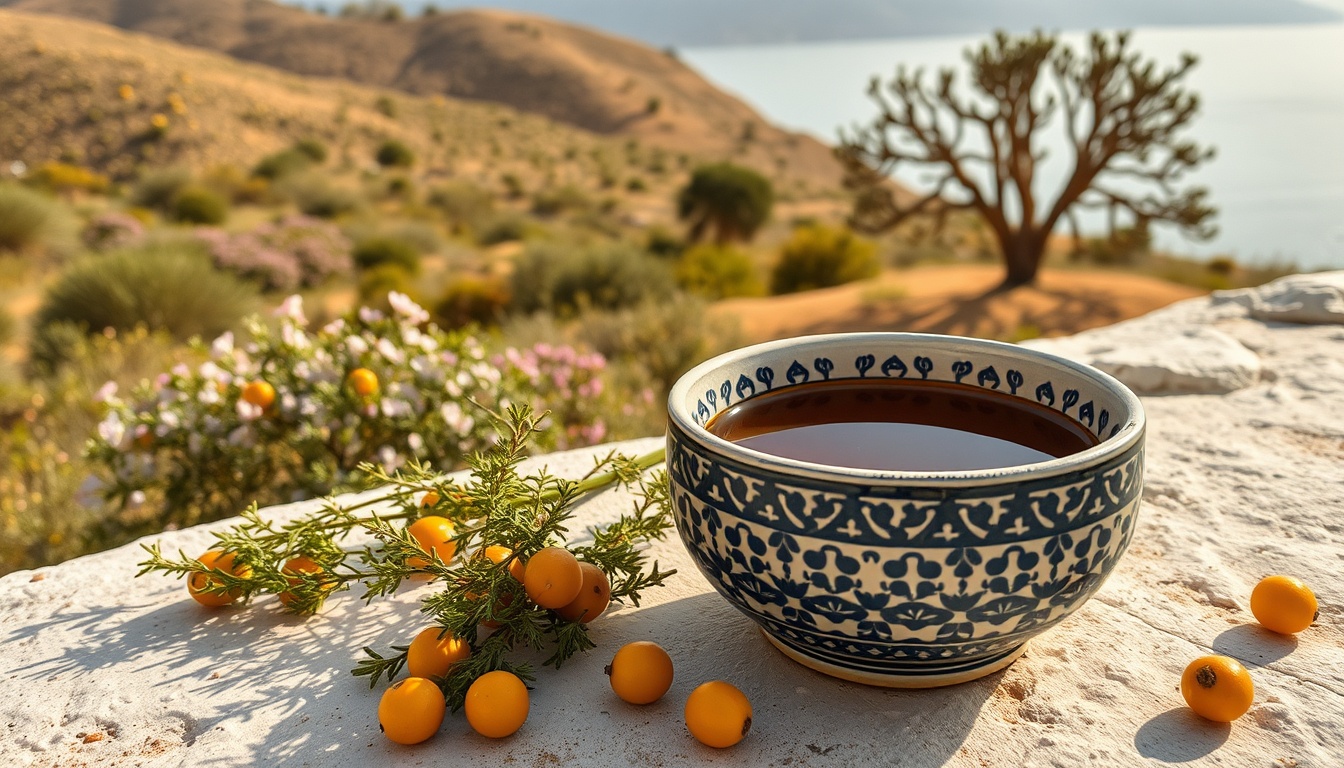
In Book IX of Homer's Odyssey, Odysseus's crew reaches the "land of the Lotus-eaters" (Λωτοφάγοι, Lotophagoi). Three sailors taste the lotus fruit and immediately forget home, wife, and family — they must be dragged back to the ships weeping. The episode, set on an island most ancient commentators placed off the coast of present-day Tunisia (the most common identification is Djerba, the island near Gabès), refers to a real plant: Ziziphus lotus, the jujube lotus shrub native to North Africa, Sicily, and the Iberian coast.
Ziziphus lotus (family Rhamnaceae) grows as a thorny shrub or small tree to 3–4 metres, producing small yellow-orange oval fruits (approximately 1 cm in diameter) in autumn with a sweet, slightly fermented flavour that ancient Greeks — who associated intense sweetness with memory alteration — found remarkable. The plant is unrelated to the aquatic lotus (Nelumbo) and the Egyptian lotus (Nymphaea caerulea) of other ancient texts; it is simply a jujube whose fruit happens to be deliciously sweet and whose nectar, when concentrated by Tunisian Apis mellifera intermissa colonies, produces one of North Africa's most distinctive monoflorals.
Jujubier honey (miel de jujubier, عسل السدر الليبي) from Ziziphus lotus — distinct from the more widely known Sidr honey from Z. spina-christi (Arabian lote tree) and Z. mauritiana — is produced primarily in the Jendouba and Béja governorates of northwestern Tunisia, where Ziziphus lotus occurs as a natural component of the degraded Quercus coccifera garrigue at 400–900 metres. The bloom window is brief: October through December, when the plant flowers during the post-summer dormancy break. The honey is dark amber to brownish-amber, thick, with a complex aromatic profile: fig-date sweetness, warm caramel depth, and a characteristic slightly fermented stone-fruit note from the lotus blossoms' chemistry. Moisture content runs 17–19% in well-ripened lots. Production is small — perhaps 80–120 tonnes per year from artisanal apiaries — and most is sold locally or in Tunis specialty stores.
Djerba Island, the most persistent ancient candidate for the Lotophagoi homeland, still grows Ziziphus lotus in its inland garrigues. Local beekeepers on Djerba produce small quantities of jujubier honey annually, though the island's tourism economy and low scrub-coverage limit yields. The cultural heritage dimension — honey from the same plant that Homer described — gives Tunisian jujubier honey a literary provenance that few honey varieties in the world can match.
Pro Tip
Tunisian jujubier (Ziziphus lotus) honey should not be confused with Moroccan, Pakistani, or Yemeni Sidr honey, which come from different Ziziphus species (Z. spina-christi or Z. mauritiana). The lotus jujube produces a softer, sweeter, less intensely caramel profile than Yemeni Wadi Do'an Sidr. If a seller claims 'Sidr honey' from Tunisia at Yemeni prices, it is likely misrepresented.
Get the Honey Buyer's Cheat Sheet (free PDF)
16 varieties on one page — color, flavor, best use and what a fair price looks like — from the 304 honeys we track.
Thymus capitatus: Cap Bon Thyme Honey
The Cap Bon peninsula — the northeast cape that juts into the Mediterranean toward Sicily, known in Arabic as Ra's al-Tib ("the fragrant cape") — is Tunisia's most botanically distinctive honey-producing landscape. The limestone terraces and garrigue scrublands of Cap Bon are covered in Thymus capitatus (syn. Thymbra capitata, headed thyme), a compact aromatic thyme endemic to the western Mediterranean that flowers from May through July. Tunisian Thymus capitatus is the same species that produces the celebrated Greek Hymettus thyme honey and Cypriot Thymus capitatus honey — the pan-Mediterranean thyme whose essential oil profile (carvacrol-dominant, 50–65%, with p-cymene, γ-terpinene) defines the Mediterranean culinary herbarium.
Cap Bon thyme honey is light to medium amber with a clear, almost luminous quality at harvest. The aroma is strongly herbaceous-aromatic: carvacrol and thymol volatiles produce the characteristic sharp-thyme-fennel top note that distinguishes Thymus capitatus honey from softer lavender or rosemary honeys. The flavour is intensely floral-herbal, with a warm persistent finish and moderate sweetness. Cap Bon thyme honey crystallises to a finely-grained pale cream paste over 4–8 months at ambient Mediterranean temperatures.
Nabeul governorate (the administrative heart of Cap Bon) is Tunisia's most commercially recognised honey-origin — "miel de Nabeul" is the domestic premium signal in Tunis and coastal city markets, used both specifically for Cap Bon thyme honey and loosely for any Nabeul-sourced multifloral. Authentic Cap Bon thyme honey carries a pollen signature dominated by Thymus pollen (Labiatae/Lamiaceae family type, elongated-elliptic, ≥ 45% in premium lots) and typically shows INNORPI NT 08.32 conformance on moisture and HMF parameters. Production in Nabeul governorate is estimated at 600–900 tonnes per year, with the best honey coming from traditional apiary placements on the limestone-garrigue belt at 100–400 metres above sea level.
Rosemary, Orange Blossom, and the Mountain Wildflower
Rosemary honey (miel de romarin) is produced from Rosmarinus officinalis bloom across the Tunisian Dorsal chain — the Tell Atlas ridge system that runs northeast-southwest from Zaghouan and Bou Kornine to the Algerian border. Rosemary blooms from February through April on well-drained limestone slopes at 200–800 metres, and the resulting honey is one of the palest in the Tunisian range: near-white to pale straw yellow at harvest, crystallising rapidly (within 4–6 weeks) to a smooth white cream. Flavour is mild, delicately floral-herbal, with a faint balsamic note. Tunisian rosemary honey is broadly similar to Spanish La Alcarria rosemary honey (DO designation) and French Provence rosemary, though Tunisian producers have not pursued a GI equivalent.
Orange blossom honey (miel de fleur d'oranger) from the extensive citrus orchards of the Cap Bon and Bizerte lowlands is a classic Tunisian seasonal monofloral — pale gold, with the characteristic jasmine-orange-neroli floral note that places it alongside Spanish azahar honey and Italian zagara honey as one of the most elegant of all blossom honeys. The bloom window (March through April for Citrus sinensis and C. aurantium) is brief and weather-dependent, and genuine orange blossom monofloral must be confirmed by pollen analysis (>45% Citrus type pollen by Louveaux count). Most Tunisian citrus honey sold domestically is multifloral with citrus as a dominant note — only spring-harvested single-location lots achieve true monofloral status.
Mountain wildflower honey from the Dorsal chain — collected from Zaghouan, Siliana, Béja, and Jendouba governorates at 400–1,200 metres — is Tunisia's primary commercial midrange category. The botanical composition varies by altitude and site: lower slopes produce multifloral dominated by Trifolium, Medicago (medick), and Ornithopus (serradella) pollen; mid-elevation garrigue produces Cistus, Pistacia, and Rosmarinus inputs; upper scrubland and forest margins bring in Quercus, Pinus, and Thymus. The resulting honey is amber to dark amber, with a complex aromatic character that reflects the Tell Atlas flora — warm, slightly resinous, with a moderate-long finish.
Apis mellifera intermissa: The Saharan Bee of the Maghreb
Tunisia's native bee is Apis mellifera intermissa, the Saharan bee or North African black bee — a subspecies of the European honey bee (Apis mellifera) adapted over millennia to the extreme heat, aridity, and sparse and seasonal nectar flows of North Africa. Apis mellifera intermissa was formally described and classified by Friedrich Ruttner in 1988 as one of the most genetically distinct subspecies in the A. mellifera complex (Ruttner, *Biogeography and Taxonomy of Honeybees*, Springer 1988). It is smaller and darker than the Italian honey bee (A. m. ligustica), with a shorter tongue than the Carniolan (A. m. carnica), and is notably defensive by European commercial standards — a behavioural adaptation to the predator pressure of North African semi-arid environments.
Apis mellifera intermissa's most important commercial trait is its extraordinary adaptation to Tunisia's climate: it tolerates ambient temperatures up to 45°C in summer, manages well through long dry periods with almost no nectar flow (by reducing colony size and metabolic demand), and exploits brief, intense bloom windows with exceptional efficiency. When temperatures are extreme, A. m. intermissa colonies enter a semi-dormant clustering behaviour not seen in European subspecies — a survival adaptation that commercial Langstroth-hive keepers must manage carefully to avoid treating it as absconding.
The conservation status of A. m. intermissa in Tunisia is fragile. Importation of Apis mellifera ligustica (Italian) queens and package bees from Italy and Slovenia has been ongoing since the 1980s, and hybridisation between imported Italian stock and native intermissa populations is widespread in coastal and accessible regions. Purebred A. m. intermissa colonies are increasingly found only in remote mountain areas where logistical difficulty and the species' extreme defensiveness discouraged wholesale Italian-bee replacement. Several Tunisian beekeeping associations have initiated A. m. intermissa conservation programs since 2010, focusing on northern Dorsal range populations. The situation mirrors the Moroccan A. m. intermissa context described in the Morocco honey guide — the two countries effectively share the same subspecies conservation challenge across either side of the Algerian border.
Pro Tip
Honey produced by purebred Apis mellifera intermissa colonies is not intrinsically different in composition from Italian-bee honey harvested from the same floral source — the bee subspecies determines foraging and colony behaviour, not honey chemistry. The intermissa conservation argument is ecological and cultural, not primarily a honey-quality argument.
Tunisia's Honey Industry, INNORPI NT 08.32, and the Authenticity Challenge
Tunisia's honey regulatory framework is administered by INNORPI (Institut National de la Normalisation et de la Propriété Industrielle), which has issued the NT 08.32 honey standard. NT 08.32 sets compositional parameters broadly aligned with Codex Alimentarius CXS 12-1981: moisture ≤20%, HMF ≤40 mg/kg, reducing sugars ≥60 g/100g, sucrose ≤5 g/100g, diastase ≥8 Schade units, free acidity ≤50 meq/kg. INNORPI also manages geographical indication registration for Tunisian agricultural products — but as of 2026, no Tunisian honey variety has achieved formal GI protection at either national or EU level, despite the distinctive terroir and named-origin character of Cap Bon thyme honey and Jendouba jujubier honey.
Tunisia's honey market has a documented authenticity challenge, particularly in the retail segment. Urban Tunis markets (souks, supermarkets, and informal street vendors) carry a wide range of honeys labelled as premium Tunisian varieties at inconsistent quality levels. The most common forms of mislabelling: (1) multifloral honey sold as thyme monofloral without pollen analysis; (2) imported Turkish, Spanish, or French honey relabelled as domestic after repackaging; (3) "jujubier" label applied to generic wildflower honey to capture the lotus-honey cultural premium. INNORPI enforcement capacity is limited and the informal small-producer segment (representing the majority of artisanal mountain honey) operates largely outside the formal standard-certification system.
Authentic Tunisian honey from the premium segment — Cap Bon thyme, Jendouba jujubier, Atlas mountain wildflower from named cooperatives — is increasingly available through Tunisian specialty food retailers in Tunis (including the Medina souk system and modern specialty stores on Avenue Habib Bourguiba), through export channels to France (where Tunisian Maghrebi-diaspora retail maintains a documented market), and through specialist online honey retailers in the EU. The France channel is by far the most reliable international source for authenticated Tunisian honey: French Maghrebi specialty importers in Lyon, Marseille, and Paris source directly from named Tunisian producers, and provenance documentation is more reliable in this bilateral trade channel than in broader EU online retail.
Key Tunisian Honey Varieties at a Glance
Tunisia's principal honey varieties span from the ancient literary connection of jujubier to the Mediterranean warmth of thyme:
- Jujubier honey (miel de jujubier, عسل السدر الليبي) — Ziziphus lotus, Jendouba/Béja/Djerba, dark amber, fig-date-fermented stone fruit, Homer's Lotus-eaters connection, Oct–Dec bloom, premium
- Cap Bon thyme honey (miel de thym) — Thymus capitatus, Nabeul/Cap Bon peninsula, light-medium amber, strongly aromatic carvacrol-thymol, May–Jul,
- Rosemary honey (miel de romarin) — Rosmarinus officinalis, Dorsal chain, near-white, mild floral-balsamic, Feb–Apr, fast-crystallising,
- Orange blossom honey (miel de fleur d'oranger) — Citrus sinensis/aurantium, Cap Bon lowlands, pale gold, jasmine-neroli floral, Mar–Apr,
- Mountain wildflower (miel toutes fleurs de montagne) — Tell Atlas/Dorsal range (Zaghouan, Siliana, Jendouba), amber-dark amber, complex Mediterranean flora,
- Eucalyptus honey (miel d'eucalyptus) — Eucalyptus camaldulensis plantations, coastal lowlands, medium amber, menthol-medicinal, year-round
- Esparto/alfa grass honey (miel de sebha/halfa) — Stipa tenacissima, steppe transition zone, very pale, mild, rare commercial category