Egypt in the World Honey Map: The Antiquity–Scale Paradox
Egypt occupies a singular and paradoxical position in the world honey economy. It is simultaneously the country with the world's longest continuous documented beekeeping tradition — an unbroken record stretching back at least 4,500 years to the Old Kingdom sun temple reliefs at Abu Ghurab — and one of the world's largest commodity honey exporters, shipping tens of thousands of tonnes of Nile Delta berseem clover honey to Europe, the Gulf states, and global commodity markets each year. The country that gave the world its first known depiction of organised beekeeping (circa 2450 BCE), that used the hieroglyphic bee as the sovereign symbol of Lower Egypt, that sealed honey in alabaster jars as offerings for pharaohs, now runs one of the most productive mass-market honey industries in Africa. No other country carries both identities as completely as Egypt: the birthplace of apiculture as a managed practice and a leading player in the industrialised global honey trade.
Understanding Egyptian honey requires holding both sides of this paradox in view. On one side, Egypt's premium honey tradition — the Sinai sidr, the Siwa Oasis desert florals, the small-volume Nile Delta orange blossom harvests from traditional beekeepers — is genuinely distinctive and tied to ecological and cultural conditions that do not exist anywhere else. On the other side, the mass-market berseem clover production of the Nile Delta has been shaped by the demands of commodity export markets, and some of that production has a documented food-safety track record that requires scrutiny. Knowing which Egyptian honey you are buying, and where it comes from within the country, is the central challenge for an international buyer. The guide that follows covers both traditions — the artisan and the commodity — with the specificity to distinguish between them.
Egypt sits at the nexus of three honey-producing regions that together form one of the world's richest honey geographies. To the north and east, across the Red Sea and Sinai, lies the Arabian Peninsula's premium sidr belt — the same Ziziphus spina-christi tree that produces Yemeni Wadi Doan sidr (see our Yemeni honey guide) grows throughout the Sinai Peninsula, the Eastern Desert, and the Nile Valley. To the west, across the Libyan Desert, the Siwa Oasis preserves a Berber honey tradition connected by geography and culture to the Moroccan Atlas thyme and jujube traditions (see our Moroccan honey guide). To the south, the Nile Valley stretches toward the Ethiopian and Sudanese highlands where Africa's wildest honey ecologies begin (see our Ethiopian honey guide). Egypt is the geographical convergence of all three, which explains why its honey range is broader than most outsiders expect.
The Hieroglyphic Bee: 5,000 Years of Documented Beekeeping
The earliest confirmed depiction of organised beekeeping anywhere in the world is a bas-relief from the sun temple of Niuserre at Abu Ghurab (Abu Sir), dated to approximately 2450 BCE during Egypt's 5th Dynasty. The relief sequence shows beekeepers working with cylindrical clay hives stacked in rows — a design recognisable to modern Nile Delta beekeepers who still use similar horizontal clay-cylinder hives — blowing smoke to calm the bees, removing honeycomb, and straining honey into sealed storage vessels. The sophistication of what is depicted is not a new technology being recorded for the first time but a mature practice already evolved well beyond its origins: the beekeepers show familiarity, ritual, and the kind of hive architecture that develops over generations. Egypt's honey history did not begin at Abu Ghurab; it merely becomes visible there. Evidence of honey use in Predynastic Egypt (before 3100 BCE) is documented from ceramic analysis at a number of Delta sites.
The bee itself held sovereign symbolic weight in ancient Egyptian cosmology. The hieroglyphic sign L2 — a honey bee, drawn with anatomical precision unusual in hieroglyphic convention — was the symbol of Lower Egypt, the Nile Delta, from at least the First Dynasty (circa 3100–2900 BCE). The pharaoh's title in formal inscription was nesu-bit — "He of the Sedge and the Bee" — where the sedge represented Upper Egypt (the Nile Valley south of Cairo) and the bee represented Lower Egypt (the Delta). This is not a metaphorical bee; it is a literal identification of the Delta's productive power — of its capacity to harvest sweetness from its landscape — as the defining characteristic of the northern kingdom. No other ancient civilisation elevated the honeybee to state-emblem status in this way. The significance is not just symbolic: it reflects that organised, commercial-scale honey production was already a defining feature of the Delta economy by the time the hieroglyphic writing system was formalised.
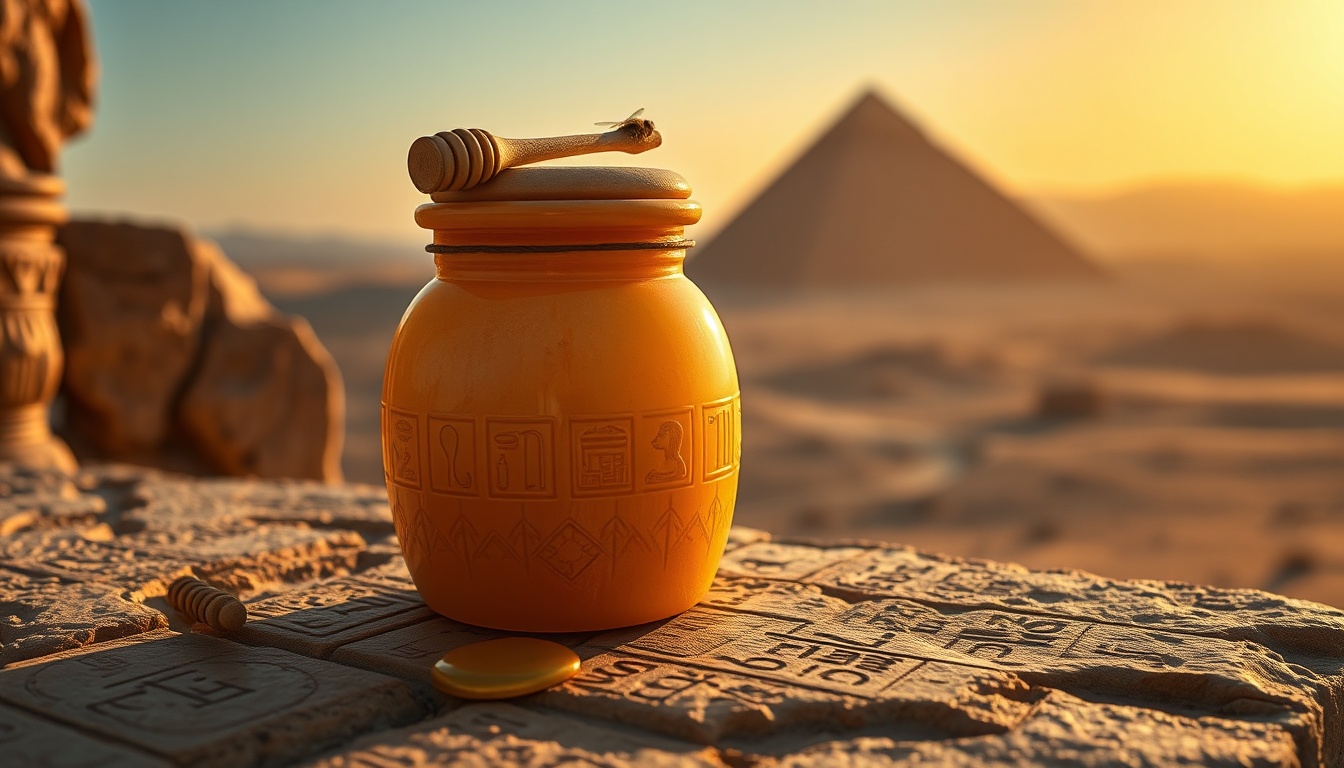
The medical papyri reinforce the extent to which honey was integrated into Egyptian material culture beyond food. The Ebers Papyrus (~1550 BCE, found at Thebes), one of the oldest surviving medical texts in the world, includes honey as an ingredient in over 147 preparations covering wound treatment, digestive complaints, and topical applications. The Edwin Smith Papyrus (surgical treatise, ~1600 BCE) specifies honey dressings for infected wounds and burns. The practical reasoning has since been validated: honey's low water activity, low pH, gluconic acid content, and in some honeys the glucose oxidase enzyme generating hydrogen peroxide are all genuine antibacterial mechanisms (see our honey pH guide). What the Egyptian physicians documented empirically over three millennia ago corresponds to the biochemistry that modern food scientists have spent the last century explaining. When Tutankhamun's tomb (1323 BCE) was excavated in 1922, sealed alabaster vessels containing residue traces consistent with honey and other organic materials were among the grave goods — honey as a preserved offering for the afterlife, a fitting use for a material whose own shelf life, under correct conditions, is essentially unlimited.
Get the Honey Buyer's Cheat Sheet (free PDF)
16 varieties on one page — color, flavor, best use and what a fair price looks like — from the 304 honeys we track.
Berseem Clover Honey: The Nile Delta Production Engine
The dominant variety in Egyptian honey production — and the variety most likely to reach international commodity markets — is berseem clover honey, produced from Trifolium alexandrinum, the Egyptian clover or berseem, a winter legume crop grown throughout the Nile Delta as a nitrogen-fixing rotation crop between rice and cotton seasons. Berseem blooms from approximately November through March in the Delta, providing an extended nectar flow that supports Egypt's approximately 2.5–3 million managed Apis mellifera hives and makes Egypt one of the top honey-producing countries in Africa and one of the top fifteen globally by volume, with annual production figures typically reported in the range of 40,000–50,000 tonnes (FAOSTAT data, 2019–2023 average). This figure is large enough to place Egypt comfortably in the first tier of global honey producers alongside China, Turkey, Argentina, Ukraine, and the United States.
The characteristics of pure berseem clover honey reflect the botanical source: it is pale amber to water-white, mild and clean in flavor with a light floral sweetness and low acidity, with a tendency to crystallise fairly quickly (within one to three months) to a fine-grained, creamy consistency. It is an excellent general-purpose honey with a neutral flavor profile suited to cooking, baking, and sweetening applications where a strong varietal character is not desired. In this sense it is functionally analogous to pure clover honey from North American Trifolium repens/pratense — both represent reliable, mild, affordable varieties that form the backbone of commodity honey in their respective markets. While pure clover honey USA benefits from North American agricultural monocultures creating exceptionally clean, consistent sweetness, Egyptian berseem clover honey offers the distinctive character of Nile Delta alluvial soils and the extended November-March bloom period, producing slightly more aromatic complexity while maintaining the same excellent general-purpose functionality. The commercial berseem product is not without genuine quality; well-extracted, unadulterated Delta berseem from responsible producers is a pleasant and honest honey. The problem lies upstream of the honey itself, in the commodity supply chain.
The Egyptian honey export sector has accumulated a documented record of food-safety and authenticity concerns that buyers in European and US markets need to understand. EU Rapid Alert System for Food and Feed (RASFF) notifications have documented Egyptian honey lots testing positive for veterinary antibiotic residues — including chloramphenicol, a broad-spectrum antibiotic banned in food production in the EU — at various points in the 2000s and 2010s. The European Commission has at different times imposed enhanced import controls on Egyptian honey requiring lot-by-lot testing before EU market entry. Separately, the commodity honey trade globally is subject to adulteration with high-fructose corn syrup and other sugar syrups, and Egyptian bulk honey has appeared in investigations of fraudulent origin or composition. None of this means that all Egyptian honey is unsafe or adulterated — it means that the commodity bulk-export sector requires scrutiny and that provenance, testing documentation, and supply-chain transparency are non-negotiable for buyers who care about what they are purchasing. The premium artisan segment (sidr, Siwa, organic Delta certifications) operates with higher transparency standards than the bulk commodity market.
Sidr Honey (Ziziphus spina-christi): Egypt's Desert Crown
Egypt's most prestigious honey variety is sidr, produced from the nectar of Ziziphus spina-christi — the Christ's Thorn Jujube, known in Arabic as sidr (سدر) or nabk (نبق). The tree is a spiny, drought-tolerant species of the Rhamnaceae family that grows throughout the Nile Valley, the Eastern Desert, the Sinai Peninsula, and the region around the Suez Canal — environments ranging from the sub-Mediterranean Sinai highlands to the hyperarid coastal desert of the Red Sea coast. Sidr flowers in autumn (October–November in most Egyptian locations), producing a generous nectar flow that skilled beekeepers have exploited for generations. The resulting honey is distinctively slow to crystallise (remaining liquid for a year or more in most cases), dark amber to reddish-brown in color, and complex in flavor: the characteristic sidr profile includes notes of butterscotch, dried fruit (dates, figs), light caramel, and a warm lingering finish that distinguishes it immediately from the mild clover honey dominant in the Delta market.
The comparison to Yemeni sidr is instructive and necessary, because the global premium honey market uses "sidr honey" almost synonymously with Yemeni Wadi Doan sidr — the product at the premium end of the international market. Egyptian sidr is a legitimate product from the same plant species, but grown in different ecological conditions and without the same provenance premium. Yemeni sidr from the Wadi Doan and Wadi Hadramawt ecosystems benefits from specific altitude (600–1,500 metres in the Hadhramaut plateau), extreme aridity during the nectar-flow season, and a traditional harvesting and quality control culture built up over centuries — conditions that produce a specific biochemical profile including elevated HMF, specific amino acid composition, and high antimicrobial activity that has attracted scientific study. New Zealand Manuka honey provides another useful premium honey comparison point: Manuka's verified UMF (Unique Manuka Factor) certification system demonstrates how scientific authentication of antimicrobial activity creates premium market positioning, while Egyptian sidr relies primarily on traditional production methods and terroir authenticity rather than laboratory-verified bioactivity levels. Egyptian sidr, harvested primarily at lower elevations in the Sinai and Eastern Desert, in a more humid and accessible environment, does not have the same altitude advantage or the same depth of traditional quality culture. It is genuinely premium by Egyptian standards and by honest comparison to the mass-market Delta clover; it is not a substitute for Yemeni sidr, and marketing that suggests otherwise is misleading. Authenticated Egyptian Sinai sidr varies with producer quality and supply chain transparency, not botanical variation.
The Sinai Peninsula contributes the most geographically distinctive Egyptian sidr. The peninsula's varied terrain — the hyperarid coastal lowlands along the Gulf of Suez and Gulf of Aqaba, the sandstone middle zone, and the granite highlands of South Sinai with peaks above 2,500 metres (Gebel Katherina, the highest point in Egypt) — supports a diverse flora that includes Z. spina-christi, Acacia species, desert herbs, and at higher elevations a more temperate shrub layer. Bedouin beekeepers in South Sinai have maintained managed hive traditions for generations, following the seasonal blooms across the peninsula's elevation gradient. The Sinai honey tradition is genuinely artisanal and the knowledge base — which trees bloom when, at what elevation, in what microclimate — is embedded in community knowledge rather than written documentation. Small cooperatives and family operations in the Sinai Governorate sell authenticated sidr honey at Egyptian specialty markets and to discerning export buyers; volume is limited and the best product rarely reaches international online retail.
Citrus, Acacia, and the Seasonal Nile Delta Varieties
Beyond berseem clover, the Nile Delta and its bordering regions support several seasonal monofloral honey varieties that represent the genuine quality spectrum of Egyptian honey. Orange blossom honey — produced from the citrus orchards of the Delta and the Suez Canal zone, which bloom in March and April — is a pale, aromatic variety with the characteristic floral-citrus character that makes citrus honeys sought-after globally. Egyptian orange blossom shares its botanical source with the celebrated Sicilian and Valencian citrus honeys of the Mediterranean, and at its best (freshly extracted, unblended, from a skilled Delta producer) it is an equally impressive product. Florida orange blossom honey provides an excellent comparison point — Florida's sandy coastal soils and year-round bloom concentration create a distinctively clean citrus expression, while Egyptian Delta orange blossom benefits from Nile alluvial minerality and more concentrated seasonal blooms, resulting in greater aromatic complexity and stronger floral-citrus intensity that rivals the best Mediterranean citrus honeys. The challenge is that Egyptian orange blossom is rarely marketed as a distinct monofloral in international export; it is more often blended into the undifferentiated "Egyptian clover honey" commodity stream, which erases the varietal premium and the producer traceability. Buyers who specifically seek Egyptian citrus honey need to work with specialist importers who can identify and separate the variety.
Acacia honey from Acacia nilotica (the Nile acacia or sont tree) is one of the oldest honey-producing plants in the Egyptian landscape — A. nilotica is depicted in ancient Egyptian botanical illustrations and its pods and bark are found in archaeological sites throughout the Nile Valley. As a honey source it produces a pale, mild, slow-crystallising variety (the high fructose:glucose ratio characteristic of acacia honeys from most species keeps them liquid for extended periods) with a clean sweetness and gentle floral note. Nile acacia honey is less intensely flavored than European black locust (Robinia pseudoacacia) acacia honey — the benchmark monofloral for the category in the EU market — but is a genuine and traditional variety. Italian acacia honey from Robinia pseudoacacia provides the perfect comparison: Italian acacia's Alpine foothills terroir creates the distinctive water-white clarity and delicate vanilla undertones that set the European standard, while Egyptian Nile acacia's ancient desert terroir along the Nile margins produces a more subdued floral character with gentle sweetness and the same exceptional liquid crystallization resistance, representing one of the world's oldest documented acacia honey traditions. Its production is geographically limited to the acacia stands along the Nile margins and in the Eastern Desert wadis, and volume is small. It is occasionally found in Egyptian specialty markets but essentially unavailable in international export.
Sunflower honey has become a growing presence in the Delta honey calendar as sunflower cultivation expanded in the Nile Delta irrigation zones over the past two decades. Sunflower honey is pale yellow, very quick to crystallise (almost always granulated within weeks of extraction), and relatively neutral in flavor with a mild vegetal-floral note. It is a mass-market variety with no premium character but is genuine and abundant. Clover and sunflower together form the backbone of the commodity sector. At the opposite end of the scale, nigella (black seed / Nigella sativa) honey from the Eastern Desert is a traditional specialty: hives placed near nigella cultivation in the cultivation zones of the Eastern Desert produce a strongly aromatic honey used in traditional medicine and sold domestically as a therapeutic product. It is rarely marketed internationally as a variety but is a genuine expression of Egypt's Islamic-medicine honey traditions, where nigella honey is valued for its association with the hadith regarding the medicinal properties of black seed.
Siwa Oasis: Honey at the Edge of the Western Desert
The most isolated and culturally distinctive honey tradition in Egypt belongs to the Siwa Oasis — a depression in the Western Desert some 50 kilometres east of the Libyan border, at approximately 300 kilometres south of the Mediterranean coast, reached by a single desert road from Marsa Matrouh. Siwa is home to the Siwi, a Berber (Amazigh) community whose language, customs, and material traditions are more closely related to the Amazigh cultures of Libya and the North African Maghreb than to Arab Egypt. The oasis has been inhabited since at least the 10th millennium BCE, and its fame in antiquity rested on the Oracle of Amun — the sanctuary that Alexander the Great visited in 332 BCE to receive confirmation of his divine status. The oasis is best known internationally today for its date palms (producing the sought-after Siwa dates) and its olive groves, but honey has always been part of the Siwi material economy.
Siwa's honey ecology is shaped by the oasis's unusual botany: an island of agriculture and vegetation in a hyperarid landscape, the oasis supports a concentration of flowering plants — jujube (Ziziphus spina-christi), wild herbs, flowering shrubs, and the peripheral desert flora of the Libyan plateau edge — that is denser and more diverse than the surrounding Libyan Desert would suggest. Siwa beekeeping uses traditional clay-cylinder hives similar in concept to those depicted in the Old Kingdom reliefs and still found across North Africa, managed by small-scale Siwi beekeepers in household or small-cooperative units. The honey produced is a desert wildfloral with botanical complexity reflecting the oasis's specific flora: notes of jujube, wild herbs, and the dry floral character of plants adapted to extreme heat and low humidity. It is not commercially produced at scale, is not available through international retail channels, and is rarely documented in the honey research literature. Its significance is cultural and geographical — it represents a continuous tradition of small-scale honey production in one of the most remote inhabited places in Africa.
The isolation that protects Siwa's tradition also limits its potential as a commercial product. Unlike Yemeni sidr or Nepalese cliff honey, which have developed international export markets supported by importers, research attention, and consumer awareness, Siwa honey is entirely a local-market product. It can be purchased in the oasis itself, occasionally at Cairo specialty food shops that source directly from the oasis, and sometimes through Egyptian premium honey retailers who curate artisan varieties. Pricing at source is modest by international premium standards — the absence of an export premium means Siwa honey is priced for its Egyptian market — but the production volume is genuinely small and authentic product is not widely available. The oasis's growing reputation as an ecotourism destination has created some interest in Siwa honey as a premium artisan souvenir product, but this demand has not yet generated the supply-chain infrastructure that would bring Siwa honey to international online retail.
Egyptian Honey Standards and Export Scrutiny
Egypt's statutory honey standard is administered by the Egyptian Organisation for Standardisation and Quality (EOS), with the current honey standard designated ES 1 (Egyptian Specification for Honey). The standard is broadly aligned with Codex Alimentarius CXS 12-1981 parameters: moisture content (≤20% for most varieties, ≤23% for heather honey), reducing sugars, sucrose ceiling, diastase activity minimum, hydroxymethylfurfural (HMF) maximum, and sensory requirements. Egypt's export sector is additionally regulated by the Central Laboratory for Residue Analysis of Pesticides, Heavy Metals and their Residues (QCAP), which provides residue testing for export certificates. However, the effectiveness of pre-export residue controls has historically been inconsistent, as documented by the EU RASFF alerts that have identified non-compliant Egyptian honey lots at EU ports of entry. The 2002 EU suspension of Egyptian honey imports (for chloramphenicol residues) and the subsequent reinstatement under enhanced monitoring conditions established a precedent for what import market scrutiny looks like for countries with documented food-safety issues in honey.
The regulatory gap in Egyptian honey is not primarily about the standard itself — the ES 1 parameters are adequate — but about enforcement consistency in the commodity supply chain. Egypt's honey sector includes a very large number of small-scale beekeepers (the Ministry of Agriculture estimates 60,000–80,000 registered beekeepers, though coverage is incomplete) whose product enters a multi-stage commodity chain involving collectors, wholesale traders, processors, and exporters. Each stage of that chain creates opportunities for blending, adulteration, and quality dilution that the point-of-export testing does not fully capture. The premium artisan segment — sidr producers, Siwa cooperatives, organic-certified Delta producers — operates with more transparency and more direct supply chains, and these are the products most likely to be what they claim to be. The commodity bulk segment, sold by the tonne rather than the jar, is where the documented issues cluster.
For international buyers, the practical implication is that country of origin alone ("Egyptian honey") is not a sufficient quality signal. The differentiation that matters is between commodity-stream product and verified-provenance artisan product. Indicators of the latter: named beekeepers or named cooperatives with verifiable identity; specific region of origin (Sinai Governorate sidr; South Sinai Bedouin cooperatives; specific Nile Delta village for berseem); residue test certificates from accredited laboratories; honest declaration of floral source and harvest year; and pricing consistent with genuine artisan production costs (for sidr, for quality berseem) rather than commodity bulk pricing (the level at which adulteration economics become attractive). Several Egyptian honey exporters operate with fully transparent supply chains and are available through specialty importers in Germany, the UK, and the Gulf states; the premium artisan tier is real and worthwhile, but requires the additional verification steps described.
Buying Authentic Egyptian Honey: What to Know
In Egypt itself, the best channels for premium honey are the specialty honey shops in Cairo's upscale districts (Zamalek, Maadi), the organic and artisan food markets that have developed in Cairo and Alexandria over the past decade, specialist retailers in Sinai Governorate capitals (Sharm el-Sheikh, Dahab, and Nuweiba have artisan honey shops serving the tourism market), and direct farm-gate purchase in the Nile Delta from producers who have established reputations. The government-sponsored agricultural fairs in Delta governorates (Dakahlia, Gharbiya, Kafr el-Sheikh) sometimes feature local honey producers with authenticated product. For Siwa honey, the oasis itself is the only reliable source; the product does not exist in an international supply chain. For Sinai sidr, a handful of Cairo specialty shops and online retailers (within Egypt) stock authenticated Bedouin cooperative product, typically at jar for genuine product.
Outside Egypt, authentic Egyptian honey at the premium tier is available through a small number of specialist Middle Eastern food importers in Germany (which has a large Egyptian diaspora and well-developed import channels for Egyptian agricultural products), the UK (similar diaspora-supported channels), and Gulf-state markets (Saudi Arabia, UAE, Kuwait) where Egyptian sidr competes in the same premium tier as Yemeni sidr but at a significant price discount. Look for explicit floral-source declarations (sidr / nabk / Ziziphus, or berseem / Trifolium alexandrinum, not generic "natural Egyptian honey"), named region of origin (Sinai, South Sinai, Eastern Desert for sidr; specific Delta governorate for berseem; Siwa for oasis honey), harvest year, and where available residue test certificates for antibiotic and pesticide residues. The residue-test requirement is specific to Egypt given its documented history and is not excessive — it is standard practice for responsible import from countries with known food-safety incidents.
For the consumer who wants Egyptian honey primarily for its historical resonance and cultural meaning rather than as a high-performance premium variety, there is a simpler framing: Egyptian berseem clover from a reputable Delta producer is an affordable, pleasant, historically-rooted honey that connects directly to the agricultural landscape that the ancient Egyptians cultivated around the Nile. It is not the most exciting honey in the world by flavor or rarity, but it is genuinely what it is — a product of the same Nile Delta that the pharaohs' beekeepers managed four thousand years ago. Bought from a traceable source with honest labeling, it is a legitimate expression of a tradition worth supporting. For the enthusiast who wants the deepest Egyptian terroir experience, Sinai sidr from a documented Bedouin cooperative is the premium option that reflects Egypt's desert honey culture in the same way that Moroccan Atlas thyme or Yemeni Wadi Doan sidr reflect theirs. See our world honey guide comparison for where Egyptian honey sits in the global premium landscape.