Start with Equal Volumes, and Write Down the Units
For a straightforward honey syrup, measure equal volumes of honey and warm water, then stir until evenly combined. One cup of each is the formula in Nate’s honey syrup recipe. You can make a smaller batch with the same volume of each ingredient. Label it “1:1 honey to water, by volume” so the next batch follows the same instruction.
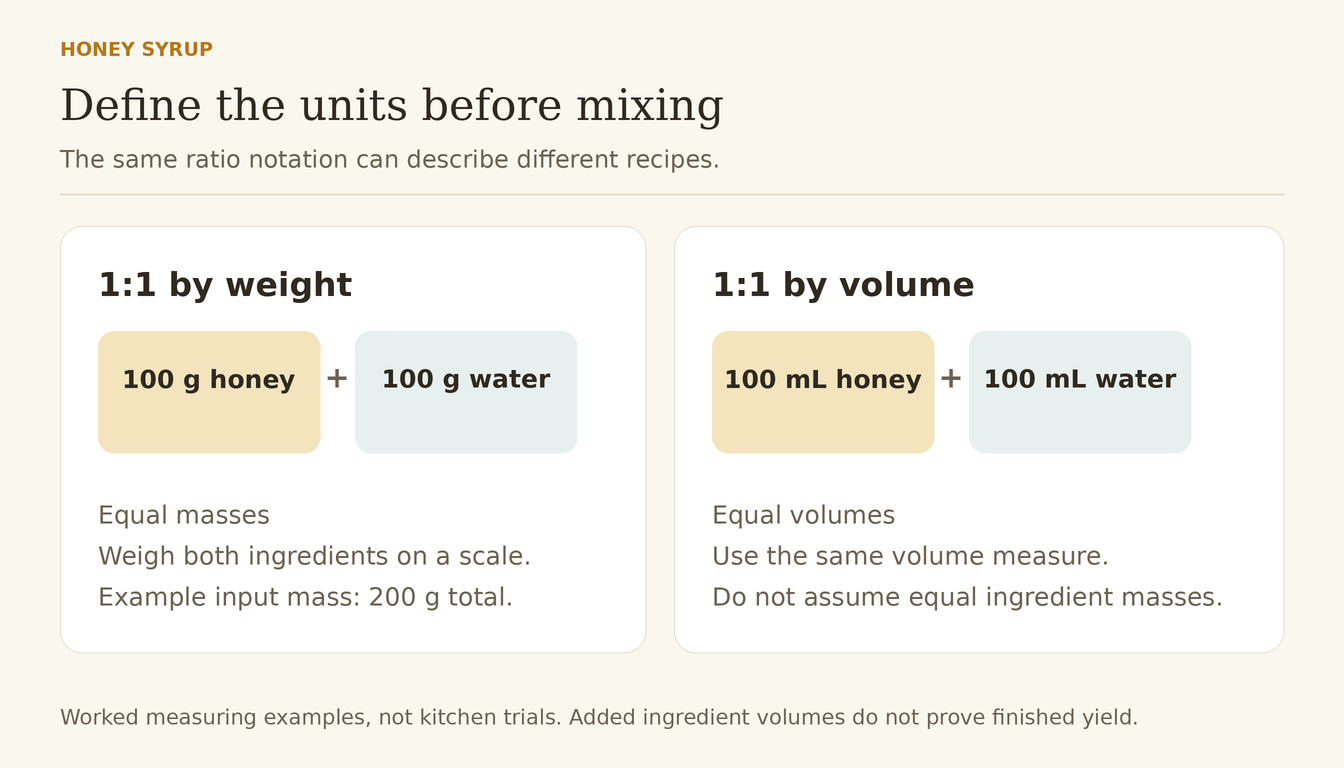
A scale gives you another formula: 100 g honey plus 100 g water is 1:1 by mass. That is a different mixture from 100 mL honey plus 100 mL water. Decide which one you mean before measuring, then use it consistently.
This guide covers plain honey and water for coffee, cocktails and other drinks. Fruit and vinegar belong to a different preparation; use the honey shrub guide for that ingredient.
Why 1:1 by Weight Is Different from 1:1 by Volume
Here, the first number always means honey and the second means added water. Grams measure mass; milliliters, cups and fluid ounces measure volume. A ratio needs both its order and its measurement basis. “Equal parts” alone leaves room for two people to make different syrups.
Honey is denser than water, so the same volume of honey weighs more. The Sioux Honey cooperative’s measuring explanation makes this distinction between fluid ounces and ounces of weight. An equal-volume honey syrup therefore contains more honey by ingredient mass than an equal-mass syrup. A bottle marked with a net weight in ounces does not tell you that many fluid ounces of honey are inside.
The comparison below is an explanatory illustration, not a record of a kitchen trial. It deliberately leaves the masses of the two 100 mL portions unspecified. You can measure those masses for your own honey instead of treating a conversion factor as exact for every jar.
- 1:1 by mass: 100 g honey + 100 g water. The honey ingredient is half of the 200 g nominal ingredient mass.
- 1:1 by volume: 100 mL honey + 100 mL water. The ingredient volumes are equal, but their masses are unequal.
- The 200 mL sum of those ingredient measures is not a verified finished syrup volume. Measure the combined syrup if you need its actual yield.
- A mixed instruction such as “100 g honey + 100 mL water” needs an explicit conversion before you call it a mass or volume ratio.
Get the Honey Buyer's Cheat Sheet (free PDF)
16 varieties on one page — color, flavor, best use and what a fair price looks like — from the 268 honeys we track.
Make the Basic Equal-Volume Syrup
Nate’s specifies warm water and stirring until the honey dissolves. The Honey Syrup section on page 68 of the Fords Gin batching guide uses very hot water, the same measuring cup for both ingredients, and thorough mixing. Both are equal-volume recipes; their water-temperature instructions differ.
For the warm-water approach, use a clean mixing jug, a liquid measuring cup, a spoon or spatula, and a clean bottle with a lid. Cup sizes can vary; using the same cup and fill line for both ingredients preserves the equal-volume ratio.
- 1. Measure the water: use 100 mL warm water for a small batch, or another chosen volume. Pour it into the mixing jug.
- 2. Measure the honey: fill the measuring cup to the same volume line. Add it to the water, scraping the cup thoroughly.
- 3. Stir: work the mixture until there are no thick honey streaks on the bottom or sides. Do not stop while honey remains stuck to the spoon.
- 4. Check the transfer: use a little of the already measured mixture to rinse honey from the cup if necessary. Adding an extra splash of water changes the formula.
- 5. Bottle and label: allow the syrup to cool, transfer it, and label the honey, ratio, units and preparation date. Refrigerate with the lid on.
Pro Tip
Warm water is the instruction in the Nate’s method. You do not need to invent a precise temperature cutoff to follow it; stirring and complete ingredient transfer are the practical checks.
Use a Scale for a Repeatable Small Batch
If you want to work entirely in grams, choose a mass-based formula explicitly. A 1:1 batch is simple to scale: the water mass equals the honey mass. It is not a gram conversion of the cup-based recipe above, because that recipe uses equal volumes.
Put the mixing jug on a kitchen scale, select grams and tare it to zero. Add the chosen honey mass. Tare again, then add the same mass of warm water. Stir thoroughly and transfer to a clean bottle. Weighing into the mixing jug avoids leaving part of the measured honey in a separate cup. Keep the scale away from spills and use a jug within its capacity.
Here is a small bottle example: 120 g honey plus 120 g water gives 240 g of nominal ingredients. Write “1:1 by mass; 120 g honey + 120 g water” on the label. The calculation does not predict 240 mL of syrup, or prove how much remains after transfer. Leave room in the bottle and measure the actual result if capacity matters.
- Smaller formula: 60 g honey + 60 g water = 120 g nominal ingredient mass.
- Larger formula: 180 g honey + 180 g water = 360 g nominal ingredient mass.
- Scaling rule: multiply both ingredient masses by the same factor. Doubling only the honey changes the concentration.
Pro Tip
“Half honey by ingredient mass” does not mean “half sugar.” Honey already contains water and other components; these calculations track the honey ingredient and the water you add.
Turn Your Favorite Cup Batch into a Gram Formula
You can keep an equal-volume recipe and make future batches with a scale. Measure the chosen volume of honey and record its mass; separately measure the same volume of water and record its mass. Use a tared container for each weighing. Those two measurements describe your cup-based batch in grams without changing it into an equal-mass recipe.
For example, suppose your measurements were 140 g honey and 100 g water. These are hypothetical numbers for explaining the calculation, not measurements performed for this article or a universal density conversion. Your recorded formula would be 140:100 by mass, simplified to 1.4:1. For a batch 60% as large, multiply both numbers by 0.6: use 84 g honey and 60 g water.
More generally, if your measured equal-volume portions weigh H grams of honey and W grams of water, the water needed for a chosen honey mass is honey mass × W ÷ H. Keep the original measurements with the recipe. If you change the honey or want tighter repeatability, measure the equal-volume portions again rather than silently reusing the example numbers.
Mix It into Coffee Before Adding Ice
The practical benefit of syrup is that the honey is already dispersed in water. Fords describes the problem with honey left on a spoon or mixing vessel, especially when the drink is cold. Premixing reduces that handling problem; it does not create a universal dose for every coffee or cocktail.
For iced coffee, add a measured amount of syrup to the coffee, stir, then add milk and ice as desired. Taste after the drink is assembled. Record the coffee quantity, milk quantity and syrup measure if you want to repeat it. Start with a modest amount and add more in small measured increments; different drink sizes and honey choices make a fixed sweetness recommendation unreliable.
For hot coffee, you can dissolve honey directly if that is more convenient. Keeping syrup ready is useful when you want the same measured ingredient for both hot and iced drinks.
Count the water in the syrup as part of the drink. An equal-volume syrup and an equal-mass syrup will not deliver the same honey amount in an identical pour. Keep your syrup formula constant while adjusting the coffee, then change one variable at a time if you want a different result.
Change Cocktail Concentration with the Whole Drink in Mind
A cocktail instruction that says “honey syrup” should ideally identify its formula. Before following it, check whether the author means equal volumes, equal masses or a richer syrup. Use the honey cocktails guide for drinks and pairing ideas; this page supplies the measuring logic for the syrup ingredient.
Richer honey formulas can be described mathematically without presenting them as tested recipes. A 2:1 by-mass alternative means 120 g honey plus 60 g water. A 3:1 by-mass alternative means 120 g honey plus 40 g water. Neither is the equal-volume method cited above. Fords also has a separate 2:1 Rich Simple Syrup section made with sugar; that sugar recipe is not evidence for a 2:1 honey formula.
Do not automatically halve a cocktail’s syrup measure when moving from 1:1 to 2:1. The numbers compare honey with water, rather than saying the finished syrup is twice as concentrated. The arithmetic below tracks ingredient masses and assumes complete, uniform mixing. It does not predict sweetness perception or convert grams of syrup into a jigger volume.
- 20 g of a 1:1 by-mass syrup contains 10 g honey ingredient and 10 g added water.
- 15 g of a 2:1 by-mass syrup contains the same 10 g honey ingredient, plus 5 g added water.
- For that specific substitution, a further 5 g water preserves both ingredient amounts. Using only 10 g of the richer syrup would reduce the honey amount.
Pro Tip
Changing the syrup also changes the water delivered to a drink. Taste the complete drink with its normal ice or dilution, and write down the revised formula.
Measure Finished Yield and Refrigerate the Bottle
Ingredient measures are a starting formula, not a measured bottle yield. If you need to fill a particular container, first prepare the syrup, let it cool and read its actual volume in a measuring jug. Record that separately from the honey and water quantities. Syrup left on tools or spilled during transfer also affects what reaches the bottle.
Fords recommends storing cooled honey syrup in the refrigerator with the lid on. Follow that storage direction rather than extending the pantry-storage habits you use for undiluted honey to a water-diluted mixture. Make a manageable batch, use clean utensils and keep the preparation date visible.
The cited recipes do not establish a universal safe refrigerator lifetime for every homemade honey syrup. A number of weeks printed elsewhere is not a guarantee for your concentration, container, handling and refrigerator. This guide therefore does not assign an expiry date or treat an added splash of alcohol as a validated preservation method.
If honey remains as a thick layer immediately after preparation, finish mixing before judging the formula. If your starting honey has crystals, make sure they dissolve fully instead of assuming a quick stir is enough. For the jar itself, the honey crystallization guide explains that change in texture; crystallization does not establish the storage condition or safety of a diluted syrup.
Choose the Honey After You Have a Consistent Formula
Use the same honey for your first few batches to keep flavor and concentration changes separate. Then compare another honey using the same formula and drink. Note the honey label and amount poured.
The best honey for cocktails guide covers variety selection, while the cocktail hub covers the drinks. A useful syrup record is much shorter: what honey you used, how much water you added, whether those measurements were mass or volume, and what worked in the finished glass.