The Yerba Mate Paradox: Third-Largest Exporter, Zero Honey Brand
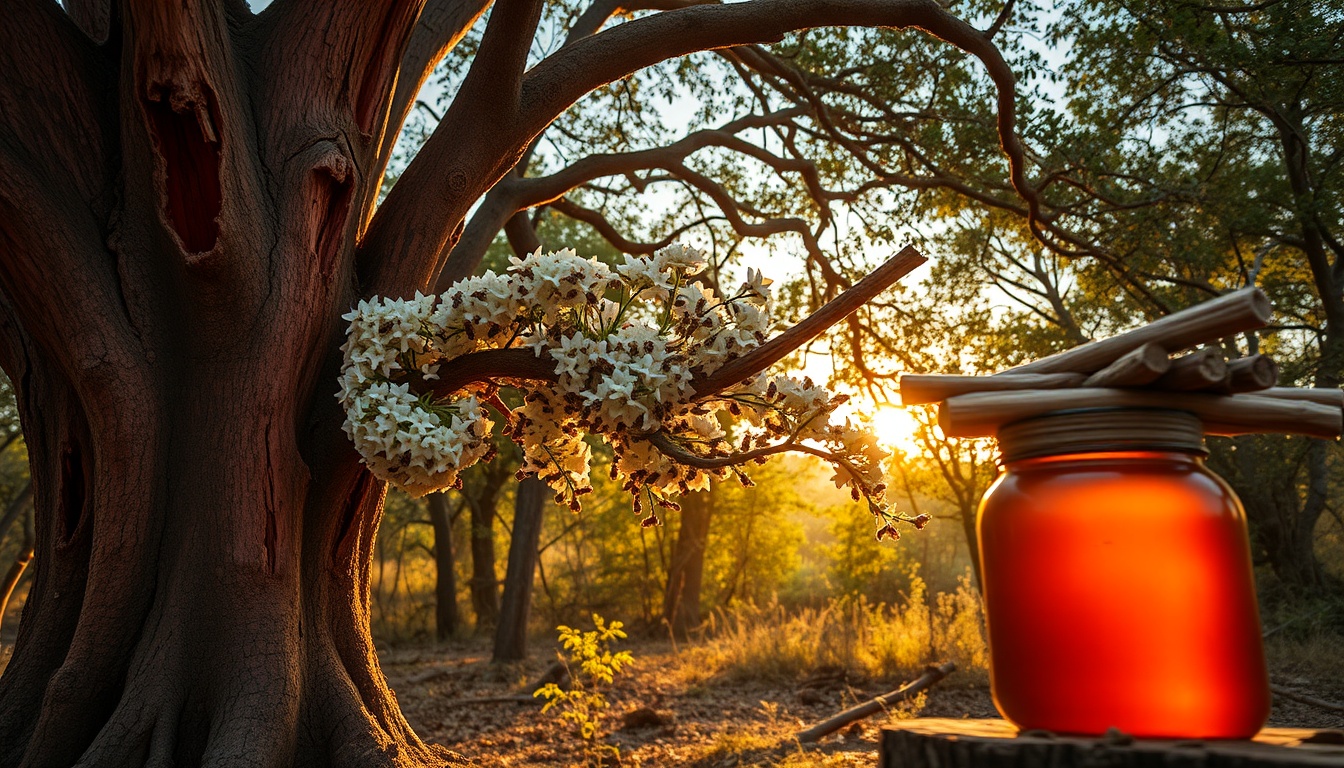
Paraguay exports 100,000–120,000 tonnes of yerba mate per year — making it the world's third-largest exporter of the stimulant tea, after Brazil and Argentina. The cultivation is concentrated in the Amambay and Canindeyú departments of eastern Paraguay, where the subtropical climate and red basalt soils of the Paranaense Atlantic Forest support Ilex paraguariensis cultivation at scales that stretch into the Brazilian states of Paraná, Santa Catarina, and Rio Grande do Sul. The plant blooms each September and October with small white, four-petaled flowers that are fragrant, accessible to Apis mellifera, and produce nectar in significant quantities.
Yerba mate belongs to the same genus as holly (Ilex aquifolium), and like holly, its honey carries a mild, herbal, slightly bitter character distinct from most commercial varieties. In the mountain regions of southern Brazil where yerba mate grows wild in the Atlantic Forest understory, beekeepers sometimes describe their autumn honey as 'erva-mate dominant' — pale amber, clean, with a herbal freshness and none of the bitterness of the dried leaf. In Paraguay's cultivated zones, the September bloom coincides with the beginning of Paraguay's spring honey flow, blending with guayaba (Psidium guajava), citrus, and pasture wildflowers.
The paradox: not one Paraguayan producer has ever labelled or marketed a varietal yerba mate honey. The plant's commercial identity is entirely about leaves — dried, aged, sometimes smoked, consumed in a gourd with a metal straw. The honey opportunity is structurally identical to the coffee-blossom gap elsewhere in the cluster: the plant is commercially significant, the flowers are bee-accessible, and no branded product exists for the honey from those flowers. For Paraguay, a country that urgently needs export diversification beyond soy and yerba mate commodities, a positioned yerba mate honey would be a natural next step. It has not happened.
Three Honey Zones: Eastern Paraguay, the Gran Chaco, and the Pantanal Fringe
Paraguay's territory divides into two dramatically different landscapes separated by the Río Paraguay, producing honey with almost nothing in common between the two sides of the country.
The Región Oriental — east of the Río Paraguay, roughly 40% of national territory but 97% of the population — is where almost all commercial honey is produced. This region was originally subtropical Atlantic Forest (Bosque Atlántico del Alto Paraná), one of the most biodiverse forests on Earth before agricultural expansion reduced it to less than 10% of its historical cover. What remains, plus the forest patches, farm borders, fruit orchards, and planted exotic species of the region, supports beekeeping across Amambay, Canindeyú, Caazapá, and Caaguazú departments. Key honey plants: yerba mate (September–October), guayaba (Psidium guajava, year-round in tropical conditions), citrus (August–September), eucalyptus (introduced, December–January), tung oil tree (Aleurites fordii, October–November, a significant honey plant in some years), and diverse wildflower pasture species.
The Gran Chaco — west of the Río Paraguay, approximately 60% of national territory — is one of the world's largest subtropical dry forests, extending through western Paraguay into Bolivia and northern Argentina. The Chaco is thinly populated (Boquerón, Alto Paraguay, and Presidente Hayes departments together have fewer than 200,000 inhabitants), roadless in much of its extent, and produces honey under conditions so extreme — summer temperatures exceeding 45°C, seasonal floods followed by total drought — that most commercial beekeeping is impractical. What honey does emerge from the Chaco is collected by Mennonite communities in the central Chaco (who maintain Apis mellifera colonies) and by indigenous Enxet, Nivaclé, and Ayoreo communities who harvest wild honey and traditional ysapé stingless bee honey. Chaco honey sources: quebracho colorado (Schinopsis balansae, November–December), algarrobo negro (Prosopis nigra, May–June), lapacho rosado (Handroanthus impetiginosus, July–August), palo borracho/toborochi (Ceiba speciosa, March–May), and diverse leguminous shrub species during the brief wet-season flowering period.
The Pantanal fringe — a narrow strip of northeastern Paraguay where the Río Apa and Río Negro converge with the Brazilian Pantanal — supports a small zone of seasonal flooded-savanna honey collecting. Moriche palm (Mauritia flexuosa) honey is collected in this area after dry-season flood recession, similar to the pattern documented in Venezuela's Llanos. This is the least commercially developed of Paraguay's three zones.
Get the Honey Buyer's Cheat Sheet (free PDF)
16 varieties on one page — color, flavor, best use and what a fair price looks like — from the 304 honeys we track.
Quebracho Colorado: The Iron Wood Honey of the Gran Chaco
Quebracho colorado (Schinopsis balansae) is the defining tree of Paraguay's eastern Chaco and transitional zones. Its name derives from the Spanish 'quebra hacha' — 'axe-breaker' — because the wood is among the densest and hardest in South America, historically used for railway sleepers, fence posts, and as a tannin source for the leather industry. The tannin extraction industry, which operated large quebracho mills (obrajes) in the Paraguayan and Argentine Chaco through the early twentieth century, was one of the first export industries in the region — preceding even yerba mate in international significance.
The quebracho tree flowers each November and December with small, fragrant clusters of white-yellow blooms. In areas where intact Chaco forest remains — particularly in the transitional zone between the Región Oriental and the dry Chaco, and in protected areas like the Ñeembucú wetlands and the Chaco National Park — quebracho honey is collected in small quantities. The honey is characteristically deep reddish-amber, with a resinous-woody aromatic profile that reflects the plant's high tannin content. It is not typically bitter (tannins do not transfer to honey in the same way they transfer to tannin-extracted water), but has a complex, earthy-spiced character that differs from any standard monofloral.
Algarrobo negro (Prosopis nigra) — the black carob tree of the Chaco — produces a second significant honey flow in May and June, during the early dry season. Prosopis honey is pale amber, with a caramel-sweet character reminiscent of mesquite honey from the American Southwest (which comes from the related Prosopis velutina). In the Mennonite colonies of the central Chaco, algarrobo is the primary commercial honey crop, and algarrobo honey is sold locally under artisan labels. This is possibly the most accessible authentic Chaco honey available to visitors to the region.
Lapacho rosado (Handroanthus impetiginosus) — the pink ipê, Paraguay's national tree — blooms July and August with spectacular rose-pink flowers before its leaves emerge. Lapacho honey, where it exists, is rare and highly local: the tree flowers during the cold dry season when bee populations may be at low points, and the spectacular bloom is more visible than productive from a honey perspective. Nevertheless, lapacho honey is noted in the artisan sector as an early-spring delicacy with a floral, lightly sweet character.
Ysapé: The Guaraní Stingless Bee and Indigenous Meliponicultura
The Guaraní name for stingless bees — 'ysapé' (sometimes written 'isapé', 'ysabeí', or 'jateí' in different dialects and regions) — refers primarily to Tetragonisca fiebrigi, a small stingless bee species endemic to the Gran Chaco region of Paraguay, northern Argentina (Formosa, Chaco, Corrientes), and adjacent parts of Brazil. Tetragonisca fiebrigi is closely related to T. angustula (the most common Meliponini species in Latin America) but differs in nesting ecology, colony size, and the chemical profile of its pot-honey. It builds the same characteristic tubular wax entrance tube as T. angustula — a narrow cylinder projecting from a tree hollow — but its colonies are somewhat smaller and adapted to the greater temperature extremes of the Chaco environment.
Guaraní communities have maintained ysapé honey traditions for centuries before Spanish contact. The traditional management system uses split log hive sections — sealed at both ends, with a small entrance hole — stored in shaded conditions near the home. Honey is harvested by opening the log, removing mature honey pots (which look like small wax spheres filled with honey), and resealing the hive. Yields are small — typically 1–3 kg per colony per year under traditional management — but the honey has distinctive properties: higher water content than Apis honey (typically 25–35% moisture), more acidic (pH 3.2–3.8), rich in lactic acid from fermentation processes in the pot, and with a fruity-sour complexity that differs from any Apis varietal.
The role of Paraguay as a Guaraní-speaking country gives ysapé a cultural authenticity marker that most stingless bee honey traditions lack: Guaraní is not a heritage language spoken only in ceremonies — it is the daily language of the majority of Paraguayans, including in urban Asunción. When a Paraguayan beekeeper speaks of 'ysapé', they are using a word that has existed in the region for at least several centuries of recorded Guaraní linguistic history, embedded in a broader taxonomy of bee species (ysapé for small stingless bees, jateí for Melipona, tatú honey bee for Apis, depending on regional Guaraní variant). This linguistic grounding is unusual among Meliponini honey traditions — most have been significantly disrupted or carried only in older generations.
Commercial interest in ysapé honey remains minimal: the small yield, high moisture content (which creates fermentation challenges for storage), and remoteness of most ysapé beekeeping from urban markets have prevented the kind of artisan-market development seen with kelulut honey in Malaysia or Jataí honey in Brazil's São Paulo state. Paraguay has no national Meliponini honey standard equivalent to Brazil's MAPA IN 11/2020. SENAVE (the national agricultural authority) regulates ysapé honey under general honey standards that were written for Apis — applying those moisture limits strictly would declare nearly all traditional ysapé pot-honey non-compliant, creating a regulatory grey area that the small artisan sector navigates informally.
SENAVE Standards, EU Approval, and the Export Pipeline
Paraguay's honey is regulated by SENAVE (Servicio Nacional de Calidad y Sanidad Vegetal y de Semillas) under Norma Paraguaya NP 1-51:2013. The standard aligns broadly with Codex Alimentarius honey standards, including moisture limits (≤20% for Apis honey) and HMF limits (≤60 mg/kg for general honey). Paraguay was approved as a honey-exporting country to the European Union under Regulation (EU) 2020/1489 — giving Paraguayan honey the same import eligibility as Brazil, Argentina, and Uruguay. In practice, most Paraguayan honey exports are purchased by packing houses that blend product before shipping to Germany, the Netherlands, and the United States. The consumer sees only 'South American honey blend' or the packing country of origin.
Paraguay produces approximately 8,000–12,000 tonnes of honey per year, depending on season — a production scale that makes it a mid-tier producer in South American context, significantly smaller than Argentina (80,000+ tonnes) and Brazil (60,000+ tonnes) but comparable to Uruguay and Chile. The major producing departments are San Pedro, Caaguazú, Concepción, and Amambay in the Región Oriental. A small but growing artisan sector operates in Asunción and in tourist zones, where monofloral or origin-specific honey is sold in specialty food stores and at the Mercado Municipal de Abasto.
The structural challenge for Paraguayan honey development is the same as for most South American origins: the established bulk export pipeline captures production before any branding infrastructure can form. A producer who invests in varietal characterization (pollen analysis, chemical fingerprinting, sensory profile description) has no guarantee that buyers will pay a premium that covers that investment when the same product can be sold immediately at commodity bulk prices. The yerba mate honey opportunity requires a producer willing to operate outside the bulk pipeline entirely — harvesting during the September–October yerba mate bloom, extracting separately, and developing a retail identity in domestic specialty markets before attempting international export. That producer does not yet exist at commercial scale.
Finding Authentic Paraguayan Honey
Authentic Paraguayan honey is most reliably found in Paraguay itself, through the domestic artisan market. The Mercado Municipal de Abasto in Asunción stocks honey from Paraguayan beekeepers, including some that note regional origin. The Mennonite colonies in Filadelfia, Neuland, and Loma Plata in the central Chaco operate cooperatives that sell algarrobo and Chaco wildflower honey locally and occasionally through organic food channels in Asunción. The Cámara Paraguaya de Apicultores (CAPA) maintains a directory of member producers.
Outside Paraguay, Paraguayan honey is rarely available with national origin identification. A buyer purchasing 'South American honey' from a German discount retailer may be buying Paraguayan product — but the blend prevents any origin story from reaching the consumer. The primary export markets that might develop a Paraguayan origin identity are the US and EU organic specialty channels, where a limited number of Paraguayan beekeepers hold EU organic certification and could in theory market certified-origin product directly. This has not scaled.
Ysapé honey specifically is essentially unavailable outside Paraguay's interior communities. The honey is consumed locally, given as gifts, or sold at roadside stands in indigenous community areas of the eastern Chaco and Amambay department. For travellers interested in experiencing ysapé honey, the most reliable access point is through eco-tourism operators in the Ybycuí National Park area or in the Mbaracayú Biosphere Reserve — areas where Guaraní communities maintain traditional meliponicultura and welcome visitors as part of community-based tourism programs.