The Altiplano Nation: Three Vertical Honey Worlds
Bolivia is a landlocked country in the heart of South America — the geographic centre of the continent and, by altitude variation, one of its most vertically extreme. The country spans from the Amazon basin in the north and east (at roughly 150–500 metres above sea level) to the Altiplano, a vast high-plateau averaging 3,750 metres and stretching from La Paz south to the Bolivian-Argentine border, flanked by two parallel cordilleras of the Andes. This vertical span of more than 4,000 metres is reflected directly in Bolivia's honey diversity: altitude, rainfall, and temperature change so dramatically across Bolivia's ecoregions that the honey produced in Beni department (humid Amazonian savannah, 200m) has essentially nothing in common with the honey produced in Oruro or Potosí departments on the high Altiplano plateau (3,800–4,200m), and neither resembles the Yungas cloud forest honey produced in the mountain-valley transition zone between them (800–3,200m).
Bolivia is also the world's context for one of honey's most unexpected connections to the global food industry. The Altiplano plateau — specifically the departments of Oruro, Potosí, and La Paz — is the geographic origin of Chenopodium quinoa, the grain crop that drove a global superfood boom in the 2010s. Bolivia supplies approximately 40–50% of world quinoa production (competing primarily with Peru), and the quinoa fields of the Altiplano are also, during flowering season, a commercial nectar source for Altiplano apiaries. Quinoa flower honey — miel de flor de quinua — is Bolivia's most botanically specific specialty, linking the country's honey industry to the same Andean agricultural heritage that made it famous as a food-export nation.
For context with the broader South American honey cluster, see guides to Peruvian honey, Ecuadorian honey, Colombian honey, Brazilian honey, Argentine honey, Chilean honey, and the World Honey Guide.
Altiplano Wildflower and Quinoa Flower Honey: The World's Highest Apiaries
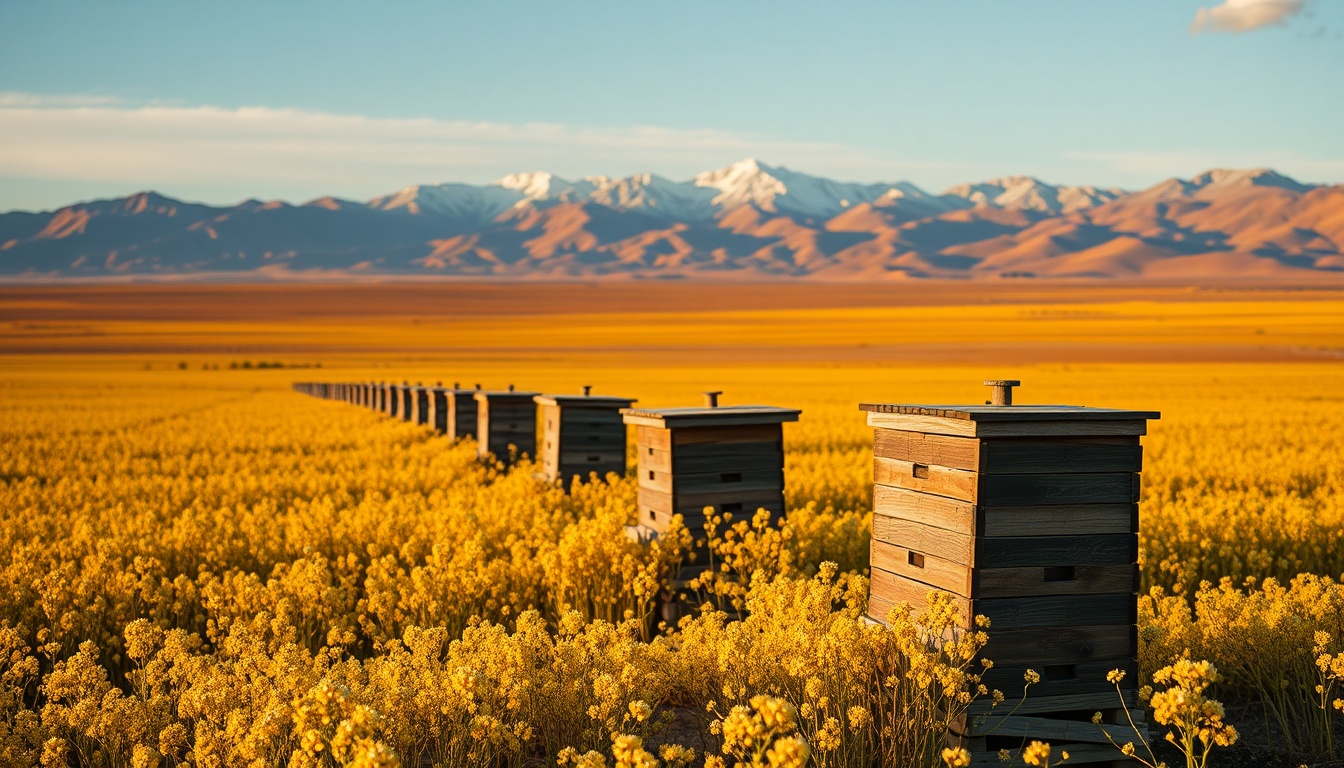
The Bolivian Altiplano is one of the world's highest permanently inhabited plateaus and one of very few places on Earth where commercial apiculture operates above 3,800 metres. At this altitude, the challenges for beekeeping are significant: lower atmospheric oxygen, intense UV radiation at high angle, strong seasonal winds off the cordilleras, and a compressed flowering season driven by the Altiplano's pronounced wet-dry cycle (November–March wet season; April–October dry season). The bees that have adapted to these conditions — primarily Apis mellifera ligustica colonies managed by Andean communities and small commercial operations in the La Paz altiplano, Oruro, and Potosí departments — are more robust cold-weather foragers than standard commercial strains, reflecting decades of high-altitude selection. Some areas of the Bolivian altiplano border zone with Chile and Peru have small feral Africanised honey bee populations, though managed operations use European-strain colonies.
The primary nectar sources of the Altiplano are native Andean plants that have adapted to the plateau's harsh conditions. Muña (Minthostachys mollis), a native Andean mint relative with intense menthol and camphor aromatics, is among the most important honey plants of the Bolivian highland and contributes a strongly aromatic, slightly medicinal character to plateau honey. Salvia haenkei (Andean sage), various Asteraceae (the daisy family dominates at high altitudes globally), native Fabaceae shrubs, Brassica species (cultivated oil crops that have expanded into highland farmland edges), and scattered Polylepis trees (the world's highest-altitude trees, found at 4,000–4,500m) contribute to the Altiplano wildflower palette. The result is a medium-to-dark amber honey with a distinctive herbal-aromatic profile unlike any European or temperate wildflower.
Quinoa flower honey (miel de flor de quinua) is produced when apiaries are placed near Chenopodium quinoa fields during the November–February flowering season. Quinoa is an unusual honey plant: its small, wind-assisted and insect-pollinated flowers produce modest nectar quantities relative to species like lavender or linden, but the scale of Bolivian quinoa cultivation (3,000–6,000 km² in the Oruro-Potosí Altiplano, peaking around 2014–2015 at the height of the global quinoa boom) makes it a significant bulk nectar source for Altiplano apiaries. Honey from areas with high quinoa cultivation density is typically labelled 'altiplano wildflower' rather than monofloral quinoa — confirmed monofloral quinoa honey requires pollen analysis and a harvest timed specifically to the quinoa bloom window, making it a specialty product of small cooperatives rather than commercial operations.
The Salar de Uyuni itself — the world's largest salt flat at 10,582 km², located in the southwest Potosí department at 3,656m — produces no honey. The salt flat is an inhospitable landscape of crystallised salt and brine, essentially devoid of flowering plants in its interior. The surrounding quebrada (ravine) and pre-puna vegetation on the salt flat's margins and the adjacent Eduardo Avaroa National Reserve support sparse highland flora, but apiculture is not practised within the Salar's immediate ecological zone. The connection between Bolivia's quinoa honey and the Salar de Uyuni is geographical and reputational rather than botanical — the same Potosí and Oruro departments that surround the Salar are Bolivia's primary quinoa-and-honey-producing territory.
Pro Tip
When sourcing Bolivian Altiplano honey, look for labels citing Oruro, Potosí, or La Paz department with altitude above 3,000m. 'Miel de altiplano' is the generic label; 'miel de flor de quinua' indicates proximity to quinoa cultivation. Muña-dominant honey from the Bolivian highlands is identifiable by its intense menthol-herbal aroma — unlike any other Andean wildflower honey.
Get the Honey Buyer's Cheat Sheet (free PDF)
16 varieties on one page — color, flavor, best use and what a fair price looks like — from the 304 honeys we track.
Yungas Cloud Forest: Bolivia's Coffee Belt and its Honey
Between the Altiplano plateau and the Amazon lowlands lies one of Bolivia's most ecologically rich transitions: the Yungas, a subtropical cloud-forest zone in the eastern Andean cordillera of La Paz department, descending from roughly 3,000m at the cloud forest upper edge to 800m where it merges into the pre-Amazonian lowlands. The Yungas are famous in Bolivia for two things: the so-called 'Death Road' (Camino de los Yungas, now primarily a mountain-bike tourist route) descending from La Cumbre pass into Coroico, and the Caranavi district — Bolivia's primary specialty coffee-growing region, producing Coffea arabica at 1,200–1,700m altitude in the Nord and Sud Yungas provinces.
Yungas honey reflects the extraordinary botanical diversity of cloud forest ecosystems at this elevation. The primary wild nectar sources include native Melastomataceae (a diverse pantropical plant family with strong bee-attractive flowers), Ericaceae (highland blueberry relatives), native Lauraceae (avocado family relatives), various Passifloraceae (passion fruit and its relatives), native Rubiaceae (coffee family wild relatives), and dozens of endemic shrub species that are found only in the eastern Bolivian cordillera. The honey is typically medium amber to amber, moderately complex, with fruity-floral notes that reflect the cloud forest's botanical richness. At the higher Yungas elevations (2,000–3,000m), the honey takes on characteristics intermediate between the herbal Altiplano wildflower and the fruity-floral lower Yungas.
Coffee blossom honey from the Caranavi district (Nord Yungas, La Paz department) is Bolivia's closest equivalent to Peru's Chanchamayo coffee blossom honey or Colombia's miel de flor de café. Coffea arabica flowers in the Yungas from June to September (Bolivia's dry season), producing fragrant white blooms with a characteristic jasmine-linalool aroma that translates to the honey as a pale-to-light amber, delicate, mildly floral product. Bolivia's specialty coffee sector has grown significantly in the past decade — Caranavi coffees have appeared in Cup of Excellence competitions — but the parallel coffee blossom honey sector is essentially undeveloped. Almost no Bolivian coffee blossom honey is labelled or marketed as such; it enters the bulk wildflower honey stream. The commercial opportunity mirrors the unfulfilled potential of Peruvian and Colombian coffee blossom honey.
Pro Tip
Yungas honey from the Caranavi district (La Paz department) is the best entry point for finding Bolivian cloud forest honey. Look for labelling indicating 'Yungas', 'Norte de La Paz', or 'Caranavi' at altitudes of 1,000–2,000m. Coffee blossom honey is rarely labelled as such — if visiting Bolivia, La Paz specialty food stores (particularly in the Sopocachi and Miraflores districts) stock labelled regional honeys from small Yungas cooperatives.
Amazon and Chaco Lowlands: Meliponini Stingless Bee Traditions
Bolivia's Amazon and Chaco lowlands — the departments of Beni, Pando, and the Amazonian portions of Santa Cruz — are home to a significant Meliponini stingless bee diversity and traditional honey production. The Beni department, a vast lowland savannah and gallery forest system in northeastern Bolivia, has documented Meliponini traditions among several indigenous communities including the Moxeño (Mojeño), Sirionó, and Tsimane peoples. The Amazonian portions of Pando (Bolivia's smallest and most forested department, bordering Brazil and Peru) have the highest stingless bee species density, reflecting the Amazon basin biodiversity pattern familiar from Brazil and Peru.
The most significant managed stingless bee species in Bolivian lowland meliponicultura are Scaptotrigona species (several, known locally as 'abeja lechiguana' or 'lechiguana'), Tetragonisca angustula ('angelita'), Melipona species (several, collectively known as 'abeja real' or 'abeja del monte' depending on local tradition), and various Trigona and Nannotrigona species. The honey produced by these species shares the characteristics of tropical Meliponini honey globally: high moisture content (25–35%), strongly acidic pH (3.0–4.5), complex organic acid profiles including lactic and gluconic acids, and a sour-sweet-fruity flavour profile completely unlike Apis honey. It does not crystallise and requires refrigeration after opening.
The Santa Cruz department — Bolivia's most economically productive lowland region — has a growing commercial beekeeping sector alongside its stingless bee traditions. The transition zone between the Santa Cruz agricultural lowlands and the Chiquitanía (the dry Chiquitano forest ecosystem, a globally significant dry tropical forest biome) supports Apis mellifera honey production from native Chiquitano woodland species: Cariniana estrellensis (the 'cuta' tree), various Leguminosae of the dry forest, and seasonal wildflower species from the Gran Pantanal extensions in eastern Santa Cruz department. Pantanal honey from the seasonally flooded lowlands of eastern Bolivia — particularly from gallery forest species and the diverse Pantanal flora — is an underexplored specialty.
Pro Tip
Bolivian Amazon Meliponini honey is rarely found outside Bolivia itself. In Santa Cruz de la Sierra and Trinidad (Beni), specialty food stores and indigenous cooperative storefronts carry stingless bee honey. Look for 'miel de lechiguana', 'miel de angelita', or 'miel de abeja del monte' as labels indicating stingless bee origin. Always refrigerate after opening; the high moisture content means unrefrigerated Meliponini honey ferments within days.
SENASAG, IBNORCA NB 184 and Bolivia's Honey Regulation
Honey regulation in Bolivia is divided between two institutions. SENASAG (Servicio Nacional de Sanidad Agropecuaria e Inocuidad Alimentaria), under the Ministry of Rural Development and Land (Ministerio de Desarrollo Rural y Tierras — MDRyT), is the national food safety authority responsible for apiculture oversight, disease management, and export certification. IBNORCA (Instituto Boliviano de Normalización y Calidad) is the national standards body that maintains the technical honey standard NB 184:2013, last revised in 2013 and aligned with the Codex Alimentarius General Standard for Honey (CXS 12-1981 as revised).
NB 184:2013 specifies parameters for Apis honey: moisture content (≤20% for standard honey; ≤23% for baker's honey), HMF (hydroxymethylfurfural, ≤40 mg/kg standard, ≤80 mg/kg for tropical-origin declaration — a Codex-parallel tropical tolerance), diastase activity (≥8 Schade units, with ≤3 acceptable for naturally low-diastase honeys accompanied by HMF confirmation), sucrose content (≤5%, ≤10% for certain specific floral sources), and water-insoluble solids (≤0.1%). Like Colombia, Peru, Ecuador, and the Philippines, Bolivia's standard NB 184 addresses only Apis honey; there is no dedicated Bolivian technical standard for Meliponini stingless bee honey. The same regulatory gap that exists across Latin America is present in Bolivia.
Bolivia's honey export sector is very small relative to its production capacity. Official SENASAG and UN Comtrade data show annual export volumes typically below 500 metric tonnes — negligible compared to Argentina's 70,000–80,000 MT or even Peru's 2,000–3,000 MT. Most Bolivian honey enters the domestic market: La Paz, Cochabamba, Santa Cruz, and Sucre all have active local honey markets where regional varieties from La Paz Yungas, Oruro Altiplano, and Santa Cruz lowlands are sold alongside informally imported Argentine honey. The MDRyT has supported apiculture development through cooperative extension programmes (FUNDE-APICULTURA and PROBOL have been active in beekeeping capacity building), but Bolivia's honey industry remains structurally domestic-focused. Unlike Peru or Ecuador, Bolivia has not developed an organic export certification cluster comparable to what Peru's Junín cooperatives or Ecuador's MAGAP organic programme achieved.
How to Buy Bolivian Honey — Authentic Sources and What to Look For
Within Bolivia, the best sources for authentic, labelled regional honey are La Paz's artisan and organic markets: the Mercado Lanza, the organic sections of the Mercado Sopocachi, and the Feria Ecológica in the Calle Colón area carry highland and Yungas honey from small producers. In Cochabamba (Bolivia's food capital, at 2,570m altitude — the zone where Yungas climate and highland flora overlap), the Cancha market and the organic-food sector of Villa Pagador and Zone Sur have consistent honey suppliers. In Santa Cruz de la Sierra (the lowland commercial capital), the Mercado Los Pozos and specialty food stores in the Equipetrol and Urbarí districts stock both Santa Cruz lowland honey and sometimes imported highland varieties. Stingless bee honey is most consistently available in Trinidad (Beni department), where Meliponini traditions are strongest.
Internationally, Bolivian honey is almost impossible to find labelled as such. Bolivia has no internationally recognised branded honey category — no equivalent to Peru's growing specialty coffee connection, Ecuador's organic bulk, or Argentina's bulk commodity exports. A small number of European and North American fair-trade importers occasionally carry Bolivian honey (look for WFTO or FLO/Fairtrade certification combined with Bolivian origin on the label), but these are rare. For travellers to Bolivia, carrying back a jar of Oruro Altiplano wildflower or La Paz Yungas honey is the most reliable path. Bolivian honey sold in Andean cultural import stores in North America or Europe is typically undifferentiated South American origin and should be treated as such rather than authentic single-origin Bolivian product.
Pro Tip
The most reliable authenticity signal for Bolivian honey internationally is FLO/Fairtrade or WFTO certification explicitly naming Bolivia as the country of origin. Within Bolivia, look for labels citing department (La Paz, Oruro, Potosí for Altiplano; La Paz Yungas/Caranavi for cloud forest; Beni for Amazon stingless bee) plus altitude where relevant. Anything above 3,000m labelled 'altiplano' is genuinely high-altitude honey; anything labelled 'Yungas' or 'Caranavi' and priced above generic honey is likely genuine cloud forest varietal.