The Vertical Country: Why Peru Has Three Completely Different Honey Systems
Peru is the world's fifth most megadiverse country by total species count — a classification that reflects its extraordinary topographic range. In the space of 600 kilometres travelling east from the Pacific coast, you cross the Atacama's northern edge (one of the driest places on Earth), ascend through the Andean cordillera to altitudes exceeding 5,000 metres, traverse the puna grassland plateau where temperatures swing from 20°C to -10°C within a single day, and descend into the Amazon basin — a system so biologically complex it contains perhaps a third of all tropical plant species. Bees exist in three of these four zones, and the honey they produce in each zone has almost nothing in common with the others.
In the sierra and puna zones (2,500-4,500m), managed Apis mellifera colonies work wildflower meadows dominated by Peruvian native plants — Schinus molle (molle pepper tree), Baccharis species, Lupinus species (tarwi), various Gentiana, Lamiaceae, and high-altitude composites. At the altitude extremes above 3,800m in Puno, Apurímac, and Cusco departments, Peruvian highland honey represents some of the highest altitude commercial apiculture documented anywhere in the Americas. In the selva alta (cloud forest, 1,000-2,500m), the same managed Apis mellifera colonies work the ceja de selva — the 'eyebrow of the jungle' — where the Andean flora transitions into the Amazon botanical palette, and where Peru's specialty coffee belt (Chanchamayo, Cajamarca, San Martín) creates conditions for coffee blossom honey. And in the selva baja (Amazon lowland, below 800m), no introduced Apis mellifera is needed: the native Meliponini stingless bees — 300+ species in Peru's territory — have been producing honey for millennia without any human management at all. Indigenous communities including the Awajún, Shipibo-Konibo, and Asháninka have practised meliponicultura (stingless bee beekeeping) since long before Spanish contact.
This guide covers all three honey zones, Peru's regulatory landscape (SENASA, Norma Técnica Peruana NTP 209.173:2019), and the surprising reality that despite this extraordinary diversity, Peru exports almost all of its honey as anonymous bulk product — predominantly to Germany and the United States — with virtually none of the world knowing what's in the jar. For context with other South American honey traditions, see our guides to Brazilian honey, Argentine honey, Chilean honey, Colombian honey, and the World Honey Guide.
Sierra and Puna Honey: The World's Highest Beehives
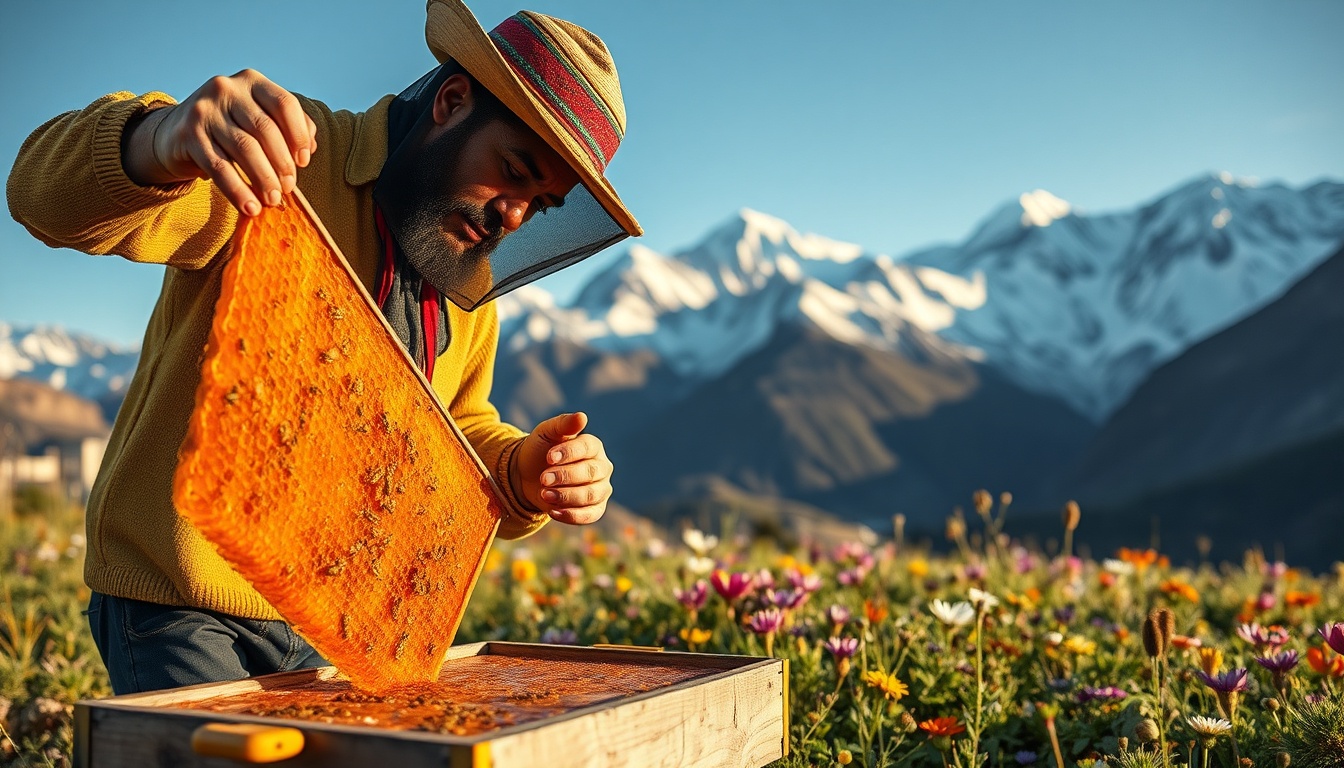
The Peruvian highlands present one of beekeeping's most extreme environments. In the Puno region bordering Bolivia, beehives operate at altitudes between 3,800 and 4,200 metres above sea level — well above the treeline of the European Alps, higher than the summit of the Jungfrau. The conditions are harsh: intense UV radiation (the Andean sun at altitude delivers ultraviolet doses 50-80% higher than at sea level), temperature extremes, a short and unpredictable flowering season compressed into the wet season (November through April), and thin air that affects bee flight energetics. Managed Apis mellifera colonies survive in these conditions because the Quechua and Aymara communities of the altiplano have selected for local ecotypes over decades — these are not Italian Apis mellifera ligustica bees imported last year, but highland populations adapted to altitude stress.
The botanical signature of puna honey reflects the uniqueness of the zone. The dominant nectar sources are not the familiar European or North American species: Schinus molle (molle, the Andean pepper tree — native to the Americas, naturalised on Andean hillsides from Ecuador to Argentina) provides a moderately resinous, medium-amber honey with a slightly warm, peppery-herbal edge. Baccharis species (chilca, tayanco) — the same genus as the Paraguayan species that creates an important South American honey — provide a more aromatic, lighter-coloured honey in the quechua zone. Lupinus species (tarwi in Quechua, the Andean lupin) are pollinated primarily by bumblebees but their field margins and surrounding matorral shrubs provide supplementary foraging. Calceolaria (zapatillas), Gentiana, Lamiaceae shrubs, and a rich palette of Compositae make up the rest of the forage in the quechua and suni zones (approximately 2,500-3,500m). The resulting highland wildflower honey is characteristically medium-to-dark amber, moderately crystallising, with a floral-herbaceous aroma and a rounded, slightly tannic character that reflects the botanical complexity of highland meadows. Price in Lima specialty markets: (approximately USD 8-16), with certified organic highland honey reaching.
Pro Tip
Genuine puna-zone honey from cooperatives like APAMEC (Apurímac), COOPAM (Cusco), or CEPIBO (highland section) typically states the altitude and region on the label. Altitude above 3,500m on the label is a strong authenticity signal for Peruvian highland wildflower.
Get the Honey Buyer's Cheat Sheet (free PDF)
16 varieties on one page — color, flavor, best use and what a fair price looks like — from the 304 honeys we track.
Amazon Meliponini: 300+ Stingless Bee Species and Pre-Columbian Traditions
Peru's Amazon territory contains one of the world's highest documented concentrations of Meliponini (stingless bee) species. Estimates vary by counting methodology, but studies from the Universidad Nacional de la Amazonia Peruana (UNAP) and the Universidad Nacional Mayor de San Marcos document 100+ stingless bee species in the Peruvian Amazon, with broader territorial estimates reaching 300+ when the full Peru–Brazil–Bolivia Amazon boundary area is included. This diversity reflects the Amazon's position as the global centre of Meliponini evolution and diversification.
The stingless bees most commonly managed for honey production by indigenous communities are Scaptotrigona species (known locally as abeja castilla or abeja de tierra), Trigona species (abeja señorita, trigona negra), and Tetragonisca angustula (the same angelita species managed in Colombia, Brazil, and across tropical South America). Indigenous beekeeping traditions centre on the cultivation of log hives (changuinas in Awajún, chapanas in Shipibo), which are maintained in house gardens and forest clearings rather than in modern wooden hives. Honey is harvested by carefully opening the brood area, extracting the honey pots made of cerumen (a mixture of wax and propolis), and sealing the colony back for recovery. Harvest yields are small — typically 1-3 litres per colony per year — but the product is highly valued within indigenous communities for both culinary and medicinal uses.
Amazon Meliponini honey has the characteristics common to stingless bee honey globally: higher moisture content (25-35% versus 17-20% for Apis honey), higher acidity (pH 3.0-4.5 compared to Apis honey's 3.5-5.5), more complex organic acid profiles including lactic, citric, and acetic acids from the fermentation process that drives the potting and curing system, and a sour-sweet-complex flavour completely unlike Apis honey. The honey does not crystallise in the same way as Apis honey (its higher fructose content and lower glucose relative to moisture keeps it fluid), and it must be refrigerated after opening due to its lower osmolarity. Pricing in Lima and Iquitos specialty markets can reach (approximately USD 32-66), reflecting the artisanal harvest method and transport costs from remote communities.
The Selva Alta Belt: Cloud Forest Honey from the Eyebrow of the Jungle
Between the Andean highlands and the Amazon lowlands lies one of the most botanically diverse and least-studied biomes on Earth: the selva alta or ceja de selva (literally 'eyebrow of the jungle'). This cloud forest zone — spanning roughly 1,000 to 2,500 metres altitude across eastern Peru — represents the transition between the temperate Andean flora above and the tropical Amazon flora below. The result is a botanical intersection where Andean shrubs, ferns, bromeliads, orchids, and tree ferns mingle with proto-Amazonian species in conditions of perpetual mist and moderate temperature (typically 15-22°C year-round). Honey produced in this transition zone reflects both botanical worlds: moderately complex, mildly aromatic, often with floral-green notes that suggest both the altitude shrubs and the lowland flowering trees.
The selva alta is also where Peru's specialty coffee belt operates — a fact with direct implications for honey. The Chanchamayo-Satipo corridor in the Junín department (1,200-2,000m), the highlands around Villa Rica ('the coffee capital of Peru'), the Cajamarca and Amazonas regions in the north, and the San Martín region further east all produce Arabica coffee in conditions ideal for the development of complex cup profiles. Coffee in bloom produces a cloud of jasmine-sweet fragrance for 2-4 days per bush per season; at the scale of Peru's coffee-growing landscape, the cumulative bloom period, staggered across altitude and microclimates, can extend for 4-6 weeks in any given region. Managed Apis mellifera colonies in coffee country can accumulate meaningful monofloral coffee blossom honey during this window — pale golden, delicate, with a floral-jasmine character similar to the Colombian miel de flor de café described in our Colombia guide. Very little Peruvian coffee blossom honey is labelled or marketed as such domestically; most disappears into polyfloral bulk. The opportunity for a branded Peruvian coffee blossom honey — following the Colombian model — is commercially significant and commercially unexploited.
Coffee Blossom Honey from Peru's Specialty Coffee Belt
Peru is the world's 5th or 6th largest organic coffee producer (depending on annual harvest and export figures), with approximately 90,000 metric tonnes of green coffee produced annually from roughly 450,000 hectares of cultivation across 14 departments. The Chanchamayo-Satipo corridor (Junín), Cajamarca, San Martín, and Cusco (the La Convención and Quillabamba valleys) represent the core of specialty coffee production. Villa Rica, in the Oxapampa province of Pasco, is acknowledged within Peru as a historic centre of coffee quality and was one of the original communities to develop the 'café de altura' (altitude coffee) marketing concept in the 1990s.
The botanical basis for a Peruvian monofloral coffee blossom honey is essentially identical to the Colombian case: Coffea arabica blossoms are nectar-rich (documented at 0.5-2.0 mg sucrose per flower, with hundreds of flowers per bush), the bloom season is short and intense (typically 48-72 hours per bloom flush, with multiple flushes triggered by rain events after dry periods), and the resulting honey is distinctively pale and floral due to the dominance of linalool, geraniol, and benzyl acetate volatiles derived from coffee blossom nectar. The challenge in building a branded Peruvian coffee blossom honey category is not botanical — the nectar source is present and abundant — but logistical: Peru's coffee-growing regions are often remote, road access to high-altitude farms is limited, and the cooperative infrastructure that would be needed to aggregate, extract, and market coffee blossom honey as a distinct product separate from the general polyfloral bulk export stream has not yet developed.
Pro Tip
For anyone sourcing Peruvian coffee blossom honey, the Awajún communities in Amazonas department and the CENFROCAFÉ cooperative in Cajamarca are among the most organised and internationally connected producers. Both participate in fair-trade frameworks (FLO certification) that could support premium honey marketing alongside their coffee.
Peruvian Honey Regulations: SENASA, NTP 209.173 and the Cooperative Sector
Honey in Peru is regulated by the Servicio Nacional de Sanidad Agraria (SENASA), the national agricultural and veterinary sanitation authority. The primary technical standard is Norma Técnica Peruana NTP 209.173:2019 — a revised and updated standard aligned with the Codex Alimentarius General Standard for Honey (CXS 12-1981 as revised). NTP 209.173:2019 specifies moisture content (≤20% for Apis honey, with a ≤23% exception for baker's honey), HMF limits (≤40 mg/kg for Apis honey; ≤80 mg/kg for honey from tropical regions with justification), diastase activity, sucrose content, reducing sugars, electrical conductivity, ash content, and water-insoluble solids. The standard explicitly addresses only Apis honey; Meliponini honey has no specific NTP standard, mirroring the regulatory gaps in Colombia, Vietnam, and Nigeria described in our other country guides.
The Peruvian honey export sector is dominated by cooperatives and large-scale aggregators rather than by branded single-origin producers. APICOOP (Apícola del Norte), PRONABEC-affiliated cooperatives in Junín and Pasco, and various regional producers' associations collectively account for the majority of Peru's formal honey export volume — estimated at 2,000-2,500 metric tonnes per year based on MINAGRI (Ministry of Agriculture and Irrigation) agricultural statistics. Germany, the United States, Belgium, and Japan are the primary destinations. Almost all of this honey enters destination markets as undifferentiated bulk, processed by importing packers and relabelled under European or North American retail brands with no indication of Peruvian origin. Peru's honey thus faces the same structural invisibility problem as Argentina, Colombia, and Nigeria — extraordinary raw material, zero brand premium, maximum supply-chain anonymity. The country has the botanical, ecological, and biochemical ingredients for a world-class specialty honey industry; it lacks only the go-to-market infrastructure that New Zealand built for manuka over 30 years.
How to Buy Peruvian Honey — Authentic Sources and What to Look For
Within Peru, the best sources for authentic varietal honey are Lima's organic and fair-trade specialty shops (Mara de Vito, La Canasta, BioMarket, and the Surquillo and Miraflores farmers markets), the craft honey producers at the Mistura food festival (when it runs), and direct purchases from producing communities via platforms like the APEGA (Sociedad Peruana de Gastronomía) supplier network. In Cusco, several honey producers in the Sacred Valley and La Convención province sell directly from small farms. In Iquitos (Amazon gateway), Amazon Meliponini honey is available at the Belen Market and from indigenous community cooperatives with artisanal craft markets.
Internationally, Peruvian honey remains genuinely hard to find as a labelled single-origin product. A handful of specialty importers in Germany, Spain, and the United States carry Peruvian highland wildflower honey under its region of origin, but the volumes are small and availability is inconsistent. Amazon Meliponini honey from Peru is even harder to find internationally — the best path is direct-to-consumer purchasing through Peruvian artisanal food platforms (Rappi, Glovo, or Lima-based e-commerce). Fair-trade certification (Fair Trade International, WFTO) provides some provenance signal: Peruvian honey with FLO or WFTO marks is more likely to be genuinely single-origin, non-blended product.
Pro Tip
Ask specifically about altitude and region when buying Peruvian honey. 'Sierra honey' from Apurímac, Cusco, or Puno above 3,000m is the premium tier. 'Selva alta' polyfloral from San Martín or Chanchamayo is the middle tier. Undifferentiated 'miel de abeja' without region origin information is bulk product indistinguishable from any South American country.