Nepal in the World Honey Map: The Grayanotoxin Paradox
Nepal occupies one of the most unusual positions in the global honey economy: it is the only country that produces two structurally distinct products from the same honeybee on the same cliff face, in the same nest, harvested twice a year by the same hunters — and one of those products is among the most pharmacologically active naturally occurring foods in the world. The Himalayan giant honeybee, Apis dorsata laboriosa, builds its combs on exposed vertical rock faces between 1,200 and 3,500 metres altitude across the hill country of central and western Nepal. In spring, from roughly March through May, these bees forage primarily on Rhododendron arboreum — Nepal's national flower, which grows in dense forests on the middle and upper hill slopes — along with other high-altitude rhododendron species. The nectar they collect contains grayanotoxins, a class of diterpenoid polyol compounds with potent ion-channel-disrupting pharmacology. The honey produced during this spring flow is what Nepali mountain communities call Pagal Mauri — literally "crazy honey" or "mad honey" — and it has been documented to cause bradycardia, hypotension, dizziness, nausea, sweating, and at high doses cardiovascular collapse when consumed in quantity. It is a controlled food hazard and a traditional medicine at the same time.
The fall harvest, taken from October through November after the rhododendron has been out of bloom for months and the bees have been foraging on a diverse alpine and subalpine flora, is something entirely different: a safe, complex, high-altitude polyfloral honey with flavors and aromas reflecting Nepal's Himalayan botanical diversity — the sweeping wildflower meadows of the Annapurna foothills, the rhododendron-free summer flora above 3,000 metres, the buckwheat fields of the middle hills. This creates honey character similar to premium mountain wildflower honey but with distinctive Himalayan terroir and extreme elevation concentration impossible to replicate below 8,000 feet. This seasonal duality — spring mad honey versus fall polyfloral — is the defining structural feature of Nepalese honey culture, and it gives the country's honey traditions a pharmacological and cultural specificity found nowhere else in the world. The rest of this guide covers both, plus the full range of Nepalese honey production beyond the cliff-harvest tradition.
Nepal sits between the world's two most discussed South Asian honey sources: India to the south and east (where Apis dorsata cliff honey from the Himalayan foothills is also produced, along with iconic varieties like Sundarbans mangrove and Kashmir wildflower — see our Indian honey guide) and the high-altitude landscapes of Tibet and Bhutan to the north. Within South Asia, Nepal's honey culture is distinctive because the Himalayan landscape is both more extreme and more accessible to cliff-harvest traditions than the Indian Himalayan foothills, and because the grayanotoxin story is specifically localized to high-altitude Nepal and a few contiguous areas of northeastern India. The Nepalese honey tradition has no equivalent anywhere else in South or Southeast Asia.
Apis dorsata laboriosa: The Himalayan Giant Honeybee
Apis dorsata laboriosa is the world's largest honeybee. Adults measure approximately 2–2.5 cm in length — considerably larger than the more familiar A. mellifera worker (roughly 1.3–1.5 cm) or A. cerana (roughly 1.2–1.4 cm). It is formally classified as either a full species (Apis laboriosa) or as a subspecies of the giant honeybee Apis dorsata, depending on the taxonomic framework; current molecular phylogenetics supports the subspecies classification but the debate continues. What is not debated is its ecology: A. dorsata laboriosa is strictly Himalayan, found at elevations between approximately 1,200 and 3,500 metres in the hill country of Nepal, northern India (Uttarakhand, Himachal Pradesh, and Sikkim/Darjeeling), and historically in southern Tibet, though Tibetan populations are much more restricted by cold and vegetation. It does not occur in the lowland Terai or in the subtropical forests below the hill zone.
The bee builds single large open combs — not enclosed hives — attached to overhanging rock ledges, cliff faces, and occasionally large tree branches at altitude. A single colony comb can exceed one metre in width and contain 30,000–100,000+ workers, with honey stores of 15–25 kg or more in a productive season. The combs are built on the underside of rock overhangs that provide protection from rain and from the bees' primary predators — Asian black bears, honey-buzzards, and Himalayan yellow-throated martens. Colony clusters of dozens or occasionally hundreds of nests at the same rock face are documented; the famous honey-hunting sites in the Kaski and Lamjung districts of the Gandaki Province (the area west and south of Pokhara) have been used for generations, with beehunters familiar with the exact location of combs that reoccupy the same rock-face site year after year after the colony completes its seasonal migration.
A. dorsata laboriosa undertakes seasonal altitudinal migration in Nepal: colonies descend from high-altitude summer nest sites in October–November, spend the winter in lower-elevation forests down to roughly 1,000 metres, then re-ascend in March–April to the cliff sites for the spring flow and honey production. This migration synchronizes with the rhododendron bloom on the ascending return — which is exactly the mechanism by which spring honey acquires its grayanotoxin load. The bees are foraging on the rhododendron precisely as they re-establish their cliff-face nests at altitude after the winter descent. By contrast, fall honey is produced after the summer foraging season on diverse non-rhododendron alpine flora, with the grayanotoxin level having declined through the summer months as the hive processes non-toxic nectar sources. The seasonal timing of harvest — which flow the honey was produced from — is the single most important variable in the safe-or-not-safe binary for Himalayan cliff honey from Nepal.
Get the Honey Buyer's Cheat Sheet (free PDF)
16 varieties on one page — color, flavor, best use and what a fair price looks like — from the 304 honeys we track.
The Gurung Honey Hunters: A Tradition at the Cliff Edge
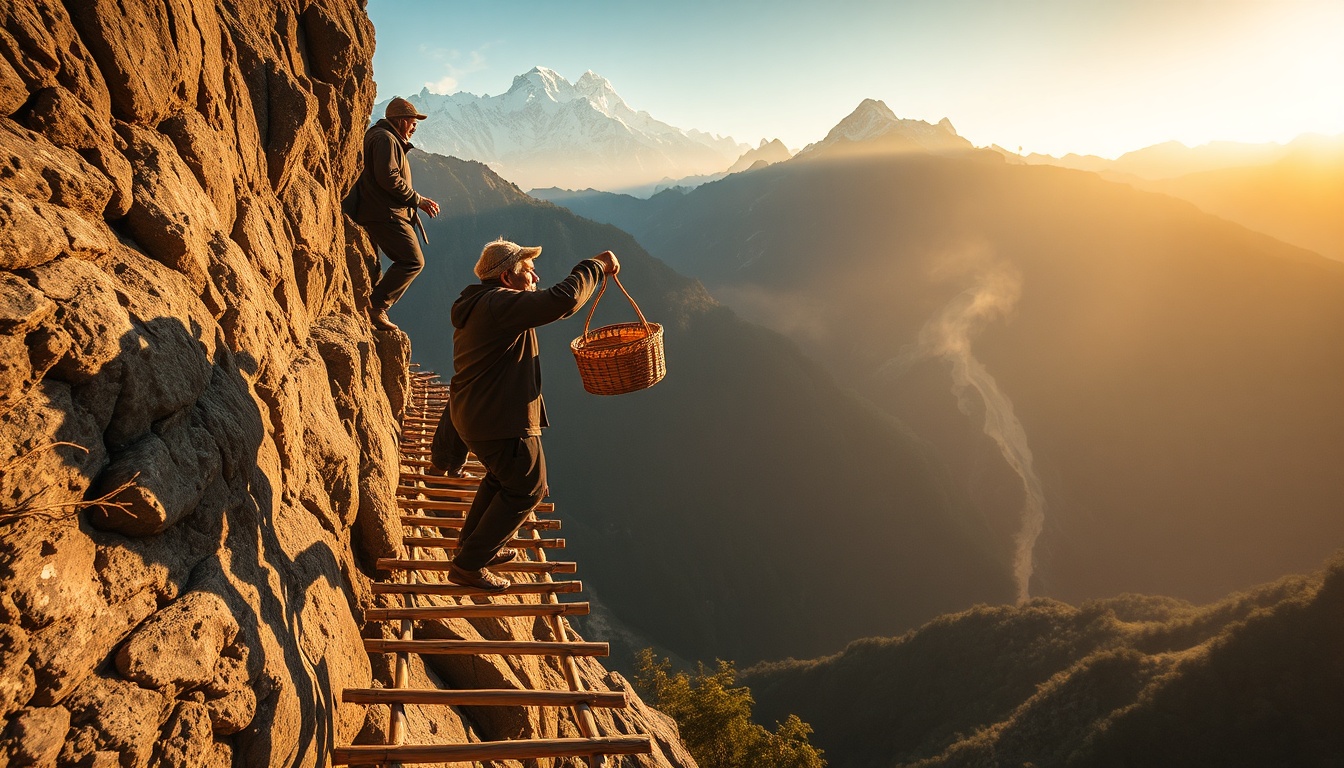
The honey-hunting tradition of the Gurung people — an indigenous ethnic community of Tibeto-Burman origin concentrated in the hill districts of Lamjung, Kaski, Gorkha, and Tanahun in central-western Nepal — is one of the most extensively documented traditional-knowledge practices in South Asian anthropology. The tradition was brought to international attention by National Geographic photographer Eric Valli, who documented the seasonal harvest in a 1988 National Geographic article and later in the 1997 documentary short "Honey Hunters of Nepal," which has since been seen by many millions of people and is credited with making Nepalese mad honey internationally known as a category. The core practice: hunters descend the cliff face on a long rope and bamboo ladder woven to reach the nest site, carrying a basket or leather container, a long-handled cutting rod (gagri) to dislodge the comb, and a smoky torch of dried grass and bark to calm the bees. The process is physically dangerous — A. dorsata laboriosa is not a domesticated species and will defend its nest vigorously — and requires intimate knowledge of the specific rock face, the colony's behavior, and the seasonal timing.
The social organisation of honey hunting in the Gurung tradition is communal rather than individual. Harvests are scheduled and organised by the village community, typically under the authority of a senior hunter whose knowledge of the specific cliff sites and seasonal timing has been built up over decades. Before the descent, a ritual offering is made to the cliff spirits and to the bees themselves — prayers, incense, and sometimes animal offerings depending on the specific local tradition — in a ceremony that acknowledges the harvest as a negotiation with the natural world rather than an extraction from it. The honey is shared according to communal norms: a portion to the lead hunter, a portion to assisting hunters, and a portion to the village as a whole. This communal structure has historically provided some degree of sustainable management — harvests are not typically conducted more than twice per year (spring and fall), and over-harvesting a site would reduce or eliminate the colonies that return to it year after year.
The tradition is under pressure from multiple directions. Nepal's Gurung population has been heavily impacted by emigration — the community is disproportionately represented in the Gurkha military recruiting tradition, and a large share of working-age men from hill communities are overseas at any time, reducing the intergenerational transmission of honey-hunting knowledge. The cliff sites in Kaski and Lamjung districts have also become tourist attractions; guided honey-hunting observation tours are now commercially operated for international tourists, and the presence of observers and cameras has altered some aspects of how the tradition is presented and performed, raising concerns among anthropologists about the line between cultural transmission and cultural performance for commercial ends. Some community members have also noted that commercial demand for Nepalese mad honey in international niche markets — Japan, Germany, and increasingly South Korea and North America — has raised economic incentives in ways that could stress the traditional twice-yearly harvest cycle. The International Centre for Integrated Mountain Development (ICIMOD), based in Kathmandu, has documented these pressures in multiple publications and advocates for community-controlled harvest protocols that preserve the sustainable management framework of the traditional system.
Mad Honey (Pagal Mauri): Chemistry, Risks, and Traditional Uses
The pharmacological activity of Nepalese spring honey is caused by grayanotoxins — specifically grayanotoxin I (also known as andromedotoxin or rhodotoxin), the dominant bioactive compound in Rhododendron arboreum nectar and honey produced from it. Grayanotoxins are diterpenoid polyols that bind to voltage-gated sodium channels in cell membranes, keeping them persistently open rather than allowing normal cycling between open and inactivated states. The result is continuous cell depolarisation, leading — at sufficient doses — to effects on the cardiovascular system (bradycardia, hypotension), the nervous system (dizziness, paresthesia, diplopia, ataxia, loss of consciousness), and the gastrointestinal system (nausea, vomiting, salivation). The toxic dose is dose-dependent: small amounts of spring honey (1–2 teaspoons) may produce only mild symptoms including numbness, dizziness, and elevated heart rate; larger doses (one or more tablespoons) can cause significant bradycardia and hypotension requiring medical intervention; very large doses have caused documented fatalities, though these are rare. The symptoms typically onset 30 minutes to 3 hours after ingestion and resolve within 24 hours without permanent harm in most cases, since grayanotoxin poisoning is primarily a sodium-channel disruption rather than a hepatotoxic or nephrotoxic event.
The traditional medicinal use of Pagal Mauri in Gurung and broader hill-community medicine takes advantage of the cardiovascular effects at sub-toxic doses. Traditional healers in the hill districts have used small, carefully calibrated doses of spring mad honey for hypertension — the bradycardia and hypotension effects, which are dangerous in excess, are therapeutically useful in controlled amounts as a vasodilatory treatment in a population with limited access to pharmaceutical antihypertensives. Similar uses are documented in Turkish "deli bal" (the analog product from Black Sea rhododendron regions, primarily Rhododendron luteum and R. ponticum — see our Turkish honey guide), in the Georgian Caucasus, and in Chinese traditional medicine references to similar products from Rhododendron-heavy mountain regions. However, Nepal's higher-altitude terroir (2,000-3,500m vs Turkey's 1,500-2,500m) and unique Rhododendron arboreum species create more concentrated grayanotoxin levels than other regional mad honey varieties. The traditional healers who administer mad honey as a therapeutic do so with a calibration based on body weight, expected potency (which varies between spring harvests), and the specific health condition being treated — a knowledge system that cannot be replicated by a tourist or export consumer without equivalent training. Consuming mad honey without this guidance for "recreational" purposes — as some international buyers do, attracted by the psychedelic effects marketed in online niche markets — is genuinely hazardous and has been documented to cause hospitalisations in multiple countries.
The international market for Nepalese mad honey has grown substantially over the past decade, driven primarily by niche-market demand from Japan (where "mad honey" is positioned in alternative-medicine channels), Germany (where honey with documented bioactive properties finds a well-developed market), South Korea, and recently North America. Authentic spring Pagal Mauri from documented Gurung harvest cooperatives trades at approximately jar at international export retail — making it one of the highest-priced honeys in the world by weight, comparable to premium Yemeni sidr and rivaling New Zealand Manuka honey UMF 15+ grades. However, while Manuka derives its premium pricing from verified antimicrobial activity through standardized UMF/MGO testing, Nepal's mad honey commands similar prices due to its unique psychoactive pharmacology and ancient cliff-harvest tradition impossible to replicate elsewhere. This price premium has created a substantial fraud problem: non-Nepalese honey (and in some cases, syrup) is sold as "Himalayan mad honey" or "Nepalese mad honey" with no verified origin and no documented grayanotoxin content. Legitimate spring mad honey has measurable grayanotoxin I content detectable by HPLC or mass spectrometry — absence of detectable grayanotoxin in claimed spring mad honey is the clearest adulteration signal. However, routine grayanotoxin testing is not widely available outside research settings, which makes origin verification difficult for most buyers.
Fall Himalayan Honey: Safe, Complex, and Underrated
Nepal's fall harvest — the October–November A. dorsata laboriosa comb harvest after the summer foraging season — produces a very different product from the spring honey that has garnered global attention. By the time of the fall harvest, the bees have been foraging on a full summer's worth of alpine and subalpine flora that has nothing to do with rhododendron: the wildflower meadows of the Annapurna Conservation Area, the late-summer flowering of Potentilla, Aconitum, Gentiana, various Compositae and Apiaceae species, the buckwheat fields of the middle hills where they are accessible from the cliff sites, and the diverse shrub-layer and tree flora of the hill zone below 2,500 metres. This creates complex polyfloral character similar to Texas wildflower honey in botanical diversity but with unique Himalayan alpine terroir concentration from extreme elevation (8,000-11,000+ feet) and compressed growing season impossible to replicate in temperate lowland regions. The grayanotoxin content in fall honey from the same nests that produced spring mad honey is not reliably zero — some grayanotoxin may persist in the honeycomb wax and cross-contaminate fall harvest if the same comb is used — but it is substantially lower than spring honey and is generally considered safe at normal consumption levels. Expert honey hunters distinguish spring and fall harvests explicitly; buyers of Nepalese honey should ask whether the honey they are purchasing is from the spring or fall harvest, not simply rely on "wild cliff honey" as a blanket descriptor.
The sensory profile of fall Himalayan polyfloral from Gurung harvest cooperatives is striking. Color ranges from deep amber to almost black in some high-altitude lots, with a viscosity that reflects the cool temperatures at which it was stored in the comb before extraction. The flavor shows the same botanical complexity as other high-altitude wildflower honeys — richly floral, faintly resinous, with a clean mineral finish — but with a depth and aromatic persistence that distinguishes it from commercial polyfloral honeys from lower altitudes. The buckwheat note, where the bees have accessed mid-hill buckwheat fields, contributes a characteristic malty-earthy undertone that experienced tasters identify as distinctively Himalayan. Granulation in fall Himalayan honey is variable: some lots with high glucose content from late-season sources crystallize relatively quickly to a fine-grained consistency; others remain semi-liquid for extended periods. Both behaviors are consistent with authentic raw honey and reflect the botanical composition of the specific harvest rather than any quality defect.
Below the Gurung cliff-honey tradition, Nepal's mid-hill zones support a second honey tradition centered on Apis cerana — the Asian honeybee — kept in traditional log-hive systems by hill-community beekeepers in Gandaki, Lumbini, and Bagmati provinces. A. cerana honey from the mid-hills is a smaller-yield product per colony (approximately 4–10 kg per colony per year) but a botanically complex polyfloral with strong local demand at hill-district markets and farm-gate sales. It is rarely found in Kathmandu export retail and is essentially unknown outside Nepal, making it a genuinely local product in the best sense. Introduced Apis mellifera has also been established in Nepal's hill districts for commercial production since the 1970s and provides the majority of honey sold in modern supermarkets in Kathmandu and other urban centres; its output is predominantly a commercial polyfloral at lower price points without the premium terroir character of A. dorsata laboriosa or A. cerana cliff and hill honey.
Regional Varieties: Mustang, Dolpa, and the High-Altitude Desert Honey
Nepal's honey geography extends well beyond the Kaski and Lamjung cliff-hunting districts that have captured international attention. The Upper Mustang district — the former Lo Kingdom, a rain-shadow trans-Himalayan plateau in the Gandaki Province that shares ecological characteristics with the Tibetan Plateau — produces a distinctive high-altitude honey from its own bee ecology. Upper Mustang sits in the rain shadow of the Annapurna and Dhaulagiri massifs, receiving less than 200 mm of precipitation annually (compared to 1,500–2,500 mm in the Pokhara basin immediately to the south), and its flora reflects this extreme environment: juniper, Caragana, Berberis, Artemisia, Ephedra, and seasonal high-altitude wildflowers adapted to cold and aridity. The honey from Upper Mustang is primarily from A. cerana (wild cliff-nesting and log-hive populations) and limited A. dorsata laboriosa foraging from the lower elevations of the district. It is light to medium amber, relatively mild in flavor compared to the full-hill-zone polyfloral, with a clean sweetness and gentle herbal-aromatic quality reflecting the sparse flora. Volume is small; most stays within the district or is sold in Lo Manthang and Jomsom markets to trekkers on the Annapurna Circuit.
The Dolpa district in the Karnali Province — the most remote high-altitude district in Nepal, largely cut off by its elevation and terrain — also has documented wild honey traditions associated with Gurung and Tibetan-heritage communities who practice cliff-harvest methods similar to those of the Kaski/Lamjung region. Dolpa cliff honey is even less commercially accessible than the main hill-zone product; it rarely reaches Kathmandu markets and is essentially never found in international export channels. Its significance is cultural and ecological rather than commercial at present. Research conducted by ICIMOD and by Tribhuvan University (Kathmandu) has documented the practice, and conservation organisations working in the Shey Phoksundo National Park area have advocated for formally recognising traditional harvest sites within the park's management framework.
In the Terai — the flat subtropical lowland belt of southern Nepal bordering India — a completely different honey economy operates. Commercial Apis mellifera beekeeping is well established in the Terai, producing mustard (Brassica species) honey in the January–March period, and a summer polyfloral from the rice-paddy and mixed-crop agricultural landscape. Terai mustard honey is pale amber to nearly water-white, mild and sweet with a typical brassica-honey character (light sulfurous note, fine crystallisation over 2–4 weeks), and is the most affordable Nepalese honey. It is the honey of everyday consumption in Nepal's urban market and is not positioned as a premium product. Litchi honey from the Terai's litchi orchards (primarily in Dhanusha, Mahottari, and Sarlahi districts) parallels the Bihar litchi tradition across the Indian border and provides a light, floral seasonal variety in the late spring. These lowland varieties are genuine but rarely exported under a Nepalese premium identity.
NS 1193, Regulation, and the Authentication Challenge
Nepal's statutory honey standard is NS 1193, administered by the Nepal Bureau of Standards and Metrology (NBSM / नेपाल गुणस्तर तथा नापतौल विभाग). NS 1193 sets compositional parameters broadly aligned with Codex Alimentarius standards: moisture content (typically not more than 20% for standard honey; heather exemption applies to some botanical categories), reducing sugars, sucrose ceiling, diastase activity, and HMF maximum. The standard applies primarily to commercially packaged honey sold through Nepali retail channels and export. It does not provide specific guidance on the classification of Apis dorsata laboriosa cliff honey, on grayanotoxin content limits, or on the authentication of geographic-origin or botanical-source claims for wild honey. This regulatory gap is not unusual — most national honey standards were written for commercial A. mellifera production and have not been updated to address the specific authentication challenges of wild honey from non-domesticated species.
The practical consequence of the regulatory gap is that the authentication system for Nepalese mad honey and wild Himalayan honey operates primarily through community-level certification rather than government inspection. The main trust layer is cooperative-level documentation: cooperatives and producer groups in Kaski, Lamjung, and other hill districts that sell through documented channels can provide harvest records, GPS coordinates of nest sites, harvest dates (which determine spring-vs-fall classification), and where available, laboratory test results for grayanotoxin content (HPLC/MS) or botanical origin (pollen analysis). ICIMOD and several NGOs working in Nepal's honey sector have supported the development of such documentation frameworks for community bee management, though coverage is not uniform across all harvest communities. For export buyers, co-operative membership plus a documented spring-vs-fall harvest classification plus a grayanotoxin test result is the three-signal authentication stack that distinguishes legitimate Nepalese cliff honey from generic "Himalayan wild honey" relabeled for the premium market.
The global research literature on grayanotoxin content in Nepalese honey is growing but not yet comprehensive. Studies published by Nepali universities (Tribhuvan University, Kathmandu University) and by international research groups working on the ethnobotany and toxicology of the Himalayan honey tradition have documented the presence of grayanotoxin I (and in some lots, grayanotoxin II and III) in spring harvest samples from Kaski and Lamjung districts, with highly variable concentration depending on the proportion of rhododendron pollen in the specific lot. Lots with rhododendron pollen content above approximately 30–40% of total pollen under melissopalynological examination are generally assumed to carry significant grayanotoxin levels; lots below 15% rhododendron pollen are generally associated with lower (potentially sub-toxic) grayanotoxin levels. The correlation is imperfect because rhododendron pollen is not the only vector — other Rhododendron-family plants (Pieris, Kalmia, and related ericaceous genera if present) could contribute — and because the relationship between pollen percentage and grayanotoxin concentration varies by year, altitude, and colony. Honest limitation: there is no widely agreed-upon minimum grayanotoxin threshold that defines "safe" versus "potentially hazardous" Nepalese spring honey for an international consumer without access to specific lot-level testing.
Buying Authentic Nepalese Honey: Safety, Sources, and What to Expect
Buying authentic Nepalese honey requires navigating several overlapping challenges: the spring-vs-fall safety distinction, the prevalence of fraudulent "Himalayan wild honey" products in international markets, the absence of a government-run traceability system comparable to Taiwan's TAP or New Zealand's UMF framework, and the price premium that makes counterfeiting economically attractive. For spring mad honey specifically, the first rule is to know what you are buying and why: Pagal Mauri is a pharmacologically active product with a documented dose-dependent hazard profile that has caused hospitalisations and, rarely, fatalities. If you are buying it for medicinal use within a traditional Nepalese or Himalayan cultural framework, you should be working with a practitioner who has specific calibration knowledge — this is not something to self-administer based on an online guide. If you are buying it as a curiosity, understand that the grayanotoxin content of any given jar is highly variable and not predictable from appearance alone. Anyone with heart conditions, low blood pressure, or on medications that interact with cardiac or antihypertensive mechanisms should avoid it entirely, and no amount should be treated as guaranteed safe without expert guidance.
Inside Nepal, the best channels for authentic wild honey are: the cooperative outlets and farmer cooperatives in Pokhara (the nearest major city to the main Kaski/Lamjung hunting districts), district markets in Besisahar (Lamjung), Besi Sahar, and Gorkha Bazaar; the NACCFL (National Cooperative Federation) affiliated honey cooperatives in Kathmandu; the periodic honey fairs organised by local agricultural development offices; and direct-from-community purchases through trekking contacts in the hill districts. The price for authenticated spring cliff honey in Nepal ranges from approximately (approximately $35–130 USD) at source, with the premium end for documented Gurung harvest cooperative product. Fall Himalayan polyfloral from the same cooperatives is typically 30–50% of the spring price — less dramatic, but no less genuine. A. cerana mid-hill honey and A. mellifera commercial polyfloral are available throughout Nepal at lower price points.
Outside Nepal, authentic Nepalese honey is available through a small number of specialty importers in Japan, Germany, and increasingly in the US and UK. Authentication signals for export product: explicit harvest-type declaration (spring/fall and year); named cooperative or named district-of-origin; grayanotoxin test certificate for spring honey (from an accredited laboratory, not a producer self-declaration); pollen analysis report (which should show elevated Rhododendron arboreum pollen for spring honey); and pricing consistent with wild-harvest production costs (jar for spring cliff honey, for fall Himalayan polyfloral from the same source). Red flags: very low prices for claimed spring mad honey; "Himalayan wild honey" labeling with no species, no district, no harvest date; claims of grayanotoxin content without a supporting test certificate; and any product positioned as a "recreational psychedelic" experience — this framing is both pharmacologically misleading and reflects the marketing norms of the unverified segment of the international market. For the broader comparative context of South Asian honey traditions, see our Indian honey guide and the World Honey Guide.