Your Liver and Why It Matters for Honey Consumption
Your liver processes virtually everything you eat, including honey. As the primary organ for fructose metabolism, sugar detoxification, and energy storage, the liver is directly affected by your sweetener choices. So the question "Is honey good for your liver?" is more nuanced than most wellness sites suggest.
The answer depends on context: the amount you consume, what you're replacing (sugar, HFCS, nothing), whether you have existing liver disease, and which type of honey you use. Research over the past decade has identified real hepatoprotective (liver-protecting) properties in honey — but also real risks from overconsumption. This guide covers both sides with primary source citations.
This section does not establish a universal or medical honey dose for this purpose. Use the daily added-sugar guide to count honey with other added or free sugars.
5 Ways Honey May Protect the Liver
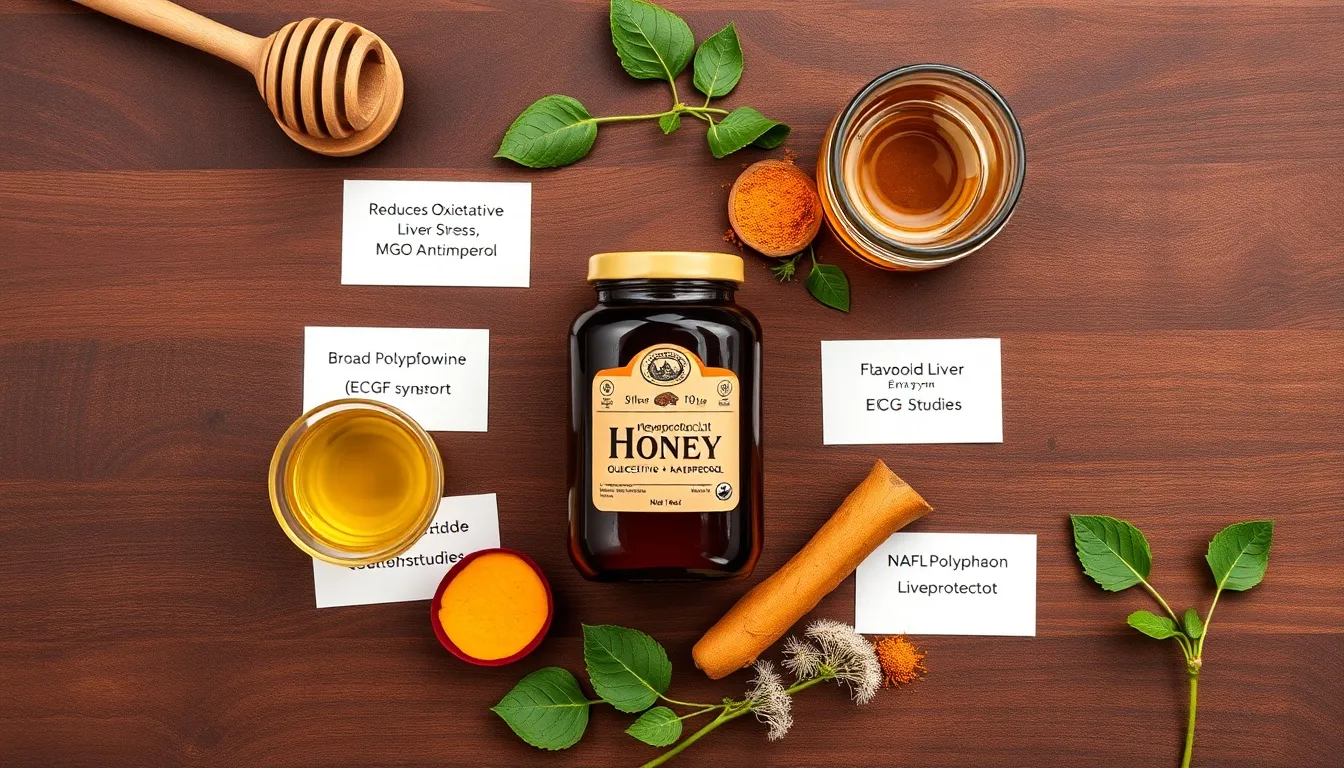
**1. Antioxidant protection against oxidative stress.** The liver is particularly vulnerable to oxidative stress because it processes toxins, metabolizes drugs, and handles reactive oxygen species (ROS) as byproducts of normal metabolism. Honey's polyphenol content — including chrysin, quercetin, kaempferol, caffeic acid, and gallic acid — has demonstrated hepatoprotective effects in multiple animal studies. A 2012 study in the Journal of Nutrition & Metabolism found that rats fed honey showed significantly lower levels of liver oxidative stress markers (malondialdehyde, protein carbonyl) compared to those fed sucrose, even at equivalent caloric intake.
**2. Anti-inflammatory effects on liver tissue.** Chronic liver inflammation drives progression from fatty liver to steatohepatitis (NASH) to cirrhosis. Honey's anti-inflammatory properties — primarily through NF-κB pathway modulation and reduced production of pro-inflammatory cytokines (TNF-α, IL-6, IL-1β) — may help interrupt this progression. A 2018 study in Biomedicine & Pharmacotherapy showed that tualang honey reduced liver inflammation markers in rats with induced hepatotoxicity by 45-60% compared to controls.
**3. Fructose composition advantage over HFCS and table sugar.** While honey contains fructose (which the liver metabolizes), its fructose-to-glucose ratio and additional bioactive compounds change how the liver handles it compared to isolated fructose or HFCS. A 2015 study in the Journal of the American College of Nutrition found that honey consumption was associated with lower hepatic lipogenesis (liver fat production) markers compared to equivalent sucrose intake. The hypothesized mechanism: honey's antioxidants and flavonoids partially counteract the lipogenic effects of its fructose content.
**4. Prebiotic support for the gut-liver axis.** The liver receives 70% of its blood supply from the portal vein, which drains the intestines — meaning gut health directly impacts liver health. When gut barrier integrity weakens ("leaky gut"), bacterial endotoxins (LPS) reach the liver and trigger inflammation. Honey's prebiotic oligosaccharides (FOS, GOS) support beneficial gut bacteria (Bifidobacterium, Lactobacillus) that strengthen the intestinal barrier, potentially reducing the endotoxin burden on the liver.
**5. Hepatocyte regeneration support.** Preliminary animal research suggests honey may support liver cell regeneration. A 2013 study in the Journal of Hepatology Research found that Manuka honey accelerated liver cell proliferation in rats with partial hepatectomy, with treated rats showing 30% faster liver regeneration compared to controls. The mechanism appears related to honey's growth factor content and antioxidant-mediated reduction of regeneration-blocking oxidative stress.
Get the Honey Buyer's Cheat Sheet (free PDF)
16 varieties on one page — color, flavor, best use and what a fair price looks like — from the 268 honeys we track.
Honey and Non-Alcoholic Fatty Liver Disease (NAFLD)
NAFLD affects roughly 25% of the global population and is the most common liver disease worldwide. It's driven primarily by excess caloric intake, insulin resistance, and high fructose consumption — which raises an important question about honey's role.
**The concern:** Honey is a significant fructose source, and excess fructose consumption is a primary driver of hepatic de novo lipogenesis (the liver converting sugar into fat). High-fructose diets are strongly associated with NAFLD development and progression.
**The counterpoint:** Several studies suggest honey is metabolized differently than equivalent amounts of isolated fructose or HFCS. A 2019 randomized controlled trial published in Nutrition Research assigned 60 NAFLD patients to receive either 70g/day of natural honey or 70g/day of sucrose for 30 days. The honey group showed statistically significant reductions in liver enzyme levels (ALT decreased 11.2%, AST decreased 9.3%) while the sucrose group showed increases in both markers.
A 2021 systematic review in Food Science & Nutrition analyzed 8 studies on honey and liver enzymes, concluding that honey consumption was associated with modest improvements in ALT and AST levels in both healthy subjects and those with liver disease — though the authors noted that most studies were small (n<100) and short-duration (4-12 weeks).
**The honest assessment:** For people without existing liver disease, replacing sugar or HFCS with moderate amounts of honey is likely neutral to mildly beneficial for liver health. For people with NAFLD, the evidence is cautiously promising but not strong enough to recommend honey as a treatment. The fructose content means that adding honey on top of an existing high-sugar diet would make NAFLD worse, not better.
Pro Tip
If you have NAFLD, the most important dietary change is reducing total fructose and added sugar intake — not switching between sugar sources. Honey can be part of a reduced-sugar diet, but shouldn't be added as an extra.
Honey and Alcohol-Related Liver Damage
Alcohol metabolism produces acetaldehyde and reactive oxygen species that damage hepatocytes. Several animal studies have investigated whether honey's antioxidant properties can mitigate alcohol-induced liver damage.
A 2011 study in the African Journal of Traditional, Complementary and Alternative Medicines found that Nigerian honey reduced ethanol-induced liver enzyme elevation (ALT, AST, ALP) in rats by 35-55%. A similar 2016 study using Malaysian tualang honey showed comparable hepatoprotective effects, with treated rats showing preserved liver architecture on histological examination compared to severe fatty changes in alcohol-only controls.
However, these are animal studies with no human clinical trials to date. The doses used (1-2g/kg body weight in rats) would translate to roughly 70-140g of honey per day for a human — far more than the recommended 1-2 tablespoons. It would be irresponsible to suggest that honey can protect against the effects of heavy alcohol consumption. The hangover remedy evidence is similarly preliminary.
What the research does suggest is that honey's antioxidant compounds have genuine hepatoprotective activity in laboratory settings, supporting the broader pattern that moderate honey consumption contributes to antioxidant defense systems that benefit liver health among other organs.
How Honey Compares to Other Sweeteners for Liver Health
The liver processes different sweeteners in fundamentally different ways, and these differences matter for long-term liver health.
**Honey vs. high-fructose corn syrup (HFCS).** HFCS delivers fructose in a form that promotes rapid hepatic uptake and de novo lipogenesis. Honey's matrix of antioxidants, minerals, and enzymes appears to partially buffer these effects. Multiple animal studies show that honey causes less hepatic fat accumulation than equivalent calories from HFCS. For a full comparison, see our honey vs corn syrup guide.
**Honey vs. table sugar (sucrose).** Sucrose is 50% fructose and 50% glucose — similar to honey's ~40% fructose and ~32% glucose. The key difference is honey's bioactive compounds. Studies consistently show that honey produces equal or lower liver enzyme elevation compared to sucrose, suggesting a neutral-to-positive comparison.
**Honey vs. agave nectar.** Agave is 70-90% fructose — significantly higher than honey. From a liver health perspective, agave is likely worse due to the higher fructose load without honey's compensatory antioxidants. See our honey vs agave comparison.
**Honey vs. no added sweetener.** Let's be honest: for liver health, the best sweetener is less sweetener. No amount of antioxidant polyphenols makes honey a liver health supplement. The benefit of honey is relative — it's a better sweetener choice than alternatives, not a food you should add specifically for liver protection.
Best Honey Types for Liver Support
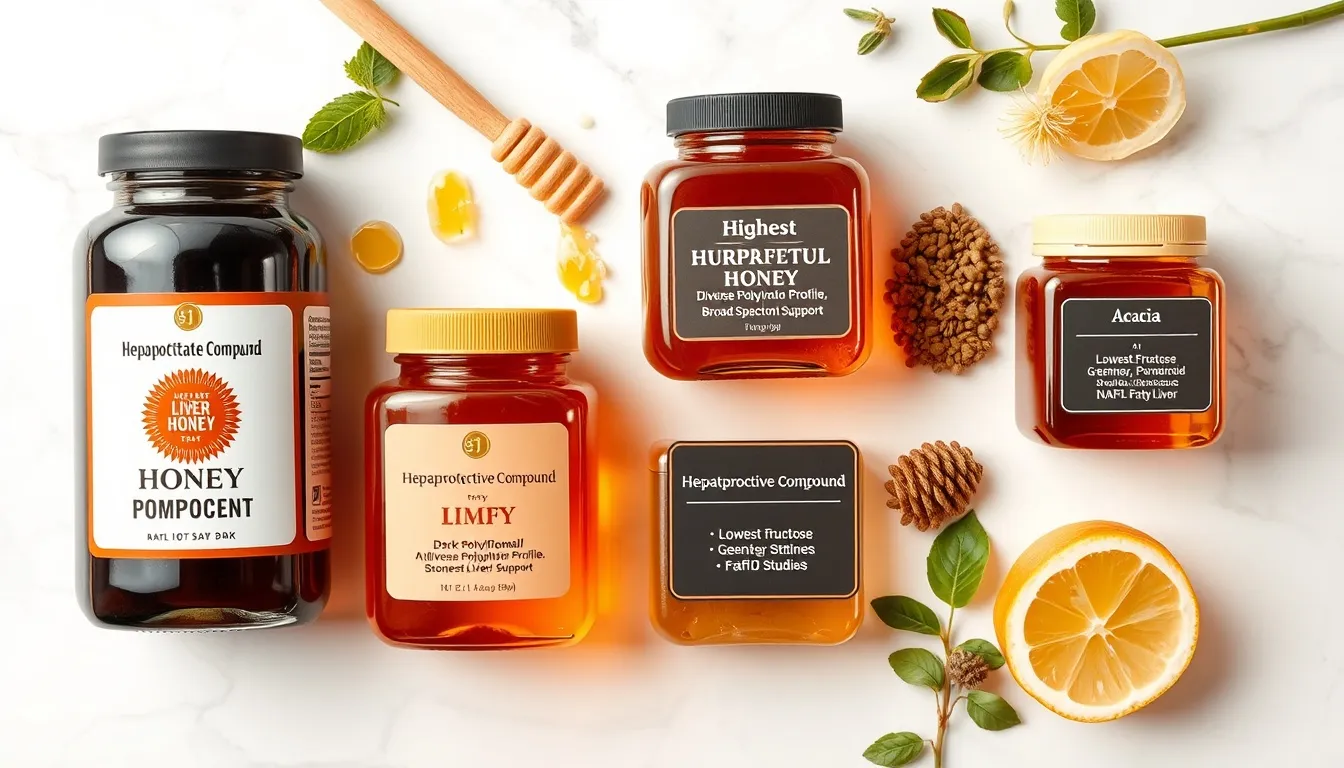
If liver health is a priority, the honey varieties with the strongest hepatoprotective evidence and highest relevant bioactive content include:
- **Tualang honey** — Malaysian rain forest honey with the most direct liver research. Multiple studies specifically tested tualang honey's hepatoprotective effects with positive results.
- **Manuka honey** ($35-60+ for UMF 10+) — High methylglyoxal content plus strong polyphenol profile. The hepatocyte regeneration research used manuka specifically.
- **Buckwheat honey** ($15-25, ORAC 16,000+ μmol TE/100g) — Among the highest antioxidant content of any honey variety (3-5x higher than light honeys). Dark color correlates with higher polyphenol content.
- **Thyme honey** ($15-25) — Mediterranean thyme honeys have high thymol and carvacrol content with demonstrated antioxidant and hepatoprotective activity.
- **Any dark raw honey** — Chestnut honey ($20-35) and heather honey ($30-50) also rank among the highest in polyphenol content. Generally, darker honeys have higher antioxidant content than lighter varieties. The key factor is that the honey is raw and unprocessed to preserve heat-sensitive enzymes and polyphenols.
Practical Recommendations
**For healthy adults seeking liver-friendly sweetening:** Replace refined sugar and HFCS in your diet with raw, dark honey — buckwheat honey ($15-25) offers the best antioxidant-to-price ratio, while wildflower honey ($10-18) and clover honey ($8-15) provide solid hepatoprotective compounds at lower cost. This is the most evidence-supported approach — the benefit comes from substitution, not addition.
**For people with NAFLD:** Reduce total added sugar intake as your primary goal, and talk to your doctor or dietitian about how honey fits into that plan. Acacia honey ($12-20, GI ~32) has the lowest glycemic impact of common varieties, relevant for NAFLD patients often managing insulin resistance. Do not add honey to an already high-sugar diet and expect liver benefits.
**For people with liver cirrhosis or advanced liver disease:** Consult your hepatologist about dietary sugar, including honey. Advanced liver disease impairs glucose and fructose metabolism, and general recommendations don't apply.
**For everyone:** Honey's liver benefits are secondary to foundational liver health practices — maintaining a healthy weight, limiting alcohol, exercising regularly, and avoiding unnecessary medications that stress the liver. No sweetener substitution compensates for these fundamentals.