Why This Comparison Matters
Honey and corn syrup are two of the most widely used liquid sweeteners in the world — but they could not be more different in origin, composition, and health impact. While honey is produced by bees from plant nectar through a complex enzymatic process, corn syrup is an industrial product manufactured by breaking down corn starch with enzymes and acids.
The distinction matters because corn syrup — particularly high-fructose corn syrup (HFCS) — has become the dominant sweetener in the American food supply, found in everything from soft drinks and bread to condiments and cereal. Americans consume an estimated 40-60 pounds of corn-based sweeteners per person per year, making this comparison directly relevant to daily dietary choices.
This guide compares honey and corn syrup across nutrition, health research, glycemic impact, cooking applications, and cost — so you can make informed decisions about which sweetener belongs in your kitchen and your body.
Nutritional Comparison: What's Actually Inside
The nutritional gap between honey and corn syrup is one of the starkest among any sweetener comparison. While both are liquid sugars, honey contains hundreds of bioactive compounds that corn syrup completely lacks.
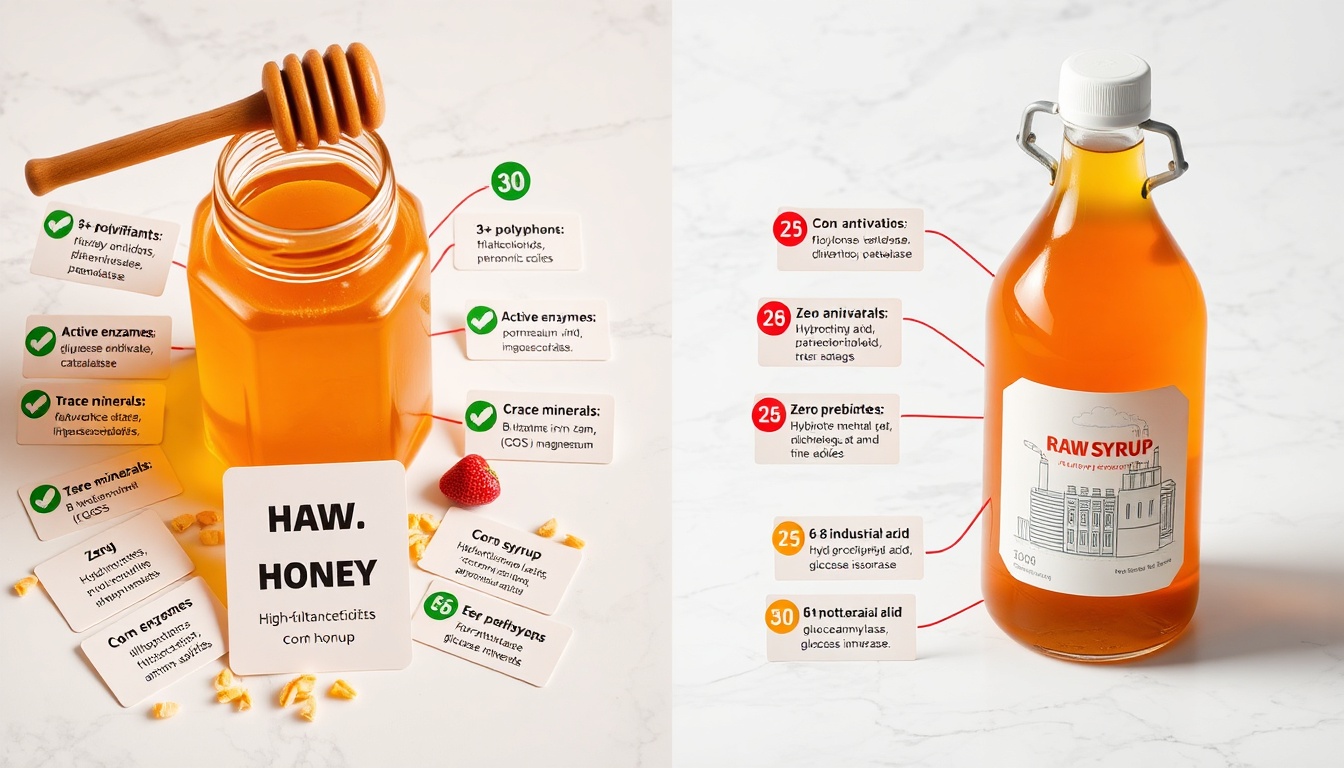
**Honey (1 tablespoon / 21g):** 64 calories, 17.2g sugars (fructose ~38%, glucose ~31%, maltose, sucrose), 30+ polyphenol antioxidants (flavonoids, phenolic acids), active enzymes (glucose oxidase, diastase, invertase, catalase), prebiotic oligosaccharides (FOS, GOS), trace minerals (potassium, iron, zinc, magnesium, copper, manganese), B vitamins (B2, B3, B5, B6), vitamin C, amino acids, and organic acids — see our honey nutrition guide for the full breakdown.
**Regular corn syrup (1 tablespoon / 21g):** 62 calories, 17g sugars (primarily glucose with some maltose and higher saccharides), zero antioxidants, zero enzymes, zero prebiotics, negligible minerals, negligible vitamins. It is, nutritionally, pure sugar in liquid form.
**High-fructose corn syrup (HFCS-55, 1 tablespoon):** 53 calories, 14.4g sugars (55% fructose, 42% glucose — close to honey's ratio but as free, unbound sugars without any accompanying bioactive compounds). HFCS-55 is the most common formulation used in beverages, while HFCS-42 is used in processed foods.
The critical difference is not just calories or sugar grams — it's what accompanies those sugars. Honey delivers its sweetness within a matrix of antioxidants, enzymes, and prebiotics that actively modulate how the body processes those sugars. Corn syrup delivers naked sugar with no nutritional co-travelers whatsoever.
Pro Tip
When reading ingredient labels, corn syrup appears under many names: corn syrup, corn syrup solids, high-fructose corn syrup, HFCS, glucose syrup, glucose-fructose syrup (in the UK/EU), and isoglucose. All are industrially processed corn starch derivatives.
Get the Honey Buyer's Cheat Sheet (free PDF)
16 varieties on one page — color, flavor, best use and what a fair price looks like — from the 268 honeys we track.
Health Effects: What Clinical Research Shows
The health research divergence between honey and corn syrup is dramatic. While honey has a growing body of evidence showing neutral-to-positive health effects, HFCS consumption has been linked to multiple metabolic concerns.
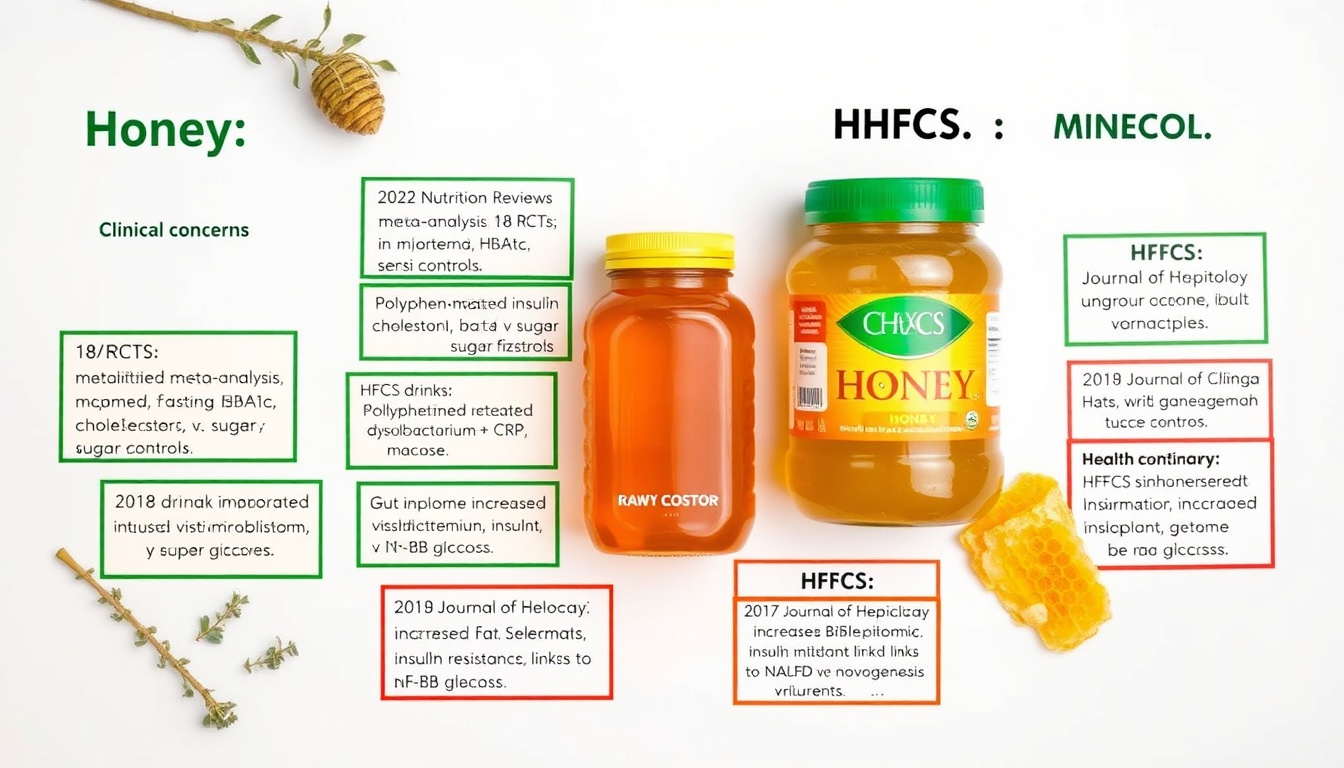
**Honey's clinical evidence:** A 2022 meta-analysis in Nutrition Reviews analyzing 18 randomized controlled trials found that honey consumption improved markers of glycemic control (lower fasting glucose, HbA1c), reduced total cholesterol and LDL cholesterol, lowered triglycerides, reduced inflammatory marker CRP, and raised HDL cholesterol — compared to sugar controls. These benefits were attributed to honey's polyphenol content, not its sugars. See our honey vs sugar comparison for the complete evidence.
**HFCS health concerns:** A 2009 study in the Journal of Clinical Investigation found that fructose-sweetened beverages (mimicking HFCS consumption) increased visceral adiposity, promoted dyslipidemia, and decreased insulin sensitivity compared to glucose-sweetened beverages over 10 weeks. A landmark 2015 study in the Journal of Hepatology linked excessive HFCS consumption to non-alcoholic fatty liver disease (NAFLD) through de novo lipogenesis — the conversion of fructose to fat in the liver.
The liver metabolism pathway is key: when fructose arrives at the liver as free, unbound molecules (as in HFCS), it bypasses the normal glucose regulatory mechanisms and is preferentially converted to fat. Honey's fructose arrives within a polyphenol matrix that appears to modulate this pathway — a 2019 study in the European Journal of Nutrition found that honey polyphenols inhibited hepatic lipogenesis enzymes, partially explaining why honey and HFCS produce divergent metabolic outcomes despite similar fructose content.
Additionally, a 2017 study in the journal Nutrients found that HFCS consumption disrupted the gut microbiome, reducing beneficial Bifidobacterium and Lactobacillus populations. In contrast, raw honey's prebiotic oligosaccharides have been shown to increase these same beneficial bacteria — see our honey and gut health guide.
Carbohydrate and Label Comparison
Honey and corn syrup are caloric liquid sweeteners that contribute carbohydrate and added sugar. Ingredient composition and processing differ, but neither category is a diabetes treatment.
Compare equal recipe servings using each product's Nutrition Facts panel. The honey carbohydrate and label guide explains serving-size total-carbohydrate counting and why neither sweetener is medically preferred for everyone.
For cooking, also compare flavor, viscosity and crystallization behavior; those functional differences do not make the products nutritionally interchangeable.
Inflammation and Chronic Disease
Perhaps the most consequential difference between honey and corn syrup lies in their inflammatory effects — and inflammation is now understood as the driver behind most chronic diseases.
Honey's 30+ polyphenols, particularly chrysin, pinocembrin, quercetin, and caffeic acid phenethyl ester (CAPE), actively inhibit the NF-κB inflammatory pathway — the master switch for inflammation in the body. The 2022 Nutrition Reviews meta-analysis found that honey consumption reduced C-reactive protein (CRP), a key inflammatory biomarker. Our honey for inflammation guide covers the five mechanisms in detail.
HFCS consumption drives the opposite effect. A 2018 study in the American Journal of Clinical Nutrition found that HFCS-sweetened beverages increased uric acid levels, which promotes inflammatory pathways. Elevated uric acid from fructose metabolism has been linked to gout, hypertension, kidney disease, and metabolic syndrome in multiple large-scale epidemiological studies.
The cardiovascular implications are significant. While honey has been shown to improve cholesterol profiles and reduce triglycerides (see our honey and cholesterol guide), HFCS consumption has been consistently associated with dyslipidemia — elevated triglycerides, increased small dense LDL particles, and reduced HDL cholesterol. A 2014 study in JAMA Internal Medicine found a significant association between added sugar consumption (primarily from HFCS-containing foods) and cardiovascular mortality.
Manufacturing and Processing
Understanding how each sweetener is made reveals why their health profiles differ so dramatically.
**How honey is made:** Bees collect nectar from flowers, add enzymes (invertase, glucose oxidase, diastase), reduce moisture through evaporation in the hive, and cap completed honey with beeswax. Raw honey is extracted from the comb with minimal processing — typically just straining to remove wax particles. The enzymatic process creates the unique bioactive compounds that distinguish honey from simple sugar solutions. See our how bees make honey guide for the complete process.
**How corn syrup is made:** Corn starch is extracted from kernels, then treated with hydrochloric acid and/or industrial enzymes (alpha-amylase, glucoamylase) to break polysaccharide chains into glucose molecules. For HFCS, an additional step uses glucose isomerase enzymes to convert a portion of glucose to fructose, followed by liquid chromatography to separate and blend the desired fructose-to-glucose ratio. The entire process involves 6-8 industrial chemical and enzymatic steps.
The processing distinction matters for a practical reason: honey is a minimally processed whole food with intact bioactive compounds, while corn syrup is a highly refined industrial product that retains nothing from the original corn kernel except the starch-derived sugars. This is analogous to the difference between whole fruit and fruit-flavored candy — the sugars may be similar, but the health impact is not.
Cooking and Baking Comparison
In the kitchen, honey and corn syrup serve different functions, and they are not always interchangeable.
**Corn syrup's advantage — preventing crystallization:** Corn syrup is prized in candy-making, caramel, and pecan pie because its glucose molecules interfere with sucrose crystal formation, keeping textures smooth and glossy. This is a genuine functional advantage that honey cannot fully replicate.
**Honey's advantages — flavor, browning, and moisture:** Honey adds complex flavor (floral, fruity, herbal notes depending on variety), promotes better Maillard browning due to its fructose content, and acts as a humectant that keeps baked goods moist longer. See our baking substitution guide for conversion ratios.
- **Pecan pie and candy:** Corn syrup is traditional and functional here. Honey substitution works but changes texture and flavor — use a mild variety like acacia or clover if substituting
- **Marinades and glazes:** Honey is superior — its enzymatic content aids meat tenderization, and its sugars caramelize beautifully under heat
- **Beverages and smoothies:** Honey is the clear choice — it adds antioxidants and flavor complexity. Corn syrup adds only sweetness
- **Granola bars and energy foods:** Honey provides sustained energy via dual-speed sugar delivery (fast glucose + sustained fructose) with prebiotic benefits. Corn syrup provides only a glucose spike
- **Salad dressings and sauces:** Honey contributes flavor depth and emulsification. Hot honey in particular has become a major culinary trend
Environmental and Ethical Considerations
The environmental footprint of these two sweeteners diverges as much as their nutritional profiles.
Honey production supports pollinator ecosystems. Managed honeybee colonies pollinate an estimated $15 billion worth of US crops annually, and beekeeping practices — when done responsibly — maintain bee populations that benefit wild plant ecosystems. Buying honey supports the beekeeping industry that sustains these critical pollinators. See our bee-friendly gardening guide for how to support pollinators.
Corn syrup production relies on industrial corn monoculture — one of the most environmentally intensive agricultural systems in the US. Corn farming accounts for approximately 40% of US agricultural fertilizer use and significant pesticide application. The conversion of corn to HFCS requires substantial industrial energy and water. Additionally, a significant portion of US corn is genetically modified (over 90%), which is a consideration for consumers concerned about GMO exposure.
Price is the primary reason HFCS dominates the food industry. Corn syrup costs $0.15-0.30 per pound wholesale due to massive corn subsidies and industrial efficiency. Quality raw honey costs $8-20 per pound at retail. This 30-60x price difference explains why food manufacturers overwhelmingly choose corn syrup — it's a cost decision, not a health or quality one.
Honey vs Corn Syrup: The Verdict
This comparison is not close. Honey is the superior sweetener by virtually every health metric:
- **Nutrition:** Honey contains 30+ antioxidants, active enzymes, prebiotics, minerals, and vitamins. Corn syrup contains zero bioactive compounds
- **Clinical evidence:** Honey improves cholesterol, reduces inflammation, supports gut health, and modulates blood sugar. HFCS consumption is associated with fatty liver, dyslipidemia, gut dysbiosis, and metabolic syndrome
- **Glycemic impact:** Honey (especially low-GI varieties) produces a moderated blood sugar response. Regular corn syrup produces one of the highest glycemic responses of any sweetener
- **Inflammation:** Honey inhibits NF-κB inflammatory pathways. HFCS promotes inflammation via uric acid and metabolic disruption
- **Environment:** Honey supports pollinators. Corn syrup relies on industrial monoculture
- **Taste:** Honey offers complex, variety-specific flavors. Corn syrup offers only neutral sweetness
Pro Tip
The one scenario where corn syrup has a legitimate functional advantage is candy-making and recipes requiring crystallization prevention. For all other uses — cooking, baking, beverages, spreads, and direct consumption — honey is the healthier and more flavorful choice.
How to Reduce Corn Syrup in Your Diet
For those looking to swap corn syrup for honey, here are practical strategies:
- **Read labels carefully:** HFCS appears in unexpected products — bread, yogurt, ketchup, salad dressing, granola bars, crackers, and canned soups. Check ingredient lists and choose products sweetened with honey or without added sugars
- **Start with beverages:** Sweetened drinks are the single largest source of HFCS in the American diet. Switch to honey water, honey and green tea, or honey lemon water
- **Make your own condiments:** Homemade honey-based salad dressings, BBQ sauce, and marinades eliminate hidden HFCS and taste better
- **Choose honey for baking:** Use our baking conversion guide to substitute honey in recipes calling for corn syrup — reduce liquid by 3 tablespoons per cup of honey and lower oven temperature by 25°F
- **Choose the right honey variety:** For general cooking, mild clover or wildflower honeys are versatile. For health benefits, darker honeys like buckwheat offer more antioxidants
Safety and Considerations
Both sweeteners are still sugars and should be consumed in moderation:
- **Infants under 12 months:** Never give raw honey to babies due to infant botulism risk. Corn syrup also carries a small botulism risk from the same environmental spore contamination — see our baby honey safety guide
- Diabetes note — Neither honey nor the compared sweetener is medically preferred. Compare exact serving-size total carbohydrate and added sugars with the honey carbohydrate and label guide, then follow an individualized care plan.
- **Allergies:** Honey may trigger reactions in people with bee or pollen allergies. Corn syrup allergies are rare but possible in people with severe corn allergies
- **Weight management:** Substituting honey for corn syrup does not automatically cause weight loss. The key is reducing total added sugar intake — see our honey for weight loss guide
Sweetener next steps
Diabetes note — Neither honey nor the compared sweetener is medically preferred. Compare exact serving-size total carbohydrate and added sugars with the honey carbohydrate and label guide, then follow an individualized care plan.
