Why Infused Honey Is the Easiest DIY Food Gift
Infused honey takes two ingredients, zero cooking skill, and about 5 minutes of active work. You steep herbs, spices, or citrus in raw honey, wait a week or two, and end up with a specialty product that sells for $15-25 per jar at farmers markets. Making it yourself costs a fraction of that.
The process works because honey is a natural solvent — its sugars and low water content slowly extract essential oils, flavors, and aromatic compounds from whatever you steep in it. Unlike infused oils, there is virtually no risk of botulism in properly made infused honey because honey's low moisture (below 18%) and acidic pH (3.2-4.5) prevent bacterial growth.
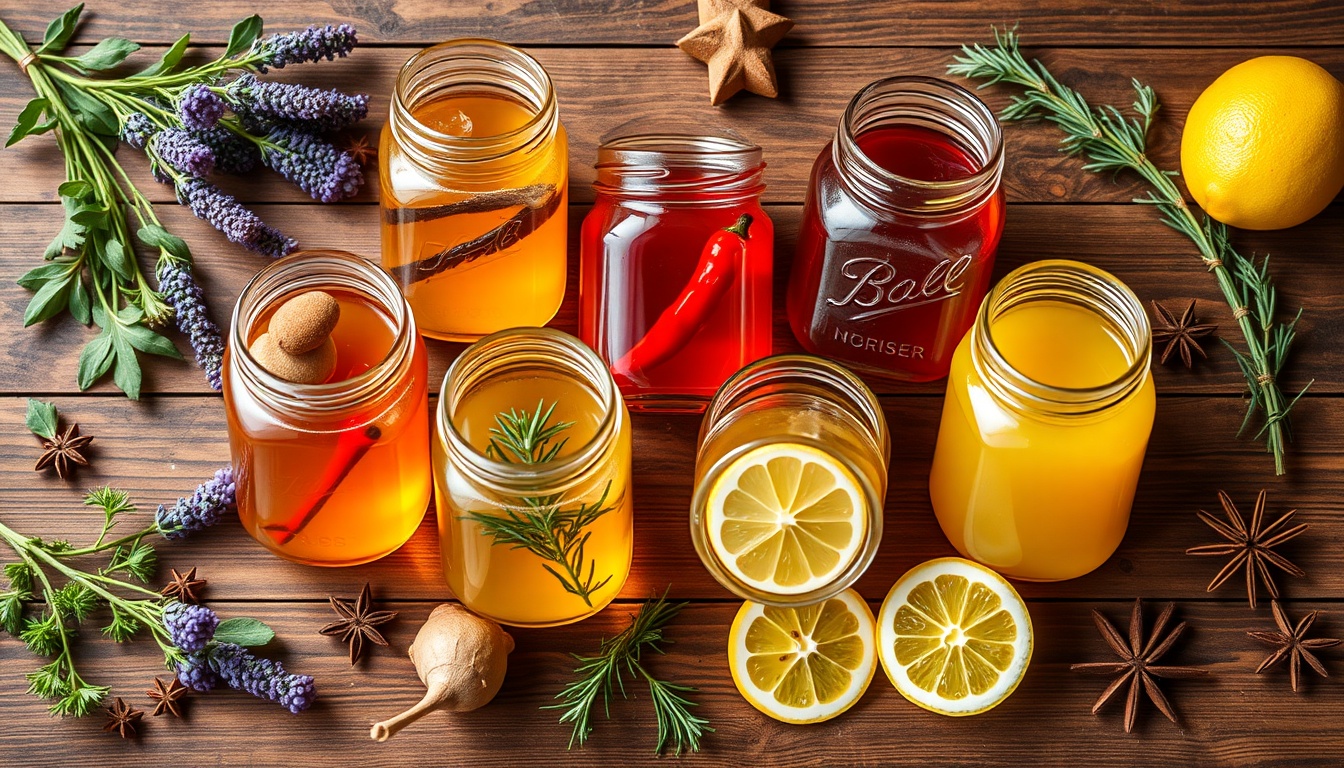
This guide covers 8 of the most popular infused honey flavors, the two main methods (cold infusion vs. warm infusion), and practical tips for getting the best results at home.
Cold Infusion vs. Warm Infusion: Which Method to Use
There are two ways to infuse honey, and each has trade-offs. The method you choose depends on what you are infusing and how quickly you need it ready.
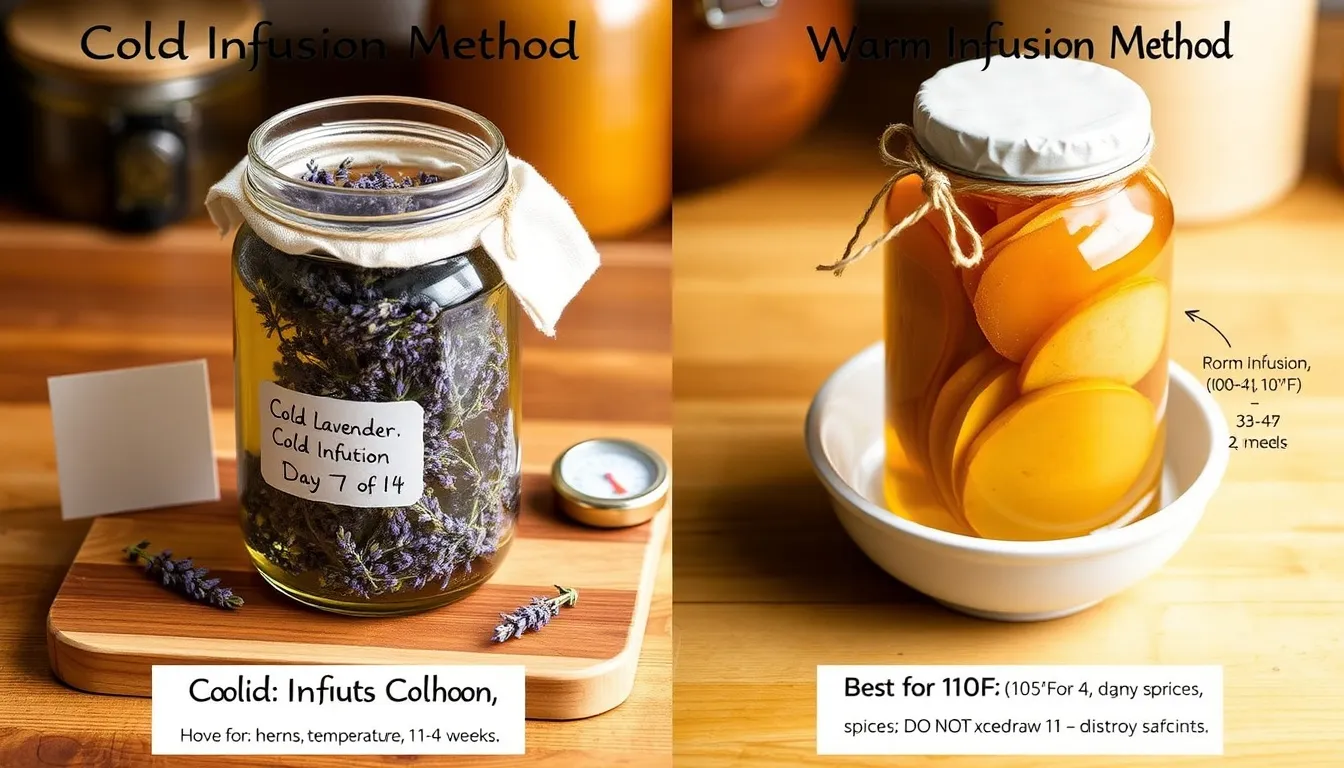
Cold infusion means adding your ingredient directly to room-temperature honey and waiting 1-4 weeks. This preserves all the raw enzymes, beneficial compounds, and delicate flavors in the honey. It is the best method for herbs, vanilla, and cinnamon — anything where slow, gentle extraction produces a more nuanced flavor.
Warm infusion means gently heating the honey to around 100-110°F (38-43°C) — warm enough to thin the honey and speed up extraction, but below the 110°F threshold that degrades raw honey's enzymes. This method works well for harder ingredients like ginger root and dried chili peppers, cutting infusion time from weeks to days. Never boil or microwave honey — high heat destroys beneficial enzymes and can scorch the sugars.
Pro Tip
If your honey crystallizes during infusion, that is completely normal. Gently warm the jar in a bowl of warm water (not hot) to re-liquefy it.
Get the Honey Buyer's Cheat Sheet (free PDF)
16 varieties on one page — color, flavor, best use and what a fair price looks like — from the 268 honeys we track.
1. Lavender Honey
Lavender honey is the most popular infusion and a staple at artisan food markets. It pairs beautifully with goat cheese, scones, Greek yogurt, and chamomile tea. Use culinary lavender (Lavandula angustifolia), not ornamental varieties, which can taste soapy.
- Add 2 tablespoons dried culinary lavender buds per cup of honey
- Use the cold infusion method — stir buds into room-temperature honey
- Infuse for 1-2 weeks, tasting daily after day 5
- Strain through fine mesh or cheesecloth when the flavor is right
- Acacia or clover honey works best — mild bases let the lavender shine
Pro Tip
Start with less lavender than you think you need. It intensifies over time, and over-infused lavender honey tastes perfumey.
2. Hot Honey (Chili-Infused)
Hot honey has become one of the fastest-growing condiments in the US, popularized by brands like Mike's Hot Honey. The sweet-heat combination is addictive on fried chicken, pizza, biscuits, and charcuterie boards. Making it at home lets you control the heat level exactly.
- Add 3-5 dried chili peppers (cayenne, chile de arbol, or crushed red pepper flakes) per cup of honey
- Use the warm infusion method — gently heat honey to 100°F and add peppers
- Steep for 5 minutes to 2 hours depending on desired heat level
- For a milder hot honey, remove seeds from peppers before infusing
- Strain or leave the pepper flakes in for continued heat development
- Wildflower or buckwheat honey adds depth to the spicy-sweet profile
3. Garlic Honey
Fermented garlic honey is a folk remedy that has gone viral on social media — and for good reason. The combination produces a mellow, umami-rich condiment that works as a glaze for roasted vegetables, a marinade base, or a drizzle on pizza. Over time, the garlic softens and the honey takes on a complex, almost balsamic quality.
- Peel and lightly crush 8-10 garlic cloves per cup of honey
- Submerge the cloves completely in honey in a clean jar
- Leave the lid loosely on — the mixture will produce small amounts of CO2 as it ferments
- Flip the jar daily for the first week to keep cloves coated
- Ready in 2-4 weeks; flavor deepens over months (some people age it for a year)
- Both the honey and the garlic cloves are edible and delicious
Pro Tip
Garlic honey is one of the few infusions that undergoes a light fermentation. The bubbles are normal. If garlic floats above the honey line, push it back down — exposed garlic can grow mold.
4. Vanilla Bean Honey
Vanilla-infused honey is luxurious and versatile. Use it in coffee, drizzled over pancakes and waffles, stirred into oatmeal, or as a base for honey butter. One vanilla bean infuses a full cup of honey with deep, warm flavor.
- Split 1 vanilla bean lengthwise and scrape the seeds into a cup of honey
- Drop the scraped pod in as well for maximum flavor
- Cold infuse for 1-2 weeks, stirring every few days
- The black vanilla seed specks in the honey look beautiful — no need to strain
- Use mild honey (clover, acacia, orange blossom) so vanilla flavor comes through
5. Cinnamon Honey
Cinnamon and honey is an ancient combination — Ayurvedic medicine has paired them for thousands of years. Infused cinnamon honey is perfect in tea, on toast, mixed into yogurt, or drizzled over baked apples.
- Add 3-4 cinnamon sticks (Ceylon cinnamon preferred) per cup of honey
- Cold infuse for 2-4 weeks — cinnamon is slow to release flavor
- Alternatively, warm-infuse at 100°F for faster results (3-5 days)
- Remove sticks when flavor reaches your preference
- Avoid ground cinnamon — it makes the honey gritty and cloudy
6. Rosemary Honey
Rosemary honey is a Mediterranean classic. In Spain, romero (rosemary) honey from bees that forage on wild rosemary fields is one of the most prized single-origin varieties. Infusing your own is easy and the herbal, piney notes are perfect with cheese, roasted meats, and crusty bread.
- Add 3-4 fresh rosemary sprigs per cup of honey (bruise slightly to release oils)
- Cold infuse for 1-2 weeks
- Strain out the rosemary when it reaches your preferred intensity
- Works well with both mild honey (clover) and more robust varieties (wildflower)
- Try it as a glaze for roasted lamb or drizzled over grilled peaches
7. Ginger Honey
Ginger-infused honey is a powerhouse home remedy for sore throats and cold symptoms. It is also outstanding in tea, stir-fry sauces, and salad dressings. The warm, spicy bite of fresh ginger pairs naturally with honey's sweetness.
- Peel and thinly slice 2-3 inches of fresh ginger root per cup of honey
- Use the warm infusion method for best results — gently heat to 100°F
- Infuse for 3-7 days, tasting periodically
- Strain through fine mesh if you want clear honey, or leave slices in
- Add a few slices of fresh ginger honey to hot water for an instant throat-soothing tea
Pro Tip
Dried ginger works in a pinch (use 1 tablespoon per cup) but fresh ginger produces a much brighter, more complex flavor.
8. Lemon Honey
Lemon honey is the simplest infusion and one of the most useful. It is a natural pairing — lemon and honey together in hot water is the most popular home remedy for colds worldwide. Infusing them ahead of time means you always have it ready.
- Add zest of 2 lemons per cup of honey (use a microplane for thin strips)
- Avoid the white pith — it adds bitterness
- Cold infuse for 5-7 days, then strain
- Store in the refrigerator if using fresh zest (the small amount of moisture from the zest shortens shelf life)
- For longer shelf life, use dried lemon peel instead of fresh
- Perfect stirred into tea, drizzled over salmon, or mixed into vinaigrettes
Storage, Shelf Life, and Gift Ideas
Most infused honeys last 2-3 months at room temperature and up to a year in the refrigerator. The exceptions are infusions made with fresh ingredients (fresh ginger, fresh lemon zest, fresh garlic) — these introduce small amounts of moisture and should be refrigerated and used within 1-2 months.
Dried herb and spice infusions (lavender, cinnamon, dried chili) are more shelf-stable because they add negligible moisture. These can last 6+ months at room temperature in a sealed jar — and pure honey itself essentially never expires.
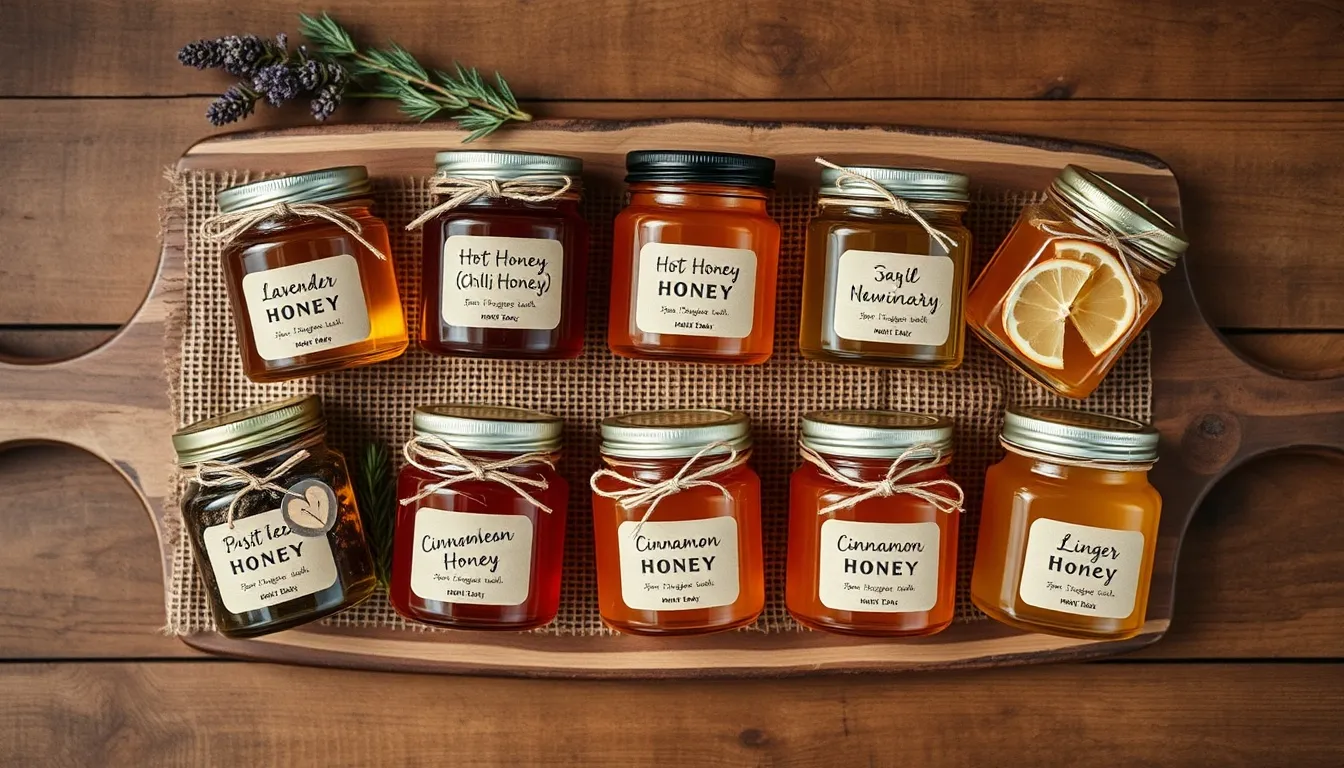
Infused honey makes an outstanding gift. Small 4-8 oz jars with hand-written labels cost under $3 each to make and look like a premium artisan product. Popular gift combinations include a 3-pack of lavender, hot honey, and vanilla bean — or a sampler set with all 8 flavors in 2 oz jars.
- Use clean, dry glass jars with tight-fitting lids
- Label each jar with the flavor, date made, and any allergens
- Always use raw honey for the best flavor and health benefits
- Avoid adding water or juice to honey — it will ferment or spoil
- If gifting, include a card with pairing suggestions for each flavor
Health Benefits of Specific Infusions
Beyond flavor, many infused honeys combine the inherent nutritional benefits of raw honey with the bioactive compounds of the infusion ingredient. Several combinations have research-backed health applications.
Cinnamon honey is one of the most studied combinations. Ceylon cinnamon contains cinnamaldehyde, which has demonstrated blood sugar-regulating effects in multiple clinical trials. A meta-analysis of 10 RCTs found that cinnamon supplementation reduced fasting blood glucose by an average of 24 mg/dL. Pairing it with honey — which has its own moderate glycemic index of 58 — creates a functional food with genuine metabolic benefits when consumed regularly.
Ginger honey combines two potent anti-inflammatory agents. Gingerols in fresh ginger inhibit COX-2 and NF-κB inflammatory pathways, while honey's polyphenols work through complementary mechanisms. This makes ginger-infused honey particularly useful during cold and flu season, and for people with chronic inflammatory conditions.
Garlic honey supports gut health through multiple mechanisms. The fermentation process produces S-allyl cysteine (SAC), a bioavailable organosulfur compound with antioxidant and cardiovascular benefits. Meanwhile, honey's prebiotic oligosaccharides (FOS and GOS) feed beneficial gut bacteria. Aged garlic honey is essentially a probiotic-prebiotic combination in a single jar.
Turmeric honey (sometimes called "golden honey") pairs curcumin's anti-inflammatory effects with honey's own bioactive compounds. The key limitation of turmeric is its poor bioavailability — adding a pinch of black pepper increases curcumin absorption by up to 2,000%. If making turmeric-infused honey, include whole black peppercorns in the infusion.