Why Honey Might Help with Headaches
Headaches are among the most common health complaints worldwide — the WHO estimates that nearly half of all adults experience at least one headache per year, and migraines alone affect over 1 billion people globally. While over-the-counter painkillers are the go-to treatment, many people search for natural alternatives that address underlying causes rather than just masking symptoms.
Honey has been used as a headache remedy in traditional medicine systems for centuries — Ayurvedic practitioners recommended honey with warm water for headaches, and ancient Greek physicians prescribed honey-based preparations for head pain. Modern science is beginning to explain why these traditional uses may have had merit.
The connection between honey and headache relief isn't about a single magic compound. Instead, honey addresses several common headache triggers simultaneously: blood sugar fluctuations, inflammation, dehydration, and micronutrient deficiencies. Understanding these mechanisms helps you use honey strategically rather than hoping for a miracle cure.
The Blood Sugar–Headache Connection
Hypoglycemia (low blood sugar) is one of the most underrecognized headache triggers. When blood glucose drops — from skipping meals, fasting, or eating high-glycemic foods that cause a spike-and-crash cycle — the brain responds with pain signals. The brain consumes roughly 20% of the body's glucose supply despite being only 2% of body weight, making it exquisitely sensitive to blood sugar fluctuations.
This is where honey's composition offers an advantage over refined sugar. Honey contains a unique fructose-to-glucose ratio (approximately 40:30) that results in slower, more sustained energy release — the fructose component is metabolized primarily by the liver without causing the rapid insulin spike that glucose alone triggers. Glycemic impact varies by variety: acacia honey has a low GI of ~32 (vs table sugar's GI 65), while common clover honey averages ~69 (Ischayek & Kern 2006). Even higher-GI varieties produce more stable energy delivery than pure sucrose due to this dual-phase metabolism.
A 2018 study published in the Journal of Food Science and Technology confirmed that honey consumption produces a more gradual blood glucose curve compared to sucrose, with a lower peak and slower decline. For headache sufferers whose attacks are triggered by blood sugar drops — particularly those who notice headaches when they skip breakfast or during afternoon energy slumps — this more stable energy delivery may help prevent the glucose crashes that trigger pain.
Additionally, honey's natural glucose provides immediate fuel that the brain can use within minutes of consumption, while the fructose component provides sustained energy over the following 1-2 hours. This dual-phase energy release makes honey particularly useful at the onset of a hypoglycemic headache.
Pro Tip
If you frequently get headaches in the late morning or mid-afternoon, blood sugar instability may be a trigger. Some people pair raw honey with a protein source (nuts, yogurt) to provide both immediate and sustained energy.
Get the Honey Buyer's Cheat Sheet (free PDF)
16 varieties on one page — color, flavor, best use and what a fair price looks like — from the 268 honeys we track.
Anti-Inflammatory Mechanisms
Neuroinflammation plays a central role in migraine pathophysiology. During a migraine attack, the trigeminovascular system activates, releasing inflammatory neuropeptides (CGRP, substance P) that cause vasodilation, mast cell degranulation, and sensitization of pain pathways. Chronic low-grade inflammation can lower the threshold for these attacks.
Honey contains over 30 polyphenol compounds — including chrysin, quercetin, kaempferol, galangin, and pinocembrin — that have documented anti-inflammatory effects. Several of these compounds specifically target pathways relevant to headache and migraine.
- NF-κB pathway inhibition — Honey polyphenols suppress the NF-κB signaling cascade, which is a master regulator of inflammatory gene expression. In migraines, NF-κB activation in trigeminal ganglion neurons amplifies pain signaling. Chrysin and galangin in honey have shown NF-κB inhibitory activity in multiple cell studies.
- COX-2 suppression — Cyclooxygenase-2 (COX-2) produces prostaglandins that promote inflammation and pain. This is the same enzyme targeted by NSAIDs like ibuprofen. Honey flavonoids — particularly quercetin and kaempferol — inhibit COX-2 expression, providing a mechanism similar (though milder) to conventional painkillers.
- Nitric oxide modulation — Excessive nitric oxide (NO) is implicated in migraine vasodilation and the throbbing pain characteristic of attacks. Honey polyphenols help regulate NO production by modulating inducible nitric oxide synthase (iNOS), potentially reducing the vascular component of migraines.
- CGRP pathway — Calcitonin gene-related peptide (CGRP) is now recognized as a key mediator of migraines, and anti-CGRP drugs (gepants, monoclonal antibodies) represent the newest class of migraine treatments. While no direct studies have tested honey's effect on CGRP, quercetin has demonstrated CGRP-modulating activity in preclinical models.
Magnesium, Minerals, and Migraine Prevention
Magnesium deficiency is one of the most well-established nutritional risk factors for migraines. The American Migraine Foundation recognizes magnesium supplementation (400-600mg daily) as an evidence-based preventive strategy, and multiple randomized controlled trials have shown that magnesium reduces migraine frequency by 40-50%.
Honey contains magnesium in modest amounts — approximately 1-2mg per tablespoon for light honeys and 3-6mg for darker varieties. While this alone won't meet the therapeutic threshold for migraine prevention, it contributes to daily intake alongside other dietary sources. More importantly, honey provides magnesium in a highly bioavailable food matrix alongside other minerals that support absorption.
Dark honeys provide meaningfully more minerals: buckwheat honey contains approximately 5mg magnesium, 50mg potassium, and 0.5mg iron per tablespoon — 3-5x more than lighter varieties. For headache sufferers, this mineral profile offers additional benefits: potassium helps regulate blood pressure (relevant for hypertension-related headaches), and iron supports oxygen delivery to the brain (relevant for anemia-related headaches).
Honey also contains B vitamins (B2, B6) in small amounts. Riboflavin (B2) at 400mg daily is another evidence-based migraine preventive, and while honey provides only trace amounts, every dietary contribution helps for individuals with marginal nutrient status.
Honey and Dehydration Headaches
Dehydration is a remarkably common headache trigger that many people overlook. Even mild dehydration (1-3% body weight loss) can trigger headaches, and a 2020 study in the Journal of Clinical Medicine found that inadequate fluid intake was associated with increased headache frequency and severity.
Honey water — warm water with honey stirred in — addresses dehydration headaches through multiple pathways. The natural sugars in honey enhance intestinal water absorption through sodium-glucose cotransport mechanisms, the same principle behind oral rehydration solutions. Honey also provides electrolytes (potassium, sodium, chloride) that plain water lacks, supporting better fluid retention.
For headaches triggered by alcohol consumption (hangover headaches), honey may be particularly relevant. Alcohol-induced headaches involve dehydration, hypoglycemia, inflammatory cytokine release, and acetaldehyde toxicity. Honey addresses the first three mechanisms directly: it rehydrates, stabilizes blood sugar, and provides anti-inflammatory compounds. The fructose in honey may also support alcohol metabolism by providing substrate for hepatic enzymes, though this mechanism is less well-established.
Practical Honey Remedies for Headaches
Based on the mechanisms above, here are evidence-informed ways to use honey for headache relief and prevention.
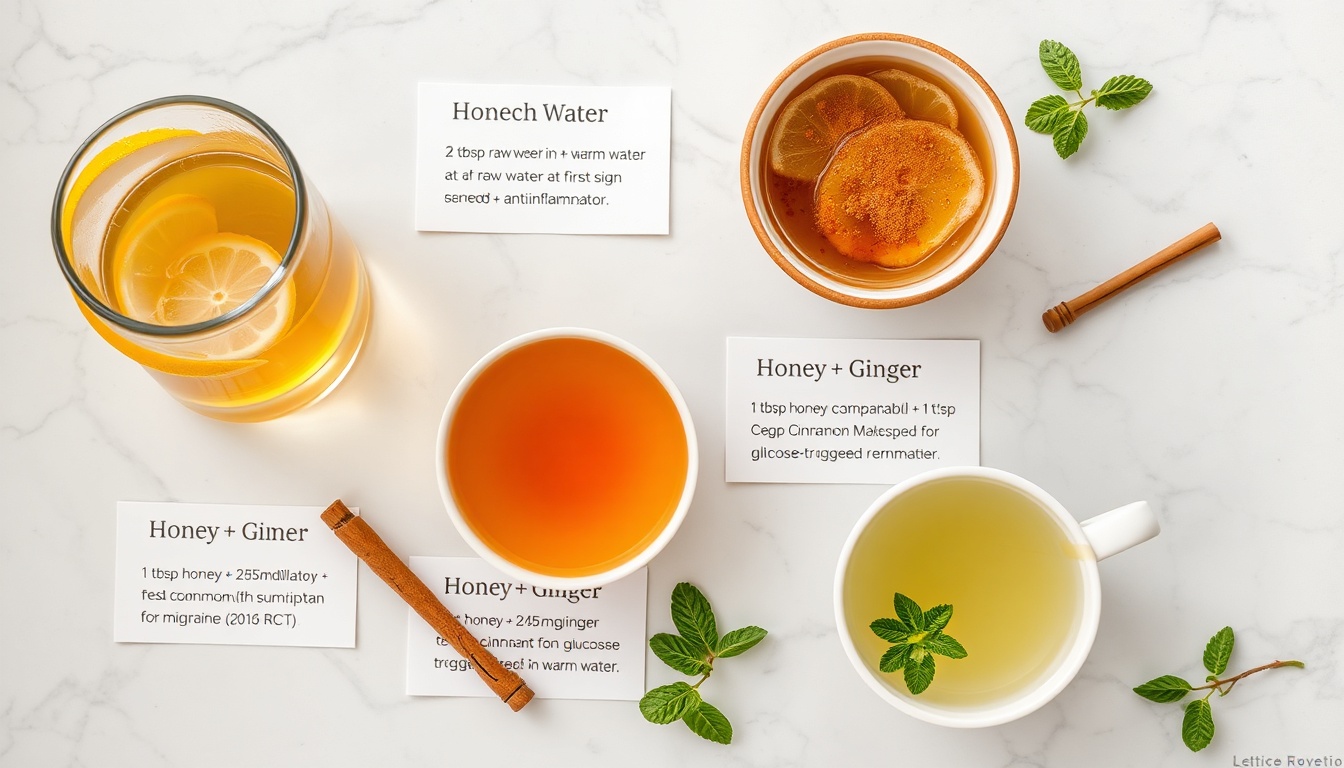
- Honey and warm water — Some people stir raw honey into a glass of warm (not hot) water when a headache starts. The warm water promotes vasodilation that can ease tension headaches, while the honey provides glucose, electrolytes, and anti-inflammatory compounds. Add a squeeze of lemon for vitamin C and additional flavonoids.
- Honey and ginger — Ginger has its own clinical evidence for migraine relief. A 2014 randomized controlled trial in Phytotherapy Research found that 250mg of ginger powder was comparable to 50mg sumatriptan (a standard migraine drug) for reducing migraine severity. Honey combined with fresh grated ginger in warm water pairs both mechanisms.
- Honey and cinnamon — Ceylon cinnamon contains cinnamaldehyde, which has anti-inflammatory and vasodilatory properties. Honey with Ceylon cinnamon in warm water is a combination particularly relevant for headaches related to blood sugar instability, as cinnamon also helps regulate glucose metabolism.
- Honey and peppermint tea — Peppermint contains menthol, which has evidence for tension headache relief (a 1996 study in Nervenarzt found topical peppermint oil as effective as acetaminophen). Peppermint tea with honey stirred in combines an analgesic and anti-inflammatory effect.
- Preventive morning honey — For people with recurrent headaches, raw honey with breakfast may help by stabilizing blood sugar through the morning, providing baseline anti-inflammatory support, and contributing to daily mineral intake. Pair with protein and healthy fats for maximum blood sugar stability.
Best Honey Types for Headaches
Not all honeys are equally beneficial for headache sufferers. The floral source, processing, and color significantly affect the relevant bioactive compounds.
- Buckwheat honey ($15-25, ORAC 16,000+) — The highest antioxidant and polyphenol content of any common honey variety. Provides the strongest anti-inflammatory effect plus the most minerals (magnesium, potassium, iron). Best choice for migraine sufferers.
- Manuka honey (UMF 10+, $35-60+) — Contains unique methylglyoxal (MGO) plus standard honey polyphenols. Its potent anti-inflammatory properties are the most extensively studied of any honey type.
- Thyme honey ($15-25) — Contains thymol and carvacrol, which have analgesic (pain-relieving) properties documented in multiple pharmacological studies. A reasonable choice for pain-predominant headaches.
- Chestnut honey ($20-35) — A dark honey with high mineral content and strong antioxidant activity. Good choice for individuals whose headaches may be linked to nutritional deficiencies.
- Budget option: Wildflower honey ($10-18) or clover honey ($8-15) — Raw honey retains enzymes, polyphenols, and heat-sensitive compounds that processed honey loses. If specialty honeys are unavailable, raw wildflower or clover is an affordable baseline option.
Pro Tip
Avoid processed, heated commercial honey for headache relief. Heating honey above 40°C (104°F) degrades enzymes and reduces polyphenol content — the very compounds responsible for anti-inflammatory and pain-modulating effects.

What Honey Cannot Do for Headaches
Being honest about limitations is important. Honey is not a replacement for proper medical evaluation and treatment of headaches, especially migraines.
Honey will not stop an acute migraine attack that's already in full swing. Once the trigeminovascular cascade is activated and central sensitization develops, you need targeted medication (triptans, gepants, or NSAIDs) — not a tablespoon of honey. Honey is more relevant for prevention and for mild-to-moderate tension headaches.
Honey will not address structural or neurological causes of headaches. Headaches caused by increased intracranial pressure, brain lesions, medication overuse, temporomandibular joint dysfunction, or cervicogenic issues require diagnosis and treatment from healthcare professionals.
The anti-inflammatory effect of honey, while real, is considerably milder than pharmaceutical anti-inflammatories. Honey polyphenols provide gentle, broad-spectrum anti-inflammatory support — useful for prevention and mild headaches, but not a substitute for ibuprofen or naproxen during moderate-to-severe attacks.
If you experience sudden severe headaches ("thunderclap" headaches), headaches with neurological symptoms (vision changes, weakness, confusion, speech difficulty), headaches that progressively worsen over days or weeks, or headaches after head trauma, seek immediate medical attention. These patterns can indicate serious conditions requiring urgent evaluation.
**Infants under 12 months must never receive honey** in any form. Honey naturally contains dormant Clostridium botulinum spores that can germinate in an infant's immature digestive system, causing potentially fatal infant botulism. This applies to all honey regardless of type or processing.
An Evidence-Based Perspective
The honest truth is that no large randomized controlled trial has specifically tested honey as a headache treatment. The mechanisms supporting honey for headaches — blood sugar stabilization, anti-inflammatory effects, mineral content, hydration support — are each individually well-documented, but the specific application to headache and migraine relief is based on mechanistic reasoning rather than direct clinical trials.
This is a common situation in nutrition research: the individual mechanisms are sound, the traditional use is longstanding, and the risk is essentially zero (honey is safe for most adults), but the specific clinical evidence for headaches is preliminary. Honey should be viewed as a supportive dietary strategy — not a primary headache treatment.
What makes honey a reasonable option is the low downside risk combined with multiple relevant mechanisms. Unlike single-target supplements (like magnesium alone or riboflavin alone), honey provides anti-inflammatory, metabolic, and nutritional support simultaneously. For someone who gets occasional tension headaches or mild migraines, incorporating raw honey into their daily routine — especially if they're replacing refined sugar — is a sensible step that aligns with broader health benefits.
For chronic migraine sufferers (15+ headache days per month), honey is best used alongside — not instead of — evidence-based preventive treatments. Work with your healthcare provider to develop a comprehensive treatment plan.