The Heated Honey Debate: Myth vs Reality
Few honey topics generate as much confusion as the question of whether heated honey is toxic. From Ayurvedic warnings that heated honey becomes "poisonous" to wellness influencers claiming honey in hot tea destroys all its benefits, the advice is often dramatic — and often wrong.
The truth is more nuanced than either side suggests. Heating honey does change its composition in measurable ways, but "toxic" is a significant overstatement of what actually happens. This guide examines the real chemistry, identifies what you genuinely lose and what you retain, and provides practical temperature guidelines for anyone who uses honey in cooking, baking, or hot beverages.
Understanding the specific compounds affected by heat — and the temperatures at which changes occur — allows you to make informed decisions rather than avoiding heated honey based on misconceptions.
What Actually Happens When You Heat Honey
Honey is a complex mixture of sugars, enzymes, antioxidants, amino acids, minerals, and volatile compounds. Heat affects each of these components differently and at different temperatures:
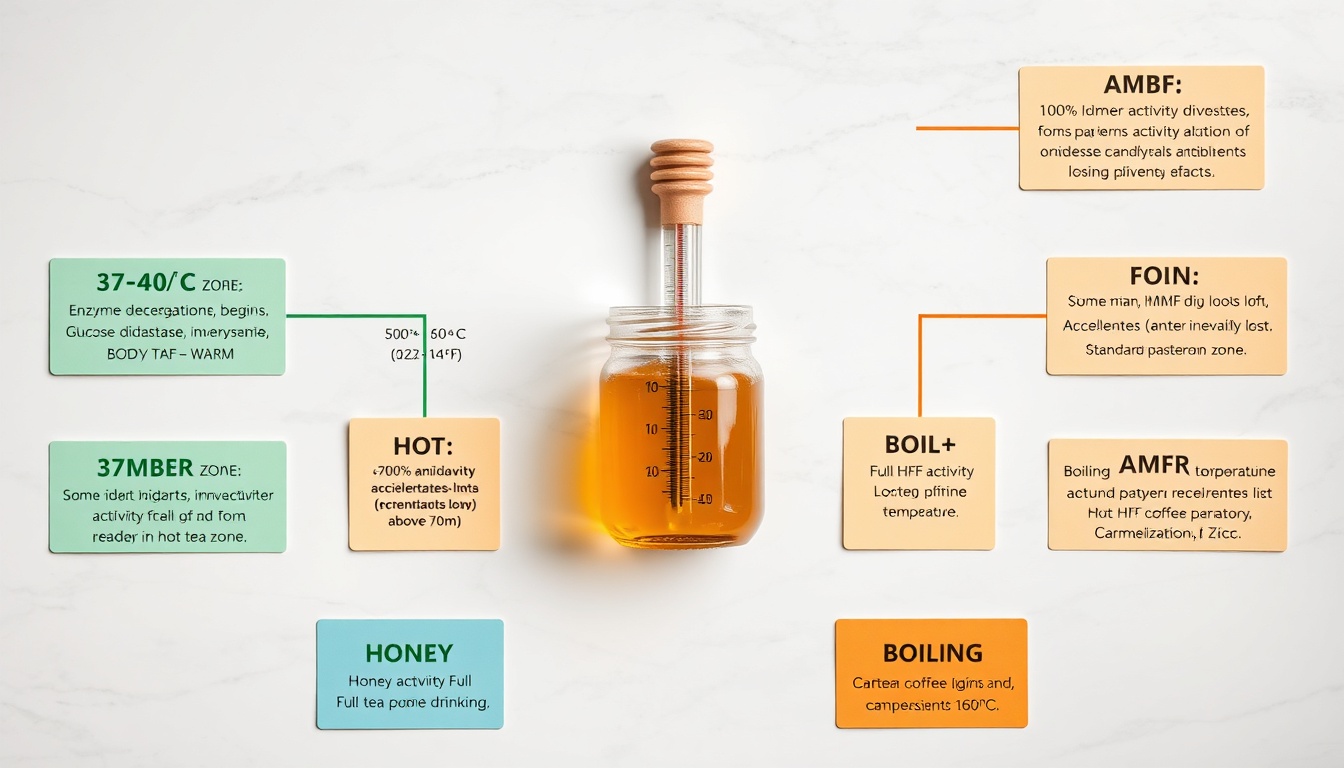
**Enzyme degradation (starts at 37-40°C / 98-104°F):** Honey contains active enzymes including glucose oxidase (which produces hydrogen peroxide, honey's main antibacterial agent), diastase (which breaks down starch), and invertase (which converts sucrose to glucose and fructose). These enzymes are proteins that begin losing activity above body temperature. Diastase — used as the standard marker for enzyme activity — loses roughly half its activity after heating to 60°C (140°F) for 30 minutes, according to a 2010 study in the Journal of Food Science and Technology.
**HMF formation (gradual above 60°C / 140°F):** Hydroxymethylfurfural (HMF) is a compound formed when fructose and glucose degrade under heat — a natural process called the Maillard reaction. Fresh honey typically contains less than 10 mg/kg HMF, while the Codex Alimentarius international standard sets the maximum at 40 mg/kg for commercial honey (80 mg/kg for tropical honeys). HMF formation accelerates significantly above 70°C (158°F) and during prolonged storage at warm temperatures.
**Antioxidant changes (complex):** This is where the heated honey story gets surprising. While some volatile antioxidants decrease with heat, studies have found that moderate heating can actually increase certain non-volatile antioxidant compounds. A 2012 study in the Journal of Food Science found that heating honey to 50-60°C for 30 minutes increased total phenolic content and antioxidant activity in some varieties — likely because heat breaks down cellular structures, releasing bound polyphenols. However, heating above 90°C for extended periods decreases total antioxidant capacity.
**Sugar caramelization (above 160°C / 320°F):** At higher baking and cooking temperatures, honey's sugars undergo caramelization, creating the characteristic browning, flavor development, and aroma that make honey valuable in baked goods and glazes. This is a standard cooking reaction, not a toxic transformation.
**Mineral stability:** Honey's mineral content — potassium, magnesium, calcium, iron, zinc — is essentially unaffected by cooking temperatures. Minerals are heat-stable elements, so the nutritional mineral value of honey remains intact regardless of how you heat it.
Get the Honey Buyer's Cheat Sheet (free PDF)
16 varieties on one page — color, flavor, best use and what a fair price looks like — from the 268 honeys we track.
Is HMF Actually Dangerous?
HMF is the compound most frequently cited as evidence that heated honey is "toxic." Here is what the toxicology research actually shows:
**HMF is everywhere in the food supply.** HMF forms naturally in any acidic, sugar-containing food that is heated or stored. Coffee contains 300-2,000 mg/kg HMF — up to 200 times more than the limit for commercial honey. Baked goods, dried fruits, caramel, fruit juices, breakfast cereals, and cola all contain significant HMF. A 2009 study in Molecular Nutrition & Food Research estimated that the average person consumes 5-150 mg of HMF daily from their regular diet.
**Animal studies require extreme doses.** The studies that found HMF toxicity used doses of 75-300 mg per kilogram of body weight in rodents — equivalent to a person eating several kilograms of heavily degraded honey daily. At realistic dietary exposure levels, HMF has not demonstrated toxicity in humans.
**Regulatory perspective:** The European Food Safety Authority (EFSA) has evaluated HMF and considers dietary exposure levels from food to be of low concern. The Codex Alimentarius limit of 40 mg/kg for honey exists as a quality indicator (fresh honey has low HMF, old or heat-damaged honey has high HMF), not because higher levels are dangerous to consume.
**The honest bottom line:** HMF in heated honey is a quality and freshness indicator, not a toxin at any realistic consumption level. You consume far more HMF from your morning coffee than you could possibly get from honey in hot tea.
Pro Tip
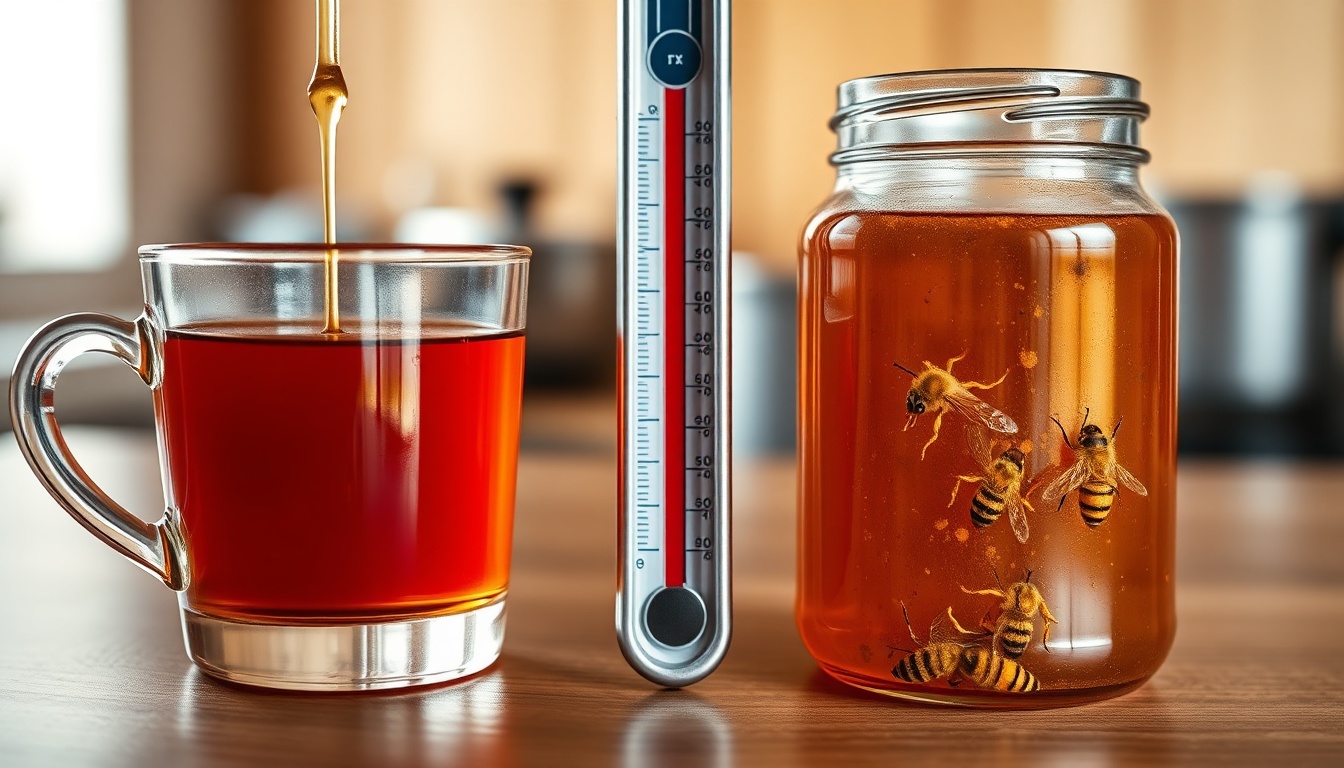
If you add honey to hot tea or coffee (65-80°C / 149-176°F), the honey is exposed to heat for only minutes — far too brief to generate meaningful HMF. The concern applies more to industrial processing where honey is heated for hours during pasteurization or to honey stored for months at warm temperatures.
The Ayurvedic Perspective: Where Does the "Toxic" Claim Come From?
The belief that heated honey is poisonous comes primarily from Ayurvedic medicine, the traditional Indian healing system. Ayurvedic texts, including the Charaka Samhita (circa 200 BCE), warn against heating honey above 40°C, stating it produces "ama" — a concept roughly translated as metabolic toxins that accumulate and cause disease.
This teaching has spread widely through wellness communities, often presented as if it were a proven scientific fact. Here is an honest assessment:
- **What Ayurveda may have gotten right:** Enzymes in raw honey do begin degrading at around 40°C, which aligns remarkably well with the Ayurvedic temperature threshold. Ancient practitioners could not have understood enzymology, but they may have observed that honey behaved differently (such as reduced wound healing effectiveness) when heated. The enzyme preservation point has genuine scientific validity
- **What Ayurveda likely overstates:** The characterization of heated honey as "toxic" or "poisonous" is not supported by modern toxicology. Millions of people worldwide consume heated honey daily — in baking, cooking, hot drinks, and pasteurized commercial honey — with no documented pattern of toxicity. If heated honey were genuinely toxic, this would be one of the most widespread food safety issues in the world
- **The cultural context:** Ayurvedic "toxicity" (ama) refers to a traditional concept of digestive disruption and energy imbalance, not acute poisoning in the Western medical sense. It should be understood within its own framework rather than misinterpreted as a modern toxicological warning
- **A reasonable synthesis:** Respect the Ayurvedic observation that raw, unheated honey has properties that heated honey loses — because this is scientifically accurate regarding enzymes and some volatile compounds. But do not fear that cooking with honey will poison you — because that claim has no scientific support
What You Actually Lose (and Keep) When Heating Honey
Here is a practical breakdown of what happens to honey's health-relevant compounds at common temperatures:
**Below 40°C / 104°F (warm, not hot — honey in lukewarm water):** Virtually no degradation. All enzymes, antioxidants, volatiles, and prebiotic oligosaccharides remain intact. This is the "safe" temperature range for preserving all of honey's raw properties.
**40-60°C / 104-140°F (warm to hot water, gentle heating):** Some enzyme activity begins decreasing. Glucose oxidase (the antibacterial enzyme) is one of the more heat-sensitive enzymes. Most antioxidant polyphenols remain stable. Prebiotic oligosaccharides are unaffected. Minerals are unaffected. Honey retains most of its health benefits at this range.
**60-80°C / 140-176°F (hot tea and coffee temperature):** Significant enzyme degradation with prolonged exposure, but brief contact (stirring honey into a hot drink) causes only modest losses. HMF begins forming but at negligible rates during short exposure. Phenolic antioxidants remain largely stable. Antibacterial hydrogen peroxide production is reduced.
**80-100°C / 176-212°F (simmering, boiling):** Most enzyme activity is destroyed within minutes. HMF formation accelerates. However, anti-inflammatory polyphenols like quercetin, chrysin, and pinocembrin remain relatively stable — these are the compounds responsible for honey's cardiovascular, anti-inflammatory, and anticancer research findings. Sugar profile unchanged. Minerals fully intact.
**Above 160°C / 320°F (baking, roasting, caramelization):** Sugars caramelize. Volatile compounds lost. Most enzymes destroyed. However, Maillard reaction products themselves have antioxidant properties. Honey in baked goods retains its mineral content, lower glycemic effect compared to refined sugar, and moisture-retaining properties.
Practical Guidelines: How to Use Honey at Every Temperature
Based on the science, here are evidence-based guidelines for different uses:
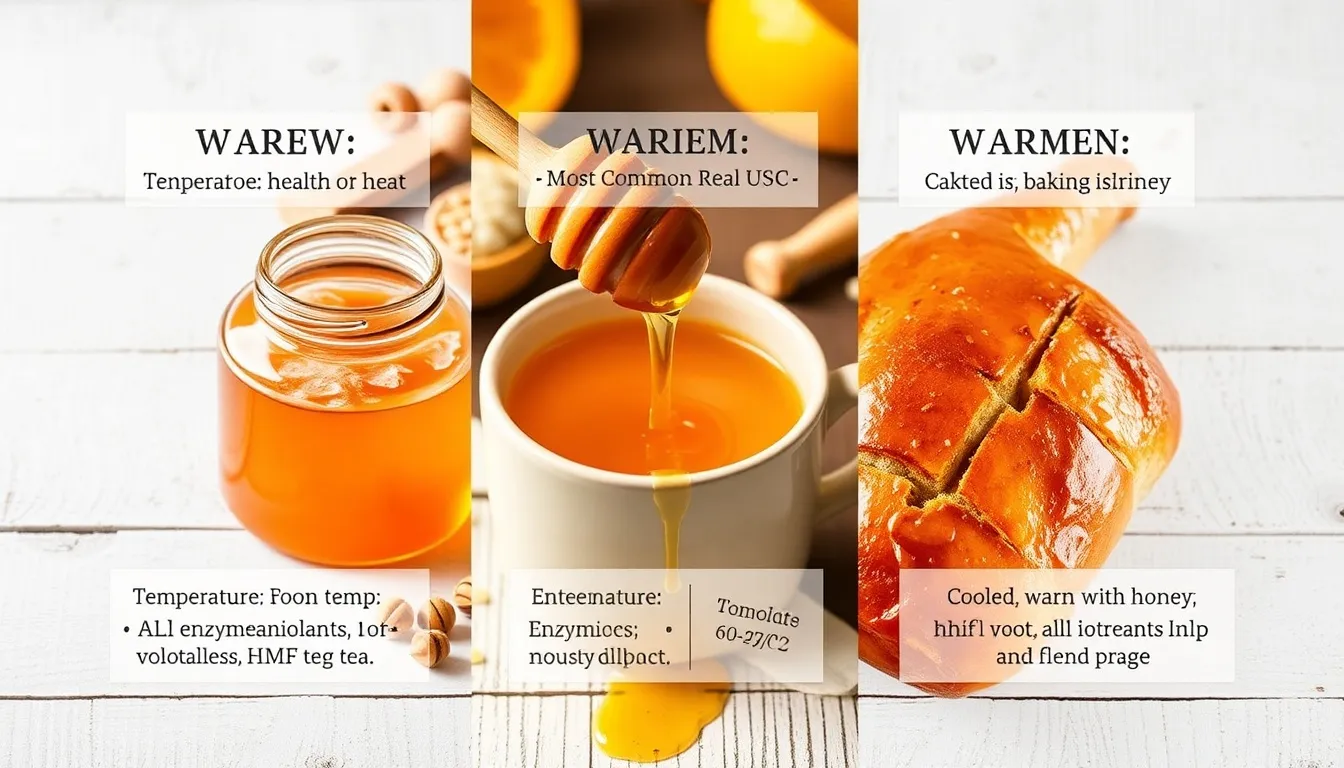
- **For maximum health benefits (raw/unheated):** Eat honey straight, drizzle on food after cooking, add to lukewarm water or smoothies, use in salad dressings, or apply topically for skin and wound care. This preserves all enzymes, antioxidants, and antimicrobial properties. Best raw varieties: acacia honey ($12–20) for its delicate, nearly transparent sweetness; wildflower honey ($10–18) for diverse antioxidant polyphenols from multiple floral sources
- **For hot drinks (tea, coffee, warm water):** Let your drink cool for 2-3 minutes after boiling (to roughly 60-70°C) before adding honey. The brief contact time at this temperature causes minimal degradation. You will lose some enzyme activity but retain most antioxidants, minerals, and prebiotic benefits. Stirring honey into a hot drink is perfectly fine. Clover honey ($8–15) and orange blossom honey ($12–20) complement tea and coffee flavors without overpowering them
- **For cooking (sauces, marinades, stir-fries):** Honey added during cooking loses most enzyme activity but retains minerals, stable polyphenols, and its characteristic flavor. The flavor compounds created through caramelization are a feature, not a flaw. Add honey near the end of cooking when possible to minimize heat exposure. Wildflower honey ($10–18) adds herbal complexity to marinades, while buckwheat honey ($15–25, ORAC 16,000+) brings molasses-like depth to glazes and BBQ sauces
- **For baking (350-400°F / 175-200°C):** Enzyme activity is eliminated, but honey still provides better mineral content than refined sugar, moisture retention, lower effective glycemic index in the finished product, and superior browning. Baking with honey is a legitimate improvement over refined sugar even though the honey is heated
- **For medicinal use (cough, sore throat, gut health):** Use raw, unheated honey for maximum therapeutic benefit. The enzyme-driven antibacterial mechanisms and prebiotic effects that make honey medicinally valuable are the properties most affected by heat. Manuka honey ($35–60+, UMF 10+) offers the strongest antibacterial activity via methylglyoxal (MGO), which is heat-stable unlike enzyme-based antimicrobials. Buckwheat honey ($15–25) is the clinically studied choice for cough suppression
Common Myths About Heated Honey — Debunked
Let us address the most widespread claims directly:
**Myth: "Honey in hot tea is poisonous."** False. Adding honey to hot tea reduces enzyme activity modestly (the contact time is short), but produces no toxic compounds at any meaningful level. You get more HMF from a single cup of coffee than from honey in hot tea every day for a year.
**Myth: "Heated honey causes cancer."** No evidence supports this claim. The HMF-cancer connection comes from a single 2008 rodent study using massive doses (300 mg/kg body weight) far beyond any realistic dietary exposure. EFSA has evaluated HMF and considers normal dietary levels to be of low concern.
**Myth: "Cooking with honey destroys ALL its benefits."** Not true. Mineral content, many stable polyphenols, lower glycemic impact, and prebiotic oligosaccharides survive cooking temperatures. What is lost is enzyme activity and some volatile compounds. Cooked honey is still nutritionally superior to refined sugar.
**Myth: "You should never put honey in anything warm."** Overly cautious. The enzyme degradation threshold (40°C) does not mean warm honey is dangerous — it means some enzyme activity begins declining. The vast majority of honey's 200+ bioactive compounds are stable well above this temperature.
**Myth: "Pasteurized honey is toxic because it was heated."** Pasteurized honey has lower enzyme activity and slightly higher HMF than raw honey, which is why raw honey is preferred for health benefits. But pasteurized honey is not toxic — it is simply less beneficial.
Raw vs Heated: When It Actually Matters
Not all honey uses require raw honey. Here is when the raw vs heated distinction is actually important and when it does not matter:
**Use raw honey when:** You are using it specifically for antibacterial properties (wound care, sore throat, skin conditions), for prebiotic gut health benefits (the enzymes and oligosaccharides work best intact), as a cough suppressant (clinical trials used unheated honey), or for topical skincare.
**Heated honey is fine when:** You are baking or cooking (you still get flavor, moisture, minerals, and lower GI than sugar), making hot honey or marinades (the flavor is the point), sweetening hot drinks (the health differences from brief heat exposure are minor), or using honey primarily as a natural sweetener rather than a therapeutic agent.
The key insight: raw honey is more beneficial than heated honey, but heated honey is not harmful. The choice depends on your purpose — therapeutic use warrants keeping honey raw, while culinary use can involve heat without concern.
The Bottom Line
Is heated honey toxic? No. Heating honey reduces certain beneficial properties — primarily enzyme activity and some volatile compounds — but does not create dangerous substances at any realistic dietary exposure level. The HMF formed during heating is present in far higher quantities in coffee, baked goods, and many other common foods that no one considers toxic.
For maximum health benefits, use raw, unheated honey. For cooking and hot drinks, use honey freely without fear. And when someone tells you that honey in hot tea is "poisonous," you can politely point them to the scientific evidence showing that their morning coffee contains orders of magnitude more HMF than their honey-sweetened tea ever will.