
Honey for Eyes: What Does the Research Show?
Using honey for eye health is one of the oldest medicinal applications in recorded history. Ancient Egyptian, Greek, Indian (Ayurvedic), and Chinese medical texts all describe honey-based eye treatments. Today, there's a growing body of modern research investigating whether these traditional uses have scientific merit.
The answer is nuanced: honey shows genuine promise for certain eye conditions, but applying anything to your eyes carries real risks. This guide examines the clinical evidence, explains what honey can and cannot do for eye health, and helps you make informed decisions about this ancient remedy.
For context on honey's broader antimicrobial and healing properties, see our guides on honey for wound healing, honey for inflammation, and manuka honey benefits.
The Science Behind Honey and Eye Health
Honey has several properties that are relevant to eye health, backed by laboratory and clinical research:
**Antimicrobial activity** — Honey's broad-spectrum antibacterial effects (effective against 60+ species including *Staphylococcus aureus*, *Pseudomonas aeruginosa*, and MRSA) are well-established. For eye health, this is relevant because many eye infections are caused by these common bacteria. A 2016 study in *BMC Ophthalmology* found that manuka honey inhibited biofilm formation by common ocular pathogens including methicillin-resistant *S. aureus* at concentrations as low as 25%.
**Anti-inflammatory effects** — Honey's polyphenols (quercetin, chrysin, pinocembrin) inhibit the NF-κB inflammatory pathway, which is involved in many inflammatory eye conditions including blepharitis, conjunctivitis, and dry eye disease. A 2022 *Nutrition Reviews* meta-analysis of 18 RCTs confirmed honey's systemic anti-inflammatory effects. See honey for inflammation.
**Osmotic and moisture properties** — Honey's high sugar concentration creates an osmotic gradient that draws fluid and nutrients to tissues, which may help with ocular surface hydration. Its hygroscopic (water-attracting) nature could support tear film stability in dry eye conditions.
**Wound healing** — The 2015 Cochrane systematic review of 26 RCTs (3,011 participants) demonstrated honey's effectiveness for wound healing. The corneal surface shares regenerative mechanisms with skin, suggesting potential applications for corneal abrasions and post-surgical healing.
**Antioxidant protection** — Honey contains 30+ polyphenols that scavenge reactive oxygen species (ROS). Oxidative stress plays a role in age-related eye conditions including cataracts and macular degeneration. Whether dietary or topical honey provides sufficient antioxidant protection to the eye remains an active area of research.
Get the Honey Buyer's Cheat Sheet (free PDF)
16 varieties on one page — color, flavor, best use and what a fair price looks like — from the 268 honeys we track.
Clinical Evidence: Eye Conditions Studied
Several eye conditions have been studied with honey-based treatments. Here's what the research shows:
Dry Eye Disease
Dry eye disease (DED) affects an estimated 16 million Americans and is one of the most studied applications of honey for eye health.
A landmark 2017 randomized controlled trial published in the *British Journal of Ophthalmology* tested Optimel Manuka Honey eye drops (standardized manuka honey in an ophthalmic formulation) in 114 patients with dry eye. The honey group showed significant improvement in tear film quality, ocular surface staining, and symptom scores compared to conventional lubricant eye drops over 8 weeks.
A 2019 systematic review in *Contact Lens and Anterior Eye* analyzed 6 studies on honey-based eye drops for dry eye and found "consistent evidence of benefit" for tear film stability, reduced ocular surface inflammation, and symptom improvement. The review noted that standardized manuka honey formulations showed the most consistent results.
A 2021 study in *Eye and Contact Lens* found that Optimel Manuka Honey eye gel improved meibomian gland function in patients with evaporative dry eye — the most common form of DED caused by poor oil production in the eyelid glands.
The mechanism appears to involve honey's anti-inflammatory effects on the ocular surface, osmotic drawing of moisture to the tear film, and antimicrobial activity against bacteria that colonize inflamed eyelid margins.
Pro Tip
The studies showing benefit for dry eye used standardized, sterile, medical-grade honey eye drops (Optimel) — not raw honey applied directly to the eye. Never put raw, unprocessed honey in your eyes without medical guidance.
Blepharitis (Eyelid Inflammation)
Blepharitis — chronic inflammation of the eyelid margins — affects up to 47% of ophthalmology patients and is notoriously difficult to treat.
A 2015 study in *Clinical and Experimental Ophthalmology* found that manuka honey micro-emulsion significantly reduced bacterial load and improved symptoms in patients with chronic blepharitis. A 2020 RCT in the same journal tested manuka honey eye drops in 60 blepharitis patients and reported significant improvement in eyelid swelling, crusting, and redness versus conventional treatment over 3 months.
Honey's combination of antibacterial activity (targeting *Staphylococcus* species that colonize eyelid margins), anti-inflammatory effects (reducing NF-κB-driven eyelid inflammation), and biofilm disruption (breaking up bacterial communities on eyelashes) makes it well-suited for this condition.
Several ophthalmologists now recommend manuka honey-based lid hygiene products as part of blepharitis management protocols.
Conjunctivitis (Pink Eye)
Bacterial conjunctivitis is one of the most common eye infections, and honey's antimicrobial properties have been tested against the pathogens responsible.
A 2014 *in vitro* study in the *Journal of Ophthalmology* tested honey against common conjunctivitis-causing bacteria (*S. aureus*, *S. epidermidis*, *P. aeruginosa*, *E. coli*) and found effective inhibition at clinically achievable concentrations. A 2004 pilot study in the *Indian Journal of Medical Research* reported that topical honey application improved symptoms in bacterial conjunctivitis patients.
However, clinical trial evidence specifically for conjunctivitis remains limited. Most ophthalmologists still recommend antibiotic eye drops as the standard treatment, with honey-based products considered as adjunctive therapy for chronic or recurrent cases.
Corneal Health and Post-Surgical Recovery
Animal studies have shown promising results for honey in corneal wound healing. A 2010 study in *Cornea* found that topical honey accelerated corneal epithelial healing in a rabbit model. A 2013 study in *BMC Complementary and Alternative Medicine* demonstrated that honey reduced corneal edema and inflammation after alkali burn injury in rats.
For post-surgical applications, a 2018 pilot study in *Clinical Ophthalmology* tested honey-based drops after pterygium surgery and found reduced inflammation and faster healing compared to standard post-operative care.
Human evidence remains preliminary, but the consistency of animal data and the known wound-healing mechanisms of honey (documented in the 2015 Cochrane review of 3,011 participants for general wound healing) provide biological plausibility.
Cataracts and Age-Related Eye Conditions
This is where claims outpace evidence significantly:
Some traditional medicine systems claim honey can prevent or reverse cataracts. While honey's antioxidant polyphenols could theoretically protect lens proteins from oxidative damage (a key cataract mechanism), there are **no human clinical trials** demonstrating that honey prevents, slows, or reverses cataracts.
Animal studies have shown some lens-protective effects. A 2010 study in *Molecular Vision* found that topical honey application delayed streptozotocin-induced cataract formation in diabetic rats. However, animal cataract models don't reliably predict human outcomes.
For age-related macular degeneration (AMD), the evidence is even thinner. While dietary antioxidants (from the AREDS2 formula) have proven benefit for AMD, no studies have specifically tested honey for this condition.
Claims that honey can restore vision, cure glaucoma, or reverse macular degeneration are unsupported by any clinical evidence.
Best Honey Types for Eye Health
Not all honeys are equal for eye applications:
- **Manuka honey (UMF 10-15+)** — The most studied honey for eye health. Its methylglyoxal (MGO) provides non-peroxide antibacterial activity that remains stable in ophthalmic formulations. Most positive eye studies used manuka-based products. See manuka honey benefits.
- **Tualang honey** — Malaysian multifloral honey with documented antibacterial activity against ocular pathogens. Used in several Southeast Asian eye research studies.
- **Buckwheat honey** — High antioxidant content (3-9x higher than lighter varieties) may provide superior ROS protection for ocular tissues. See buckwheat honey benefits.
- **Thyme honey** — Strong antimicrobial properties via thymol and carvacrol that have been tested against biofilm-forming bacteria relevant to eye infections. See thyme honey benefits.
Pro Tip
For any eye application, only use sterile, standardized medical-grade honey products specifically formulated for ophthalmic use. Raw honey — even high-quality manuka — has not been sterilized and may contain contaminants, spores, or particles that are dangerous to the eye.
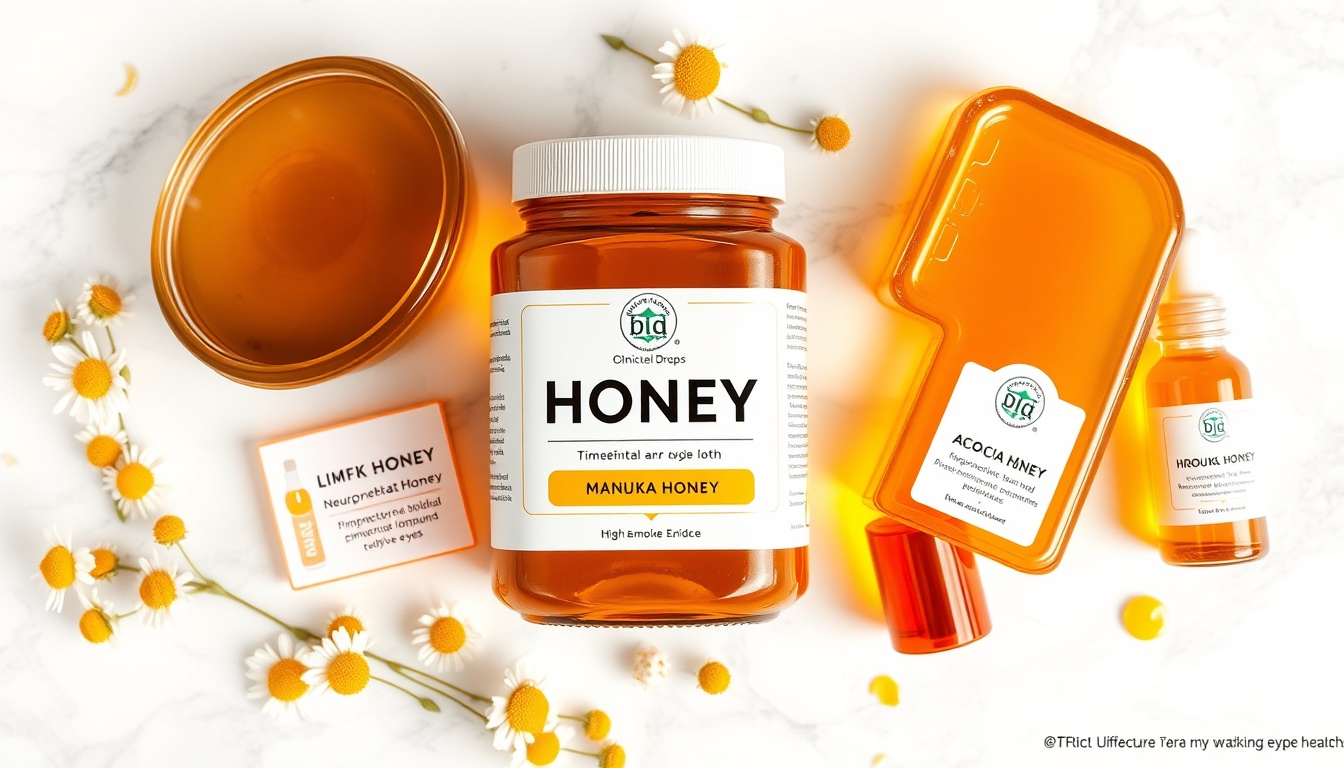
Safety: Critical Warnings
Eye safety must be taken extremely seriously. The eye is one of the most vulnerable organs, and inappropriate treatment can cause permanent damage:
**Never apply raw honey directly to your eyes** — Raw honey is not sterile. It may contain bacterial spores (including *Clostridium botulinum*), pollen particles, wax fragments, and other contaminants that can cause severe eye irritation, allergic reactions, or infection. Only use products specifically manufactured and sterilized for ophthalmic use.
**Expect stinging** — Even medical-grade honey eye drops cause temporary stinging and tearing upon application (typically lasting 30-60 seconds). This is a normal osmotic response, not an allergic reaction. However, if stinging is severe or persistent, discontinue use.
**Allergy risk** — People with bee product allergies or severe pollen allergies should avoid honey-based eye products. A 2019 case report in *Contact Lens and Anterior Eye* described allergic conjunctivitis triggered by manuka honey eye drops in a patient with bee sting allergy.
**Not a replacement for medical care** — Eye infections can progress rapidly and cause permanent vision loss. Bacterial keratitis, for example, can perforate the cornea within 24-48 hours. Always see an ophthalmologist for: sudden vision changes, eye pain, light sensitivity, colored discharge, a red eye that doesn't improve within 24 hours, or any eye injury.
**Contact lens wearers** — Remove contact lenses before using any honey-based eye product. Wait at least 15 minutes before reinserting lenses.
**Children** — Do not use honey-based eye products on infants under 12 months due to botulism risk. For children, always consult a pediatric ophthalmologist before using any non-standard eye treatment. See when can babies have honey?.

Honey Eye Products: What's Available
Several commercial honey-based eye products exist that have been formulated for safe ophthalmic use:
**Optimel Manuka+ Eye Drops and Eye Gel** — The most studied product, manufactured in Australia by Melcare Biomedical. Contains standardized manuka honey (16% Leptospermum honey) in a sterile ophthalmic formulation. Available over the counter in many countries. This is the product used in most published clinical trials.
**Optimel Antibacterial Manuka+ Eye Drops** — A higher-concentration formulation designed for bacterial blepharitis and meibomian gland dysfunction.
**Medical-grade manuka honey ointments** — Some wound-care-grade manuka products (like Medihoney) are occasionally used off-label for periocular (around-the-eye) application by dermatologists for conditions like periocular dermatitis, but these are NOT formulated for use ON the eye itself.
When purchasing, look for products with: sterile manufacturing, ophthalmic-grade formulation, standardized honey concentration, and preservative-free single-use vials (preferred for dry eye patients).
Dietary Honey for Eye Health
Beyond topical application, eating honey may support eye health through several systemic mechanisms:
**Antioxidant intake** — Honey's 30+ polyphenols contribute to overall antioxidant status, which is protective against oxidative damage to ocular tissues. Dark honeys like buckwheat, chestnut, and honeydew provide the highest antioxidant levels. See honey nutrition facts.
**Anti-inflammatory effects** — Systemic inflammation contributes to dry eye disease, uveitis, and diabetic retinopathy. Honey's NF-κB-inhibiting polyphenols may reduce background inflammation that affects eye health. See honey for inflammation.
Diabetes note — Honey is a fast-acting carbohydrate. The honey carbohydrate and label guide explains label-based carbohydrate counting; treatment and medication decisions belong in an individualized care plan.
**Gut-eye axis** — Emerging research suggests gut microbiome health influences ocular surface inflammation and dry eye. Honey's prebiotic FOS and GOS support beneficial gut bacteria. A 2020 review in *Progress in Retinal and Eye Research* described the gut-eye axis and its implications for inflammatory eye disease. See honey and gut health.
This section does not establish a universal or medical honey dose for this purpose. Use the daily added-sugar guide to count honey with other added or free sugars.
Honest Assessment: What Honey Can and Cannot Do
Based on the current evidence, here's a realistic assessment:
- **Promising evidence** — Dry eye disease (standardized manuka eye drops), blepharitis (eyelid inflammation), and bacterial biofilm disruption on the ocular surface.
- **Preliminary evidence** — Bacterial conjunctivitis, corneal wound healing, and post-surgical recovery.
- **Insufficient evidence** — Cataract prevention or reversal, glaucoma, macular degeneration, and vision improvement.
- **No evidence** — Claims that honey can restore lost vision, cure blindness, change eye color, or replace prescription eye medications.
The Bottom Line
Honey — particularly standardized manuka honey in ophthalmic formulations — shows genuine promise for certain eye conditions, especially dry eye disease and blepharitis. The evidence base is growing, with multiple RCTs supporting its use as an adjunctive treatment.
However, eye health is not an area for DIY experimentation. The difference between a sterile, standardized honey eye drop and raw honey from a jar is the difference between a studied medical intervention and a potential eye emergency. Always use products specifically formulated for ophthalmic use, and consult an eye care professional before starting any new eye treatment.
For general health benefits, include raw honey in your diet for its systemic antioxidant and anti-inflammatory effects, which may support eye health from the inside out.