What Are Stretch Marks and Why Do They Form?
Stretch marks (striae distensae) are a form of dermal scarring caused by rapid stretching of the skin beyond its elastic capacity. When skin stretches too quickly — during pregnancy, growth spurts, rapid weight gain, or bodybuilding — the collagen and elastin fibers in the dermis (the skin's middle layer) tear. The body repairs these tears with scar tissue, which looks and feels different from surrounding skin.
New stretch marks (striae rubrae) appear red, purple, or pink because the tearing exposes blood vessels in the dermis. Over time, these fade to white or silvery (striae albae) as blood vessels recede and the scar tissue matures. This color progression is important for treatment — newer, colored stretch marks respond better to interventions than older, white ones.
Stretch marks affect up to 90% of pregnant women, 70% of adolescent girls during growth spurts, and 40% of adolescent boys. They're also common in people who gain or lose weight rapidly, those on long-term corticosteroid therapy, and bodybuilders. Genetics play a significant role — if your parents had prominent stretch marks, you're more likely to develop them.
The key challenge with stretch marks is that they're dermal scars, not surface-level skin damage. Any effective treatment needs to reach the dermis and stimulate collagen remodeling — which is why most topical treatments have limited evidence.
What Honey Can Do for Stretch Mark-Prone Skin
Honey has not been studied in clinical trials specifically for stretch marks. This is an important caveat to state upfront. However, honey has been extensively studied for wound healing and scar reduction — processes that share biological pathways with stretch mark formation and repair.
The 2015 Cochrane systematic review of 26 randomized controlled trials involving 3,011 participants found that honey-treated wounds healed 4-5 days faster than conventional treatments. While stretch marks aren't open wounds, the collagen remodeling and tissue repair mechanisms are closely related.
A 2017 study in Burns examined 150 burn patients and found that honey-treated burn scars had significantly better Vancouver Scar Scale scores — measuring pigmentation, vascularity, pliability, and height — compared to standard treatment. Since stretch marks are essentially internal scars, these collagen-remodeling effects are potentially relevant.
Get the Honey Buyer's Cheat Sheet (free PDF)
16 varieties on one page — color, flavor, best use and what a fair price looks like — from the 268 honeys we track.
5 Mechanisms That May Help with Stretch Marks
Honey's potential for stretch marks lies in five evidence-based mechanisms:
- Collagen remodeling — A 2017 study in Molecules demonstrated that honey stimulates fibroblast proliferation and collagen synthesis. Fibroblasts are the cells responsible for building the collagen matrix in the dermis. By promoting organized collagen production, honey may help remodel the disorganized collagen bundles characteristic of stretch marks.
- Deep moisturization — Honey is a natural humectant that draws moisture into skin layers. Well-hydrated skin has better elasticity and is more resistant to tearing. The sugars in honey (fructose and glucose) create a moisture-binding film that penetrates beyond the surface epidermis, potentially reaching the upper dermis where stretch marks originate.
- Anti-inflammatory effects — Stretch marks involve an inflammatory phase during formation. Honey's polyphenols (chrysin, pinocembrin, quercetin) inhibit the NF-κB inflammatory pathway, which may reduce inflammation-driven collagen destruction during the early stages of stretch mark formation.
- Gentle exfoliation — Honey contains gluconic acid, a natural alpha-hydroxy acid (AHA) that provides mild chemical exfoliation. Regular AHA application has been shown to improve skin texture and stimulate collagen production in the dermis. Glycolic acid (a similar AHA) has demonstrated stretch mark improvement in controlled studies.
- Antioxidant protection — The 30+ polyphenols in honey neutralize reactive oxygen species (ROS) that damage collagen fibers. By protecting existing collagen from oxidative degradation, honey may help preserve skin elasticity in areas prone to stretching.
Best Honey Types for Stretch Marks
Different honey varieties offer different strengths for skin repair:
- Manuka honey (UMF 10-15+, $35-60+) — The strongest evidence for wound healing and tissue repair. Its unique methylglyoxal (MGO) compound provides additional antimicrobial and anti-inflammatory activity beyond other honeys. Best for newer, red/purple stretch marks where inflammation is still active.
- Buckwheat honey ($15-25, ORAC 16,000+) — Contains 3-9x more antioxidants than lighter honeys, providing superior protection against collagen-degrading free radicals. Its darker color indicates higher polyphenol content. Good for daily preventive care during pregnancy or growth periods.
- Wildflower honey ($10-18) — Offers the broadest spectrum of polyphenols from multiple floral sources. The diversity of bioactive compounds may address multiple pathways simultaneously. A good all-around choice at an accessible price point.
- Acacia honey ($12-20, GI ~32) — Lighter, milder, and less sticky than darker varieties. Lower in antioxidants but gentler on sensitive skin. Good for those who find darker honeys too heavy for facial or sensitive-area stretch marks.
- Heather honey ($30-50) — Exceptionally high in antioxidants and unique thixotropic (gel-like) properties that may help it adhere to skin better during treatments.

5 DIY Honey Treatments for Stretch Marks
These treatments combine honey with ingredients that have their own evidence for skin repair:
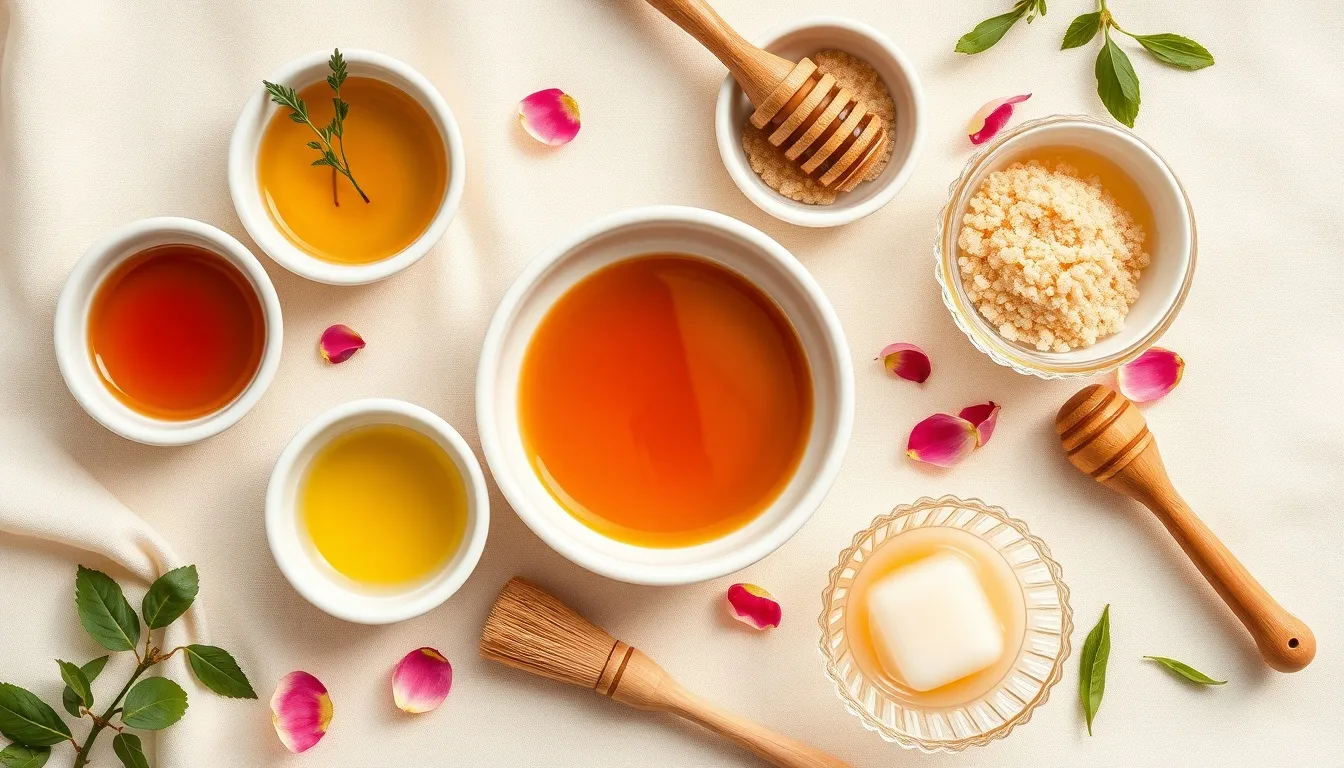
- Honey and olive oil massage — Mix 2 tablespoons of raw honey with 1 tablespoon of extra virgin olive oil. Massage into stretch marks in circular motions for 5 minutes. The massage itself stimulates blood flow and collagen remodeling, while olive oil's oleic acid enhances absorption. Leave for 20 minutes, rinse with lukewarm water. Use 3-4 times weekly.
- Honey and aloe vera gel — Combine 1 tablespoon of manuka honey with 1 tablespoon of pure aloe vera gel. Aloe contains acemannan, which stimulates fibroblast growth factor and has been shown in a 2009 Skin Pharmacology and Physiology study to improve skin elasticity. Apply to stretch marks, leave for 30 minutes. Best for newer, red stretch marks.
- Honey and coconut oil overnight treatment — Warm 1 tablespoon of raw honey with 1 tablespoon of virgin coconut oil until blended. Apply to stretch marks before bed, cover with a soft cloth or old t-shirt. Coconut oil's medium-chain triglycerides penetrate skin effectively, and its lauric acid supports tissue repair. Rinse in the morning.
- Honey-sugar scrub — Mix 2 tablespoons of raw honey with 1 tablespoon of raw sugar and ½ teaspoon of lemon juice. The sugar provides physical exfoliation while honey provides chemical exfoliation via gluconic acid. Gently massage into stretch marks for 3-4 minutes. Use 2 times weekly maximum to avoid over-exfoliation. Not for new or inflamed stretch marks.
- Honey and egg white firming mask — Whisk 1 egg white until frothy, fold in 1 tablespoon of raw honey. Apply to stretch mark areas, let dry for 15-20 minutes until tight. Egg white albumin temporarily tightens skin and provides amino acids for collagen synthesis. Rinse with cool water. Use 2-3 times weekly.
Pro Tip
Always do a patch test 24 hours before applying any new mixture to a large area. Apply a small amount to your inner forearm and check for redness, itching, or irritation. Budget-friendly: raw clover honey ($8-15) works well for the olive oil massage and sugar scrub recipes — save manuka for the targeted aloe vera treatment.
Honey During Pregnancy: Prevention Strategy
Since prevention is easier than treatment, using honey topically during pregnancy may help maintain skin elasticity in stretch mark-prone areas (abdomen, breasts, hips, thighs).
A preventive routine: After showering, massage a thin layer of raw honey mixed with a carrier oil (olive, coconut, or sweet almond) into areas that are stretching. The massage improves circulation, the honey provides humectant moisture and anti-inflammatory polyphenols, and the oil creates an occlusive barrier that locks in hydration.
While no topical treatment is guaranteed to prevent stretch marks (genetics and the rate of stretching are the dominant factors), maintaining well-hydrated, elastic skin gives it the best chance of stretching without tearing. A 2015 review in the Journal of the European Academy of Dermatology found that daily moisturizing with massage reduced stretch mark severity compared to no treatment.
Note: topical honey application during pregnancy is safe. The botulism risk associated with honey applies only to infant ingestion, not to skin contact at any age.
Realistic Expectations: What Research Tells Us
Honesty matters more than hope. Here's what you should realistically expect:
- Newer stretch marks (red/purple) respond better to topical treatments than older ones (white/silver). If your stretch marks are still colored, early intervention with honey may improve their appearance as they mature.
- Complete removal of stretch marks with any topical treatment — including honey — is not supported by clinical evidence. Stretch marks are permanent changes to the dermis.
- Improvement in texture, color intensity, and visibility is a realistic goal. Consistent honey application over 8-12 weeks may soften the scar tissue, reduce redness, and improve overall skin texture in the area.
- Honey works best as part of a comprehensive approach: hydration (internal and external), gentle massage, nutrition (vitamin C, zinc, and protein for collagen synthesis), and gradual weight management.
- Professional treatments (laser therapy, microneedling, retinoid creams) have stronger clinical evidence for stretch mark reduction than any topical home remedy. Honey can complement these treatments but shouldn't replace them if appearance is a significant concern.
Honey vs Other Stretch Mark Treatments
How does honey compare to other commonly recommended stretch mark treatments?
- Tretinoin (prescription retinoid) — The strongest topical evidence. A 1996 Archives of Dermatology RCT showed 20% reduction in stretch mark length over 6 months. However, it's prescription-only and unsafe during pregnancy. Honey is safer but less studied for this specific condition.
- Bio-Oil — Very popular but evidence is limited. A 2010 study showed improvement in stretch mark appearance, but the study was manufacturer-funded and small. Honey offers comparable moisturizing with additional anti-inflammatory benefits.
- Cocoa butter — Despite widespread use during pregnancy, a 2008 BJOG RCT of 175 women found no difference between cocoa butter and placebo for stretch mark prevention. Honey has stronger evidence for skin repair through its wound-healing research.
- Centella asiatica (gotu kola) — Some evidence for stimulating collagen synthesis. A combination of Centella and honey could theoretically address multiple repair pathways.
- Hyaluronic acid — A 2013 review found early application to new stretch marks showed benefit. Can be used alongside honey — hyaluronic acid for deep hydration, honey for anti-inflammatory and collagen-stimulating effects.
- Laser and microneedling — The strongest evidence for mature stretch marks. Fractional CO2 laser and microneedling stimulate collagen remodeling in the dermis. Honey applied post-procedure may support healing, but always follow your dermatologist's post-care instructions.
When to See a Dermatologist
While honey is a safe home treatment to try, consult a dermatologist if:
- You develop stretch marks without an obvious cause (no pregnancy, weight change, or growth spurt) — this could indicate Cushing's syndrome or other hormonal conditions.
- Stretch marks cover large areas of your body or appear suddenly.
- You want evidence-based treatment with the strongest clinical support — dermatologists can offer prescription retinoids, laser therapy, or microneedling.
- Stretch marks cause significant emotional distress or affect your quality of life — professional treatment and counseling support are available.
- You notice stretch marks alongside other symptoms like fatigue, weight gain, or skin thinning — this may indicate an underlying medical condition.