Why Honey Keeps Coming Up in Scar Research
Honey's reputation in wound care is backed by serious clinical research — the 2015 Cochrane review analyzed 3,011 participants across 26 RCTs and found honey accelerated healing in partial-thickness burns by 4-5 days compared to conventional dressings. But wound healing and scar reduction aren't the same thing.
A wound that heals faster doesn't automatically produce a better scar. What matters for scarring is how the body rebuilds tissue after the wound closes — specifically the collagen remodeling phase that continues for 6-18 months. This is where honey's properties get genuinely interesting, though the direct clinical evidence is more limited than many natural health sites suggest.
This guide separates what honey can realistically do for scars from what's been overpromised, covering the science behind honey's wound-healing properties and how they translate to scar outcomes.
How Scars Form: The Biology That Matters
Understanding scar formation helps explain where honey might intervene. Scarring follows a predictable four-phase process.
- Hemostasis (minutes) — Blood clotting seals the wound. Platelets release growth factors that recruit immune cells. Honey isn't relevant at this stage.
- Inflammation (days 1-6) — Immune cells clear debris and bacteria. Excessive or prolonged inflammation leads to worse scarring. This is where honey's anti-inflammatory properties become relevant — polyphenols that inhibit NF-κB can modulate this critical phase.
- Proliferation (days 4-21) — Fibroblasts deposit new collagen (primarily type III) and form granulation tissue. The wound contracts and re-epithelializes. Honey's growth-factor stimulation and moist wound environment support orderly tissue formation.
- Remodeling (3 weeks to 18+ months) — Type III collagen is gradually replaced by stronger type I collagen. Scar tissue reorganizes. This longest phase determines final scar appearance. Excessive collagen deposition creates hypertrophic or keloid scars; insufficient remodeling leaves wide, depressed scars.
Pro Tip
The inflammation phase is the critical window for scar outcomes. Excessive inflammation drives fibroblast overactivation and excess collagen — the direct cause of raised, red scars. Honey's anti-inflammatory action during this phase is its strongest mechanistic argument for scar reduction.
Get the Honey Buyer's Cheat Sheet (free PDF)
16 varieties on one page — color, flavor, best use and what a fair price looks like — from the 268 honeys we track.
5 Mechanisms: How Honey May Reduce Scarring
Honey acts on multiple scar-relevant pathways simultaneously, which is why it performs better than single-mechanism treatments in some studies.
- Anti-inflammatory collagen regulation — Honey's polyphenols (chrysin, pinocembrin, caffeic acid) inhibit the NF-κB pathway, which directly controls inflammatory cytokines (TNF-α, IL-1β, IL-6) that drive fibroblast overactivation. A 2017 study in Molecules found honey treatment modulated fibroblast behavior in vitro, promoting orderly collagen deposition rather than the disorganized collagen bundles that characterize hypertrophic scars. Honey for inflammation covers the mechanism in detail.
- Moist wound healing environment — Honey's hygroscopic nature maintains optimal moisture at the wound surface. A meta-analysis in the Journal of Tissue Viability confirmed that moist wound healing produces less scarring than dry healing — the established basis for modern occlusive dressings. Honey achieves this while adding antibacterial protection that synthetic dressings don't provide.
- Antibacterial infection prevention — Wound infection is one of the strongest predictors of poor scarring. Every infection episode extends inflammation and increases collagen overproduction. Honey's broad-spectrum antibacterial activity (effective against 60+ species including MRSA) reduces infection risk, indirectly protecting scar outcomes. The 2008 University of Ottawa biofilm disruption study demonstrated honey's ability to penetrate bacterial biofilms — a key advantage over topical antibiotics.
- Growth factor and angiogenesis support — Honey stimulates vascular endothelial growth factor (VEGF) and fibroblast growth factor (FGF), promoting healthy blood supply to healing tissue. Adequate blood flow during the proliferation phase ensures oxygen and nutrient delivery for organized collagen formation rather than the chaotic fibrosis that produces noticeable scars.
- Mild acidic pH — Honey's natural pH of 3.2-4.5 creates a mildly acidic wound environment. Research published in Advances in Skin & Wound Care found that acidic environments reduce protease activity (which degrades new collagen), increase oxygen release from hemoglobin, and enhance fibroblast activity — all favorable for organized scar formation.
Clinical Evidence: What Studies Actually Show
Here's where honesty matters. The evidence for honey in wound healing is strong. The evidence for honey specifically reducing scar appearance is promising but less robust.
- 2015 Cochrane review (3,011 participants, 26 RCTs) — Honey healed partial-thickness burns 4-5 days faster than conventional treatments. Faster healing correlates with less scarring (shorter inflammatory phase), but the review didn't specifically measure scar quality outcomes.
- 2012 Annals of Burns and Fire Disasters study — Compared honey dressings to silver sulfadiazine in burn patients. Honey group showed less contracture formation and better cosmetic outcomes, though the study was small and not blinded.
- 2017 Burns study — 150-patient RCT on pediatric partial-thickness burns found honey-treated wounds had significantly better scar scores at 3 months using the Vancouver Scar Scale (measuring pigmentation, vascularity, pliability, height). This is one of the few studies that directly measured scar quality, not just healing speed.
- 2010 IJLEW study — 50 patients with burn wounds showed honey-treated group had less hypertrophic scarring at 6-month follow-up compared to conventional treatment.
- 2018 Journal of Cosmetic Dermatology pilot — Small study on post-acne scars using topical manuka honey. Showed modest improvement in scar texture and pigmentation over 12 weeks, but lacked a control group.
Pro Tip
The strongest evidence is for burn scars, where honey's combination of faster healing, reduced infection, and anti-inflammatory effects converges. Evidence for surgical scars and acne scars is weaker and mostly from small, uncontrolled studies.
Honey for Different Scar Types
Not all scars respond equally to treatment, and honey's mechanisms are better suited to some scar types than others.
- Hypertrophic scars (raised, red, within wound boundaries) — Best evidence for honey. These result from excess collagen and prolonged inflammation — exactly what honey's NF-κB inhibition addresses. Early application during the inflammatory phase may prevent formation. Once formed, honey may help by reducing ongoing inflammation and promoting collagen remodeling.
- Keloid scars (raised, spreading beyond wound boundaries) — Limited evidence. Keloids involve genetic predisposition to extreme fibroblast overactivation. Honey's anti-inflammatory properties may provide modest benefit, but keloids typically require medical intervention (corticosteroid injections, silicone sheeting, radiation). Don't delay medical treatment for a natural remedy.
- Atrophic scars (depressed, pitted — typical of acne) — Moderate theoretical basis. These result from insufficient collagen production, so honey's collagen-stimulating properties are relevant. However, deep pitted scars (ice pick, boxcar) typically require professional treatments. Honey for acne may help prevent new acne scars by reducing inflammation.
- Post-inflammatory hyperpigmentation (flat, darkened marks) — Some evidence for honey's mild tyrosinase inhibition, which may gradually lighten dark marks. Honey for dark circles discusses this mechanism. Results are subtle compared to vitamin C serums or hydroquinone.
- Surgical scars — Promising but understudied. Applying honey post-operatively may reduce infection risk and inflammation, indirectly improving scar outcomes. Some plastic surgeons are incorporating medical-grade honey dressings (Medihoney, Activon) into post-surgical protocols.
- Burn scars — Strongest evidence. The 2017 Burns RCT, 2012 Annals of Burns study, and multiple smaller trials consistently show improved scar outcomes with honey in burn care.
Best Honey Types for Scars
The type of honey matters significantly for scar applications, primarily due to differences in antibacterial strength, anti-inflammatory potency, and safety for open skin.
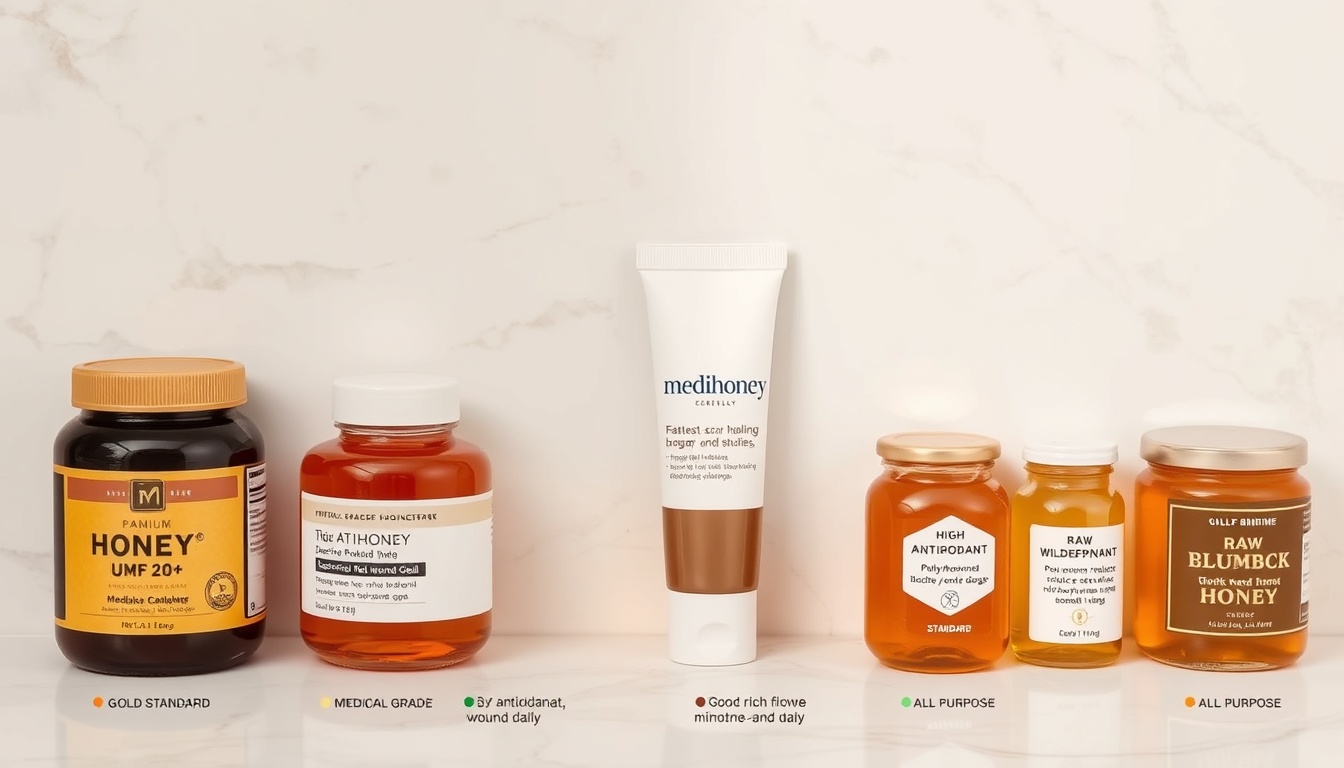
- Medical-grade manuka honey (Medihoney, Activon) — Gold standard for open wounds. Gamma-irradiated for sterility, standardized MGO content, FDA-cleared for wound care. Use exclusively for wounds that haven't fully closed. The wound-healing guide covers FDA-cleared products in detail.
- Manuka honey UMF 10-15+ ($35-60+) — Strong all-around choice for closed wounds and existing scars. Methylglyoxal provides non-peroxide antibacterial activity. Higher grades (UMF 15+) are more potent but also more expensive — UMF 10+ is sufficient for scar massage.
- Buckwheat honey ($15-25, ORAC 16,000+) — 3-9x higher antioxidant content than lighter honeys. The robust polyphenol profile may provide stronger anti-inflammatory effects for scar remodeling. Less studied specifically for scars but strong antioxidant rationale.
- Thyme honey ($15-25) — Among the highest antioxidant honeys with antimicrobial strength rivaling manuka through different pathways (thymol, carvacrol). Good option for scar care, especially if manuka isn't available.
- Wildflower honey ($10-18) — Broad-spectrum polyphenol diversity at an accessible price. Good budget alternative to manuka for daily scar massage, especially for large scar areas where manuka's per-application cost adds up. Clover honey ($8-15) also works for basic moisturizing massage on maturing scars.
- Avoid: Processed commercial honey for scar treatment. Ultra-filtration removes pollen and reduces enzyme activity. Heating destroys hydrogen peroxide production. The anti-inflammatory and antibacterial compounds that matter for scarring require raw, unprocessed honey.
How to Use Honey for Scars: Practical Guide
Application method matters. Here's a structured approach based on scar stage.
- Fresh wounds (first 1-2 weeks) — Only medical-grade honey should ever be used on an open wound, and even then, application and dressing changes should be directed by a clinician — this is not a home protocol. This early window, when inflammation is being managed, has the most impact on eventual scar quality.
- Newly closed wounds (weeks 2-8) — Once a wound is fully re-epithelialized (closed with new skin), some people apply raw manuka or buckwheat honey and gently massage it in — the massage itself is thought to help break down collagen adhesions. There is no established amount, frequency, or duration for this; use your judgment and stop if you notice irritation.
- Maturing scars (2-18 months) — At this stage, the scar is actively remodeling collagen. Some people continue honey application alongside gentle scar massage to promote organized collagen alignment. This is when you might add complementary ingredients.
- Old scars (18+ months) — Scars older than 18 months have largely completed remodeling, so honey's impact is more limited. It may provide mild moisturizing and gradual pigmentation improvement, but don't expect dramatic changes. Professional treatments (laser, microneedling, chemical peels) are more effective for mature scars.
Pro Tip
Never apply raw honey to an open wound unless you are using medical-grade, gamma-irradiated honey products. Raw honey from a jar, however high-quality, is not sterile and could introduce contaminants to an open wound.
Honey Scar Combinations: DIY Treatments
Honey can be combined with other evidence-based ingredients for enhanced scar treatment. These are for closed wounds and existing scars only.
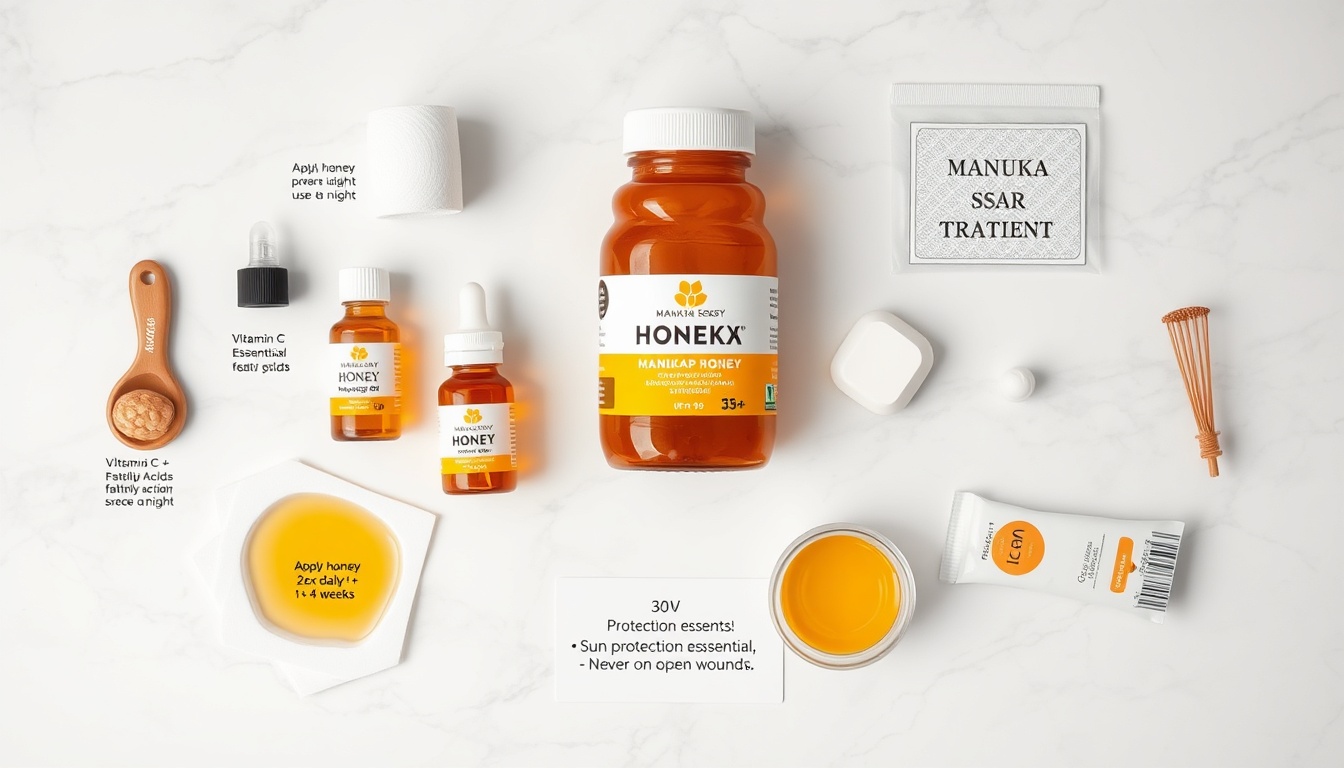
- Honey + olive oil — Combining raw manuka honey with extra-virgin olive oil is a common approach for closed scars. The olive oil provides oleocanthal (anti-inflammatory), squalene (skin barrier repair), and improved spreadability for massage. The 2003 Complementary Therapies in Medicine study found this honey-oil combination significantly improved skin conditions.
- Honey + aloe vera — Combining honey with fresh aloe vera gel is another approach people use on closed scars. Aloe contains acemannan, which stimulates fibroblasts, and aloin, which inhibits melanin production in hyperpigmented scars.
- Honey + turmeric — Combining honey with turmeric powder is used by some for closed scars. Curcumin provides additional NF-κB inhibition and has been independently studied for scar reduction. Note: turmeric can temporarily stain skin yellow — use on body scars, not face.
- Honey + coconut oil — Combining honey with virgin coconut oil is another option for closed scars. Coconut oil's lauric acid adds antibacterial support, and its medium-chain fatty acids support collagen production.
- Honey + vitamin E — Combining honey with vitamin E oil is a traditional approach, though clinical evidence for vitamin E alone is mixed (a 1999 Dermatologic Surgery study found no benefit). Combined with honey's multi-mechanism approach, the combination may provide better results than either alone.
Honey vs. Proven Scar Treatments: Honest Comparison
Where does honey fit in the scar treatment hierarchy? Here's a realistic comparison with established options.
- Silicone sheeting/gel — The gold standard for hypertrophic and keloid scars, with the strongest evidence base (multiple Cochrane-grade reviews). Mechanism: occlusion, hydration, static electricity affecting collagen. Honey provides similar hydration plus active anti-inflammatory compounds — but silicone has decades more scar-specific clinical data. Consider using both: honey during the inflammatory phase, silicone during remodeling.
- Corticosteroid injections — First-line medical treatment for keloids and severe hypertrophic scars. Directly suppresses collagen overproduction. Far more potent than topical honey for these conditions. Not appropriate for atrophic or flat scars.
- Pressure therapy — Standard for burn scars. Reduces blood flow and collagen synthesis. Often combined with silicone. Honey can complement by reducing inflammation under pressure garments.
- Laser treatment — Fractional laser resurfacing is the most effective treatment for atrophic (pitted) acne scars. Works by controlled injury that triggers organized collagen formation. Honey is not a substitute for this level of scar revision.
- Microneedling — Creates controlled micro-injuries that stimulate collagen production. Multiple RCTs show significant improvement in atrophic scars. Some dermatologists are experimenting with honey-infused serums post-microneedling, but this isn't yet evidence-based.
- Sunscreen — Often overlooked but critical. UV exposure causes hyperpigmentation in healing scars. Sunscreen (SPF 30+) every day on new scars is more important for preventing dark scars than any topical treatment, including honey.
Pro Tip
The most effective scar strategy combines approaches: honey during the early inflammatory and proliferative phases, silicone or pressure therapy during remodeling, and sunscreen always. Don't rely on any single treatment.
Realistic Expectations
Setting honest expectations prevents disappointment and delays in seeking appropriate treatment.
What honey can realistically do: reduce redness and inflammation in new scars, maintain moisture for optimal healing environment, potentially reduce hypertrophic scar formation when applied during the inflammatory phase, provide mild improvement in scar texture and pigmentation over weeks to months, and complement professional scar treatments.
What honey cannot do: eliminate existing deep scars, replace medical treatment for keloids, remove pitted acne scars, produce dramatic overnight results, or substitute for laser, microneedling, or surgical scar revision when these are indicated.
If scarring significantly affects your quality of life or self-confidence, consult a dermatologist or plastic surgeon. Honey is a reasonable complementary approach, but professional scar treatment has advanced dramatically. Modern fractional lasers, subcision, and filler techniques achieve results that no topical treatment — natural or pharmaceutical — can match.