What Is Toenail Fungus and Why Is It So Stubborn?
Toenail fungus — known medically as onychomycosis — is a fungal infection of the nail plate caused primarily by dermatophyte fungi (Trichophyton rubrum and Trichophyton mentagrophytes), with yeasts (Candida species) and non-dermatophyte molds accounting for a smaller percentage of cases. It affects an estimated 10-14% of the general population, with prevalence rising sharply with age to nearly 50% in adults over 70.
The infection typically begins as a white or yellowish spot under the nail tip and progressively causes thickening, discoloration, brittleness, and distortion of the nail. Left untreated, onychomycosis rarely resolves on its own because the nail plate acts as a physical barrier — both protecting the fungus from topical treatments and providing a keratinous environment where dermatophytes thrive.
This stubbornness is exactly why people seek alternative approaches. Conventional oral antifungals carry liver toxicity risks, topical pharmaceuticals have modest cure rates (around 17-35% for ciclopirox lacquer), and treatment courses last 3-12 months regardless of the method. Against this backdrop, honey's well-documented antimicrobial properties have drawn interest as a potential natural adjunct — but the picture is more nuanced than most wellness blogs suggest.
Honey's Antifungal Mechanisms: How It Fights Fungi
Honey possesses multiple antifungal mechanisms that work through different pathways. Understanding these helps explain both the promise and the limitations of using honey for toenail fungus.
- Hydrogen peroxide production — When diluted (as occurs on moist skin), the enzyme glucose oxidase in raw honey produces a slow, sustained release of hydrogen peroxide. This creates an oxidative environment hostile to fungal cells. The concentration is high enough to inhibit microbial growth but low enough to avoid tissue damage — a balance pharmaceutical antiseptics struggle to achieve.
- Osmotic effect — Honey's extremely high sugar concentration (approximately 80% sugars by weight) and low water activity (0.56-0.62 aw) create intense osmotic stress on fungal cells, drawing water out through their membranes and inhibiting growth. This is the same mechanism that allows honey to remain shelf-stable indefinitely.
- Low pH — Honey's acidic environment (pH 3.2-4.5) is inhospitable to most dermatophytes, which prefer a slightly acidic to neutral pH (5.0-7.0) for optimal growth. The gluconic acid in honey creates conditions below the fungal comfort zone.
- Methylglyoxal (MGO) in manuka honey — Manuka honey contains methylglyoxal at concentrations of 100-1000+ mg/kg, providing non-peroxide antimicrobial activity that persists even when hydrogen peroxide is neutralized. MGO disrupts fungal protein function and has shown activity against dermatophytes specifically.
- Polyphenol disruption of fungal structures — Honey polyphenols (flavonoids like chrysin, pinocembrin, and galangin, plus phenolic acids) can interfere with ergosterol biosynthesis — a critical component of fungal cell membranes analogous to cholesterol in human cells. Some polyphenols also disrupt chitin synthesis, weakening fungal cell walls. This mechanism is shared with the azole class of pharmaceutical antifungals.
- Biofilm disruption — Fungal biofilms are a major reason infections persist. Honey has been shown to penetrate and disrupt microbial biofilms, potentially improving access to fungal cells that would otherwise be protected.
Pro Tip
The combination of these mechanisms is key — fungi are less likely to develop resistance to honey than to single-mechanism pharmaceutical antifungals, because they would need to simultaneously adapt to osmotic stress, oxidative damage, low pH, and membrane disruption.
Get the Honey Buyer's Cheat Sheet (free PDF)
16 varieties on one page — color, flavor, best use and what a fair price looks like — from the 268 honeys we track.
What the Research Actually Shows: In Vitro Evidence
Several laboratory studies have investigated honey's antifungal activity against the specific fungi responsible for toenail infections. The results are genuinely promising at the cellular level, though an important distinction must be drawn between in vitro (lab dish) and clinical (on actual toenails) effectiveness.
A 2012 study published in the Asian Pacific Journal of Tropical Biomedicine tested manuka honey against multiple fungal species including Trichophyton mentagrophytes (a common cause of onychomycosis) and several Candida species. The researchers found significant antifungal activity at concentrations achievable with topical application, with minimum inhibitory concentrations (MICs) ranging from 20-40% (v/v) depending on the species.
Also in 2012, research published in Archives of Medical Research examined thyme honey and found potent antifungal effects against Candida species, with activity attributed to both the hydrogen peroxide pathway and the thymol-derived polyphenols unique to thyme-sourced honey. The study noted that thyme honey showed stronger antifungal activity than several other monofloral honeys tested.
A 2016 study in Frontiers in Microbiology demonstrated that honey — particularly manuka honey — could disrupt fungal biofilms at sub-inhibitory concentrations. This is significant for onychomycosis because dermatophytes form biofilms within the nail plate that protect them from both immune responses and topical treatments. If honey can weaken these biofilms, it may improve the penetration of other treatments.
Perhaps most directly relevant, a 2018 study in Mycopathologia specifically tested manuka honey against dermatophyte species including T. rubrum and T. mentagrophytes — the two primary causes of toenail fungus. The researchers found dose-dependent inhibition of dermatophyte growth, with complete inhibition at concentrations of 30-40% manuka honey. The study also observed morphological damage to fungal hyphae (the thread-like structures fungi use to grow).
These studies collectively demonstrate that honey — especially manuka honey and thyme honey — has genuine antifungal activity against the organisms that cause toenail fungus. However, killing fungi in a petri dish is very different from clearing an infection from underneath a toenail.
The Honest Reality: Why Lab Results Don't Equal a Cure
Here is where intellectual honesty is essential. Despite the encouraging in vitro data, there are currently no published randomized controlled trials testing honey specifically for onychomycosis in human patients. This is a significant gap.
The core challenge is nail penetration. The toenail plate is a dense, keratinized barrier typically 1-2mm thick. Dermatophyte fungi colonize the nail bed underneath this barrier, the hyponychium (the area where the nail meets the skin), and the nail matrix. For any topical treatment to work — honey or pharmaceutical — it must penetrate through the nail plate to reach the fungi.
Even pharmaceutical topical antifungals struggle with this. Ciclopirox nail lacquer (Penlac) achieves only about 17-22% complete cure rates after 48 weeks of daily application. The newer efinaconazole (Jublia) improved on this with approximately 15-18% complete cure and 55% mycological cure, partly because of better nail penetration technology. Honey, being a viscous natural product, has no engineered penetration-enhancing formulation.
This doesn't mean honey is useless for toenail fungus — it means expectations should be realistic. Honey may be most effective for early-stage infections where the fungus hasn't fully penetrated the nail plate, for nail-fold and surrounding skin involvement, as a complementary treatment alongside conventional therapy, and for prevention of recurrence after successful treatment.
Anyone claiming that honey alone will reliably cure established toenail fungus is not supported by the current evidence. What the evidence does support is that honey has real antifungal mechanisms that are active against the relevant fungi — the delivery challenge is the bottleneck, not the antifungal activity itself.
Pro Tip
Filing the nail surface before applying honey can improve penetration. Podiatrists use this same strategy (debridement) to enhance topical pharmaceutical delivery.
Best Honey Types for Antifungal Use
If you decide to try honey as part of your toenail fungus management strategy, the type of honey matters significantly. Not all honeys have equivalent antifungal potency.
- Manuka honey UMF 15+ — The best-studied honey for antifungal applications. The UMF (Unique Manuka Factor) rating correlates with MGO content, and higher-rated manuka showed stronger antifungal activity in the 2018 Mycopathologia study. Look for UMF 15+ or MGO 514+ for therapeutic use. Manuka's non-peroxide activity means it remains antimicrobial even in conditions where the hydrogen peroxide pathway might be less active.
- Thyme honey — Demonstrated strong antifungal activity in the 2012 Archives of Medical Research study. Contains thymol-derived compounds that provide additional antifungal mechanisms beyond those found in most honeys. Greek and Spanish thyme honeys are widely available and tend to be more affordable than high-grade manuka.
- Buckwheat honey — The darkest common honey variety, with 3-9x higher polyphenol and antioxidant content than light honeys. While not specifically studied for onychomycosis, its high polyphenol load suggests stronger ergosterol-disrupting potential. Also provides excellent anti-inflammatory support for irritated surrounding skin.
- Raw, unprocessed honey — Any raw honey retains its full enzyme complement, including glucose oxidase (for hydrogen peroxide production) and other bioactive compounds destroyed by pasteurization. If you can't access manuka or thyme honey, raw local honey is significantly better than processed commercial honey.
Pro Tip
Combining honey with propolis may enhance antifungal effects. Propolis contains its own potent antifungal compounds (pinocembrin, galangin, CAPE) and has been studied specifically against dermatophytes with positive results.
Honey Application: What People Try
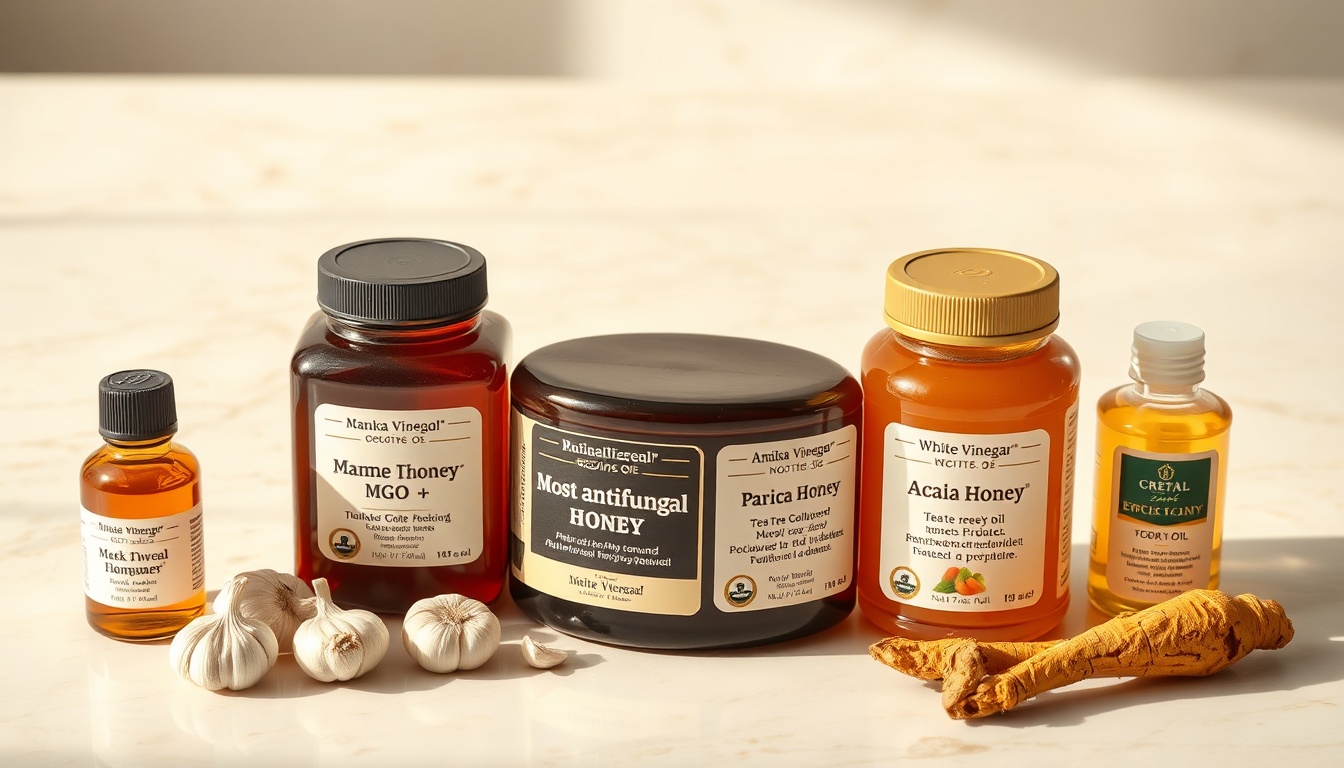
No standardized clinical protocol exists for honey application to fungal toenails. People who try this generally soften and gently thin the nail first (soaking, then light filing, without filing aggressively enough to cause pain or bleeding) to improve penetration, clean and dry the nail and surrounding skin, then apply manuka or thyme honey to the nail and cover it with gauze or a bandage to keep it in place. There is no established amount, contact time, or treatment course, and any visible effect would take months to appear because toenails grow slowly (approximately 1-2mm per month). A podiatrist can advise on professional nail debridement and topical delivery if you want guidance beyond this.
Honey vs Conventional Treatments: A Fair Comparison
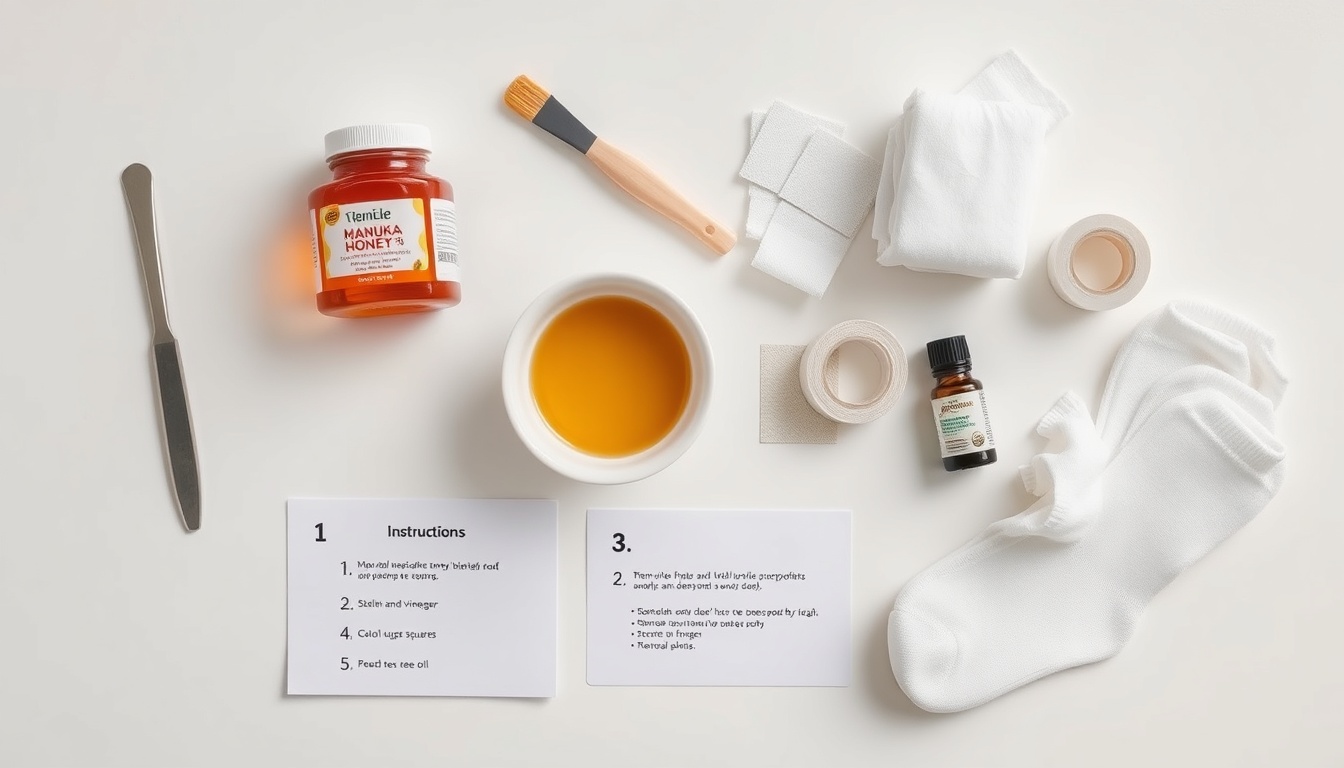
To make an informed decision, it helps to understand how honey stacks up against the pharmaceutical options your doctor might prescribe.
Oral terbinafine (Lamisil) is the gold standard, with complete cure rates of 38-50% after 12 weeks of daily pills. It works systemically, reaching the nail bed through the bloodstream and bypassing the penetration problem entirely. However, it carries risks of liver toxicity (liver function tests are required), drug interactions, taste disturbances, and gastrointestinal side effects. It is the most effective single treatment available.
Ciclopirox nail lacquer (Penlac) is a topical antifungal painted on like nail polish daily for 48 weeks. Complete cure rates are modest at 17-22%. It has minimal side effects but requires extreme diligence in application. Honey is arguably comparable in terms of mechanism (topical delivery challenge) but without the clinical trial data to prove equivalent efficacy.
Efinaconazole (Jublia) is a newer topical with better penetration technology, achieving approximately 15-18% complete cure and 55% mycological cure after 48 weeks. It is expensive (often $600+ per month without insurance) and requires daily application to clean, dry nails.
Laser treatment uses focused light energy to heat and kill fungal cells through the nail plate. Clinical evidence is mixed, with some studies showing temporary improvement in appearance but modest long-term mycological cure rates. Costs range from $500-1,500 for a course of treatments and are rarely covered by insurance.
Honey offers zero risk of systemic side effects, is inexpensive (even high-grade manuka is roughly $30-50 for a jar that lasts months of nail treatment), and provides additional benefits like skin healing for the surrounding toe area. Its limitation is unproven clinical efficacy for onychomycosis specifically and the nail penetration challenge shared by all topical approaches.
Complementary Strategies: Combining Honey with Other Approaches
Honey may work best not as a standalone cure but as part of a multi-pronged antifungal strategy. Several natural and conventional approaches can be combined with honey application.
- Coconut oil — Contains caprylic acid and lauric acid, both with demonstrated antifungal activity. Mixing honey with coconut oil may improve spreadability while adding complementary antifungal compounds.
- Olive oil infusion — Olive oil's oleuropein has antifungal properties, and the oil can help honey adhere to the nail surface while providing emollient benefits to surrounding skin.
- Tea tree oil — One of the more studied natural antifungals for onychomycosis. Some people mix a small amount into honey before application to add terpinen-4-ol, which has demonstrated activity against T. rubrum. Tea tree oil is potent and can irritate skin — check appropriate dilution or ask a healthcare provider before use.
- Nail debridement — Having a podiatrist professionally thin the affected nail (or doing gentle filing at home) significantly improves topical penetration for any treatment, including honey.
- Oral antifungal support — If your doctor prescribes oral terbinafine or itraconazole, applying honey topically as a complement is safe and may enhance results by attacking the fungus from both systemic and topical directions simultaneously.
- Immune system support — Raw honey as part of a regular diet supports immune function through prebiotic effects. A stronger immune response helps the body fight fungal infections from the inside.
Myths About Honey and Toenail Fungus: Setting the Record Straight
The popularity of natural remedies has spawned considerable misinformation about honey and toenail fungus. Here is what the evidence actually supports versus what is wishful thinking.
- Myth: Honey cures toenail fungus in weeks — Reality: Even pharmaceutical treatments take 3-12 months. Toenails grow at about 1-2mm per month, so regardless of how quickly the honey kills fungus, visible improvement requires months of consistent application as the healthy nail grows out.
- Myth: Any honey works equally well — Reality: Antifungal potency varies enormously by type. Medical-grade manuka honey (UMF 15+) and thyme honey have demonstrated significantly stronger antifungal activity than generic commercial honey, which may have lost most bioactive compounds during processing.
- Myth: Honey can replace oral antifungals for severe infections — Reality: For severe onychomycosis involving the nail matrix or multiple nails, oral antifungals are far more likely to achieve a cure because they bypass the nail penetration barrier entirely. Honey is better suited to early-stage or mild infections.
- Myth: Honey's sugar feeds the fungus — Reality: While fungi can metabolize sugars, honey's extremely low water activity (0.56-0.62) and high osmolarity actually dehydrate fungal cells. The net effect is antifungal, not pro-fungal. This is well established in the antimicrobial literature.
- Myth: You need to eat honey to treat toenail fungus — Reality: Systemic delivery of honey's antifungal compounds through ingestion is not well-supported for nail infections. The topical application delivers active compounds directly to the site. That said, eating raw honey daily does support immune function, which helps the body fight infections generally.
Prevention: Keeping Toenail Fungus from Returning
Whether you've treated toenail fungus successfully or want to avoid it in the first place, prevention is far easier than treatment. Fungal reinfection rates are high (10-50% within a few years), so ongoing vigilance matters.
- Keep feet dry — Dermatophytes thrive in warm, moist environments. Change socks daily (or twice daily if you sweat heavily), choose moisture-wicking materials, and allow shoes to dry completely between wearings (alternate pairs).
- Protect feet in public areas — Wear shower shoes or flip-flops in gym locker rooms, public pools, and hotel bathrooms. These are prime fungal transmission environments.
- Maintenance honey applications — Some people continue occasional honey application to the nails after treatment, though there's no established regimen shown to prevent recolonization.
- Trim nails properly — Keep toenails trimmed straight across and not too short. Jagged edges and micro-trauma from improper trimming create entry points for fungal infection.
- Treat athlete's foot promptly — Athlete's foot (tinea pedis) is caused by the same dermatophytes and frequently spreads to toenails if left untreated. Address any skin fungal infection quickly to prevent nail involvement.
- Support skin health around nails — Healthy, intact skin around the nails is the first line of defense. A honey and coconut oil foot balm applied regularly can maintain skin integrity while providing low-level antifungal protection.
- Disinfect nail tools — Use separate nail clippers for infected and healthy nails. Clean tools with rubbing alcohol or hydrogen peroxide after each use.
When to See a Podiatrist or Dermatologist
Honey is a reasonable first-line approach for mild toenail fungus, but certain situations warrant professional medical evaluation.
See a doctor if the infection involves more than 2-3 nails, the nail has lifted significantly from the nail bed (onycholysis), you have diabetes or peripheral vascular disease (fungal nail infections can lead to serious complications including cellulitis and ulceration in these populations), there is pain, redness, or swelling around the nail suggesting secondary bacterial infection, the fungal infection has spread to surrounding skin and is not responding to topical treatment, or you have tried consistent honey application for 3-4 months without any sign of improvement.
A podiatrist or dermatologist can confirm the diagnosis (not all nail discoloration is fungal — psoriasis, trauma, and bacterial infections can mimic onychomycosis), prescribe oral antifungals when warranted, perform professional debridement to improve topical treatment outcomes, and monitor for complications. Getting a proper diagnosis before committing to months of any treatment is wise — studies show up to 50% of clinically suspected nail fungus cases have a non-fungal cause.
The Bottom Line: A Promising Tool, Not a Guaranteed Cure
Honey — particularly manuka honey (UMF 15+) and thyme honey — has genuine, research-backed antifungal activity against the dermatophyte fungi that cause toenail infections. The in vitro evidence from studies published in Mycopathologia (2018), the Asian Pacific Journal of Tropical Biomedicine (2012), Archives of Medical Research (2012), and Frontiers in Microbiology (2016) consistently demonstrates honey's ability to inhibit and kill these organisms.
The gap between laboratory promise and clinical proof is the nail plate itself — a physical barrier that limits all topical treatments, natural or pharmaceutical. Until randomized controlled trials test honey specifically for onychomycosis in human patients, we cannot claim it is a proven treatment. What we can say is that the biological rationale is strong, the risk is essentially zero, and the cost is minimal.
For early-stage or mild toenail fungus, trying honey application — combined with nail filing, good foot hygiene, and patience measured in months — is a reasonable natural approach before or alongside conventional treatments. For moderate-to-severe infections, honey is best used as a complement to medical treatment, not a replacement.
If you are exploring honey's broader therapeutic potential, the evidence is considerably stronger for wound healing, skin conditions, and cold sores — conditions where topical delivery is not impeded by a keratin barrier. The antifungal mechanisms are real; the challenge is getting them to where the fungus lives.