Honey, Pepper and a Rimmed Pan
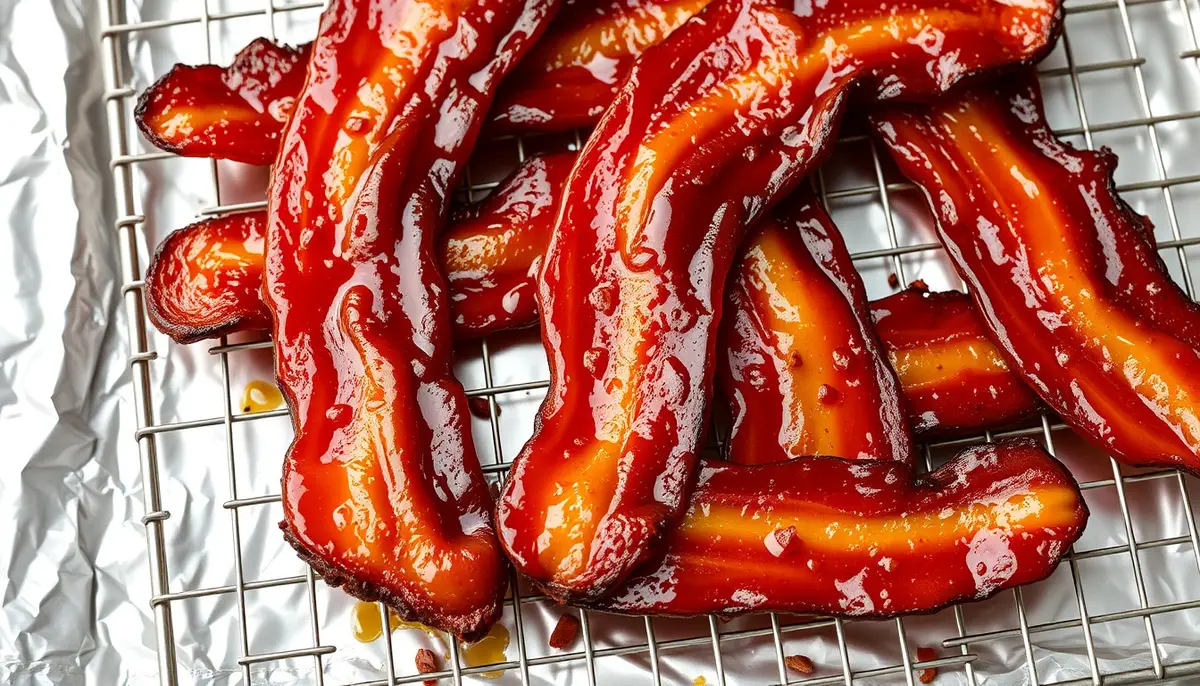
A thin coating of honey gives bacon a sweet contrast to its salt and smoke. Start baking the bacon before brushing on the glaze, then watch it closely near the end. A rimmed pan catches drips; only an oven-safe rack should go inside the oven.
Recipe
Honey Glazed Bacon
Oven-baked bacon brushed with honey and black pepper. Four portions from one pound of raw bacon; allow about 35 minutes including a 5-minute cooling period.
3Ingredients
Yield: 4 servings
- 1 pound thick-cut pork bacon, unprepared
- 3 tablespoons clover honey
- 1/2 teaspoon ground black pepper
Ingredient amounts scale; instructions show the original batch. Cooking times and pan sizes may need adjustment. Season to taste. Honey grams use US measures at 20°C and 17.5% moisture, a density estimate; weigh your honey for precision.
Instructions
- 1Prepare the panHeat the oven to 400°F (200°C). Set an oven-safe rack over a foil-lined rimmed baking sheet. Arrange the bacon in one layer.
- 2Start renderingBake for 10 minutes without honey. Use the package cooking guidance as well as the visual texture; thickness changes the timing.
- 3Brush with honeyMix 3 tablespoons honey with 1/2 teaspoon black pepper. Carefully remove the pan and brush the mixture across the bacon.
- 4Finish cookingBake another 10–15 minutes until the bacon is cooked and the glaze is amber, watching closely so it does not burn.
- 5Cool and portionCool on the rack for 5 minutes, then divide the cooked bacon into 4 portions. The strip count depends on the package, rather than a fixed 12-strip yield.
Estimated nutrition per serving
494.26 calories · 42.08 g fat · 13.16 g carbohydrate · 15.61 g protein · 852.31 mg sodium
Serving: 1/4 of the batch; raw-input estimate before rendered fat is removed
Calculated from ingredient weights and USDA FoodData Central: 168277, 169640, 170931. Estimates use ingredient input weights; actual portions, brands and cooking losses vary. Omitted nutrient values are unavailable, not zero.
Measured Ingredients and Method
The recipe card lists the measured base ingredients and named steps. Follow those amounts first; the variations below change the ingredients, timing and nutrition.
- 1 pound thick-cut pork bacon, unprepared
- 3 tablespoons clover honey
- 1/2 teaspoon ground black pepper
Get the Honey Buyer's Cheat Sheet (free PDF)
16 varieties on one page — color, flavor, best use and what a fair price looks like — from the 304 honeys we track.
Choosing the Best Honey for Bacon
Use mild clover honey for the base. Wildflower honey has a more variable floral character; buckwheat honey gives a bolder, malty note. More ideas: honey for cooking.
The chart is an editorial flavor-pairing guide, from 1 (mild) to 5 (bold), rather than a laboratory intensity measurement. Individual jars vary.
1 = mild, 5 = bold. Editorial pairing guidance, not laboratory measurements; jars vary.
- Clover
- A mild base
- Wildflower
- A floral note
- Buckwheat
- A bolder flavor
Matching a honey to another dish: the honey flavor map
5 Honey Glazed Bacon Variations
Once you have the base recipe down, these twists keep things interesting:
1. Honey Sriracha Bacon. Mix 2 tablespoons honey with 1 tablespoon sriracha. The sweet-spicy-tangy combination is outrageously good. For even more heat, use hot honey as the base instead of plain honey.
2. Black Pepper Honey Bacon. Double the black pepper to a full teaspoon — or use 2 teaspoons for a serious pepper crust. The coarse grind creates a crackling texture against the smooth glaze. This is the version restaurants serve.
3. Maple Bourbon Honey Bacon. Mix 2 tablespoons honey with 1 tablespoon maple syrup and 1 tablespoon bourbon . Rich and complex with caramel depth. Excellent on brunch platters.
4. Rosemary Honey Bacon. Finely chop 1 tablespoon fresh rosemary and stir into the honey glaze. The herbal, piney notes cut through the richness beautifully. Serve on a cheese board alongside honeycomb.
5. Brown Sugar Honey Bacon. Mix 2 tablespoons honey with 2 tablespoons brown sugar. The brown sugar adds a deeper molasses note and creates a thicker, crunchier crust. The classic "candied bacon" approach — just better with honey.
Serving Ideas
Honey glazed bacon is versatile far beyond breakfast:
- Brunch centerpiece — Stack on a platter alongside scrambled eggs, honey pancakes, and fresh fruit
- Burger topper — Two strips on a cheeseburger adds smoky-sweet crunch that elevates any patty
- Salad garnish — Chop into bits and scatter over a spinach or kale salad with honey balsamic dressing
- Cheese board — Lay strips alongside aged cheddar, blue cheese, honeycomb, and crackers
- Snack platter — Serve with honey roasted almonds and dark chocolate for a sweet-salty snack spread
- Sandwich upgrade — Add to BLTs, grilled cheese, or chicken sandwiches for a sweet-smoky layer
- Holiday appetizer — Wrap around dates or figs, secure with a toothpick, and bake until crispy
Tips for Perfect Results Every Time
A few tricks that make the difference between good and exceptional honey glazed bacon:
- Use a wire rack — Without a rack, the bottom of the bacon sits in rendered fat and never crisps. The rack also lets air circulate underneath for even cooking.
- Don't skip the pre-bake — Those first 10 minutes without glaze render the fat, which gives the honey something to grip onto. Glazing raw bacon means the honey slides right off.
- Brush, don't pour — Brushing gives you a thin, even coat that caramelizes into a crispy shell. Pouring creates thick pools that burn on the edges and stay gooey in the middle.
- Cool on the rack — Moving glazed bacon to a plate while hot means it sticks permanently. Leave it on the rack until the glaze sets (about 5 minutes), then it lifts off cleanly.
- Store leftovers right — Refrigerate in a single layer between parchment paper for up to 3 days. Reheat in a 350°F oven for 3-4 minutes to re-crisp the glaze (microwaving makes it chewy).
Rendering Changes the Finished Nutrition
Bacon loses fat and water during cooking. The card is a conservative input-based calculation using all the raw bacon and honey; it does not claim that rendered drippings are eaten. Actual cooked-serving calories and fat can be lower, but no unmeasured amount has been subtracted.
The USDA raw-bacon record reports carbohydrates and sugars independently: 0 g carbohydrate and 0.35 g sugars per 100 g. Its small inconsistency can carry through to the ingredient estimate; the source values are retained.
What the Nutrition Estimate Covers
The card sums USDA FoodData Central ingredient-input values and divides by 4. 1/4 of the batch; raw-input estimate before rendered fat is removed. This is an estimate, not a laboratory analysis of the finished dish.
Different brands, extra ingredients, topping amounts and the variations change the result. The calculation does not invent a cooking-loss or discarded-food correction.