
The Complicated Relationship Between Honey and Bloating
Honey and bloating have a more nuanced relationship than most health websites acknowledge. Depending on your digestive system, the type of honey, the amount, and what's actually causing your bloating, honey can either help relieve discomfort or make it significantly worse.
This isn't a contradiction — it's biology. Honey contains compounds that reduce gut inflammation, support beneficial bacteria, and calm digestive spasms. But it also contains fructose and oligosaccharides that are classified as FODMAPs — fermentable carbohydrates that cause gas and bloating in 30-40% of the population, particularly those with IBS or fructose malabsorption.
Understanding which category you fall into determines whether honey is part of the solution or part of the problem. This guide covers both sides honestly, with practical guidance for each scenario.
How Honey Can Help Reduce Bloating
For people without fructose sensitivity, honey has several mechanisms that can genuinely improve bloating and gas.
- Anti-inflammatory gut effects — Bloating often stems from low-grade gut inflammation that impairs motility and increases gas production. Honey's polyphenols inhibit the NF-κB inflammatory pathway in intestinal tissue, reducing mucosal swelling that contributes to the "distended" feeling. A 2012 study in the Journal of Medicinal Food demonstrated honey's anti-inflammatory effects on colonic tissue specifically.
- Prebiotic support for beneficial bacteria — Honey's fructo-oligosaccharides (FOS) and galacto-oligosaccharides (GOS) selectively feed Bifidobacterium and Lactobacillus species — the same bacteria that reduce gas production and improve motility. A 2020 review in Nutrients confirmed that prebiotic supplementation reduced self-reported bloating in multiple RCTs. The key insight: prebiotics initially may increase gas as the microbiome adjusts, but sustained use typically reduces bloating.
- Antimicrobial activity against gas-producing bacteria — Bloating from small intestinal bacterial overgrowth (SIBO) involves excessive fermentation by bacteria in the small intestine. Honey's broad-spectrum antibacterial activity (effective against 60+ species) selectively targets pathogenic species while sparing beneficial Lactobacilli, potentially rebalancing the populations responsible for excessive gas production.
- Gastroprotective coating — Honey's viscous consistency coats the gastric and intestinal lining, creating a protective layer that can reduce the irritation that triggers bloating after meals. A 2006 study in BMC Complementary and Alternative Medicine found honey enhanced mucosal healing in the GI tract.
- Motility support — Bloating frequently results from slowed gut transit (food sits too long, allowing excessive fermentation). Honey's osmotic properties and mild stimulation of motilin and gastrin hormones can gently encourage normal intestinal movement, helping gas pass rather than accumulate.
Get the Honey Buyer's Cheat Sheet (free PDF)
16 varieties on one page — color, flavor, best use and what a fair price looks like — from the 268 honeys we track.
When Honey Makes Bloating Worse: The FODMAP Factor
Here's the critical caveat that many honey health guides ignore: honey is classified as a high-FODMAP food by Monash University — the world authority on FODMAPs and IBS. Specifically, honey contains excess fructose (more fructose than glucose), which is poorly absorbed by people with fructose malabsorption.
Fructose malabsorption affects an estimated 30-40% of the general population, though many people don't realize they have it. When unabsorbed fructose reaches the large intestine, colonic bacteria ferment it, producing hydrogen, methane, and carbon dioxide gas — the direct cause of bloating, distension, cramps, and flatulence.
The Monash University FODMAP app classifies honey as follows:
- Up to 7g (about half a tablespoon) — Low FODMAP, generally tolerated by most IBS patients.
- Above 7g (more than half a tablespoon) — High FODMAP, likely to trigger symptoms in fructose-sensitive individuals.
- One tablespoon of honey (21g) contains roughly 8.6g of fructose and 7.5g of glucose — the excess fructose (~1.1g per tablespoon) is what causes problems for sensitive individuals.
Pro Tip
If you have IBS or known FODMAP sensitivity, the dose matters enormously. Half a teaspoon of honey in tea is likely fine. Two tablespoons drizzled on yogurt may trigger significant bloating. Start with very small amounts and observe your response over 24 hours before increasing.
Honey and IBS: What the Research Shows
Irritable bowel syndrome (IBS) affects 10-15% of the global population, and bloating is one of its most common symptoms. Honey's relationship with IBS is genuinely complex.
On one hand, a low-FODMAP diet — which restricts honey — is the most evidence-based dietary intervention for IBS bloating. A 2016 meta-analysis in the European Journal of Nutrition of 9 RCTs found that low-FODMAP diets significantly reduced bloating, pain, and overall symptoms in 50-86% of IBS patients.
On the other hand, honey's anti-inflammatory and prebiotic properties target the exact mechanisms underlying IBS. A 2017 review in the World Journal of Gastroenterology found that prebiotic supplementation (including FOS, which honey contains) improved IBS symptoms across multiple studies — but the prebiotics were given in controlled doses, not unlimited amounts.
The reconciliation: dose-dependent responses. Small amounts of honey (under the Monash 7g threshold) may provide anti-inflammatory and mild prebiotic benefits without triggering fructose-driven fermentation. It's the excess that causes problems.
- IBS-D (diarrhea-predominant) — Honey's osmotic properties can worsen diarrhea at higher doses by drawing water into the intestine. Stick to very small amounts (half teaspoon or less). Honey for diarrhea provides more detail on when honey helps vs. hurts with loose stools.
- IBS-C (constipation-predominant) — Honey's mild osmotic laxative effect may actually help here. The fructose-driven water retention in the colon and prebiotic-stimulated peristalsis can gently ease constipation, though bloating may temporarily worsen before improving.
- IBS-M (mixed) — Most unpredictable response. Start with the smallest dose (quarter teaspoon) and monitor symptoms for 48 hours before adjusting.
Best and Worst Honey Types for Bloating
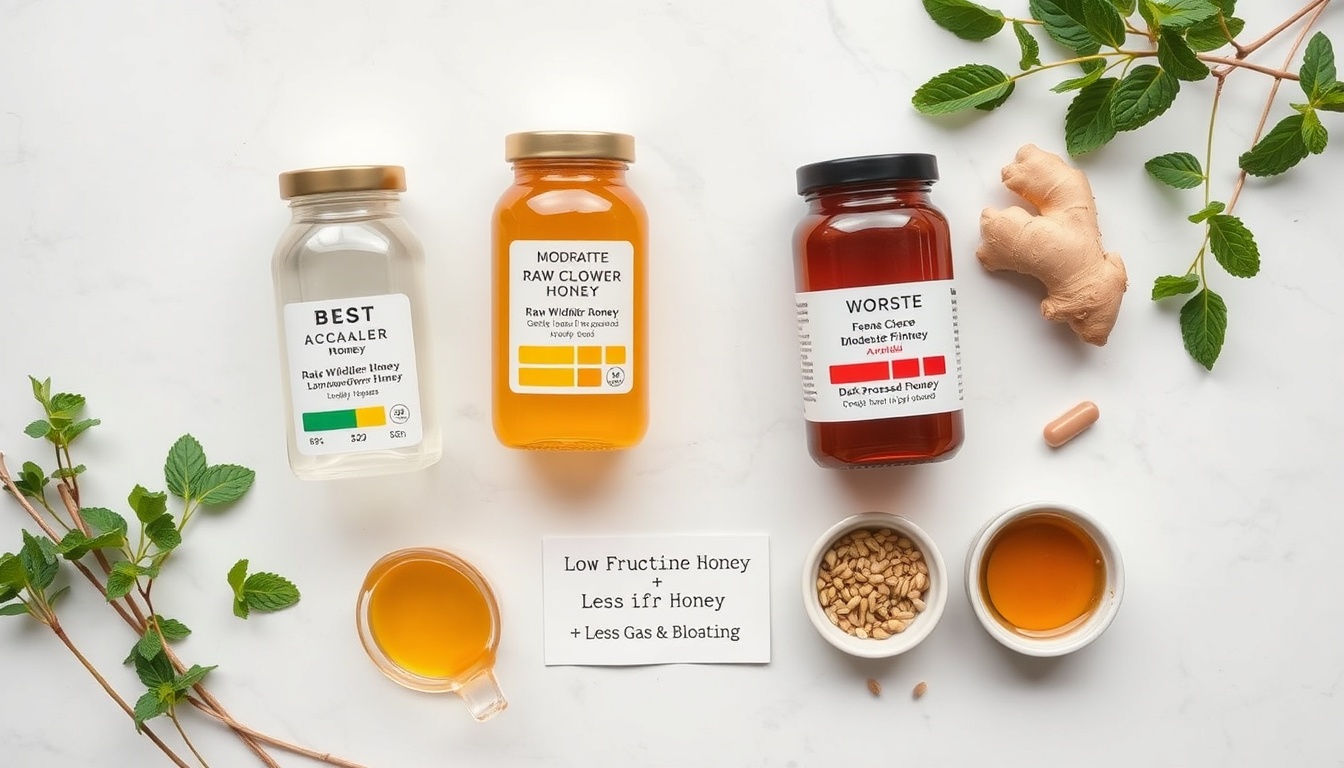
Not all honeys have the same fructose-to-glucose ratio, which directly impacts their bloating potential.
- Best: Acacia honey ($12-20, GI ~32) — Highest fructose-to-glucose ratio of common honeys, but paradoxically may cause fewer acute symptoms because its lower glycemic impact results in slower absorption. However, the excess fructose is still present. For FODMAP-sensitive people, the dose limit still applies.
- Good: Clover honey ($8-15) and wildflower honey ($10-18) — Moderate fructose-to-glucose ratios. Well-tolerated by most people at normal serving sizes (1 tablespoon). Their robust prebiotic content may provide gut benefits that offset mild fructose effects in non-sensitive individuals.
- Good: Manuka honey ($35-60+) — Strong anti-inflammatory properties specifically in gut tissue. Methylglyoxal (MGO) has demonstrated effects against H. pylori and gut inflammation. But still high-FODMAP at doses above 7g.
- Potentially worse: Honeys with very high fructose-to-glucose ratios like tupelo honey ($25-45, ~1.65:1; White 1975) — While excellent honeys, the excess free fructose is more pronounced, potentially worsening fructose malabsorption symptoms in sensitive individuals.
- Avoid for bloating: Cheap commercial "honey" that may be adulterated with high-fructose corn syrup. HFCS has even higher excess fructose than natural honey and no compensating anti-inflammatory or prebiotic benefits. How to tell if honey is real.
Practical Protocols: Using Honey for Bloating Relief
If you're not FODMAP-sensitive and want to use honey's anti-inflammatory and prebiotic properties to address chronic bloating, here's a structured approach.
- Warm honey water before meals — Mix half to one tablespoon of raw honey in warm (not hot) water, 20-30 minutes before eating. The warm honey water coats the stomach lining, primes digestive enzymes, and may reduce post-meal bloating through gastroprotective effects.
- Honey-ginger combination — Ginger is one of the most evidence-backed natural remedies for bloating and gas. A 2019 systematic review in Food Science & Nutrition found ginger significantly accelerated gastric emptying and reduced bloating across 10 RCTs. Combining honey and ginger provides anti-inflammatory synergy (honey's NF-κB inhibition + ginger's COX-2 suppression) plus ginger's prokinetic effects.
- Honey-ACV tonic — Apple cider vinegar with honey (1 tbsp each in 8 oz water before meals) may improve bloating by stimulating gastric acid production in people with low stomach acid — a common but underdiagnosed cause of upper abdominal bloating.
- Honey with probiotics — Combining honey's prebiotic FOS with probiotic yogurt creates a synbiotic effect. A 2014 review in the World Journal of Gastroenterology found synbiotics more effective than either prebiotics or probiotics alone for IBS bloating.
- Honey-peppermint tea — Peppermint is antispasmodic (relaxes smooth muscle in the intestinal wall). A 2019 BMC Complementary and Alternative Medicine meta-analysis of 12 RCTs (Alammar et al.) found peppermint oil significantly reduced IBS symptoms including bloating and abdominal pain. Honey-sweetened peppermint tea combines menthol's antispasmodic effects with honey's anti-inflammatory activity.
Pro Tip
Start with one approach for at least 2 weeks before judging effectiveness. Gut microbiome shifts take time. Initial prebiotic exposure may temporarily increase gas before the microbiome stabilizes.
If Honey Makes Your Bloating Worse
If you consistently experience bloating 2-6 hours after eating honey, you likely have some degree of fructose malabsorption. This doesn't mean you need to avoid honey entirely — you need to manage the dose.
- Reduce to the low-FODMAP threshold — Stay under 7g (about half a tablespoon) per sitting. This amount typically falls below the malabsorption threshold even in sensitive individuals.
- Pair honey with glucose-containing foods — Fructose absorption is enhanced when consumed alongside glucose. Eating honey with toast, oatmeal, or other carbohydrate-containing foods improves fructose transport via the GLUT5 transporter and reduces the unabsorbed fraction reaching the colon.
- Spread intake throughout the day — Rather than one large dose, small amounts multiple times daily reduce the fructose load per sitting.
- Consider a low-FODMAP elimination phase — If bloating is significantly impacting quality of life, a 2-6 week strict low-FODMAP elimination (excluding honey) followed by systematic reintroduction helps determine your personal threshold. The Monash University FODMAP app provides structured guidance.
- Try alternative sweeteners if needed — For FODMAP-sensitive individuals who want sweetness without excess fructose: maple syrup (sucrose-based, low FODMAP at 2 tbsp), rice malt syrup (glucose-based, FODMAP-free), or stevia (zero-calorie, FODMAP-free). Each has trade-offs compared to honey's nutritional benefits.

Bloating Red Flags: When to See a Doctor
While occasional bloating is normal and manageable with dietary adjustments, some patterns warrant medical evaluation.
- Bloating that doesn't respond to any dietary changes after 4+ weeks.
- Bloating accompanied by unintentional weight loss.
- Progressive worsening of bloating over weeks or months.
- Bloating with blood in stool, severe abdominal pain, or persistent vomiting.
- New-onset bloating after age 50 (warrants screening for more serious conditions).
- Bloating with signs of obstruction (inability to pass gas, severe distension, vomiting).
- Night-time bloating that wakes you from sleep.
- **Infants under 12 months must never receive honey.** Honey naturally contains dormant Clostridium botulinum spores that can germinate in an infant's immature digestive system, causing potentially fatal infant botulism. This applies to all honey regardless of type or processing.
Pro Tip
Honey and other natural remedies are appropriate for functional bloating — the everyday discomfort from diet, stress, or IBS. They are not treatments for organic GI disease. If symptoms are severe or worsening, see a gastroenterologist before self-treating with dietary changes.
The Bottom Line: Honey and Bloating
Honey's relationship with bloating is dose-dependent and individual-specific. For the 60-70% of people without significant fructose malabsorption, honey's anti-inflammatory, prebiotic, and gastroprotective properties can genuinely help reduce chronic bloating — especially combined with ginger, peppermint, or probiotics.
For the 30-40% with fructose sensitivity (including many IBS patients), honey above small amounts is likely to worsen bloating through colonic fermentation. The solution isn't necessarily avoidance — it's finding your personal dose threshold, typically at or below the Monash low-FODMAP cutoff of 7g per sitting.
The most important first step: track your symptoms honestly for 2 weeks with and without honey. Your gut's response is the only evidence that matters for your specific situation.